
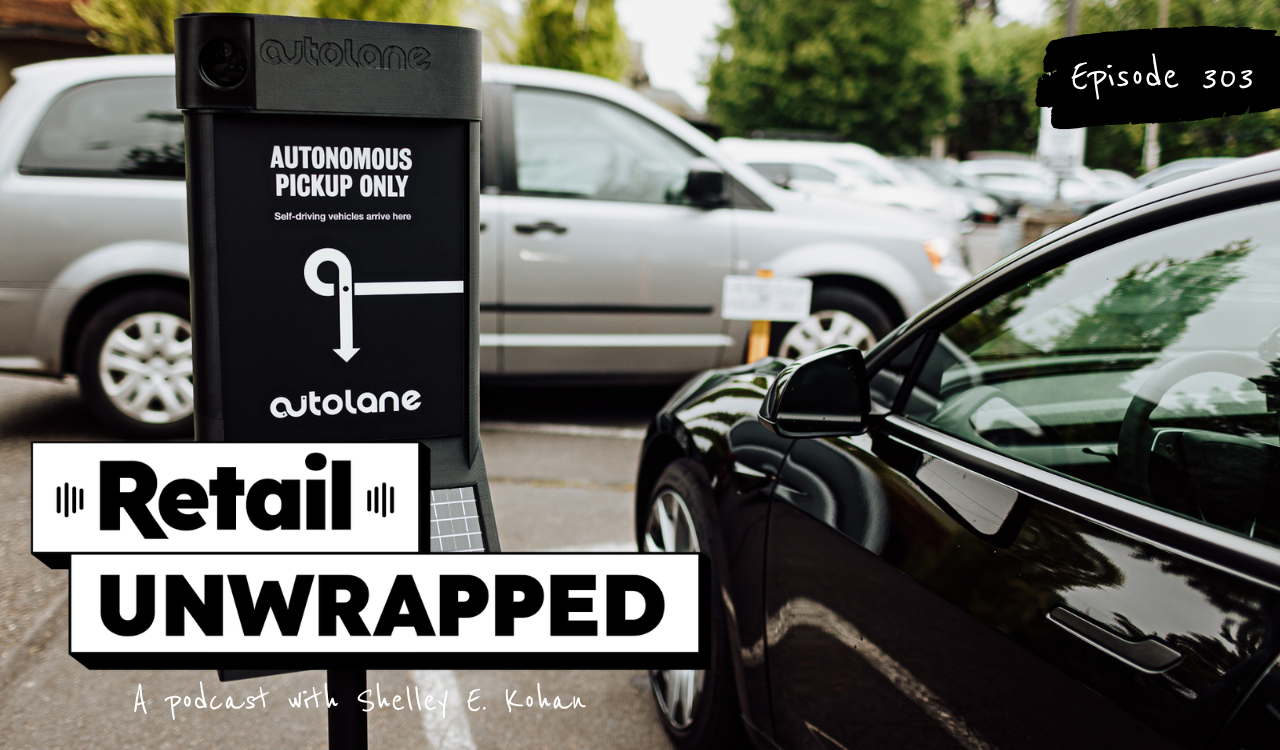

Every retailer preparing for autonomous delivery is watching the wrong vehicle; the real disruption isn’t a drone or a sidewalk bot; it’s the driverless car already parked in the customer’s driveway. These autonomous vehicles are the next curbside pickup agents. But what happens when dozens of unmanned vehicles all show up for the same six parking stalls at the same time? Join Shelley and Ben Seidl, CEO and Co-Founder of Autolane, as they discuss the potential crisis brewing at malls and stores for managing these fleets of cars. Major retail landlords, including Simon Property Group, Federal Realty, and Jamestown, are already installing driverless parking infrastructure across properties in Austin, Atlanta, Phoenix, San Jose, and beyond. Planning ahead is never too early, and retailers need to be ready for new wave of autonomous deliveries.
Special Guests
Ben Seidl, CEO & Co-Founder, Autolane
Transcript
Ben Seidl (Autolane) (00:00)
we don’t have one of these cars, we’ll probably want to receive our orders autonomously because it’ll be cheaper. And so there’s just this like very exciting world in which this general purpose technology of self-driving
Which has always been applied to ride hailing, begins to be applied to other industries.
Shelley E. Kohan (00:44)
Hi everybody and thanks for joining our weekly podcast. I’m Shelly Kohan and I’m very excited to welcome Ben Seidl, who is the CEO and co-founder of Autolane. So Ben, welcome.
Ben Seidl (Autolane) (00:57)
Thank you so much, Shelley. It’s awesome to be here.
Shelley E. Kohan (00:59)
It’s great to have you here, and we’re gonna talk about one of the most important things that I think a lot of retail and retailers and brands are actually not talking about, and it’s autonomous delivery. So I know you’ve spent the last decade building this business at this intersection between retail, real estate, and technology. And so I’d love to kind of start our conversation.
about what is autonomous delivery and what does that mean in the retail and environment. And of course real estate, but you’ll tell us how real estate connects into that.
Ben Seidl (Autolane) (01:32)
Yeah, yeah, thank you for the introduction. That’s that’s a great framing. It’s you know, the the the world as it pertains to transportation is changing significantly and I think we can see that in some of our major American cities, in particular Austin or
San Francisco, Los Angeles, Atlanta, you can see Waymo’s and you can see Tesla rowboat taxis, which are kind of autonomous Teslas. And you know, these these vehicles have been on the roads now since March of 2024, with Waymo in particular, giving paid commercial driverless rides around cities. And that technology has improved significantly over the last couple years in particular.
It’s now scaling to to many cities, kind of seemingly by the week at this point. And so I, as someone who worked in commercial real estate, have been building businesses in and around retail, retail real estate and logistics for for a long time now. I I got really excited about thinking through the ramifications of
with autonomous, so driverless kind of technology scaling and becoming more ubiquitous across the the United States, the conversation has largely been centered around ride hailing. So ride hailing with no driver and
what that market looks like and how that’s gonna change Uber and Lyft and how people get around and I think that’s a fantastic starting point and certainly is the the main use case for autonomous vehicles today. But it’s not the only one. and what got me excited to to build AutoLane was the idea that eventually these cars would be used for other purposes. Logistics, delivery, all types of things.
things, right? And and even kind of more far out, eventually you’ll be able to buy one of these cars and you will have a car that can drive itself if you so choose. You’ll have a car in your driveway that’s capable of driving itself around. And so if you believe in kind of the trajectory of this technology like I do and and and we do at Autolane, then it’s logical, I suppose, to to project that these cars can also do
delivery. And so kind of the idea that got me really excited about building this company was I’ve got a Tesla at home and my wife and I don’t drive. We haven’t really driven for almost a year and a half now. We just get in the car, type in the address, or actually at this point you can just talk to the car and say, take me to Whole Foods. And it says, Are you sure you want to go to this Whole Foods? What about the one over there? And you say, Yeah, the Whole Foods on Hawthorne.
And it types in the navigation instructions for you automatically and you press one little button that just says s start self-driving and away you go. Car will park itself, everything. And so I’ve now been kind of in this experience of not driving my own car, like I said for now like a year and a half, which sounds crazy, but it’s it’s here and
What’s what’s fascinating to me is I began thinking, well, if my car can drive itself and it’s doing this for my wife and we’ve been doing this for a while now, like eventually it will be able to drive without me in it. and that’s gonna be crazy because in an instance where that’s possible, wouldn’t I be able to send it to Whole Foods itself?
to pick up my grocery order, couldn’t I send it to Bloomingdale’s to the curbside pickup area and it could hypothetically pick up my order and bring it back to me while I’m at work.
And I started to kind of imagine this future that I again I don’t think is is very far away. It sounds like something from 2040, but I I generally believe we’ll see the first instances of this later next year. But that’s that was the imagination kind of run wild that I had that we’ve built the business on, which is how do we connect these self-driving cars to businesses and private properties like a mall or a stadium or what have you.
Because that’s going to be crucial if we want to get the highest level of value and utility out of this technology. We’ll want it to go do things for us. We’ll want it to do our errands. It will be able to do that. We’ll want it to, if
we don’t have one of these cars, we’ll probably want to receive our orders autonomously because it’ll be cheaper. And so there’s just this like very exciting world in which this general purpose technology of self-driving
Which has always been applied to ride hailing, begins to be applied to other industries.
And so that’s what autolane’s kind of all about. And that’s what my fascination is, is helping retailers get prepared for this moment because it is, in in our opinion, going to change a lot about how delivery economics work, consumer behavior, operations, store design. I mean, you go down the the list of
what would need to be adapted if you start to see this technology take off the way I’m describing it. It starts to kind of impact many, many aspects of running a retail business. So it’s an exciting time to to to be building in this space and really fortunate to have you as a a leading voice who’s been covering us and you saw us in New York at our NRF booth, which was kind of the where we met. Yeah. So that’s where we met and
Shelley E. Kohan (07:17)
At the trade show, that’s right. We met at the trade show in NRF
Ben Seidl (Autolane) (07:22)
Yeah, and so we’ve
Shelley E. Kohan (07:23)
six months ago.
Ben Seidl (Autolane) (07:24)
it’s it’s great to to have, you know, someone of your caliber in the industry be able to A verify this is, you know, potentially an exciting innovation for the retail industry, but also you know, for me to have someone to to bounce ideas off of ’cause it’s I’m not a retail executive, I’ve I’ve not come from that world.
But I know enough, you know, us I suppose to be dangerous, but it always helps me to kind of build relationships with with voices in the industry like yourself who can help us navigate, you know, how to explain this technology, how to get the story out so that more retailers can learn about what’s possible. so thanks again for having me on this and the amazing Forbes article you wrote a couple weeks ago.
Shelley E. Kohan (08:10)
Absolutely. So one of the things I think is interesting, so I think a lot of retailers and brands are really spending a lot of time
focused on the logistics piece, the, you know, how can you get autonomous delivery, get packages to customers. I think the one area that maybe a lot of retailers and brands are just starting to think about maybe is that other piece you mentioned about the Bloomingdales or the Nordstroms. So or going to Wegmans or Whole Foods, you know, it’s you know, I don’t know of anyone that loves going to a grocery store unless they’re, you know, just kind of going to see what’s what’s new, what’s available, they have time. Most people it’s a task.
And as you said, you run a lot of tasks right now on your Tesla that you know, do you really need to go to the drugstore and you need to go to you know the grocery store? And if you bought something online, why can’t the car pick it up for you? So I think that’s really fascinating. And but then I think about okay, so I’m gonna send a car to Nordstrom’s, and Ben, you’re gonna send a car to Nordstrom’s, and our producer Joanne is gonna send a car to Nordstrom’s. Now, Nordstrom’s has all these cars showing up, and that’s kind of what that’s the problem.
problem you’re solving. So Kit let tell us a little bit about the work you’re currently doing. I think you’re doing some work with Simon Properties and now some other properties across the US. Talk a little bit about that infrastructure that’s needed to to make this a reality.
Ben Seidl (Autolane) (09:32)
You nailed it, you nailed it. And that’s you know, if you really distill Otelane’s role in all of this
To to be very clear to the audience, we don’t develop the self driving technology, we don’t make or you know, sell the cars, we don’t even operate the cars. We are this kind of central layer, what what I like to call kind of this connective tissue between the cars and their destinations, whether that’s the business parking lot itself or a multi tenant property like a Simon Mall that may have a hundred premium tenants.
At it. to your point, the complication then becomes if you if you agree with all of that stuff being possible, then you also must go one step further, which is to say exactly what you said. And if we have multiple cars coming to pick up multiple orders on behalf of multiple customers, and those cars are most likely being
manufactured by different OEMs. So one might be a Tesla, one might be a Toyota, one might be a Nissan. They have different autonomous vehicle technology on them. They all n must be integrated into the retailer somehow because the store associate, in order to interact with the car, at the very minimum, has to be able to open the trunk to put your order in. And so how is
How is a you know Bloomingdales going to in integrate with Tesla and Toyota and Nissan and keep up to date with all this technology so that that autonomous delivery handoff can be seamless and cost effective? and so so you’ve got two significant problems with in in the scenario you described. One, the actual volume and the orchestration of these vehicles arriving to
static number of parking stalls. You know, usually these curbside banks of stalls are limited.
And so, you know, what if those stalls are full and if the car decides to park on the other side of the parking lot and now you’re asking a store associate, okay, well, this the car is telling me it’s on the other side of the mall. I gotta spend five minutes one way walking all the way there just to drop this order off in the trunk and then walk back to the store. If you’re the store, you’re not gonna be able to economically support that for very long because of the amount of labor that would take. And so you’ve got this coordination issue in the parking lot that would have to be figured out.
If you were to do anything more than one order at a time. So that’s kind of step one of what Autoline’s platform does. We have a hardware sensor that’s in the parking lot at the curbside stalls that monitors the autonomous vehicle activity and it kind of routes the cars and orchestrates that so that there’s some type of order to the chaos in a world in which multiple cars are coming.
so that’s step one and then step two is really around the complexity of the technology w from an integration standpoint. So like I was mentioning earlier, if they’re all the same car, all the same integration, that’s easier.
But actually what will happen is not only will you have multiple cars vying for the same physical space, which needs to be fixed, you then have the software and the technology problem that you have to build integrations into all these car companies, and each one of those integrations is different. And so Autolane does both of those things primarily for our customers, and our customers are grocers, retailers, retailreats, you know.
and and QSR companies. And so that is primarily the benefit is if you are interested in trying this out, if you’re a retailer, QSR brochure, what have you, you then need some type of technology like what Autolane has built as a platform that enables you to do this out of the box, seamlessly, and and and kind of with the state of the art practices. So that’s really Autolane’s
mission and and kind of position in the industry. and it’s a very important one. so I you know it maybe would be helpful to kind of talk about this in super practical terms. In Austin as you as you mentioned, we’re live in Austin, Texas with this delivery platform.
We’ve been doing it also over the last nine months with all of the major retail REITs. So Simon Property Group, MesaRich, Jamestown, Federal Realty, more coming on like GGP. And so we’ve we’ve really got great traction with the retail landlords who own these big shopping centers and big malls. They they understand that the future is autonomous and they’re trying to get ahead of that now. and so we’ve had a lot of success.
success
working with them. And so we’ve installed the technology at properties across those those property owners’ portfolios in at this point Atlanta, Austin, Phoenix, San Jose, soon to be San Francisco, Los Angeles, and Miami. and that’s really great because our initial installations with with the property owners, the retail REITs is very cool because they have two problems.
They have an orchestration of autonomous ride hailing cars that they need to
Shelley E. Kohan (15:05)
Right.
Ben Seidl (Autolane) (15:05)
figure out because they’ve got Waymo’s coming in left and right, going all over their property, not organized. They also have Tesla’s Robo Taxis coming into their properties, again, organized, n unorganized, no interaction with these cars. And so these properties are like we have a headache of dealing with all of these ride hail autonomous vehicles.
And then we’re also going to have a headache of autonomous delivery vehicles showing up. And so Autolane System solves both of those problems for them with one solution. and that’s why it’s been a really great focus vertical for us. but but but I think the most interesting stuff that we’re doing is probably with our our restaurant partner, so in in Austin.
Shelley E. Kohan (15:51)
That’s great. Okay, so before we get to that example on the restaurant partners, so I kinda liken it to do you remember when Uber and all the ride shares became really big a few years ago at the airports? It was a nightmare. The
Ben Seidl (Autolane) (16:03)
Yeah. Yep.
Shelley E. Kohan (16:05)
first, I don’t know, six months to a year, it was a nightmare. There was like
You didn’t know where to go to get your car. And now you walk through airports, it’s clearly signed. There’s a special so that it took them a while to kind of catch up with the consumer. And I kind of see the same thing now in terms of that with the malls, but even more so with the coordination of the pickups and all that. And I know you kind of describe yourself, I kind of like the way you say this is you’re like the air traffic control, you know, system that helps coordinate the effort. The other thing I think is really interesting is your tell us just a little bit about.
about
the 3C framework and why that’s important. And then we’ll get into that restaurant example.
Ben Seidl (Autolane) (16:46)
Yeah, yeah.
W I’m glad you brought that up because kind of it’s easy to get lost in all the details and in the weeds with some of this stuff ’cause it feels very futuristic or maybe even improbable to people who aren’t seeing autonomous vehicles in their towns or cities, which a lot of which is most people. and so, you know, framing it in terms of Lyft and Uber at the airports is a really easy way for everyone to kind of quickly grasp what it probably looks like in some of these places.
And it’s just like that. It’s just like your Lyfter, Uber, Ratshare area in an airport, but think of that at a mall or a shopping center, and there are these little auto-lane zones, and that’s where all the autonomous vehicles arrive into. Then we monitor all that activity and give that to the to the property and the business so that they can see all the traffic that’s coming in. And that is very akin to an air traffic control system at an airport. That’s kind of how we think about it. so th
Shelley E. Kohan (17:44)
I totally got in trouble
recently at a mall because I I asked for an Uber where where I was standing in the mall and then I went outside to wait for it and I was now on the wrong I was in the wrong spot. And so I got in trouble from the driver telling me, well
Ben Seidl (Autolane) (17:59)
Yeah. Yeah.
Shelley E. Kohan (18:01)
you can’t like so I thought, okay, didn’t know that. So yeah, what you’re doing is really important.
Ben Seidl (Autolane) (18:06)
Yeah.
Yeah, it’s really important to have especially in the early days of a technology like a driverless car, you know, i I think what’s what’s fascinating before I answer the kind of the three C’s question is the the reason why an air traffic control system for autonomous vehicles is existential versus an air traffic control system for regular Lyft, Uber, DoorDash drivers.
is that humans, you know, are very good at using their brains and their memory and reading signs and using social awareness to understand, even if they don’t know the exact
ways in which they’re supposed to traverse a property. They can guess or they’ve been there before or they can follow social norms and they’ll figure it out and they can text you and y y you know, you can negotiate and and figure things out. They as drivers can negotiate with other drivers. They might be needing to to to figure something out in the parking lot over. y none of that is possible with an autonomous vehicle. It’s not going to we’re
answer your your text message. It can’t if a human driver and an autonomous vehicle are fighting over a parking stall or a curb at a Simon Mall, you can’t even make eye contact with someone or negotiate that, process it. And so then you take one step further and you say, well what if it’s an autonomous vehicle in an autonomous vehicle?
it just starts to get really, really confusing and chaotic and that is why it’s very different than the need for you don’t really need an autonomous sorry, you don’t really need an air traffic control system for DoorDash drivers.
While that might be nice in some instances, you don’t really need it because humans will ultimately figure it out and take care of themselves. But an an autonomous vehicle can’t really do that without precise instructions. And so it is a very different problem when it when you remove the driver. and and that’s kind of gets into what the the three Cs are that I like to to to describe the value or or kind of the the the reason why our system is so important.
Is you have a coordination issue, which is what we were talking about earlier, where you might have multiple cars coming to just a few stalls, and how how do you coordinate that? That’s a that’s an issue. So that n that must be figured out. You also then have to have some communication, as we just talked about. Somehow
you know, clearly things don’t usually go right when it comes to like a DoorDash pickup at a mall and a rideshare pickup at a mall. There’s just a lot of communication that’s gotta take place between the driver and the either store associate or the rider. And that’s done in verbal or text or whatever. We figure it out as humans. But
that that again is missing if you have a robotic vehicle and so the communication layer is really important. We allow the cars to communicate their ETAs to the property or the business. Hey, I’m gonna this car is gonna be there in six minutes. It’s gonna arrive at stall four. It’s coming to pick up Shelly’s order number one two three from Sephora. I’m telling Sephora that I’m coming in there in six minutes. That way the Sephora store associate can know that.
Right in ahead of time. Then when the car arrives, our system checks it in, tells the Sephora store that hey the car that Shelley sent is here.
Can you bring out order number one, two, three to the trunk, to the curve? The system opens the trunk, they put the order in, system closes the trunk, system pushes the navigation instructions to where you, Shelley, wanted it to be delivered. so that communication has to be very precise, it has to be fast in real time in order for any type of order handoff or or conversation about the order to take place. And so we provide that. And then lastly, you have control, which is
You again that like in the example of the store associate, you have to have some way to at least open the trunk. And so we provide integrations into the trunk for all these major OEMs, and then that way the store associate can press open trunk, put the order in, close trunk, and away it goes. So communication, coordination, and control are kind of the three tenets, the three Cs, I would say, about any autonomous.
Orchestration that you kind of have to solve if you don’t want to have complete chaos on your hands. You take out one of those Cs, you have an issue. If you can coordinate it and communicate with it, but you can’t get the trunk open, or
Shelley E. Kohan (23:02)
Ha ha
Ben Seidl (Autolane) (23:03)
it doesn’t work, you got a problem. If you can open the trunk but you don’t know you didn’t know when it was coming, and it’s like, here I am, and you’re like, I the order’s not even prepped, it’s not in the bag, it’s gonna take fifteen minutes.
You got a problem and then if you have like your earlier point, if you have three cars coming to one stall, how is that gonna work? So you you really have to have all three of those Cs in order for any type of basic functionality to happen for autonomous delivery. and that’s kinda what we’re proud to to be building and and bringing to the market as a as a brand new solution.
Shelley E. Kohan (23:38)
great it sounds seriously very futuristic like it sounds like we’re not gonna see this till you said what 2040
but that’s not true. You think this is actually gonna be happening in the next year. And I know you’re already doing work with restaurants, specifically similar to what you just described about the Sephora order. So tell us what you’re doing with restaurants. And I just want to hear like what do you really think that from a retail brand shopping perspective we’re actually gonna see this in the next year, maybe even for a holiday?
Ben Seidl (Autolane) (24:10)
So my my short answer is it’s completely location dependent. Like similar to how it is today across the United States, some cities have Waymo’s or Tesla Robotaxis, some cities have sidewalk bots, some cities have drones, some cities have all of them or none of them. So it really it really will depend on where you live within the United States. if if you’ll have access to this sort of a futuristic consumer experience. But
What I will say is what what we have live already is the the autoling platform does orchestrate autonomous ride hail vehicles. So it already does interact and do those things with Waymo’s at you know shopping centers across the United States where we are. So it does that and it’s been doing that for about nine months. But on the delivery side, we just recently launched kind of the delivery use case for the auto and platform in Austin with a
regional
restaurant group called So Chinese and T So Chinese Take Out and Delivery. And what they have is a network of five stores across Austin and they do just pick up or delivery. They don’t have a kind of dine in component to their their facilities. These are storefronts, they are in major strip centers and, you know, inline locations, but they but you can’t eat inside. You just take out or delivery. And they do a a very significant amount of delivery on a monthly basis in Austin and they’re super well
well loved and and used.
brand in in Austin for this type of thing. And so they reached out, we met them at a also at a trade show. and they were interested in figuring out ways that they can continue to push the envelope on providing better delivery experiences because again they’re a very delivery heavy brand. And so we had kind of worked with them for a couple months to think through how exactly we could implement this for their customers and at their restaurants and
And we integrated with them, you know, over over about a month and tra tested some things and got ready for for a launch, which happened just a couple weeks ago on July 7th, I believe,
that was a really exciting moment to to launch the delivery aspect of Automan’s platform with so Chinese there and since then.
We’ve seen some really exciting results out of that. to the point that I’m pretty convinced that autonomous delivery is going to be very well received by the general public. it’s it’s pretty early still as far as the the consumer data and
everything else coming out of the the initial operation there. But it’s it’s certainly promising and of the people who have chosen to get their Seo Chinese order delivered autonomously through us, they’ve been very happy with it and the the take rate is is really great to see. So we’ll see you know kind of how we scale that outside of SO in Austin.
But today, just given SO’s volume in in in Austin, they’ve got a lot more volume than than even we could handle with our initial fleet, which is just thirteen Model Y Teslas in Austin. So we’re gonna kind of max out our fleet with Seo and then we will kind of reco reevaluate next steps. But the the the early indication is that consumers really like it.
They they they want more of it and I think they they are excited about having options.
to how their delivery comes to them.
Shelley E. Kohan (28:00)
Yep.
Ben Seidl (Autolane) (28:01)
Because if you think about it, you don’t really you you don’t get an option when you order delivery. You really only get an option of how fast it comes. So you order from Amazon, they say do you want it tonight or tomorrow morning or over the weekend and different price points, that you don’t get to choose how it’s delivered to you, it’s delivered to the exact same way, regardless of whatever time you choose. The only thing that changes is the price.
and so for us what we’re finding is that if you do give consumers the choice to decide on the modality of how the delivery happens, a lot of them are interested in other types of delivery modalities. And so we’ll we’ll we’ll see as as the data, you know, continues to crystallize. But it’s cool. It’s cool to be on the forefront of offering a new type of consumer
Shelley E. Kohan (28:46)
It’s very cool.
Ben Seidl (Autolane) (28:47)
experience and making people happy. The people who have done it are just
Yeah, really really interested in how this whole space is gonna evolve.
Shelley E. Kohan (28:57)
So based on all your background, your knowledge, the tech you know the technology the best, what what do you think retailers and brands should be thinking about today if they want to be first in the market of this delivery, on autonomous delivery, especially for like retailers and brands, you know, like the Nordstroms and Sephora’s and you know, all the other either direct-to-consumer brands or the retailers out there?
Ben Seidl (Autolane) (29:25)
Yeah, it’s it’s it’s a great question. what I would say is, well, of course, visit goautolane.com or or reach out to me on LinkedIn if you want to chat about this or learn more. I’m happy to happy to have a conversation. ultimately this is something that I think retailers who do a lot of last mile delivery
they should be at least asking some questions and investigating this new opportunity for autonomous delivery. If they aren’t already it some retailers have tried, you know, the sidewalk bots or the drones or what have you, but those are kind of those are very different implementations of autonomous delivery. Our system in Austin is completely run on passenger cars, brand new Model Ys. So, you know, of course, a brand new Model Y can carry a lot more goods, bigger goods, can get things to a much farther
distance than drones or or sidewalk bots. So I I think that retailers should certainly you know continue to keep an eye on this consumer behavior and this option if you do a lot of last mile delivery. Particularly for the reason that ultimately this will be a lot more cost effective of a a delivery mechanism.
And that matters to a lot of retailers. I I see some incredibly high prices sometimes when I check out for re specifically retailers like a Best Buy or a Macy’s or Bloomingdale’s. I mean you’re talking ten, fifteen dollar same day delivery fees, which i’m just a lot of money, I suppose depending on how much you need it, but it’s that’s a lot. and so I think the promise of autonomous delivery for for a lot of these retailers is offering
you know, sub two hour or same day delivery for a lot lower cost, but also in a in a in a new way that consumers are gonna be interested in, which is it’s a little bit you’ve just got more control, you got privacy, no one’s gonna potentially, you know, touch your order. You’ve just got this like very new way of interacting with delivery that again, businesses that do a lot of last mile delivery should probably be keeping an eye on.
Shelley E. Kohan (31:37)
Love it Ben. Well I really appreciate you being here today and I hope we can like further our conversation. Maybe later in the year we’ll do another check-in point on how things are going.
Ben Seidl (Autolane) (31:46)
I love that. Yeah, there’ll be a lot
to talk about, absolutely. Thanks, Shelley.
Shelley E. Kohan (31:50)
Well, again, thanks so much for being here.
Ben Seidl (Autolane) (31:53)
Yeah, I really appreciate it. Bye.