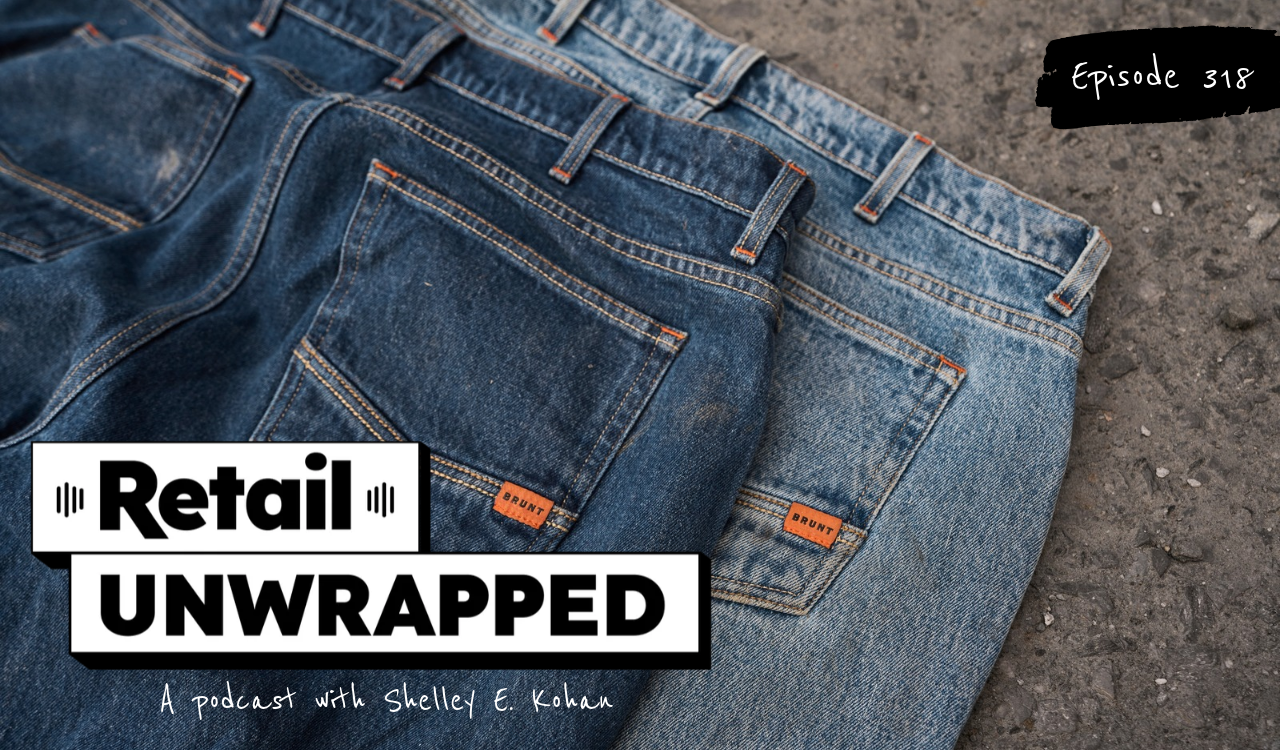

It’s personal with entrepreneurs who start values-based brands. BRUNT Workwear was created by, and caters to, blue-collar trade industry individuals in the construction, building, utilities, manufacturing, landscaping and agricultural industries who need sturdy footwear and workwear apparel that they trust. Find out how a passion project has grown from DTC to physical retail with the mission to be the most dominant workwear brand by 2030. Join Shelley and Eric Girouard, CEO of BRUNT Workwear, as he discusses his new move to wholesale in 250 Boot Barn stores, his new move to physical retail with a flagship in Reading, Massachusetts, and BRUNT Workwear’s move into denim apparel denim, one of the most competitive categories in retail, with a jean designed by workwear insiders for practicality and durability. Listen to a candid conversation with intention; BRUNT Workwear has pledged to donate a million dollars’ worth of work boots in 2027.
Special Guests
Eric Girouard, Founder + CEO at BRUNT Workwear
Transcript
Shelley E. Kohan (00:05)
Hi everybody, thanks for joining our weekly podcast. I’m Shelly Cohan and I’m very excited to welcome back Eric Gerard from Brunt Workware. Welcome back.
Eric Girouard (00:14)
Thank you, Shelley. Appreciate you
having me back. Nice to see you again.
Shelley E. Kohan (00:19)
my gosh, it’s such a thrill having you back. And I’m like the biggest fan of brunt workwear. I I think I told you I bought my husband a pair of boots, he loves them. I bought pants, I love them. So we’re big fans. We think that you’re just creating a great brand and an awesome community around that brand. So welcome.
Eric Girouard (00:39)
Appreciate the support. That means a lot and and we’re very proud uh to be able to support the folks out there that need need gear to to to do the work that needs to get done. So we appreciate it.
Shelley E. Kohan (00:53)
No, it’s great. So for those of our listeners that may have missed your previous episode, uh first I would say go back and listen to it because it’s quite amazing. Um, but also Brunt started in 2020 during the pandemic and you started originally as an online boot brand for tradespeople. Um and then fast forward six years, you’re 300 million plus in business. You have
stores across the US. You just expanded a partnership with Bootbarn, which we’ll talk about here. And we have a great exciting announcement that we’ll save to the end about a new product launch. So um I’m excited to have you back. It’s awesome.
Eric Girouard (01:35)
Thank you, thank you. Likewise, I appreciate it.
Shelley E. Kohan (01:37)
eh So let’s first talk about um you’ve been very disciplined about your kind of expansion into wholesale. So can you talk
Eric Girouard (01:45)
Mm-hmm.
Shelley E. Kohan (01:46)
us a little bit about that and kind of what you learned from the customer that kind of preempted your wanting to get into wholesale?
Eric Girouard (01:56)
Yeah, so obviously we started online in D to C only and as we we were growing quite rapidly, but we were s hearing from a lot of our m customers online or potential customers online, as well as some of our own customers that even did had shopped with us, that there was this real desire to still go into a physical retail store and try on the product and see it and compare it to some of the competitors. And so as we dug into that, um
We knew we could still build a big business on D to C alone, but we didn’t want to ignore, you know, almost half of the population out there that likes to shop in physical retail. And um, you know, we had this internal mission to to be the most dominant workwear brand by twenty thirty and we said if we ignore, you know, roughly half the population, we’re never gonna be able to do that. We’re not gonna be able to service the people that won that like the retail store experience and so on and so forth. And so it was pretty, pretty uh it was
not only quite literally consumer driven, but it was um customers asking for it, customers some customers saying I’m not gonna be able to shop or or experience print work work until you’re in a physical retail store. And so it was uh consumer led, consumer driven and we took a very methodical approach in how we went there to to make sure we did it right and appropriately and uh protected the brand along the way and chose the right partners and every decision was very carefully thought through.
Shelley E. Kohan (03:23)
It’s so interesting. So two quick things I will tell you. One is I love the fact that you you your whole brand was built on listening. You listened
Eric Girouard (03:31)
Mm-hmm.
Shelley E. Kohan (03:31)
to people, you listened to the consumer, you listen to what’s right, you listen to what’s wrong. So I think that’s really important in today’s environment. And I think your payback for that is gonna be, you know, this very loyal brand following that you have because people know that you listen and then you take action. Um so kudos.
Eric Girouard (03:48)
Yes, it is
fundamentally a a fundamental core tenant of of what built Brunt. It’s how we operate, it’s how the team operates, how the company operates, and it is the fundamental difference between us having this conversation today and me not being here doing something completely different. It’s the fundamental uh differentiator what has made Brunt continue to work for our customers out there.
Shelley E. Kohan (04:16)
I think the other thing you’ll be very excited to hear, although I don’t have a crystal ball and I’m not a fortune teller, and I can’t tell the future, but here’s what I can say consumers want physical retail back. They want to be in the stores, they want the socialization, they want to be back in the physical space. So I think your timing is just so perfect. It was perfect when you launched to be online, and I think your timing now to kind of expand out from the wholesale perspective is also coming at a great time for the consumers.
So one
Eric Girouard (04:45)
Yep.
Shelley E. Kohan (04:46)
of the interesting things I learned about you, which I kind I kind of find um fascinating, is that your bull your boots that you had in retail sell sold out faster than what you had planned for. And instead
Eric Girouard (04:59)
Mm-hmm.
Shelley E. Kohan (05:00)
of trying to feed it, feed it, feed it, you actually did the reverse. You chose to slow down. Can you tell us a little
Eric Girouard (05:05)
Yeah.
Shelley E. Kohan (05:05)
bit about that?
Eric Girouard (05:08)
Yeah, so um so when we launched physical retail and some of our our wholesale partners, it was about a hundred and ten doors in February of twenty four. We honestly had no idea how the brand was gonna do in physical retail, right? We had been D to C online only for the first three years and it was the first time we were gonna be on shelves, first time we were gonna be next to some of our competitors, so on so forth. And we were pleasantly surprised in the first week some of our biggest retail partners were like, We’ve never seen anything like this before. Sell through rates were
You sell through rates are in the lowest single digits because they want to make sure they have inventory. Some of ours were sixty, seventy percent. So, um, while that seems great and and there is a good side to that that the brand caught and resonated and was selling exceptionally well. The negative to that is all of a sudden now you have empty shelves, you don’t have all sizes in stock, you actually have an you have a bad customer experience. And so we decided um, you know, a lot of people in that situation would have just stuffed the channel and
Sold in as much product as the retailers are willing to buy and they would have they would have bought a lot. We decided, okay, let’s let’s we had a bunch of partners that were about to expand in the next season. So we had 110 doors. We probably had about another hundred or so doors from net new retailers. We actually pushed those retailers off and said, Listen, we’re not gonna be able to service your business. We’re not gonna be able to service our customers in your retail store. It’s gonna be a bad experience. I wait one more season.
Let us use that inventory to satisfy our existing retail partners that needed all that inventory so they could fill their shelves and not have bad customer experiences. And we, you know, in the grand scheme of things, we need you to be patient. We we will get to you, but we want to make sure that when consumers are experiencing brunt in a retail store, they are not disappointed that they are not able to try on andor purchase the product that they intended to when they got there. And so we we slowed things down methodically.
allowed us to make sure everything was working appropriately on the operational side, make sure our marketing was all firing, and then make sure obviously our inventory and assortment in the stores was ideal for expansion. And and then every season since then we’ve we’ve expanded uh gradually but very methodically, very disciplined, and um we never let it get out of control, which I’ve seen happen to a lot of brands when you have that that that type of sell through in a brand with brand heat at the level that we did.
You can let it the tail can wag the dog and I always said I’d rather build this for legacy than try to capitalize on any single year, any single season, which which is um which is hard to do and requires discipline, but it’s a fundamental uh game changer for us.
Shelley E. Kohan (07:49)
I love that, Eric. There’s so many things about what you said that just really resonate. And I think that oftentimes we are trying to chase that. But you’re right. You work so hard to build this loyal customer that really believes in your brand and your product and your your ethos of your brand. And you know, you have one customer walk in and have a bad experience. It’s very difficult to get them back. So um I love how you approach that. Uh always have the consumer in the center. I know a lot of brands say that and we
You know, that should be what every single retailer and brand thinks about, but you actually execute it every single day with every single decision.
Eric Girouard (08:24)
Yeah.
I say to my team, every brand in the market says they have the consumer at the center of all their decision making. Very few actually practice what they preach.
Shelley E. Kohan (08:36)
It’s so true. So tell me, I’m very excited about your new boot barn partnership. I love boot barn. It is such a quirky, fun experience going into Boot Barn. I can’t put my finger on it exactly, but I love that brand. I love going into that store. So how did that come about? Did they chase you? Did you chase them?
Eric Girouard (08:56)
Yeah, so in the in the beginning it was a little bit of both. We were chasing them and then they were chasing and and it was kind of you know, their a west their business is historically and is it and still is driven by the the western side of the business, Western fashion, western a little bit of western work, but it’s a very western inspired store. And so as we started to look at the brand partners that we wanted to partner with from, you know,
Obviously all you do wanna check all the box. Are they are they the right partner? Are they gonna present the brand appropriately? That was a big question mark was this is a Western s driven store, but they have a little bit of work. Is that a place we should be? And um and I think they were also trying to figure that out as well. And we ended up meeting, the teams ended up meeting. Um I’m not sure who reached out to, but we ended up kind of meeting and it was a s pretty much a matchmade in heaven from the first meeting where the
They really wanted us in the retail stores. Really we really wanted to partner with them and be in their retail stores. And um and from there, uh we and similarly we rolled out very methodically. We did a small test and uh in any re new retail partner that we start with, we always start with a relatively small test, ten to twenty doors just to make sure you never know operationally are there gonna be kinks. You never know is uh the the the geography a little bit different. You just always we never wanna
unintentionally create a problem and so we a lot of retailers want to go all doors right out of the game we’re like, listen, let’s just do a test together. We’re gonna learn some things along the way and then we’ll gradually accelerate as we as we get things going. And that’s what we did with Foot Barn. We launched um in a a very small subset of doors and it’s different there because they’re footwear, right? We launched in footwear first always and then we add a parallel later and test to make sure.
their footwear is actually on racks. So it’s not in boot boxes. And so it’s by size and and and rows. And that was a first for us. We’ve always been in our boxes and and so on so forth. And so we had no idea um what that was gonna mean for us, if it was gonna mean anything different. And to pleasantly to our surprise again, sell through rates were off the charts. It was incredible. The consumers that liked shopping boot barn obviously found the brand there now, but we were also driving we heard from the boot barn team a lot of
Brunt consumers, younger consumers that had never shopped in boot barn were now going into boot barn stores. And so it was a win-win for them. And um and since then we’re now in you know up to 250 stores uh of their 580 doors that they have now. Um we’ve also launched Apparel, which is doing incredibly well there, and we’re continuing to expand and partner closely with Boot Barn and just a very methodical partnership in how we grow.
It would have been an easy thing to say, let’s go all doors in every location, put put everything in there and that’s where things start to you know, you have some backfires and some issues and it could be a geography, it could be the wrong style in a wrong region, part of the you know, depending on the style and so we’ve uh got a really close relationship with a team there um and continuing to grow with a lot more to go.
Shelley E. Kohan (11:57)
That sounds so cool. And I think what I love about um that whole story is I never really thought about this, but you’re right. When I go to boot barn, it’s so easy for me because I go to my size, I see what’s available in my size, and then I choose. I don’t go and choose
Eric Girouard (12:11)
Mm-hmm. Yep. Yep.
Shelley E. Kohan (12:12)
a boot to then find out, oh, sorry, it doesn’t come in your size. Um, but
Eric Girouard (12:16)
Right, right, right.
Shelley E. Kohan (12:17)
I I’m wondering, so for you to go from out of to go from selling in a box to out of a box, that’s a big merchandising shift. And there’s so many things.
that could go wrong with that, the mismates, the damages, like how did
Eric Girouard (12:31)
Yeah.
Shelley E. Kohan (12:32)
you leap into that, you know, a hundred percent?
Eric Girouard (12:34)
S
yeah, those are the chan I mean we had we and we learned our lessons together, right? That’s why we do tests. it was the f you know, we have our our boot box is is is a is a really incredible unboxing experience. It’s um on
Shelley E. Kohan (12:47)
It is.
Eric Girouard (12:47)
the out you know, the the box on the outside is is is corrugate because we use our boot boot box as also our shipping box, so we don’t, you know, we’re conscious in that in that regard.
When you open it up, it’s got shiny, it’s it’s a shiny interior, a little bit like a toolbox is this is supposed to give off the impression with a custom note from me, a shop cloth, uh adjustable with insole system card that explains how you can adjust the fit of your boots, uh a brunt sticker. And so when we f initially partnered, a lot of that collateral that tells the brunt story and fuels the brunt experience.
was no longer intact. And so we had to partner with Boot Barn closely. How do how can we recreate some of that stuff? So creating some special hang tags that cover a lot of the messaging, create uh another hang tag that talks about the adjustable with insole system, a sticker that now can go on that hang tag. So we had to work together to like basically recreate the box experience that we had for all of our digital customers and all of our other wholesale partners, specifically for Boot Barn and how they sell.
Shelley E. Kohan (13:48)
That’s so funny. So I I will tell you, I stole my husband’s box and I stole his sticker away from him when I bought him the boots. So that’s interesting.
Eric Girouard (13:54)
there you go. I love to hear that. That’s good. We want we love those stickers
to be used, so yes.
Shelley E. Kohan (14:02)
No, the stickers are great. Okay. So let’s talk about um are you gonna do a shop within a shop with them?
Eric Girouard (14:09)
So we are working on future expansions of t of testing some shop within shops. Um, you know, uh shop within shops were a new new concept for me, right? I didn’t come out of this category and really even understand. Probably two years ago, if you asked me what that meant, I wouldn’t even been able to tell you. But as you think about a brand like Brunt that, you know, we when we test an account, we test with a couple SKUs of footwear and then we expand more skews of footwear, then we test in a few items of apparel and then expand from there.
Um once an account gets more mature, where we’ve been in there longer, we know how things are operating smoothly, then the next kind of the next phase, if you want to continue kind of expanding together, is to consider the shop within shop concepts, which is basically a mini brunt experience within a retailer. And so that’s everything. There’s different forms and fashion to it, but it can be from different c different fixtures that are built and designed by the brand, which which we have done in in
not only for our own retail store, but just for us physically just to see how things look, but different signage, different creative, different branding. And basically w the goal is when someone walks into that section of the store, they feel like they’re in the Brunt experience, right? And so we are we are uh working towards testing together um shop within shop. And if that goes well, similarly, we’ll it will likely expand. If it doesn’t
No harm, no foul. We’re not getting ahead of our skis and we always kinda test and learn and then scale if it makes sense.
Shelley E. Kohan (15:39)
Yeah, that made that that makes perfect sense. I love how your testing approach. Um, one thing I will say, it’s it’s almost as if you’re taking that beautiful big flagship store. I think it’s like three thousand square feet. So you’re taking that,
Eric Girouard (15:50)
Yeah.
Shelley E. Kohan (15:51)
and the reason you built that, correct me if I’m wrong, is so that you can walk in and feel the whole experience, not just for the consumer,
Eric Girouard (15:57)
Yes.
Shelley E. Kohan (15:58)
but the team can kind of do it. So if you take that same idea and you make a mini store of that, you’re kind of getting that
Eric Girouard (16:05)
Yeah.
Shelley E. Kohan (16:05)
same type of uh
Feeling and experience, right?
Eric Girouard (16:09)
Exactly. That’s the com total goal. We built that store for two reasons. One was, um, for our own for my for myself, selfishly, for my team, just to we just to see what Brunt would look like in its best form possible, right? If we if we did everything we could to build the flagship store, uh wrap our head around, see how all the all the product and all the uh from apparel to footwear merchandise together with design elements and very unique things. And then also um
For our wholesale partners, when they come to town, part of the day that we spend with the our
Shelley E. Kohan (16:42)
Wow.
Eric Girouard (16:43)
partners is we bring them, it’s eight minutes from here, we bring them to a retail store to show them what the brunt experience looks like. Obviously, they’re not gonna be able to replicate, you know, they’re not gonna build a three thousand square foot store just for us, but it gives them a sense for what the ultimate brunt experience. They get a lot of ideas on their own and hey, can we do some of this and how can we partner together? And it’s really been really, really helpful for our wholesale partners to see it and
you know, people walk through the store, the the flagship store and they’re you know, I had I had one of our partners in last week who had never been uh been to the retail store and they said it just feels like it has a soul. Like it just you walk around the store it feels like it’s so authentic, it’s so on brand, it just it it’s what I think Brunt would look like physically if I if I ever dreamt it up. And that having that kind of authenticity and the palp palpability of the brand is just really, really helpful for us.
We go forward.
Shelley E. Kohan (17:38)
No, that’s great. I’m wondering if you brought all your childhood friends who helped with the idea of brunt into the store and they must have been blown away.
Eric Girouard (17:48)
Yes, so we had the grand opening, I believe it was May second last year. And um I brought all my childhood for we call them our namesakes because I named they all helped me develop different products and so I named the product after them. So our Marin Boot is Matt Marin, our Boldick boot’s Dan Boldock. I went to nursery school with both of those those guys. And so all the products are named after them. They all came up for the grand opening for the unveiling and the ribbon cutting. Um
And yeah, they’ve they were just completely blown away with the restore. That’s this is so unbelievable and they were super proud of what we built and and uh even to this day we have folks that come up for the first time that weren’t were from across the country that maybe couldn’t come up that day that see it and are just absolutely blown away with the experience.
Shelley E. Kohan (18:34)
Definitely coming there. It’s on my list. It’s on my bucket list to visit your store in the next year. So um
Eric Girouard (18:39)
Love to have you. Yes. Happy to do a tour myself.
Shelley E. Kohan (18:43)
awesome. So tell us a little bit about this own retail. What are you thinking about in terms of your own retail stores? How are you expanding? What does that look like?
Eric Girouard (18:53)
Yeah, so obviously the flagship was was the kind of the pinnacle of getting our first flagship retail store out there and um you know unique format, freestanding, much bigger than we would build if we built a second one. And so we’re gonna be very selective going forward. Um similarly, we test, learn, scale, test, learn, scale, and
So our next door, which we’re working on right now, will be a different format, obviously. It won’t be a flagship. It’s gonna be kind of um in a in a high traffic center, so to speak, more uh in a more uh high high shopping center, but more of a traditional retail store. And and so similarly we wanna test that format out. It’s gonna be smaller, how what things from the flagship make it over there, what things don’t, and why, and then what how does it look, how does it feel, what’s the experience, and so
we’re gonna be very methodical and very calculated as we move re retail. We don’t need it for to for growth or to chase revenue or to chase profit. We really wanna build the next few stores to really understand how retail for Brunt operates in different you know, this one’s right under our thumb. We can go there if there’s an issue or there’s a problem, there’s a question, we can pop down there. This one’ll be farther away intentionally so that it can we can understand how our retail stores operate.
on their own without needing corporate oversight and overhead and all that stuff.
Shelley E. Kohan (20:19)
No, that sounds great. So I have to ask you a question. I don’t know if I’m allowed to ask this question because it’s supposed to be a big secret. But I’m gonna ask you anyway.
Eric Girouard (20:25)
Mm-hmm. Yes.
Shelley E. Kohan (20:28)
Is there really a hidden room where customers give you feedback on product in your flagship
Eric Girouard (20:34)
Y
Shelley E. Kohan (20:34)
store?
Eric Girouard (20:35)
yeah, so there’s a hit we call it the think tank and it’s actually in the back left corner of the retail store and it’s it’s literally quite it is actually a porta potty that and the reason it’s a porta potty on every job site, every major job that starts before the crew gets there,
Shelley E. Kohan (20:52)
Course.
Eric Girouard (20:53)
a porta potty always gets delivered because they need that to get the job, you know, get through the job. They’ll be there for sometimes weeks, months.
So it’s a it’s what you arguably the first piece of equipment that gets delivered to a job site, and arguably the most important, um, depending on who you ask.
And so you open up the porta potty and it’s completely empty, and the back side opens up into a 15 by 15 room, and that’s where we stage, it’s locked, and that’s where we stage all a lot of future product of future innovations from materials to designs to actual product and
What we’ll do is our product team will go there on certain days and they’ll let customers shop after they check out so we don’t interrupt them while they’re shopping. We’ll invite them back there if they want to see and weigh in and provide thoughts and feedback on some of the the new product down the road to help
us.
Um, you know, it’s a really qualitative experience. So you can only get to twenty to thirty people on any given day, depending on how long the team’s there. But it really you find
There’s some things that you find out from the actual customers who are on the job all day long that you would never learn in an office like this. You’re just we’re too insulated, we’re not we’re not out there doing it. And so it really helps us make better decisions that are driven again by the customer telling us what they like, what they don’t like, what they need, what they want, and so on and so forth.
Shelley E. Kohan (22:13)
Eric, that’s brilliant. I’m brilliant. I am shocked that no other retailer, and I shouldn’t say no other, but none that I know of have done this because it’s a brilliant idea. Kudos to you. I mean
Eric Girouard (22:24)
Yeah, it’s it’s it’s
similarly ever you know, similar to what we said before, everyone says they’re consumer centric. You know, it’s a real investment. We had to build out the space, we have to staff it, we have to man it. It’s not something the minute, you know, i it’s easy to say, it’s very hard to do and follow through with because it is not only it’s not only a financial investment, it’s a time investment, it’s an energy investment. And you know, that’s like I’ve said, that’s what’s differentiated us, uh and and gotten us to where we are today.
Shelley E. Kohan (22:53)
That’s great. Okay. Now let’s talk about your big announcement. I’m very excited about this. So uh I’m not gonna like steal your thunder, but tell us what you recently are now having as a product.
Eric Girouard (23:06)
Yes, so we are excited to announce that we are officially entering the denim category. And
Shelley E. Kohan (23:15)
Mm.
Eric Girouard (23:15)
t depending on who you are, which what your background is as a listener, um, that’s either that’s either seems like yeah, that’s actually not that big of an idea, or it’s like wow, that’s actually a massive idea. And the reason it uh it is big of an opportunity for Brunt um is similarly
We did a bunch of research on our existing customers, our apparel buyers, and there is an incredible amount of denim, even denim that’s not necessarily made for the work site. From a lot of other brands that aren’t necessarily work inspired, the amount of denim that’s worn on the job site is insane. It’s it’s it’s more than you can ever imagine. You would think if you’re not in the in the in the trades or in in um in in that line of work, you might think everyone just wears work pants. Actually, denim is huge, and our customers
were asking us for it and we were like, what denim? That doesn’t make sense. Like that’s fashion brands do that. Like, no, we need denim. We wear sometimes fashion brand denim to work because we like to wear denim. Imagine you made work denim and what would work denim look like. And so then we started to talk to more customers and do our research and understand, okay, where did things fail, where do they break down, where are some limitations on the brands that you’re wearing, and then we incorporated all that feedback into making what we be what will be called our Cody
um work jean. And so um so yeah, that’s coming around the corner. We have the Cody work jean um in an athletic straight fit and also uh a boot cut. So there’s two different fits and two different washes, dark blue and and a and a light stone wash. And yeah, we’re super excited to get in the category. Our existing customers have been asking for it. Customers that haven’t been able to shop from us ’cause they don’t buy wanna buy classic work pants, wanna buy denim, are waiting for it.
And we couldn’t be more proud. Um the the the features, the functionality, all the all the stuff is is very, very special and we’re very proud.
Shelley E. Kohan (25:08)
That’s amazing. So and it’s kind of funny that you talk about denim as a fashion brand. I agree it’s a fashion brand. and there’s lots of fashion denim, but denim actually started as you know, for gold miners, right? And so
Eric Girouard (25:19)
Correct, correct. Yep.
Shelley E. Kohan (25:20)
it’s it started as a trades, you know, brand, but kind of now is in the um fashion part sold by many
Eric Girouard (25:28)
Yes.
Shelley E. Kohan (25:29)
different retailers, and it’s super competitive. You sure you’re gonna like this is a competitive, it’s like throwing you in the middle of a shark infested water here.
Eric Girouard (25:37)
Yeah. You know, we love honestly, we love going into crowded categories, right? If you think about we started we started in the work boot category. What’s there hard couldn’t be a more crowded category than you can imagine. So in in Denham is is equally, if not more, uh more crowded with real stiff competition and
you know, not only from the subtle features, you know, we’re we’re things we did, you know, we put a little bit of stretch in our denim, right? It’s a it’s a heavy duty, real work denim, but we put a little bit of stretch in it so it doesn’t it doesn’t fit like those stiff, heavy c kind of cardboard jeans that that my father used to wear and even when I was growing up I had it’s got a little bit of stretch in it. We reinforce you know, a lot of the pockets, the hand pockets, um
When you put your phone, your keys in it, and you’re working, you’re getting in and out of the truck or in out of the equipment, it digs into your hips. So we made our front pockets extra long so that whatever’s in there actually sits on your thigh instead of digging into your hips. Um, they also a lot of those hand pockets on the front will fray and rip, and then ultimately you can’t really use the gene anymore. We actually rolled the denim over a couple inches down so that it doesn’t tear and rip where a lot of people’s guy guys were showing us holes in their pockets. And then on the back side, similarly.
The back end or the back bottom of the pocket, we designed uh we put two layers of denim in the bottom where a wallet or or a phone will typically start to wear a hole in the bottom. And so we kind of solved for all the common issues where the where uh all these other brands typically break down, especially if you’re taking a non-work denim, wearing it to do work. It’s not built for that. And so we took we took the things that they needed, we built them in based on what they told us, and that’s what we’re gonna be bringing back to the market. So we feel like we’ve got a not only an
Incredible product, but obviously, you know, the brand is really strong and really re resonates and the combination of great product with a strong brand is a one two punch and and it’s pretty deadly.
Shelley E. Kohan (27:31)
Sounds like you put a lot of thought into really using this as a tradesperson denim. Something that’s really gonna work as people are in the field.
Eric Girouard (27:42)
Yep, very much so sticking to our thesis, which is everything we make has to be able to stand up to the job site. If it can’t, there’s no w that’s what we stand for. It’s it’s if it doesn’t, then there’s no reason for us to make it. We’re not in the fashion business, we’re not in the lifestyle business. Yes, people can wear that stuff to do those things, but it has to meet the job site standard.
Shelley E. Kohan (28:03)
Eric, I’m glad you said that because I use I wear your stuff as a fashion statement. Okay, so I use it from a fashion.
Eric Girouard (28:07)
To in you know, I’m s yeah, yeah. And I’m you know, I sit in office a lot a lot
of the time too, so it’s not you know, there’s a lot of folks that uh uh and a lot of our customers as well. They wear they have their work set and they wear it you know, forty, fifty hours a week, then they then what not only do sometimes they not change out of it, but then they also have brunt for their nights, their weekends. It’s it is become uh part of their life more so than just their work.
Shelley E. Kohan (28:35)
I think Eric, y I I’m sure you know this, but in case you don’t, you know, so when I wear the brunt work pants, I love the some of the features you just mentioned, like the phone being deeper on my thigh as opposed to right in my pocket almost
Eric Girouard (28:48)
Yes.
Shelley E. Kohan (28:49)
falling out, especially for women. Women’s jeans are
Eric Girouard (28:51)
Yes.
Shelley E. Kohan (28:51)
the pockets in the front are ridiculous. And so the reason
Eric Girouard (28:54)
Yes, yeah.
Shelley E. Kohan (28:54)
I wear it when I’m when I’m out and about is because it’s awesome. It’s you know, I know it’s tucked away, I don’t have to worry about it. So,
Eric Girouard (29:02)
Yes.
Shelley E. Kohan (29:04)
I have to ask you, is Cody Denham uh men’s and women?
Eric Girouard (29:09)
It is just men’s to start. So obviously we have a big men’s business and so we always test similar, test and learn. So for us we uh
with anything right, wanna test in men’s. If it works, then we can continue to expand. But on the flip side, for some reason if there were ever an issue or a challenge or something like that, you always want to be able to roll back, right? And so whenever folks come out and launch in every category, every gender, every style, right? We’re only in two fits, right? A lot of brands have ten, twelve fits. You do this big launch and then something happens to go wrong, it’s really hard to recover. And we do this methodically so that we don’t often have to roll back, but if we have to it
It’s not as detrimental to the overall brand in the business that it could be if it was a swinging for a home run instead of a singles and singles. Singles win games. Um home runs get a lot of the fanfare, right?
Shelley E. Kohan (30:01)
That’s my God, I love that analogy. Well, I will look forward to the women’s denim coming out next year. Give me something to look forward to. Um
Eric Girouard (30:06)
Yes. Yeah. Exactly. Exactly.
Shelley E. Kohan (30:10)
before we leave, I do have to mention one thing. And I have to mention this because you will not brag about this, but I am gonna brag about it because I think you’re doing some important work. But you just donated like a million dollars worth of boots to trade schools for school for students in twenty twenty seven, right?
Eric Girouard (30:29)
Correct, correct. Yeah. So we Yeah,
Shelley E. Kohan (30:30)
That’s your commitment.
Eric Girouard (30:32)
so we we actually have a even a bigger commitment which is that and that’s a part of it. So we we had a mission or commitment or pledge, whatever you want to call it, a little over a year ago, which was by twenty thirty. We didn’t know how we were gonna get there because you know the b we you never know how fast the business is gonna grow, but our goal was we wanted to donate a hundred thousand pairs of boots to trade school students by twenty thirty. And um and so to to kind of
Pour little bit of gas in that fire, we just pledged next year alone we’re gonna donate a million dollars worth of work boots in twenty twenty seven, just that single year to help accelerate us. We’ve donated pairs so far.
So we’ve obviously got you know, it’s the clock’s ticking or you know, and I watch it all the time. we’ve gotta get going and so it was a a little bit of a gas little bit of gasoline to pour onto that program to to expedite and make sure we’re making our we we don’t just wanna hit the hundred thousand pairs by twenty thirty. I like to do it either a little sooner or a little bit more, but um but it’s our way of uh
putting our money where our mouth is and and and making sure our mission to support the next generation of trade workers, the people that are gonna build the roads that we drive on, the houses that we live in, the buildings that we work in, and um and that’s our goal is is is fueling the next generation.
Shelley E. Kohan (31:52)
Well, Eric, thank you. Thank you for supporting our communities and thank you for creating such a great brand. And thank you for being back on Retail Unwrap. We love having you on.
Eric Girouard (32:02)
Thank you, Shelley. I appreciate you having me and I appreciate your support as a loyal customer.
Shelley E. Kohan (32:08)
Absolutely.