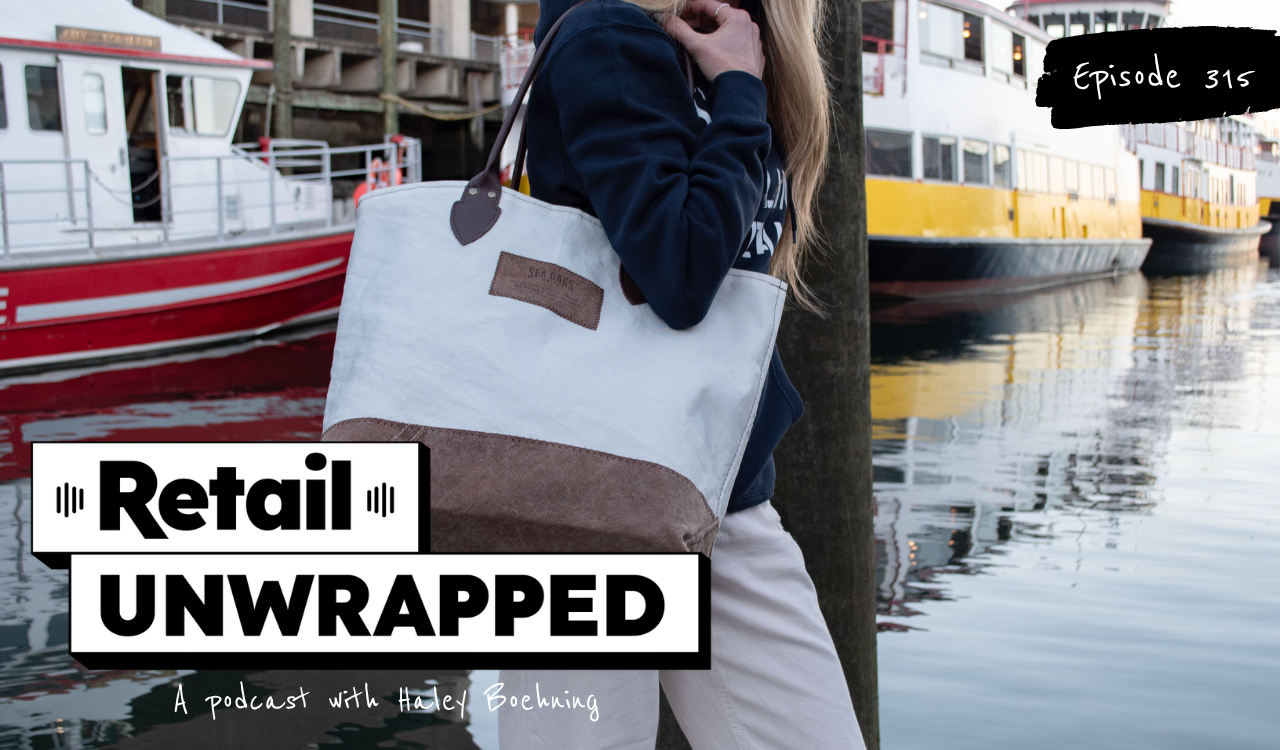

Sea Bags is built on a novel concept that is both clever and obvious. After sails have outlived their useful life on a sailboat, Sea Bags saves them from the landfill and transforms them into one-of-a-kind bags, accessories and home goods. Seems obvious for an artisanal brand based in Custom House Wharf in coastal Portland, Maine. It has scaled into a successful mission-driven business based on three principles: sustainability, made in the USA, and giving back generously to the community. Join Haley and Laura Hnatow, Vice President of Marketing and eCommerce at Sea Bags, to discover how a 20-year-old company with a startup attitude has built an authentic, nimble business boosted by a passionate focus on mission and impact.
Special Guests
Laura Hnatow, Vice President of Marketing and eCommerce, Sea Bags
Transcript
Haley Boehning (00:05)
Welcome to Retail Unwrapped, the Robin Report’s weekly conversation on the trends, consumer behaviors, and issues at the core of retail. I’m Hailey Boning. Today I’m speaking with Laura Natto. She’s Vice President of Marketing and E-Commerce at Seabags, a Portland, Maine-based manufacturer and retailer that transforms recycled sailcloth into handcrafted tote bags, accessories, and home goods.
Since joining Seabags in 2013, Laura has led the brand’s marketing and e-commerce efforts, building on her career that spans more than three decades across retail, catalog marketing, advertising, and digital commerce. Laura and I talked about Seabags’ mission-driven business model.
And how having that mission as a filter for thinking enables the business to say hell yes or hell no faster and allows this small but nimble team to stay close to their customer and establish some pretty major partnerships, like the NFL, the Empire State Building, Pebble Beach, and more. Laura shares her thoughts on where marketing is going next and how she hopes to see seed bags lead that change.
Behind every bold business move is a brand story that deserves to be told. This is Seabags.
Haley Boehning (01:22)
you so much for joining us, Laura. will you do us a favor and introduce yourself to our audience?
laura hnatow (01:30)
Well, thanks for having me, Haley. My name is Laura Natto. I am the Vice President of Marketing and E-Commerce at Seabags.
Haley Boehning (01:40)
so so sea bags started in a really unique way. Can you tell us a little bit about the origin of the brand?
laura hnatow (01:48)
Yeah, I it is a unique story. It started as a hobby business originally,
Haley Boehning (01:52)
Mm-hmm.
laura hnatow (01:53)
and our current CEO was interested in changing careers and she ended up talking to the hobbyist co-founding Seabags as it is today about 20 years ago. And the idea was that there is you know the
Sport of sailing, which I hear Haley, that you’re actually very passionate about.
And there’s the issue of sales after they’ve outlived their useful life on a sailboat, you know, they they start to not function at optimal levels and they usually end up in landfills. And this hobbyist ended up identifying that you know there was this unused material. Beth, our current CEO and the co-founder of the business, was just enamored with the story and the functionality of the product, and she had in her ham family history.
And lineage, experience, and in the main cut and sew industry, and which had gone to the wayside years and years ago. She was very committed personally and passionate about the idea of bringing cut and sew back to Maine. And with this new business idea, she was very passionate about combining sustainability with the ability to bring cut and sew back to Maine, to make jobs in Maine, so a made in USA product. So it the
The evolution of the brand was really kind of an unexpected evolution.
Haley Boehning (03:26)
That’s interesting. And and it sounds like starting from the very beginning, the company has had a stakeholder orientation. So you you talked about sustainability and you talked about jobs in Maine. And how did that having that as a foundation for the the brand and the company influence how you operated for those first few years?
laura hnatow (03:47)
Well, the first few years, you know, I was not part of the business. So I’m gonna be speaking historically from the knowledge that I know, but I can also tell you from my perspective how it’s influenced my experience. I’ve been with CVAX for 13 years. Beth was very clear, Beth Greenlaw, she’s the CEO, co-founder, and she was very clear about defining what the mission of the company needed to be. There were gonna be three pillars. We were gonna be made green in product and practice, made in the USA, and we were gonna give back generously to our community.
And those three pillars stand up the business fully. And was how she began the process of making decisions on where growth was going to happen over time. When I came into the business, I had the opportunity to evaluate this as a job opportunity.
It was such an easy choice because when Beth explained the three pillars to me, it became this clear filter about how you would conduct business. You would put it through these three mission statement elements.
And if something wasn’t really resonating with one of the three, it gave you a moment to pause and say, is this really the right thing for our next step, our next opportunity, our next yes, our next growth? And that’s made my job immensely easier. And I think that’s one of the reasons why when people go to a CBAC store, when people come to the website, that the experience that they have is very authentic and it’s very seamless between them because
We are using the mission as our North Star.
Haley Boehning (05:28)
So having having that mission or those three mission pillars as a filter for your thinking, I can imagine when the business was three people, four people, five people, that was one tool that you were able to use. What were the challenges that you found as you you came in at you’ve been there 13 years? So when you came in and the business was really beginning to scale.
were there any times that those filters were tested?
laura hnatow (05:54)
Certainly. Certainly they were tested. And I think, you know, it’s less about
that we were making choices that were misaligned and more about when you get to a point where you’re scaling and growing, you start to get offered more opportunities than you can take advantage of based on the size that the company is. You know, and we are a really nimble resource constrained company for the amount of stuff that we get accomplished. I mean we’re I am really regularly impressed by by what we’re able to do. But the
Challenge with that is you have to know when to say yes and when to say no. And there’s always going to be competing priorities. And one of the lessons I took very early from Beth was when you’re saying yes to something, you’re saying no to something else. And we needed to make sure that all of our yeses were hell yeses, and that you know the no’s were something that we felt really convicted about. Like, nope, that’s not the right move because, and you understood why. Because
Around the corner was going to be yet another opportunity. And we had to believe that, you know, in this idea of riches were always available. And that has been the case. So I would say that’s the biggest challenge that we’ve had to deal with in pursuit of growth over the years. And also, you know, more recently as a brand, we’ve really retooled the idea of
the value of growth and making sure that it we’re going after the right type of growth and that again it’s aligned in supporting the mission and it’s also supporting the customer and the customer experience. And those things all have to resonate with each other.
Haley Boehning (07:37)
Good. Tell us a little bit about the customer. So you know, before you came to Seabags, you were you are an expert, you’ve written the book on customers, you know, you you really are you go deep in customer intimacy.
You take that that customer centricity into your role at Seabags and how do you see the customer, the Seabags customer?
laura hnatow (08:00)
Yeah, I I think that’s an excellent question, Haley, because I think a lot of brands look at their customer in terms of solely a persona. They give it a name. It’s Susan, she shops at, you know, these five stores. We didn’t take that approach, and instead the approach was to really look at who are buying these bags. I think early on Beth talked about how originally she thought the customer was going to be sailors. And we very quickly found out that that is not the case.
Not
sailors, certainly sailors appreciate our product. and the people who do sail trade with us certainly are interested in having our products, but mostly, you know, it’s females, as you might expect. people who are
Value a coastal lifestyle, people who think sustainability is an added value to a product, people who really appreciate made in USA. These are values and traits that we can offer that a lot of other products can’t offer independently without the assistance of either another brand or a collab. We can offer them all within one product, not in a collection of products. It’s really quite unique.
Haley Boehning (09:15)
is that combination of that that understanding that you have of your customer and the the mission driven part of your brand story how has that helped you with some of the partnerships that you’ve been able to develop over the last couple of years
laura hnatow (09:31)
Well, I think it’s part of the reason why some of the partnerships have happened. you know, we have a handful of really wonderful partners. You know, we are an NFL licensed company, which is exceptionally exciting. We bring a sustainability story to the NFL that they didn’t have on their own. we work with Life is Good, who has been a wonderful partner of ours for over five years now. And, you know, working with them, you know, they have a really interesting
Interesting vibe in terms of coastal lifestyle. You see a lot of their product have beach day vibes and you know lake living aesthetic, and those things are very aligned with our product mix. So lots of opportunities to work with like-minded brands that really value having a sustainability story. We’ve also had opportunities to work with other sustainability brands as well. You know, partners in the charitable giving space.
Like Four Oceans, for example. Really wonderful. We also worked with the Empire State Building Launch, which is the most sustainable building in the world, if you didn’t know. So there are all kinds of opportunities where the pillars of our mission help us form and solidify those partnerships and you know give our partner either a storyline that they didn’t have, or it’s an opportunity for us to bring.
Bring this coastal experience, the main experience, to a whole new customer base through a the lens of another brand.
Haley Boehning (11:12)
Right. You have such an amazing heritage as a business that’s just built into your story. And you’ve you’ve found ways it looks like to leverage that heritage, to to serve your customers in the way they wish to be served and also to to grow the business. Can you maybe talk a little bit about the heritage lines and and anything that might be coming up that’s exciting?
laura hnatow (11:36)
Well, I’m glad you asked. you know, one of the things that has always come up, customers will come into our stores or ask us in social media. We have very engaged social media following. And the curious curiosity of customers is well, do you know where the sale is from? And one of the challenges in acquiring sales from all over the world, which we do, we have an incredible sale acquisition team. and we take sales in at all of our retail stores as well, is cataloging where the sales came from.
From is very challenging. So we do not know where every single sale came from, but we do know where a lot of them come from. And when we do, and the story is really interesting, historic sometimes, we’re able to tell that story, and it’s always a really rich experience. And we use the opportunity to do that in our heritage collection to create a halo effect for customers to understand that every one of these sales, whether we know what boat it sailed on or not.
Is a story in and of itself. And an example is this coming Friday. I’m very excited. We’re launching our next heritage release. It’s called the Ticonderoga after the sailing vessel Ticonderoga, which was built in 1936. So this is an almost a hundred-year-old vessel. It is still sailing today.
And we acquired some sails from the vessel, and we have made a limited edition of 30 bags from the sails of the vessel. unique findings and details on these bags with antique brass and leather handles, and the inside pocket tells the story of the boat, and there’s a a patch that shows the stern of the boat.
Haley Boehning (13:19)
So
laura hnatow (13:20)
with the name. And I mean they’re just beautiful bags. They are premium and just luxurious products. And
Haley Boehning (13:26)
Mm.
laura hnatow (13:27)
the great thing is is that there’s thirty. So the exclusivity of the bag itself, it’s a story. It’s historic. And customers love to hear it. And even if you’re not one of the lucky people who gets one of the thirty, just learning about the story and understanding that, you know, you’re carrying a story on your shoulder. And you can be part of that and you can continue its journey.
I think that really creates a richness for the products that we sell and also for the customer and how they stay engaged with our brand and wanting to be part of that storytelling.
Haley Boehning (14:00)
That’s great. See, you seem to be tapping into something, a trend, a desire that I I feel out there right now. A number of us from the Robin Report were at the Fast Company Innovation Festival a few weeks ago, and there was a lot of talk with the marketing and brand folks there about these limited editions and heritage and and reuse. Could you speak to kind of what you’re seeing in the in the marketplace that other marketers might might learn from in this experience you’re having?
laura hnatow (14:29)
Yeah, no, I I absolutely agree with that. We are seeing that ourselves. We have so as I said, you know, we are all of our sales are recycled and all of our products, that means if you buy an anchor or an octopus tote or the crab that you got, Haley,
Haley Boehning (14:45)
Yeah.
laura hnatow (14:46)
they they’re all made from recycled sailcloth.
But what’s unique in our vintage line, vintage and heritage are the same line. Heritage is just the you know the cream of the crop, is that these are the original markings on the sale. The sales came with these markings on them. People are very, very interested in kind of these bespoke one off products because of the individuality that goes along with it. I want a product that nobody else has, I want to be able to tell the story, here’s where I got it. and also if they can add a level of personalization too, which is also something.
That we do, which a lot of other brands can’t do. But because we are a manufacturer as well as owning our own supply chain, we are able to customize products one-off just in time. And customers really appreciate that. So, you know, for example, we recently did a really nice retail event at one of our retail stores where we had a whole bunch of children come in and color on
white paper bags, you know, make their own sea bag on a paper bag. And then we took all of those paper bags, we picked a winner and we made it into a sea bag and we gifted
it back to the the young young man who made the winning design. But I mean really fun. But the ability for us to be able to customize products fully to your vision and give that customer the opportunity to have this bespoke experience.
Pick their handle colors, pick whether or not they have a pocket on the bag. That’s unique in retail, and not everybody can offer that, and especially at the speed that we’re able to do it. So I do
Haley Boehning (16:24)
Yeah.
laura hnatow (16:24)
think there’s quite a bit of a trend to the nostalgia element and the vintage, as well as kind of personalization and making a product truly independent and a reflection of your personality.
Haley Boehning (16:35)
Yeah, I love the the speed at which you’re able to respond in those moments. I also love this recruiting tactic that you have of getting them when they’re that young. So your your your your
laura hnatow (16:44)
yeah.
Haley Boehning (16:46)
design team is growing, but you might need to wait for them to graduate from elementary school, high school, maybe. Exactly.
laura hnatow (16:50)
Yeah. You know what? I’m gonna talk to HR about that. That’s a good one.
Haley Boehning (16:55)
So I wonder you know, you are in a position where you do a significant amount of direct to consumer. You have these wonderful partnerships and you have stores.
from from a marketer’s standpoint, what is it that that having both stores and this rich, robust online community, what does that give you as a as a company and as a brand?
laura hnatow (17:17)
I mean it’s
I it’s gold, right? I to I talk to so many people who are pure play D to C and they have, you know, one store or no stores and they’re like, how great is it that you get to actually talk to your customers on a regular basis. The information that our retail staff is able to share with the product development team, with the marketing team, about you know, what customers are saying about products is invaluable, yeah, we can get that feedback as well online through ratings and reviews.
But it’s different when it’s a conversation and the managers are able to say, I’ve heard this five times. You know, it’s a repeated request, customers really want this. We can respond to it in a more accurate way. So I think there’s that element. In addition to that, we’ve always viewed our stores as billboards for the brand, right? Because where we have located our retail locations, they’re in coastal destinations. So customers are happening.
upon the store. They’re learning it for the first time. that’s less print ads that I would have had to do, you know, and digital ads in that space because they’re they’re learning about the store on their own. And our sales staff at the stores, I mean they’re top notch in terms of telling the story. They really explain the bag, I sorry, the boat to bag story like nobody else. So I think having a retail store to support the D2C and the B2B business is fantastic.
And you know, in the flip direction, right, it’s important that we have an incredible online presence with brand storytelling that’s very resonant that can help direct people to all of our retail stores for ease of purchase. If you live in a community near one of our seabag stores, we hope that you’ll come in and visit us because the collection at the retail store is entirely different than what you might find online because all of our vintage bags are unique.
Haley Boehning (19:17)
really interesting yes increasing your re repeat customers within your local community there’s
laura hnatow (19:22)
Yes. Yes.
Haley Boehning (19:24)
So I bought a sea bag. There she is with my lovely seabag tag. I hope
laura hnatow (19:28)
she’s beautiful. Thank you. Thank you for supporting us.
Haley Boehning (19:32)
that my my brother and sister-in-law are not watching this before Christmas, otherwise they know it’s coming their way.
laura hnatow (19:36)
Jesse.
Haley Boehning (19:38)
But as I was looking at this bag and looking at the construction of it, it reminded me that that as you said, new two bags are alike, but you have a very literally hands-on production for your bags. And
laura hnatow (19:51)
Yes.
Haley Boehning (19:52)
you know, you the people who are making these bags, I think, are down the street from your corporate office there in Portland.
laura hnatow (19:56)
Yes.
Haley Boehning (19:58)
a lot of retailers, especially retailers that are interested in scaling, might see that as a problem.
laura hnatow (20:03)
Mm-hmm. Mm-hmm.
Haley Boehning (20:03)
a puzzle to be solved. But
you see it as as a benefit. Can you talk about that, how that has changed the business and and what benefits you think it brings to you?
laura hnatow (20:16)
Yeah, I think that’s an excellent observation and question. It, you know, I think the reason why people think it’s a problem is because it is a scalability concern, right? You it’s hard to scale a business when your business is founded on an artisanal handmade product.
And yes, that is true, a hundred percent. But also, you know, I did mention that we’re very nimble and as an organization I think we’re super innovative in terms of using new processes. We’re looking into new technologies for the way that we manufacture, we’ve brought in new technologies already.
and we have really refined the products that we make, how we make them. We make decisions smart about how we make products, and sometimes there are tough decisions that we have to make, like you know, eliminating a product skew that we’re very passionate about, but we know that at the end of the day takes too long to make and doesn’t have profitability tied to it. heartbreaking, but it doesn’t mean no not ever. Sometimes with that product, it’s no not now. Let’s figure out how to do
What we do well and deliver on those products so that we enhance our customer experience as opposed to detract from it. So those are hard decisions to make. Overall, I think having our manufacturing down the street from us is an incredible benefit. You know, we don’t have to pack up the leadership team to go on a road trip to go walk through the factory. I go to the factory regularly, and when I go there, it’s an empowering.
Experience because not only do I know people’s names, but also have the opportunity to say, like, you know what? I have my phone, I’m gonna take some video. we’re gonna shoot some video for social media. I happen to be here, I’m gonna bring it back, and my social media team is gonna put that video to work so people can see the product as it’s being made. we do that all the time, and it’s part of what makes us be able to deliver the brand story authentically on a regular basis. It’s not that.
That we’re sending a video team in and they shoot once every three months. Like we’re just there doing other things and catching somebody sewing a bag that we know is gonna be a hit, or we know it’s launching on Friday, for example, you know, and we get to show the just the quality care and artistic nature of how we put it back together.
Haley Boehning (22:45)
Great, wonderful example of the the leaders of the company both telling and living the story and and being steeped in it every day and how that changes the decisions that you make, strategies that you create. I wonder if you could contrast something for me. So you you were at LL Bean.
Much larger company catalog, very different from the experience you’re having at Seabags. And thinking of some of the other marketers and brand folks that are listening to this interview, I wonder, could you share, were there things that you needed to unlearn in moving from a brand and a business like that to Seabags that have have proved to be really valuable for you?
laura hnatow (23:29)
Yeah, that’s excellent. And that’s exactly what it was unlearning. I remember early on when I was working with the CEO probably in my first week or two on the job, he said, It’s the same thing as what we did at LL Bean. It’s just less zeros. And
Haley Boehning (23:50)
Ha ha.
laura hnatow (23:51)
He was right to a degree, but where it wasn’t true was in the rigidity and structure that comes with an enterprise level business that size is that
You be the the structure, while really important, it it imbues a kind of rigidity that doesn’t allow for creativity and innovation and the possibility of considering, like, well, what if we did this? Even though that is an outrageous suggestion, right? What if we did it? and the yes and opportunity in kind of using that, you know, going down that rabbit hole can lead to really rich considerations.
And I think that unlearning was important and not necessarily being married to, well, we do it this way because we’ve always done it that way.
Haley Boehning (24:47)
as I’m listening to you talk, it sounds like there are some mindsets that are particular to your brand and your business that have enabled you to think creatively and for you and the rest of the team to to lean into this innovation. Could you speak to what you think those mindsets are?
laura hnatow (25:07)
Yeah, I think it’s as I’ve described to a lot of people, we’re we’re a 20-year-old startup company. It I mean it’s very much a startup environment. we’re not a startup company, obviously we were very successful. We’ve had many years of growth and reinvestment. So it’s just that we operate in that manner in a way because we’re always considering innovation at the forefront of what we do and look at every opportunity.
not just as the next domino, but as like, wow, this could be really something. And like how how would we innovate this? And everything’s kind of like greenfield to some degree.
Haley Boehning (25:50)
Interesting. So what I as this small company, I think, you know, normally this is a question for the CEO and the founder, but I know you’re all so close. I’m going to ask you, you know, what what is your vision for what’s next when you look five, ten years down the line for seabags? What what do you hope to see?
laura hnatow (26:08)
Yeah, I well, I am really close to Beth. She is extraordinary leader and she does work with everyone on the leadership team really closely. She’s super transparent about what her vision is. So we’re all really in tune with it. I think, you know, five, ten years, I I think that’s a bit of a lofty goal for me to predict, given the speed of AI these days. But I will talk, you know, a little bit closer to current days that looking at like the next
Year to three years. I mentioned it earlier, personalization is a huge opportunity. We are so nimble, we have such capabilities, and because as I said, you know, we’re artisanally made by hand, we have the ability to really lean into that heavily. It’s just a matter of figuring out how we can do it at scale and at a quicker pace, so that you know it’s less of a burden on our artisans because the people who are making these products.
you know, one at a time, right? How many totes a day can we make? so I think that is that’s a real opportunity. So looking at things like you know monogramming
Adding personalization to the bags in terms of like changing handle colors and features like pockets, you know, all of those things are currently things that we offer. custom making bags, but really expanding on those areas. I see that as as really exciting. the technologies that we might use to do that, also super exciting. and I am also looking forward to how the evolution of digital marketing is
Is changing at a rapid pace. Opportunities like social commerce, I think, are really going to change the way that we do business. I’m really excited. We launched a new website last year. It’s been fantastic and we’re consistently iterating on it and adding new features. But I think you know we’re gonna be live selling on it in no time. I think that we’re gonna be live selling other places in no time. Other people are already doing it very successfully, co-creating.
with our customers. I see that as like a real interesting opportunity down the road. So I I think that there’s a lot more coming, retail, experiential retail, changing how we interact with customers in retail experiences. But I d I do think it’s a lot of it has to do with how the marketplace is changing and the fact that as like I said, a Nimble company, we’re primed to take part in it.
Haley Boehning (28:48)
Yeah,
it’s interesting. You as you talk about your future and some of the things that you’re doing right now when it comes to product and supply chain and all of that, you’re you know we we interview retail radicals here at the Robin Report, and it’s so interesting to me that the things that are most radical or that I hear you talking about that are most radical are actually the most human.
laura hnatow (29:09)
Mm-hmm.
Haley Boehning (29:10)
And
I wonder is there is there anything we haven’t talked about that when you think of what’s radical about sea bags and the way you do what you do for seabags, anything we haven’t talked about that you think would be useful for our listeners to hear?
laura hnatow (29:25)
Well, I think, yeah, it it may not seem radical, but I think it is. one of the reasons that I mentioned at the beginning of the interview is that I took the opportunity because of the mission. And I think having a very, very well-defined mission that you’re committed to that isn’t just words on the wall.
And that people are living every day is critical to the success of the business. And I’m not suggesting that that’s a radical idea. It certainly isn’t. But what I think is radical is the idea that every day you’re making decisions and you are thinking about that mission and how that mission translates to the customer experience or doesn’t when you make that decision. And that goes for everything that you do. We were having a conversation.
Today about our packaging. And the leadership team was getting together, and we know we all really want to tell the brand story everywhere we can, but we don’t want to put a
Catalog in the packages telling that rand story that’s just gonna get tossed in the landfill afterwards. And that is the conundrum that we find ourselves in: is how can we tell the story without having to create any landfill waste? Sure, we can put a QR code on the box and hope that people will scan it. They might not.
And so these are decisions that are really challenging. And so that’s, you know, what I would consider radical decision making is that sometimes we make decisions that aren’t necessarily in the brand’s best interest because they’re in the
Customers’ best interest. They’re in the world’s and our community’s best interest. And so, you know, that’s just one example, but I think it’s that commitment to the mission and being really clear on it that helps us make decisions that are the right decisions for the brand. And I would say that most marketers should really lean into that. And you know, i this came about really because
Two years ago when the Beth took back over as the CEO, you know, she was asking people if they knew what the mission was in the company. And it was amazing how many people didn’t actually have it nailed. And to no fault of their own, because it was just that just meant it was an opportunity for all of us to get really clear on it, to talk about it more frequently, and to like imbibe it into the culture of the company. And I think making sure that mission becomes part of the culture and just everyday.
Haley Boehning (32:08)
Great. Yeah, I wonder it this work that you’ve put in to get everybody on the same page, to help everybody understand the story of the business, your purpose, your mission. Now that you’ve done that work, are there examples that you can point to of how that has directly impacted performance?
laura hnatow (32:31)
Yes. I will use the example of our flagship store. The our flagship store in Portland, Maine came about because you know, during COVID, lots of retail space became available and we needed a place to do a pop-up and there was this great big space and so we took it over.
Again, in this kind of innovation mindset, we went from this is a pop-up to all of a sudden this is our flagship to this is a great thing. And that store did well. It wasn’t until we decided we need to use the window of the store to tell the boat-to-bag story visually. And we had been wanting to do that for a while and we finally committed to doing it.
The visual of that storefront is incredible. We see people who passerby is on the street. We get two cruise ships a day in Portland, Maine during the fall, and people just walking by and reading all the details, all the stats from how many yards of rope that we use and how a bag gets made. And eventually leads to people trailing into the store, already knowing the story before they get anywhere into the store where a sales rep can interact with them and actually reinforce.
It further. So that’s a real example, I think, of how we knew the brand story ourselves. We knew what the mission was, but we hadn’t translated that mission into an easily digestible snippet for the customer to experience on their own without us interacting with them. And we did it there, and that flagship store is our top performing store. it rivals
you know, just a a lot of the other store, like when you add up the next ten stores, I mean it’s still it’s it’s an exceptionally productive store space. granted it is big, but the ultimately is just an incredible store experience. The customers rave about it. And you know, I think it really becomes just the physical translation of the mission in a store experience.
Haley Boehning (34:45)
I cannot wait. I’m gonna have to sail up to see the
laura hnatow (34:48)
Yeah.
Haley Boehning (34:48)
fantastic store.
you mentioned earlier that the landscape is changing dramatically. you you know you mentioned AI, but there are also a lot of other trends that are happening. when you look back 20 years in the this world that you’ve been operating in, what are the things that we just can’t put the genie back in the box?
laura hnatow (35:08)
years ago, and what still rings true today, and then what I look forward to 20 years will still be true, is I still think customer experience and tying that customer experience to a marketing experience, making sure those two things don’t get unthreaded is really important. That and that’s I think accelerating, you know, when I mentioned before social commerce and co-creation is that.
Customers expect at this point to tell you what they want and have you listen and execute on it. And that’s part of making sure that marketing and product development are working really tightly together. And that’s one thing I’m very proud of at Seabags that you know I have a really tight relationship with the vice president of product, Tara. She is
Really good collaborator and partner and listener and very interested in what the customer has to say. She monitors our social media constantly and
Haley Boehning (36:10)
Yeah.
laura hnatow (36:10)
is looking at the landscape of competitors as well to see what other people are doing. So, you know, I do think that you you know, as much as AI is coming into the forefront and people feel like AI is gonna take over and everything’s gonna be automated, I don’t think that that’s gonna be the case. I do think there’s gonna be a lot.
places where that will happen like you know at the gas pump you’re you know you’re probably not gonna have a human interaction at the gas pump ever again and that’s okay because that’s not a value added transaction in a lot of cases but when you’re talking about a product that you have passionate experience with like Haley you talked about you’re a sailor and you sailed from New York to Maine. I mean what an experience you know if when you go in to buy a seabag you’re not wanting to do it from a kiosk you want to talk to somebody right you want to have an
experience or if you do it on the website you want to know that at some point during the transaction that we know who you are and that we’ve connected with you and we value you as a customer. I don’t think that’s going away no matter how social commerce begins to evolve further and further and how AI evolves further. And I do think that the marketing tools will change.
Email may not ever exist in twenty years. You know, who knows?
Haley Boehning (37:29)
Thank God.
laura hnatow (37:30)
you know, exactly. I mean my inbox is atrocious. You can ask anybody who knows me. it’s it’s insane. I’ve never had a zero based inbox. But
Haley Boehning (37:39)
It’s a it’s a
dream we all have.
laura hnatow (37:41)
It’s a dream, I know. But I mean, I you
know, I do I think the tools will change and I think customers will evolve with it and the the intelligent and innovative brands will also do the same. And I think that letting the customer lead is a great space to be in and listening really intently to the customer is critical for that growth.
Haley Boehning (38:07)
Great
advice. who are you watching right now? both maybe within retail and outside of retail that are doing things that are inspiring you or getting your creative juices flowing.
laura hnatow (38:18)
Yeah, in in retail, this is almost an easy answer. I’m watching Paxson. Bree Olson. she is doing incredible work. And I mentioned the term co-creation a few times. That’s the
Her name of her book, and she is really leaning into customers and letting customers kind of lead what you know what they expect from that brand. And it’s interesting. I think it’s a different concept. I think that the way that I was brought up at LL Bean, it was all about we have, you know, this
vision for where the fall season’s gonna go. We got the the color themes, we were told that, you know, the pants are gonna get more cropped this year and you know, and we’re gonna react to all that. We’re gonna do our vision of that. And that is I think
you know, still done to some degree, but now customers are like, No, no, no, let me participate. And I think that’s important. And I also think it’s very exciting. And so that’s why I keep talking about this you know, personalization angle on it. I I think that
Bree’s doing a great job there. She’s really leaning into influencers in a very interesting way, both at a celebrity level and at a non-celebrity level, which is important. And I I want to continue to see how they evolve that brand, you know, especially because it was a brand that was on the verge of bankruptcy. So that’s who I’ve been watching. and then outside of retail, you know, that’s a really interesting question. I
I spend a lot of time listening to podcasts and I find the whole
a self-help space very interesting, like the Mel Robbins space and the, you know, the self-made millionaire space and how these people are evolving their brands. And they’re using all the same tools we’re using. They’re just using them very differently and very much focused on unit economics and how they can move things forward quickly and expand subscriber bases. so I think that’s interesting and that to me, like customer growth has always been challenging.
To achieve when you’re focused just on product releases, and here’s our next spring release is coming, and we’ve got to grab as many customers as we can, or at our retail stores, for example, and doing list growth. Whereas these subscriber-based models have a very different approach to how they grow subscribers. So I pay attention to that space a little bit to see if I can glean any tricks and tips that I can translate into kind of the more product-based retail.
Haley Boehning (41:11)
Great, yeah. It sounds like you’ve you are building in a beautiful community of of customers and fans and and the team that you have there at Seabag. So I think you’ll you’ll go well. You’ll do well there. So
laura hnatow (41:25)
Yeah, yeah. No.
We have a l we have a lot of talent on the team and one of the things that I’m so proud of and grateful for is that the leadership team that we have, there’s a lot of longevity in the team. I mean, it’s incredible. I know I said I was there for 13 years, but I am not the most tenured person on the leadership team and there are plenty of other people right around me. So it’s amazing to work with the same people for more than a decade and have everybody continue to be as passionate as they were the day they started.
Haley Boehning (41:57)
How does that change how you operate as a business, that kind of longevity?
laura hnatow (42:04)
Well, I think, you know, back to that point of the, you know, we do it this way, so we always, you know, that’s just why we do it this way. it that’s a danger for sure. But because of the culture being one of innovation,
And particularly because Beth’s leadership style is one to question always, like, well, why do why are we doing it that way? Why aren’t we doing this? Like she she is very good at kind of asking the next five questions. And everybody it feels, you know, safe in an environment where they don’t mind answering the questions. You know, nothing is threatening. And so I think
that I think is really healthy. I think it’s a group of people, we all trust each other to make the right decisions. And because we meet once a week as a group and we make the decisions together mostly, it’s all backed by data. So if we show up to a meeting and we’re making a suggestion and there’s no data behind it, Beth will send us away and say, Come back to me next week when you have data.
Haley Boehning (43:09)
Well.
laura hnatow (43:10)
And so I think you know, when we operate in that manner, it removes a lot of the negative human.
dynamics that potentially could come with working with the same people over a long period of time. And then, you know, also we’ve got a nice mix of age ranges too in terms of experience. And so it’s nice to have some really tenured people in their career as well as some younger people coming in with really new hot ideas that you know are more tied to technologies that we’re not, you know, perhaps as adept at, you know, 30 years into our career.
Haley Boehning (43:47)
That’s great. That d that diversity and inclusion of all those different people, it sounds like it’s making you a stronger, stronger culture and a stronger place. Yeah.
laura hnatow (43:55)
I would say so.
Haley Boehning (43:56)
Yeah, that’s great.
great. Well, you have such a great story and such a great brand. Thank you so much for sharing everything about the brand and all that you’ve learned and what you see in the future with us and with the Robin Report audience today. It’s been a delight.
laura hnatow (44:09)
Thank you, Haley. I absolutely appreciate the time and your enthusiasm.