
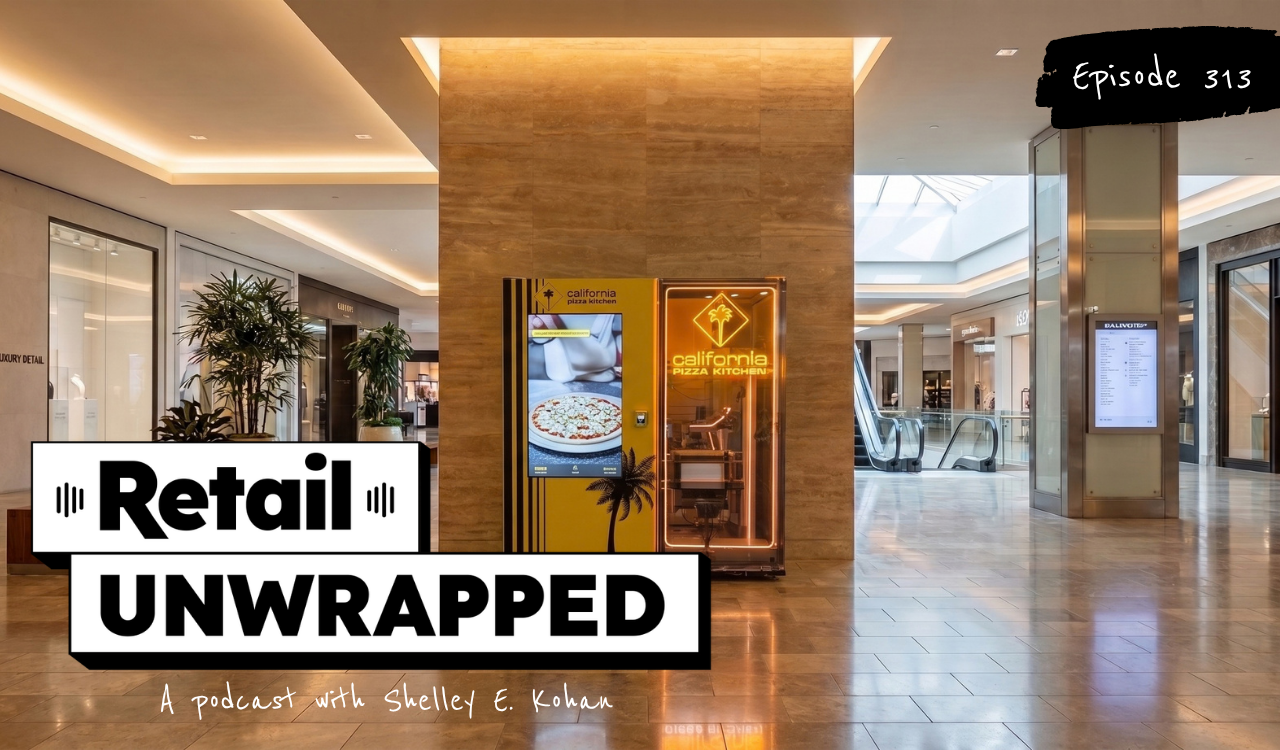

Restaurant growth has always meant more square footage, more leases, more licensees and fees, and more capital at risk. California Pizza Kitchen is betting the next chapter of its 41-year-old brand on meeting the consumer where they are and staying true to what built the brand in the first place. Join Shelley and Michael Beecham, President of California Pizza Kitchen, as they reveal why the founders were brought back and where the smartest path to today’s diner may lead to a vending machine or the frozen food aisle.
Special Guests
Michael Beecham, President of California Pizza Kitchen
Transcript
Shelley E. Kohan (00:06)
Hi everybody, thanks for joining our weekly podcast. I’m Shelley Cohan and I’m super thrilled and excited to welcome Michael Beecham, the president of California Pizza Kitchen. Welcome, Michael.
Michael (00:19)
Well, thank you very much. I’m excited to be here.
Shelley E. Kohan (00:22)
we know your company fondly as CPK, and you are currently running a 40-year-old brand that generates over
Michael (00:30)
41.
Shelley E. Kohan (00:31)
41 sorry, 41-year-old
Michael (00:32)
What do want?
Shelley E. Kohan (00:34)
brand. Thank you for correcting me. and you do about 1 billion in annual global revenue across restaurants, across frozen pizza business. And now what I’m super excited to talk about later is automated retail, which
Michael (00:51)
Yes.
Shelley E. Kohan (00:51)
If you
were to ask me, pizza was never part of automated retail. So that is super exciting for me to talk about that. So I know I know our listeners know the brand, but I’ll just do a very quick review. Opened in 1985 in Beverly Hills. unfortunately, like many businesses in 2020, COVID kind of shut a lot of businesses down, filed for bankruptcy, and then most recently.
In December 2025, Consortium Brand Partners acquired CPK and we are on fire right now. And one thing I love, Michael, that I’m gonna ask you to talk about a little bit later is you’ve are you’re asking the founders of the business from back in 1985, the two people that founded the business, you’re trying to get input from them on what it made it special to go forward. So I’m super super excited to have you here today.
Michael (01:49)
Thank
you so much.
Shelley E. Kohan (01:52)
so let’s kind of talk I think it’s important to talk about what how CPK made its success in the mid eighties. What what what what made it successful and how did it lose it? And the reason why I want you to talk about that is because we’re looking at a forward strategy that is inclusive of what made it successful when it first opened.
Michael (02:15)
Yeah, and by all metrics, if you were to have placed a bet as to whether it would have been successful back then, two lawyers with no restaurant experience opening a restaurant in Beverly Hills probably would not, the numbers wouldn’t be in their favor. But they were obsessively focused on service, culture, and food, and food quality. They built a restaurant around what they love.
when they went out to restaurants, they hired Ed Ladue, who was a famous chef that had worked under Wolfgang Puck, and he invented the barbecue chicken pizza. And so that sort of the birth of artisan pizza in sit down restaurants started at CPK. Prior to CPK, pizza was something you got on a slice from a pizzeria and you had three choices, cheese, pepperoni and sausage. Maybe mushrooms would get thrown in there, but.
And after that, then CPK kind of grew an entire cuisine segment of California cuisine and of pizza that we could pretty much find almost anything to put on top of.
Shelley E. Kohan (03:27)
Yeah,
it’s so interesting because I think you actually push forward other restaurants doing the same thing like PF Chang’s and Cheesecake Factory. You kind of came out there with this kind of unique cultural experience, right?
Michael (03:42)
Yes, I think, you know, and we’re, it’s interesting when Technomic, which is one of the industry’s leading analyst firms, when they put us into a comp segment of other brands, it’s always very difficult because we’re sort of in a category of one, but we inspired so many. so, PF Chang’s, which I’m a huge fan, as well as Cheesecake Factory, we were the first ones that got those mall locations.
and pulled people away from the traditional food court experience and combined shopping with dining with experience on one trip. But ultimately, we’re still, we’re considered a polished casual brand. So it’s an elevated experience and food, but at a casual dining price. And most of that is because our cuisine
we can make at a lower cost than high protein concepts. And that allows us to get more value and better experience and better food and better for you food with the ingredients that we have for a price that’s affordable and reachable by most families.
Shelley E. Kohan (04:57)
Yeah, and I think especially right now, I think you have the, you know, economy in your favor right now. I think a lot of people in the US market, but also globally, but specifically to the US market, they’re looking for exactly what you just described, an elevated experience, but something, you know, a family can actually afford.
Michael (05:17)
And we have the economy in our favor, but we also have the trend in our favor that better for you. You know, with all the GLP-1 medicines and people looking for ways to lose weight, the CPK menu has always been perceived as that a health halo around it because of our fresh ingredients paired with these globally inspired flavors.
bold flavors that allow you to still have an indulgent experience but feel good about it when you’ve when you’re done eating.
Shelley E. Kohan (05:48)
Yeah. So I wanted you just talk about I don’t want to spend too much time on it because I want to spend time on future forward, but I just want can you tell us a little bit about what was learned during that period of time where the company filed bankruptcy? A lot of companies went through this at the same time. How how did CPK kind of lose its way?
Michael (06:08)
don’t
know that we lost our way. We lost a lot of locations. know, CPK has been owned by several entities over the years. I came into it right after the bankruptcy. We had reluctant owners. They were our debt holders that now became owners. And we had a lot of leases around the country that were of good stores where we had a solid fan base, but written in the lease, had to invest.
significant capital for remodels on a regular cadence. And when you don’t have that money to invest in a remodel, we lose leases and we lost a lot of them. And in some locations that were very profitable stores, because we had owners that weren’t interested in investing in the brand. And so if you asked me what our learnings were, it was we had to be scrappy and figure out how do we ensure that
We stay afloat in the stores that we have that we really drill down into food and service to ensure that we could keep our fan base because we didn’t have marketing money. And without marketing money, you don’t have anything to hide behind other than the experience and the fact that everybody that comes in is going to come back. And so you hone in on what
is the basics in the restaurant industry of food and service. And the third big thing, we had to find ways to get to our consumers in other ways, asset light ways. And that was the birth of looking at this automated retail, looking at additional CPG opportunities. We’ve lived in the frozen aisle for now, 20 plus years, 25 years. And was there opportunities around the supermarket beyond the frozen pizza aisle for us?
looked at international markets, looked at ways through very innovative platforms like Ghost Kitchens to get to the consumers and fans that we had in markets where we no longer had a brick and mortar restaurant. But could we prop up a kitchen to be able to still service them through delivery?
Shelley E. Kohan (08:21)
That’s unbelievable. I love your term asset light.
because I really feel now that you’ve explained it more in detail, I think that is something a lot of retailers, especially coming out of the pandemic, they had to really kind of start thinking very creatively.
Michael (08:37)
Yes.
Shelley E. Kohan (08:37)
and they had to become more agile, which I think they’re much more agile now than they were six years ago. But I like that term asset asset light. I think that’s important to understand. The other thing that I find really interesting, I’d love to know how this came about, what was the inspiration is you
You’re actually asking now the original founders for input. So, how did that come about and what does that look like?
Michael (09:02)
So,
you know, along the way, I’m not sure where they kind of got distance and it may have been probably in the 2000 teens. We, you know, we’ve got great founders and when you have great founders, you have a wealth of knowledge of resources. Everybody loves their baby best and knows their baby best. So if you’ve got a founder who’s interested in still sharing the ethos of the brand,
the, you know, what makes the culture, the sparkle, you tap into that. And so I think the first real conversation that I got to have with both of the founders was at our 40th birthday party. We brought them in and celebrated them and everything they built because the brand is what it is because of them.
And it just kind of continued to progress from then. then Rick wrote an outstanding book about CPK. And it’s basically, it was the roadmap. So what better way to do to, if you had a chance, if you read a book that was a great book and you went to a book club, you’d love to have the author in one of the seats. So if you have the opportunity to grab them and say, tell us what you meant by this. Tell us what you think. Tell us how we’re doing.
It’s very difficult sometimes for leaders to realize that the brand is more important than them. And so put your ego aside, put everything aside and focus on what’s most important for the brand, which means go back to the guys that built it and say, show us the way, talk to us, tell us what you think. And I hope we have a great relationship with them forever.
Shelley E. Kohan (10:55)
that’s great. So I’m gonna ask you Michael something personal. Tell me what surprised you when you met them? Like what what kind of surprised you the first time you met them or interacted with them?
Michael (11:07)
So I love founder led brands. I’ve worked for many of them. When they came, both of their wives were there. And there’s such a spotlight always on Rick and Larry.
that
Michael (11:22)
you know, ran the dining room floor and were in the kitchen and and ran the office and and a lot of the culture got built with with their influence as well. So hearing all the stories from the very beginning, that we would have never known of their involvement and their influence if it wasn’t from that first meeting.
Shelley E. Kohan (11:44)
That’s great. And I think it goes back to something you said a few minutes ago about here are two guys, they were practicing attorneys, they didn’t know the restaurant business. And I think if you don’t know the business, you’re you’re back there working it every day. You’re kind of learning it. And so maybe that’s where some of that came from. It’s just diving in and just doing every job throughout.
Michael (12:09)
I I would a hundred percent agree. And I think if they knew more about the restaurant business, we probably would not have the CPK we know and love today. You know, it it it takes
Shelley E. Kohan (12:19)
Totally.
Michael (12:19)
people who come in kind of boldly to say, I I don’t have predisposed opinions. I’m not gonna follow convention. I’m just gonna do what I think is right and that’s the and it worked.
Shelley E. Kohan (12:32)
I love it. Okay, so I wish I was a fly on the wall the day you were in the creative meeting where someone raised their hand or threw out, hey, let’s do automated pizza. Tell me tell me about that moment.
Michael (12:51)
I will tell you that moment. That was an executive meeting and it was something look the I’ll give you the background and the and the premise to it. So as you you mentioned the pandemic before. It changed everything for us, not only as as brands and restaurants, but as consumers. As consumers, we learned how to and very quickly, how to get food in a different way. we could get it when we wanted, how we wanted, and where we wanted.
My own mother, who’s 85 years old, she calls it Grub Dash, but she I don’t know why. But she would order, and she wanted to be going a Uber one time. That was that was fun. She would order food once a week. She still does it because because she could. She because it was not something that someone of her age ever would have done before, but during the pandemic, you had no other choice.
She always orders Italian food because she’s Italian, she complains about it, but then does it again the next week. so but as consumers, when the when dining rooms opened back up, we didn’t ever go back to it being normal. We still wanted that in dining room experience. But instead of making food at home a lot of times, we just picked up our phone, hit the app, and said, let’s have it brought to us. my family doesn’t order that much, maybe just three or four times.
a day that we see DoorDash or Uber drivers coming up to our house for for my wife and I or our kids. But it it became a way of life, how to do things. So but here was the problem. It’s expensive is it and it’s getting more and more expensive. When DoorDash and Uber Eats went public, they had to, they no longer could could base everything on valuation. They had to turn a profit.
And so now you started to get costs that were layered on to the consumer and costs that were layered on to the restaurant, who then built it back in the price. So you could order something that you would in a restaurant be at $30 for most brands. And if you order at home, before you know you’re at $45, $48. And so people are kind of we what we saw was there was this need and a demand. People wanted to get things closer to where they are were. They wanted to
have brands show up where they were, but at the same time they’re getting price squeezed. And add that to increasing labor costs, restaurants closing earlier, no longer giving room service in hotels in an airport, restaurants are are at nine o’clock, you’re not going to find food. And what we found was this pent-up demand, these little mini food deserts and
A love for a brand that if we could if we could execute in a way where they got the same quality food in our restaurant, but wherever they were, that they would jump at the opportunity to do that. So it was a two and a half year project that I think everybody at the beginning thought was absolutely insane. and yeah, if you run the fly on the wall, I was probably the one that people were looking at with very, you know, like, what on earth are you thinking?
But we went into it with the one caveat that if we if any point during this journey we realized that what we were going to give was a product that was less of a quality that what was in the restaurant, we’d pull the plug. And but we got there. We got there in a way where we’re extremely proud of what we’re serving. And we are now on college campuses, airports, we’re about to go into malls, hotels, a whole bunch of military bases.
You’ll see us in hospitals, big box retail stores. It’s it’s and it’s not just us. You’ll see a lot of other other brands now are jumping into it because they’ve seen the the success that we’ve enjoyed with it.
Shelley E. Kohan (16:53)
That’s great. So you did a pilot at Atlantic Airport, right? Atlanta Airport? Tell me about that. Okay, Dallas Love Field.
Michael (16:58)
Our first was well, our first was Dallas Love Field. Atlanta was our second.
So Dallas Love Field was our first pilot, and we were doing at on some days 100 to 140 pizzas a day that were coming out of a out of a machine. and we learned a lot from it and and you know, it was it was our first generation machine. The quality was very good, but sometimes we would if we were
The amount of pizzas that were coming out of it, we would have challenges, it would slow down the cook time because the oven had to recalibrate. And we realized
Shelley E. Kohan (17:37)
Right.
Michael (17:37)
we had to be built for speed and scale. we’ve now since I think we’re on our second or we’re going into our third generation machine, and it’s a completely different machine. The original machine was refrigerated to cook, and it was about three minutes. The new machine is frozen to cook.
And it’s in 90 seconds. And the frozen to cook machine means there can be there’s no waste because the shelf life went from seven days inside of a machine to technically one year, even though we’re turning that machine out almost every day. But it allows our partners to then expand the menu and feel good about putting in not just the four pizzas we started with, but pastas, mac and cheese, our buttercake dessert.
And not have to worry about throwing product away if all of it isn’t selling at pace, because the shelf life is fine as a frozen product.
Shelley E. Kohan (18:39)
Unbelievable. So I have to, I’m, I have an operations background. I spent like 40 years in store operations. How are you replenishing, if you’re selling that many pizzas out of a vending machine or automated, I don’t, I don’t know if vending machine’s an okay term to use, but as you’re as you’re selling, how is how are you doing replenishment?
Michael (19:00)
So we have partnered with a company called T Rock. We have three partners right now. Evolve Vending does our airports, Access vending does our universities, and T Rock pretty much has the the rest of the country. And T Rock is a is a very large company with 30 warehouses, 4,000 employees, and they operate 2,000 vending machines now. the machine most of the machines are averaging
They could average 60 to 70 pizzas a day. And so replenishment is a machine basically could hold two days worth of product. Unfortunately, people don’t buy it the exact same P-Mix that you’ve got it stocked. So you figure every day and a half somebody’s in there restocking the machine. But the tech does all the work for us. It tells us not only what’s in the machine, what’s been sold, what needs to be restocked, but it knows that on a Thursday at
in Dallas and the airport, you’re gonna sell more pepperoni than cheese, or that or rather more cheese and pepperoni than on a weekend when there’s more families and kids. So it is a predictive sales model in in allows us to stock it in a way that we’re hopefully able to capitalize on the P-Mix and not have to run there two times a day.
Shelley E. Kohan (20:22)
So what I love about the story you just told is instead of you trying to execute in these three very different environments, you’ve gone to experts that really know how to execute in these environments, the mall, the universities, and then the other areas. So I I think that’s excellent. The partnerships are important because they excel at what they do and you excel at making the pizzas high quality.
Michael (20:50)
Our job is to make sure that we are, as CPK always has, high quality, globally inspired flavors that our products get to them at the highest quality but lowest price, constantly looking at innovation on the machines. And their job is to make sure that they execute, that it’s fully stocked, that it’s in the right location. The beauty of this model is, and and if you came from the restaurant business, you’ll understand this, is
If we’re in a location that’s not great, we just move it. We literally just move it to the next building or around the corner or whatever until we get it optimally in the in the perfect location. the the payback on the machines are less than a year. So it it is back to that asset light. It is a capital light, but brand heavy. People see it, they engage with it. There’s a large video screen on the front that that we can push brand messaging and advertising.
of what our products are. And it’s a great experience. You know, we they’re it’s it’s a quick cook time. we get great feedback on the quality of the pizzas. We’re about to launch our pastas and our and our buttercake, which if you’ve not had our buttercake, I dare say you haven’t lived, but if you have, you know, because it’s one of those, it’s it’s a life changing experience. But now we will be able to deliver that through our network of vending machines as well.
Shelley E. Kohan (22:19)
That’s awesome. So I was gonna guess that the kiosk is asset light, just because it makes sense. Is is the kiosk a profit channel, a marketing channel, or kind of a little of both?
Michael (22:32)
absolutely both. So we we are a our partners own the kiosks, they operate them, and then it’s a it’s a revenue share. but they’re they are the they’re a good profit model. But we didn’t go after it at out of the gate to say this is this is a the most important part of here was profit. We went after it as we have a we have two things at California Pizza Kitchen that every brand would
love to have, which is a very strong brand reputation and very high brand recognition. But too much white space. We have too few stores and too many guests out there that know us. And so we had to find ways to get in front of them to and and continue to engage them. And it’s very cyclical if if we are I was at grocery shop last week and I I
you know, relay the story. My kids grew up on CPK. I was a single dad. They had CPK a couple of times a week. It was long before I worked for CPK. They were never in a CPK. They grew up on CPK frozen pizza. But when they went to college, there was there was actual restaurants near both of their schools. And they graduated into being dining room customers on their own because they fell in love with the brand growing up.
And we we find the same thing. If we’re in universities and we are serving a student population because we’re where they wanna be. Like we’re in the Georgia Tech in the library. and those are some smart kids because we’re doing great sales. So they’re all in the library, apparently. and they’re hungry. So they are you know, they’re they’re gonna know, they’re gonna remember when when they’re when it’s
A date night or they’re getting into their 20s, they have their first job, they’re looking for a place to go to lunch, and they see a CPK logo and restaurant, that’s where they’re gonna go. And so we’re curating our own future guest base through all of these different channels. Our CPG business, our automated retail business, and our restaurant business trades customers and guests back and forth.
Shelley E. Kohan (24:48)
That’s great. Okay, so I have two requests for universities. So I’m a professor at Fashion Institute of Technology in New York City. We need one there,
Michael (24:55)
Okay.
Shelley E. Kohan (24:56)
and Syracuse University needs one as well.
Michael (24:59)
I believe we’re
I think we just got into Syracuse this week.
Shelley E. Kohan (25:03)
No way, seriously? That
Michael (25:05)
I believe we are. Yep.
Shelley E. Kohan (25:06)
that is so exciting, awesome.
Well, I think it’s great. one one last thing I just want to talk about because I personally love so we’ve talked about, you know, the customer, the loyalty, the quality of the food. But the other thing I think you’re really good at as a brand is being there during cultural moments, right? And so I love what you did with World Cup, with the Penley Kick Pizza, I think it was called. you’ve done some other things. So talk a little bit of why about why that is important to you as well.
Michael (25:40)
You asked the question before about what did we learn. you had put it when we you you said when we lost our way was really when we lost a we lost a a a bank to be able to draw from. we learned how to continue to be in the conversation rather than buying your way into it. And so there are two ways that brands really show up. It’s either they buy advertising,
And they go up and they buy billboards and commercials and paid media, or a brand can think through and say, Well, what kind of fun things can we do to engage with our guests? Either our guests or people who don’t or aren’t our our you know guests, but we want them to be. and the so the World Cup thing was was one of those great examples. Another was our fortieth birthday last year, where we had staged a midlife crisis.
And don’t know if you had seen it, but it was after Jaguars rebranding. so so we had some fun with it, but before Cracker Barrels, which you know that would make would have made us really scared, and we we staged a whole rebranding of the of CPK and as a 40th birthday stunt, and people believed it. Everywhere you went online, you saw the logo changed. We had
We made it retro, like almost like a a goth club thing. And
Busy Phillips, who, the actress who was a a hostess, had been a CPK hostess in her before she had her acting career. We had hired her to engage with us and actually stage an intervention. And the whole message of it at the end was, yeah, we’re 40 and we’re okay with it.
So we’re not changing our name, we’re not changing our logo, we’re not changing anything.
We’re okay exactly with who we are. So CPK is really good at finding unique creative ways that don’t cost a lot of money to go out and make a lot of noise and remind people why they love the brand and to come spend some time with us.
Shelley E. Kohan (27:59)
Yes, I love that. Now I have to go back and look at that ad series on the 40th birthday. That that’s so cool. Yeah.
Michael (28:06)
It’s so much fun. Yeah. I’ll
send you a link to the the recap video, but it is a lot of fun because the one of the funniest parts was the we had done a a fake merch shop that had our we changed our brand like the tagline to fresh to death. We we even kept the the corporate center employees in the dark. They didn’t even know. It was only a small group of people that knew that this was not real.
And so we did it’s you know, focus groups that had corporate employees and they were all sitting there like, huh, because they didn’t want to be because we were pretending like we were so excited about this new branding and this was really it’s gonna be the new CPK, the new future. And we had all this house music being played and in the commercials. And so we put this fake merch up, but then all of a sudden people were writing wanting the merch. And we’re like, wait, what? This is this isn’t real.
So we had to put it all sold out and pretended like it was so overwhelmingly successful. But you know, pr it’s a dangerous thing for brands to to rebrand or to to do that. And our whole message was we’re we’re not gonna have a midlife crisis because we are quite comfortable with who we are and always will be.
Shelley E. Kohan (29:27)
I love that. And that’s a great way to end our conversation. Michael, so much. Thank you so much for being here today. What a great conversation. And I’m gonna hunt down those kiosks because I want a pizza for one of those kiosks.
Michael (29:43)
Well, I hope you do. And but we have two things coming that that I want you to watch out for. after twenty-five years of being in the frozen app aisle, we will arrive or frozen pizza aisle will arrive in the frozen app aisle at K in Q one in a big way where you’ll be able to get CPK frozen apps in a supermarket near you. And we partnered with the Golden West Food Group to do that.
And over the next couple of weeks in the news, you’re gonna see other announcements of other places in the store in your local soup supermarket where you’re gonna see C C PK products arriving.
Shelley E. Kohan (30:23)
I love it. Well, I will definitely be on a lookout for that. that’s great. And the apps are great too. So I look forward to getting some of those at the grocery store.
Michael (30:33)
Absolutely.
Shelley E. Kohan (30:34)
Thank you so much.
Michael (30:37)
Well, thank you so much for having me.