
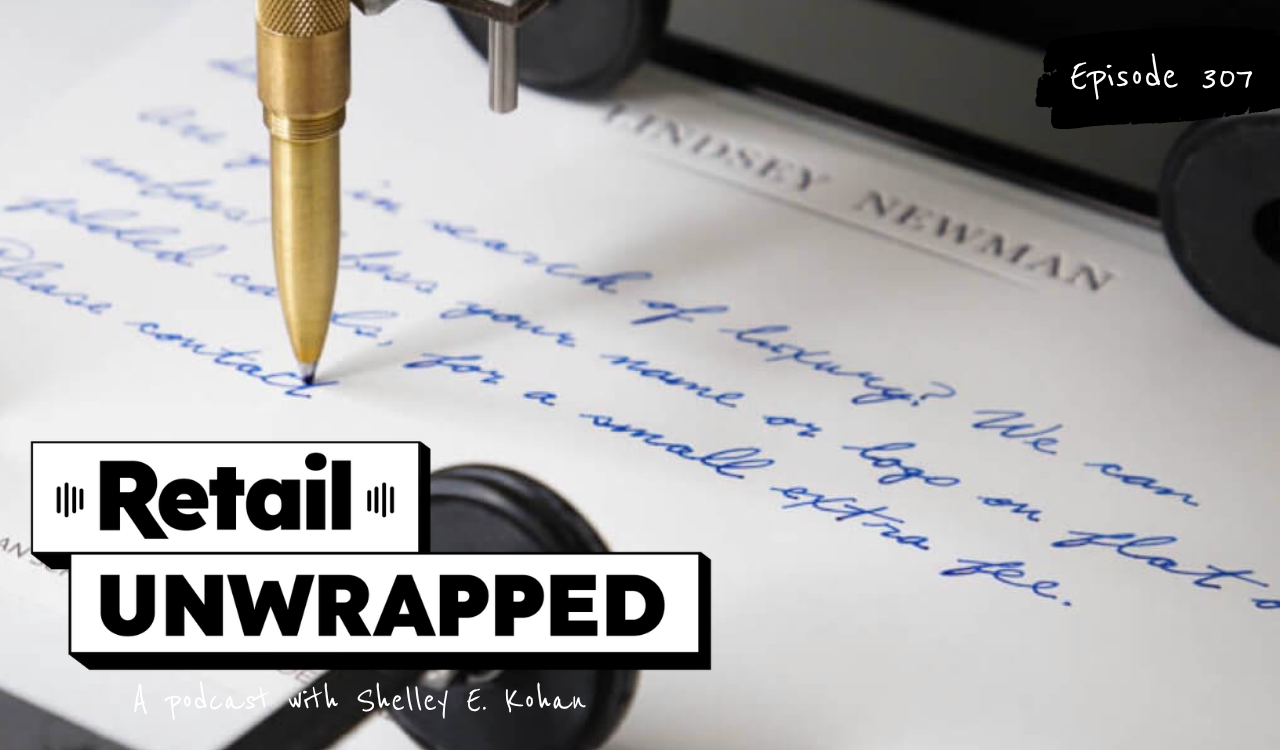

Membership points and convenience aren’t the same thing as loyalty. Starbucks found this out the hard way when their app went dark; customers didn’t wait in line for their order; they walked down the street to the competition. Join Shelley and David Wachs, founder of Handwrytten, as they reveal why personal attention beats personalization. They unpack what scalable tools retailers can use to keep customers feeling valued. Real loyalty is emotional, relatable and trustworthy; personalized tech tools could usher in the return of the lost art of handwritten notes…written and addressed in longhand by robots!
Special Guests
David Wachs, Founder of Handwrytten
Transcript
David Wachs (00:00)
given the the difference between a handwritten note, a printed note, a text message, email, SMS, we we measured them all. We said, what would make you most
compelled to go back to the store? Or or actually the question was, what would make you feel appreciated? And the number one answer was a handwritten note. And we said, if you did feel appreciated, what would you do?
Shelley E. Kohan (00:51)
Hi everybody and thanks for joining our weekly podcast. I’m Shelley Kohan and I’m very excited to welcome David Wachs who is you are literally a serial entrepreneur. You’re an expert in mobile marketing, mobile CRM, and building loyalty in a highly automated world. So welcome.
David Wachs (01:11)
Thank you so much for having me, Shelley. it’s a real pleasure.
Shelley E. Kohan (01:15)
That’s great. And your latest venture is super interesting to me because I love getting these in the mail. When I go shopping and I get one of these in the mail, I’m really happy. You have a company called Handwritten, written with a Y, and you’re bringing
David Wachs (01:29)
Mm-hmm.
Shelley E. Kohan (01:29)
back the la the lost art of letter writing through scalable robot-based solutions that write your notes in pen to customers, which is fantastic. You’re changing the way people and brands are connecting. So I love what you’re doing there.
David Wachs (01:46)
Thank you. Yeah. It’s we are now fourteen or sorry, twelve years old. So we’ve been doing this quite a while. And we’re actually the largest company in the world that does it. we’ve got about two hundred robots that write out notes in longhand. we then put them in envelopes, write out the envelopes and put a real stamp on them and mail them. And we do this for people all over the world now.
Shelley E. Kohan (02:13)
That’s great. So, David, I want to tell you a very quick story that you’re actually is actually gonna make your day. It’s gonna make you very happy. So I know when I get one of the notes that looks like it’s handwritten, I I love it, right? I know it’s not handwritten, but it looks handwritten. I love
David Wachs (02:28)
yeah.
Shelley E. Kohan (02:28)
it. There’s a couple companies I buy for well, I’m in retail, so
David Wachs (02:31)
Yeah.
Shelley E. Kohan (02:31)
I I kind of know, right? The backstory. But here’s the fun fact I want to share with you. I was talking to my son who’s Gen Z the other day, and I said, Hey buddy.
let me ask you a question. If you bought something and you got a thank you note that was written by hand, would you be impressed by that? You know what he said? Yes. Shockingly. I was surprised because Gen Z’s so, you know, into technology and everything, he said he would love that. So I thought that would make your day.
David Wachs (03:00)
Yeah.
well we have data to back it up. If you visit handwritten.com, again, h-a-n-d-w-r-y-t-ten.com and you click resources at the top, we put out a consumer research outreach survey where we surveyed 2,000 consumers back in 2025, so last year. We did it prior to that, I want to say in 2022 or 2023. And
what your son is saying is what people are saying is that
given the the difference between a handwritten note, a printed note, a text message, email, SMS, we we measured them all. We said, what would make you most compelled to go back to the store? Or or actually the question was, what would make you feel appreciated? And the number one answer was a handwritten note. And we said, if you did feel appreciated, what would you do?
And the it’s all the good things. It’s buy more, buy more frequently, rate and review more, tell friends about it. So it’s all the stuff that you as a retailer really want to see. and I think it’s because we are all and may you know if I’m going off the rails here, please tell me to r rein it in. But I think it’s because we are all sensory deprived and everything these days is on the screen in front of us. We can’t feel anything.
so that’s part of it. And then the other part is I think what people really crave is not personalization. Personalization doesn’t mean anything. Everything is personalized. Every email you receive is personalized. Hey, when you log into a website, it says, you know, thank you for logging in, Shelley. You know, big deal. What people want
Shelley E. Kohan (04:48)
Right.
David Wachs (04:49)
is personalized attention or personal attention. And that handwritten note gives the impression.
that you sat down and spent four to five minutes writing a handwritten note specific to them. And when you were doing that, all you could think about was them, because if you thought about other stuff, you’d screw up your note. And I think that personal attention is what really people crave. It’s not personalization.
Shelley E. Kohan (05:17)
I
love that distinction between the two. And today our topic is something you’re an expert in, and that’s really building customer trust in an AI-driven world. And specifically, we’re gonna talk about some CRM stuff. And
David Wachs (05:30)
Yeah.
Shelley E. Kohan (05:31)
you know, when I think about CRM and loyalty, I’m gonna bring up a company that we’re gonna talk about in a second, Starbucks. So Starbucks used to be like back in the day, Starbucks was the longtime leader in building customer loyalty, in fact.
The mobile app, you may not know this, but here’s a fun fact about retail. That Starbucks, the Starbucks mobile app was the catalyst for mobile payments in the United States finally gaining traction. So mobile payments never went anywhere, never went anywhere. As soon as Starbucks allowed payments, all of a sudden all the mobile payments went crazy because of the loyalty program and being able to pay in the app.
And Starbucks now has, I think, close to 36 million active members, which is kind of crazy. And it drives fifty-seven percent of its total US revenue. So loyalty is a big, big deal there. And the crazy statistics are the members that are part of this loyalty program visit stores five point six times more than the non-members. And this is the craziest stat of all.
Those super super loyal customers, those top ten percent, they’re visiting Starbucks twice a day. Twice a day. That’s just insane. So we are gonna start with talking about the big app fail that Starbucks had. You’re gonna tell us a little bit about that. But also I just wanna remind our listeners quickly that Starbucks had major outages before. They had one in 2023, 2024.
twenty twenty five and the most recent one. So tell us what happened and in your opinion, what was the bigger fail than the app going dark?
David Wachs (07:24)
Yeah, so th to my understanding the the Starbucks app was not functioning, which led people to not being able to place their their orders in advance. And this happened a few weeks ago. and because they couldn’t place their order in advance and pay in advance, they were you know, they either had to go somewhere else, which is where a lot of these people did, or they had to wait in line and they weren’t planning on that because
It’s very different to go and pick up your your s your Starbucks coffee from the pickup window versus having to wait in line and do it. you know, the the the issue that I think Starbucks faces, which is not unique to Starbucks, is they think they have loyalty when what they really have is kind of a trade-for-point system, where whether it’s actual points or in this case convenience.
they’re not really building loyalty. It’s just they have this convenient way of people buying their omnipresent coffee. In other cases, it could be you’re part of a loyalty program, and what do you get? You get these points. But as soon as you stop getting the points, you’re not loyal anymore. So were you loyal at all? You know, that’s that’s the question.
Shelley E. Kohan (08:39)
Yeah.
David Wachs (08:40)
Is is is it actual loyalty or is it I don’t know what you call it? It’s really just a mechanism for
buying your customers through points or buying your customers through you know through the convenience factor. Now the convenience at Starbucks is real and what would you do about it? And it’s difficult. You know, I used to build these apps and it’s not like when the app goes down, Starbucks often doesn’t have the the cell phone numbers of these people because they communicate over push notification. So you
Shelley E. Kohan (09:14)
Right.
David Wachs (09:14)
can’t
You can’t notify them that the app is down. You might be able to email them actually, but you won’t be able to send them a push notification. You can’t send them a text message. You could probably email them and let them know the app is down, and then send them with that email a a link to their last three purchases and say, just simply click one of these, we’ll have it ready for you. So I think they do need to come
Shelley E. Kohan (09:42)
But no one no one’s
no one’s reading their email. Like they’re on the app, they want their coffee, they’re not gonna be looking at their email,
David Wachs (09:45)
I know. I know.
Shelley E. Kohan (09:48)
they’re not gonna say, I wonder if Starbucks is eat but like what’s amazing about this whole story is you would think that the consumer would just suck it up and wait in line, but they didn’t. They
David Wachs (09:59)
Yeah, they went elsewhere. Yeah.
Shelley E. Kohan (10:01)
they just they just skipped it.
David Wachs (10:03)
Yeah. So there’s no real loyalty, right? It’s not a loyalty thing, it’s a convenience thing. And I get that. And it creates an opportunity for Joe Joe coffee down the street to to get a piece of that. so yeah, and then the question is after this outage, if all these users were exposed to other coffee brewers, will they end up going there instead moving forward? Probably not. They’ll probably end up back at Starbucks because the ease of the ease of the experience. but I think
You know, the bigger issue is really defining a true loyalty system, not just one that relies on bribery and making things super, super convenient. But how do you actually build loyalty so that it’s durable during these down cycles, right? Like so that the clients will come back and they are willing to wait in line the one time that the out the app goes down this year.
Shelley E. Kohan (10:58)
I
think the other thing that you may have a point of view on also is that you have these high frequency touch points that kind of outsize everything else. And the Starbucks app I think is an example of that, no?
David Wachs (11:11)
Mm-hmm.
Absolutely. I mean, they’re they’re not talking to the person behind the counter at Starbucks anymore. They’re just placing the order in the app. And so, you know, it’s funny you were talking about your son and him wanting things physical. These people, they don’t even want to look up from their phone to to place their order. So yeah, it’s really tough when that’s your only channel. And I think y you
It it’s real tough. Like I don’t know I’m a terrible guest here because I think, you know, you need to cater to that. You need to cater to their their their desire for a a frictionless transaction, but you also need to build the the true loyalty where they’re willing willing to weather just an ounce of friction on the day that things don’t go appropriately. Because unfortunately stuff happens in every
every company with every website and every app. So I I think the true answer is trying to build a more robust loyalty program than one that simply relies on convenience or points.
Shelley E. Kohan (12:20)
Right. And so how can retailers and brands we want to leverage AI to kind of boost this customer experience and loyalty and retention, but we also want to make sure it doesn’t feel over robotic, so to speak. So there’s
David Wachs (12:34)
Yeah.
Shelley E. Kohan (12:34)
a time and place for, you know, super robotic, which is, you know, and this is the last time I’ll bring this up. The Starbucks app, super efficient, right? It’s all about
David Wachs (12:43)
Mm.
Shelley E. Kohan (12:43)
efficiency. but what what can retailers and brands do
to make sure that they have the right offer, right channel, right moment with their customer base.
David Wachs (12:56)
Yeah, I think one thing they can do is build a a real multi-channel preference center. So what I mean by preference center is allow people to opt in for all sorts of different communication. And they can surface this right in the the the Starbucks app. So ask clients, you know, do they want to receive emails? in the event that the Starbucks app goes down, can we send you a text message? Would you like to receive a note occasionally, a handwritten note?
with maybe an offer, you know, as on your birthday. And then once you build out this holistic preference center, you can really d kind of determine the the the four C’s around it. Contents, the contents of the message, the channel, the cadence, and then the final one is is really community. You know, is there a communal aspect to that that content? So really thinking about multi-channel marketing, not just pushing another
Push notification to the Starbucks app and trying to kind of build a holistic approach around that is one way to kind of improve loyalty. Another thing you can do is try to boost loyalty through exclusivity. So there you could either have a special event for your best Starbucks clients. I keep using Starbucks just to kind of, as they’ve had such a tumultuous period.
But you know, you could have a special event or special drinks that are kind of off menu, kind of follow the in and out model there and make those only available to Starbucks. Now, Starbucks is all about personalization. So maybe you give them a few additional ways to personalize or or something something like that. but I think there’s ways to use exclusivity that make people people feel really seen and heard and and
kind of improve loyalty that way too.
Shelley E. Kohan (14:54)
Yeah,
Nordstrom’s does a great job
of that. So Nordstroms has their anniversary sale, which just ended, but
David Wachs (15:00)
Mm-hmm.
Shelley E. Kohan (15:01)
that’s like the you know, you get exclusive access to fall goods early at a lower price. So
David Wachs (15:06)
Yeah.
Shelley E. Kohan (15:07)
there’s lots of that and events we’ve seen a lot of different retailers do that as well. So going back to what you said about the you know four C’s, so one thing
David Wachs (15:17)
Yeah.
Shelley E. Kohan (15:17)
I don’t see happening, David, is I don’t see because consumers they don’t want to put
effort into it this I want to call it personalization, but you call it personal intent. They don’t want to put effort into it. Like I don’t see them going through and and going through all these different profiles with every retailer or brand. I want this, I want that. Is there a way where automation can kind of figure me out and decide when I wanna get an email and when I want to use the app and when I want to do drive by and pick up and
Is there a way that we can somehow automate that? Can retailers do that behind the scenes?
David Wachs (15:53)
Well absolutely.
yes, I think using data science you can absolutely try to pinpoint not pinpoint but broadly find broad strokes and when people are are most most prone to interact and and surface
messaging then. I also think you can use the channels they’ve already opted into to lightly nudge them to opt into other channels. So as opposed to just popping up a
Shelley E. Kohan (16:19)
yeah.
David Wachs (16:19)
big preference center, maybe you’re using the Starbucks app one day and it says you know, a little thing pops up and it just says, in case we lose you here, can we have your cell phone as a backup? And then so it doesn’t feel like a huge lift where you have to fill out a big form. I think that’s a great way to do it too. We’ve also
when I was doing the text messaging company, I was working for a a big a a very large retailer, and we said use client surveys as an opportunity to get people to opt-in. So what I mean by this and getting them to do this is going to be difficult. Not everybody’s gonna want to do a survey, but you can say in the survey, you know, do you think do you think people would want to receive
le you know, text messages in the case of an early access to a sale. And then if they say yes, at the end of that say, you know, would it be possible for us to get, you know, would you like to join that right now? So you can use these opportunities and basically say, we want your opinion. And then when you get their opinion, you also get them to opt in. It’s a little sneaky, but we’ve seen it being used in the past. There’s there’s really a lot of and then or you could use sweepstakes and other
enter to wins to collect this information, then say, can we also reach out to you from that too? Because, you know, consumers, I think because we’re being barraged by so much
Shelley E. Kohan (17:49)
Yeah.
David Wachs (17:50)
content these days, you know, you’re swiping through your phone and every 15 seconds you’re reading another message. And then 15 seconds later you forget what you’ve read or watched. You know, I c I can’t remember anything that I just saw on Instagram. we’re all so short attention spanned here that you really do need
To opt into multi channel to be able to fully understand that customer and for them to understand you too, you know. So
Shelley E. Kohan (18:15)
It’s it’s so true.
And I have to say, so now I’m I I know a lot of people are going through this. Now we’re doing the all these authenticators. Now your bank’s doing authenticator, your company, your email.
David Wachs (18:27)
yeah. Multi factor. Yeah. Yeah.
Shelley E. Kohan (18:31)
So now it’s worse than it’s ever been. Like I used to be able to put my phone away, but now I have to make sure I have it with me everywhere I go because I’m having to do this authentication. So I think the pushback here is gonna be
what I call digital detox is consumers are just gonna like they just wanna get away. They want to run away from their technology or their phone. So I
David Wachs (18:54)
Yeah, yeah.
They that’s why we’re here. That’s why my company and I’m not on this on your your show to to talk about handwritten with a why. I’m here to talk about handwritten with an I because I think handwritten notes have outsized returns nowadays and more so than ever, thanks to all the AI slop, you know. there’s so much mass personalization, I’ll call it, and
just pure content because sending emails are free or basically free. So why not just send a trillion of them at you every day? And what that ends up with is email fatigue and nobody pays attention to any of it or Instagram fatigue, whatever. So that’s why I think showing your clients they really matter by doing something that seems unscalable is really kind of important. And that could be sending
Shelley E. Kohan (19:50)
Yeah.
David Wachs (19:50)
a handwritten note. That could be
having again having an an an early access event, picking up the phone and calling, although from our survey we find that yes, phone calls are the most personal. They also run the risk of being the most annoying. So you have to be very, very careful if you are calling your your clients to check in on them. and it’s also hard to do at scale, you know, how how to make it a non-annoying experience and really don’t turn them
Shelley E. Kohan (20:18)
Yeah.
David Wachs (20:19)
off. so
Shelley E. Kohan (20:22)
So
we’re heading into holiday, which is
David Wachs (20:24)
Yeah.
Shelley E. Kohan (20:24)
one of the biggest profitable parts of the year for retailers for sure. And so you can’t really
David Wachs (20:28)
Yeah.
Shelley E. Kohan (20:31)
think about implementing something, you know, super significant right now because we’re headed into the season. What is something that you think, you know,
David Wachs (20:38)
Yeah.
Shelley E. Kohan (20:40)
mid sized retailers, what can they do today to really impact holiday?
David Wachs (20:47)
I think a few things. I think number one, you can get ahead of it and not I mean, obviously you need your you know, BFCM, your Black Friday Cyber Monday, but you could also have a sale a couple weeks in advance and try to get ahead of it that way. We have a lot of clients at handwritten that don’t send holiday cards, they send Thanksgiving cards, or they don’t save send Thanksgiving cards, they send
Valentine’s Day cards after. So they’re they’re trying to get away from the noise of everything
Shelley E. Kohan (21:21)
Yeah.
David Wachs (21:22)
happening on one day. Now, obviously, BFCM is super important and you have to hit that hard, but you could also try to extend it, whether it’s through early access to BFCM or just calling it our pre-Thanksgiving sale, whatever whatever that is. Now I know that’s an old tactic, but but it is something we’re seeing. The other thing we are seeing is
We’re seeing these kind of micro sales that are very specific and tailored to a again, a demographic. So you know, David, we’ve set aside these five items for you. And yes, it’s kind of mass personalization, but it still does, it still has value. we have clients that send handwritten notes to their top 20% of clients with a unique coupon code in them.
They know that they’re only going to get that coupon once a year. That’s the their handwritten note from the CEO campaign. Those coupon codes see a 20% redemption. and these handwritten campaigns are super easy to implement. if you use a company like us, I’m not gonna say you have to use us necessarily, but they’re easy, they’re easy to implement. we are seeing kind of these just these multi-channel programs. It’s nothing, it’s it’s nothing super new, but
having the Thanksgiving cards go out instead of the happy holiday cards is a big one these days.
Shelley E. Kohan (22:47)
I think the other thing
you mentioned, ’cause it always works with me, and American Express does this really well, is even even they send the unique here’s your unique code. Like it makes people
David Wachs (22:57)
Yeah.
Shelley E. Kohan (22:58)
feel special, right?
David Wachs (22:59)
Yeah. Yeah, we you know, y it could even be yeah, that’s unique code that we include on the card. We can and and and others do it as well where you’ll like sticky glue a little card in there, so it’s like a gift card that you get with your name on it. You know, that gets expensive and for most retailers it’s not worth it, but but you s if you’re American Express it certainly is. So you can you can do things like that as well. you know, there there’s
I think you just have to honestly just try to differ differentiate if everybody else is sending email, email, email, what are you doing that’s different? And I think if you have a an actual physical store having some special hours just for your best clients is a great way to go. Early access to the deals, early access to the products. In the case of Starbucks, it could be
you just have, you know, you’re coming out with this drink, this Frappuccino in a week, but just give them that access to that specific Frappuccino early. There’s a lot of ways to make people feel like they are special. And that’s, you know, that’s what everybody wants these days.
Shelley E. Kohan (24:05)
Definitely.
So going beyond holiday, what should
David Wachs (24:09)
Yeah.
Shelley E. Kohan (24:10)
brands and retailers be thinking about heading into twenty twenty seven with everything that we just talked about, with all this automation, all this,
David Wachs (24:17)
Yeah.
Shelley E. Kohan (24:18)
you know, mass personalization, you know, what should we be doing going
David Wachs (24:21)
Yeah.
Shelley E. Kohan (24:22)
into the next year?
David Wachs (24:24)
I think they need to think about mass personalized detention. and g getting physical again. Obviously I’m biased, that’s what I do for a living. We get physical through handwritten notes, but though those those opportunities to provide personalized detention, I think I think is what’s making the difference.
Shelley E. Kohan (24:44)
Awesome. Any closing thoughts you’d like to share with our listeners?
David Wachs (24:51)
yeah, I I think, you know, everybody is so focused on getting the next clients and building that dashboard showing new client acquisition and customer acquisition and email growth rate. You know, let’s let’s build our email list so we could spam the heck out of them. But what they’re not paying as much attention to is the
the leaky hole on the bottom of their bucket, which is client churn and customer churn. And if you’re able to make that customer feel really special, whether it’s through any of them the the means that we spoke about today, you’re able to get so much more value out of those clients that otherwise would have churned out or would have stuck with you, but would have just waited for the next sale. And if you can
tr build true loyalty with them and show, you know, show why you deserve their loyalty, they will withstand those moments of your app being out, or they will buy from you without a point in return, you know, loyalty point in return or a sale. So I think there’s true opportunity to build stronger, more dura durable relationships that don’t rely on points and convenience, but
But our you know, true loyalty. Now obviously points and convenience are a part of that, but but you need more than that to have true loyalty.
Shelley E. Kohan (26:21)
And I think, David, I think the most important element that you mentioned is more important today and next year than ever before, and that is reducing the churn and the retention. Because as agentic commerce gets bigger and bigger and bigger, I feel there’s going to be a big drop in loyalty because agentic commerce is going to be the ones picking, you know, the products and services for consumers. So I do think that is a great solution for.
Retailers and brands to really focus on in the next year.
David Wachs (26:53)
Yeah, I well I think AgenTic is gonna kind of continue the commoditization of I I hate to say it commoditization of commodities. What do I mean by that? Well, I think like if you go on Amazon, it’s very different today than five years ago. On five years ago there were brand names on Amazon. Now when I go on Amazon, it’s just a bunch of letters. It’s just it’s just a bunch of letters. The the names of these companies are Chinese just letter farms.
And you don’t, you know, the product is okay, the product’s good, but you’re not buying from a company. It’s been fully commoditized. I think the same thing is is going to continue through agentic commerce. However, those products that really matter to people, whether it’s an article of clothing or a picture frame or jewelry or whatever it is, people will really want to buy from companies they know and trust and not just a race to the bottom on price.
So I I think you know, it’s really important to continue to build these experiences and build loyalty. Additionally, as I mentioned at the beginning, before getting started, if you are fighting on price and you are in this agentic battle of, you know, against the rate, you know, on the race to the bottom, ratings and reviews are super important. And if you can follow up after an experience, whether that’s after a bad experience,
And try to turn that bad one into a good one, which is a whole nother conversation I could talk to you about. But if you were to send them a handwritten note or do something to win their loyalty then and get some great ratings and reviews, those ratings and reviews are gonna really put you a leg up on the agenda commerce front. And then certainly if you just have a good experience and you do something different to set yourself apart from the pact, again, it’ll get you ratings and reviews, which will help you filter to the top on I agenda commerce. So
I do think these little touch points are are very important, maybe more so in this day and age of of AI.
Shelley E. Kohan (28:54)
Well, thank you, David. It’s been
a pleasure having you here.
David Wachs (28:58)
Thank you, Shelley. I appreciate it.