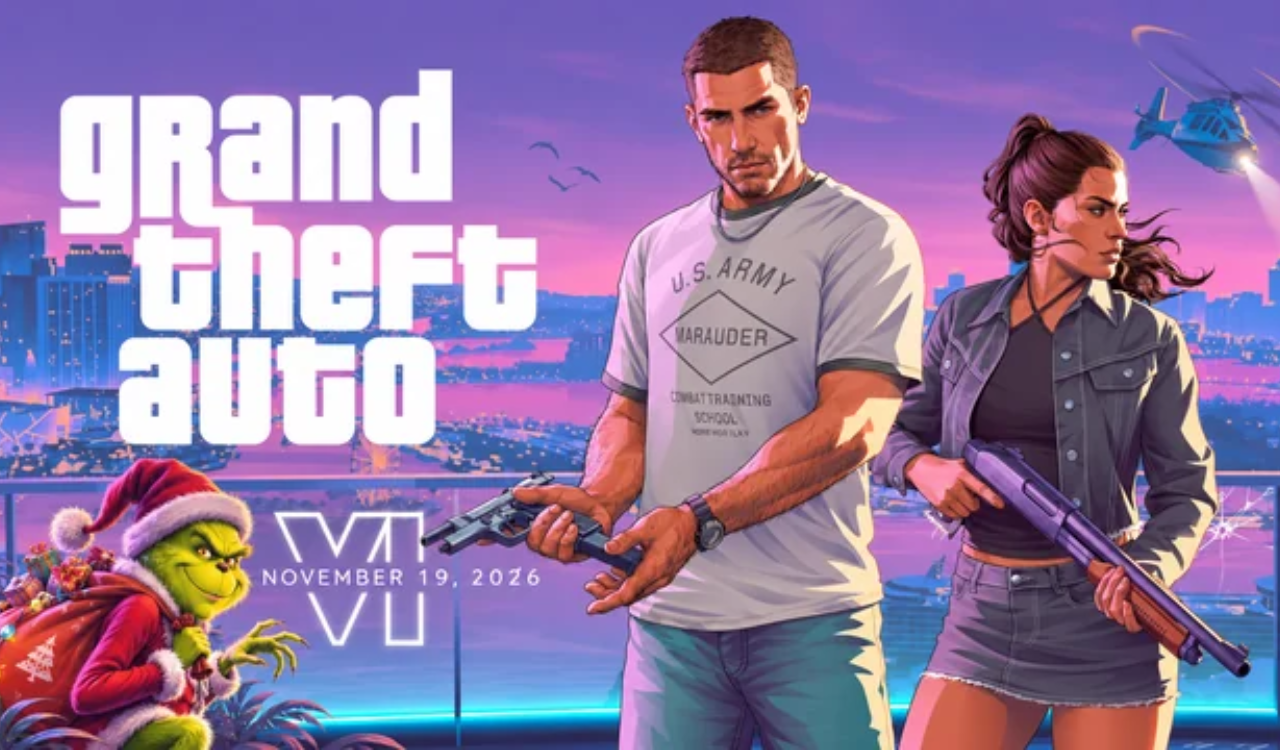

Image generated by AI
According to Deloitte’s 2026 Holiday Retail Survey, American households expect to spend an average of $1,654 this holiday season, even as 79 percent anticipate higher prices. Christmas is coming early this year for Rockstar Games. And for Sony, Microsoft, Best Buy, GameStop, and even Uber Eats, the holiday season could turn into an unexpected bonanza. But for thousands of other American retailers already struggling against economic headwinds, this Christmas could get downright ugly.
What’s the expectation for GTA 6? And the answer is: The new release is expected to divert the spending and attention of holiday shoppers at the expense of retailers.
Grand Theft
On November 19, just eight days before Black Friday, Rockstar will unleash Grand Theft Auto VI, arguably the most anticipated entertainment release in history. And while millions of Americans prepare to spend countless hours committing virtual crimes across Leonida, Rockstar’s sprawling, Florida-inspired digital universe, the company may be preparing to pull off the biggest real-world retail heist of the holiday season.
The potential loot? Billions of dollars in consumer spending that might otherwise have gone toward clothing, jewelry, toys, home goods, and other traditional Christmas purchases. But the economic tidal wave won’t stop with the game itself. From gaming consoles and televisions to accessories, food delivery, and countless other purchases, GTA 6 could redirect billions in spending, creating spectacular winners and potentially devastating losers.
The Grinch Is Picking His Victims
The numbers surrounding GTA 6 are staggering. According to Sensor Tower estimates reported by The Washington Post, the game had already generated more than $1 billion in estimated digital preorders before its release, representing more than 10 million copies sold. Approximately three-quarters of those preorders reportedly came through PlayStation, suggesting Sony could be particularly well positioned to benefit from the launch. The standard GTA 6 edition retails for what is, in my opinion, an accessible $79.99, while the Ultimate Edition costs $99.99. According to Reuters’ November 9 reporting, Sensor Tower estimated that nearly 90 percent of preorders through late August were for the premium version. Think about that. While conventional retailers battle increasingly price-sensitive consumers with promotions and discounts, GTA 6 customers are voluntarily paying a 25 percent premium for a product they haven’t even played. The lesson is unmistakable: consumers may be cautious, but they’ll still spend aggressively when they believe something is truly worth it.
And that may be just Rockstar’s opening act. Gaming investment firm Konvoy projected in July 2025 that GTA 6 could generate $7.6 billion in global revenue during its first 60 days. It’s an aggressive forecast, and one that other industry analysts have questioned. But consider its implications: James Cameron’s Avatar, one of the most successful films ever made, has earned approximately $2.9 billion worldwide since its release in 2009. If Konvoy’s forecast proves accurate, GTA 6 could generate the equivalent of nearly three Avatars in just two months. And that’s only the beginning. Additional game sales, in-game purchases, virtual currency, premium content, and related hardware could ultimately push its cumulative economic footprint into the tens of billions of dollars.
Now consider the American market. When GTA V launched in 2013, Take-Two’s annual report showed that 47 percent of the company’s fiscal-year revenue came from the United States, with the rest generated internationally. Although those figures reflect Take-Two’s overall business rather than GTA V alone, applying a similar geographic split to Konvoy’s projection would imply approximately $3.5 billion in American consumer spending during GTA 6’s first 60 days.
All this raises a question that should be keeping every retail executive awake at night between now and Christmas: When consumers suddenly find billions of dollars for a video game, what are they choosing not to buy?
The GTA Tidal Wave
The economic shockwave will extend well beyond GTA 6 itself. The game won’t run on older PlayStation 4 or Xbox One consoles. Its initial release is limited to PlayStation 5 and Xbox Series X|S, forcing gamers who haven’t upgraded their systems to spend hundreds of dollars on new equipment if they want to participate. And the hardware isn’t cheap. According to Circana, the average PlayStation console purchased by American consumers during the first eight months of 2026 cost approximately $597. Sony’s premium PlayStation 5 Pro commands around $900. Add the $79.99 GTA 6 standard edition, controllers, headsets, or additional storage, and a seemingly modest entertainment purchase can become a $700 to $1,200 investment. Throw in a larger television or gaming monitor, and the spending climbs even higher. The arithmetic is eye-opening. If a million American consumers purchase a new $600 console primarily because of GTA 6, that’s another $600 million in hardware sales. Add accessories and other upgrades, and the secondary economic impact could stretch into the billions.
The tidal wave may already be forming. In September, U.S. PlayStation 5 unit sales increased 22 percent year over year, while hardware revenue surged 43 percent, according to Circana data reported by Bloomberg. GTA 6 anticipation is clearly contributing to the upgrade cycle, alongside higher hardware prices and demand for premium consoles. And then there’s this spoiler alert: In October, gaming publication Video Games Chronicle reported that GameStop was listing pre-owned PS5 Pro consoles for $1,399.99, approximately $500 above the new-console price because the new ones were out of stock. The listing wasn’t proof that consumers were actually paying that much, but it illustrated how unusual the hardware market has become.
For Best Buy, Walmart, Target, and GameStop, GTA 6 could be an extraordinary windfall. For furniture stores, apparel chains, toy stores, jewelers, and other traditional retailers competing for the same discretionary dollars, the outlook is considerably less festive.
The Grinch Steals Time
Not everyone believes GTA 6 will meaningfully cannibalize Christmas shopping budgets. Michael Bismuth, co-founder and Lead AI Director of Miami-based creative studio cuz., argues that retailers may be focusing on the wrong threat. “I think the retail impact is overstated, and retailers are worrying about the wrong thing. GTA 6 won’t steal Christmas budgets; for millions of families, it is the Christmas gift. One game at a fixed price doesn’t empty a wallet. What it does steal, however, is attention. Weeks of evenings that used to go to scrolling, browsing, and shopping online will go to Vice City instead. So, the real threat isn’t to sales; it’s to visibility.”
It’s an important distinction. Retailers aren’t merely competing for disposable income. They’re fighting for the hours consumers spend browsing, comparing products, discovering brands, and making purchases. And GTA 6 threatens to monopolize that attention precisely when retailers need it most. Every hour spent roaming Vice City is an hour potentially not spent browsing Amazon, visiting a mall, or discovering the next holiday must-have. For retailers, that represents competition considerably more formidable than another store’s Black Friday discount.
A Selected Bonanza
Of course, GTA 6 won’t be bad news for everyone. Some families will purchase the game as a Christmas present. Others will buy consoles and accessories in addition to their planned holiday gifts. And the game’s impact could ripple into industries that seemingly have little connection to gaming.
Uber Eats, DoorDash, pizza chains, snack manufacturers, and energy drink brands could benefit from consumers spending extended periods at home. Streaming services, meanwhile, may lose viewing time as gamers abandon Netflix or Disney+ for Leonida, illustrating how the GTA phenomenon could create winners and losers far beyond electronics.
The GTA tidal wave may also extend far beyond Christmas 2026. Its predecessor, GTA V, has sold more than 230 million copies worldwide since 2013. If GTA 6 eventually sells 230 million copies at a hypothetical average selling price of $90, that would represent $20.7 billion in cumulative consumer spending on the game alone. And that’s before in-game purchases.
GTA Online has demonstrated how consumers can continue spending on virtual currency, automobiles, properties, weapons, clothing, and other digital merchandise long after purchasing the original game. Take-Two reported in November that recurring consumer spending accounted for 81percent of its quarterly net bookings across its entire gaming portfolio. Bismuth believes retailers should embrace the cultural moment rather than compete against it. “The smartest retailers won’t fight GTA 6, they’ll borrow its culture. The game is a love letter to Miami: neon, sunsets, excess. Expect that aesthetic everywhere this season, from fashion drops to holiday campaigns. The brands that ride the moment will win. The ones that compete with it will be invisible.”
Rockstar’s Ultimate Heist
The game launches on Thursday, November 19, right before a weekend and just days ahead of Thanksgiving. As The Wall Street Journal reported, some fans are even saving vacation days and rearranging work schedules to play. When GTA 6 arrives, headlines will focus on shattered records, massive downloads, and millions of players finally entering Rockstar’s new digital universe. But the bigger retail story may unfold quietly: a sweater that doesn’t get purchased, a watch that stays in the shopping cart, or a Christmas gift gets downgraded because someone just bought a PlayStation.
Individually, these choices won’t make headlines. Collectively, they could redirect billions in spending across the retail economy. For companies riding the GTA tidal wave, Christmas 2026 could be spectacular. For traditional retailers already fighting over every discretionary dollar, the timing could hardly be worse.