
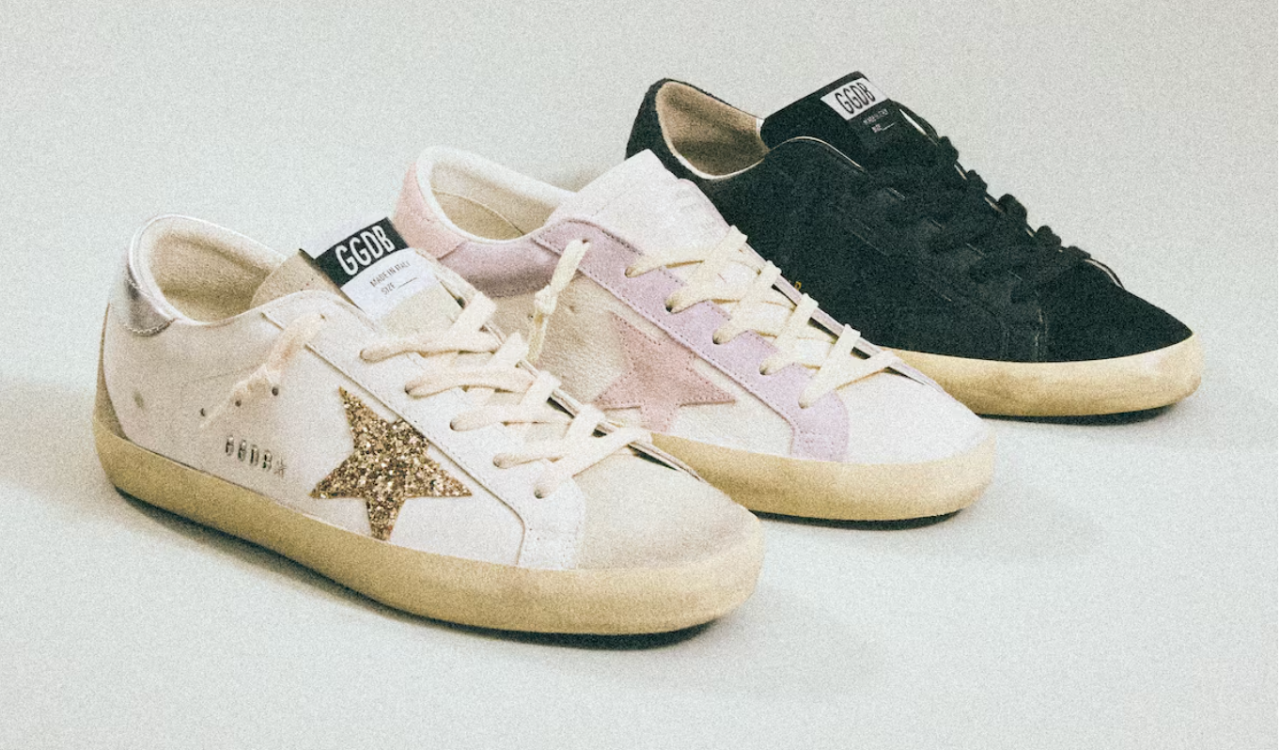

Sneakers are losing some of the cachet they enjoyed when buyers were willing to pay hundreds of dollars for limited editions on resale platforms such as StockX. Remember the Nike Air Force 1xTiffany & Co. drop? But sneaker culture remains integral to contemporary style; it’s just that the likes of Nike have lost their footing, replaced by challenger brands that offer both authenticity and distinction. One growth opportunity emerges as consumers across generations are willing to pay more than $500 for the Star logo that comes with a pair of Golden Goose sneakers.
Golden Goose occupies a white space between a $150 premium Nike and a $1,000 designer sneaker from Dior, bringing luxury craftsmanship to a category dominated by sportswear. This appeal is reflected in data from McKinsey & Co., which found that 68 percent of U.S. luxury consumers believe newer or disruptive brands better reflect their identity. My TRR colleague and next gen expert Jasmine Glasheen adds, “In a fashion world inundated by maximalism and neon graphics, Golden Goose’s vintage aesthetic feels like a love letter to good, old-fashioned craftsmanship. Next gen consumers who are thirsty for dependable products can’t get enough of this high-ticket, high payoff sneaker brand.”
Is Golden Goose still a go-to brand for Gen Zs? And the answer is: It hits all the marks of personalization, vintage craftsmanship and cool…at a collector’s price.
Golden Goose Crushes the Sneaker Market
Golden Goose was founded in 2000, yet it ticks many of the boxes associated with a legacy luxury brand. The “perfect imperfection” hallmark of its sneakers encompasses innovation, creativity and uniqueness that are central to its brand’s identity. The individually distressed finish is a distinctive reminder that no two pairs are exactly alike. Yet the brand also celebrates the traditional luxury values of craftsmanship and provenance, with each pair requiring more than four hours to craft by hand in Italy. This high standard associated primarily with Italian luxury handbags has been meticulously adapted to the sneaker category.
As luxury brands struggle to regain relevance in an unpredictable marketplace environment, Golden Goose has cemented its status as a disruptor brand. Group revenues increased from €266 million in FY 2020 to €734 million in FY 2025. There are few signs of slowing momentum. In the first quarter of FY 2026, the group reported net revenues of €173.2 million, an increase of 10 percent compared to the same period of the previous year. Its EBITDA margin of 31.9 percent is an indicator that the pricing power continues to match brand desirability.
Next Gen Luxury Code
Golden Goose describes itself as a “Next Gen global luxury company,” a positioning that aligns with broader shifts in luxury consumption. A U.S. study found that intrinsic experiential value, personal fulfillment, and sustainability are among the most important factors influencing consumers’ willingness to engage with emerging luxury brands. Glasheen says, “Golden Goose’s Instagram presence shows exactly how they cut through the noise to reach next gens. Images are product-focused with a vintage feel, usually featuring a single product, retail location, or maker in each image. With 1.7 million followers and counting, Golden Goose’s success is a lesson for brands to refocus on craftsmanship.”
Golden Goose’s co-creation experience enables its brand followers to collaborate directly with artisans. While mass customization programs such as Nike By You are nothing new, Golden Goose’s “Made Of Life” concept goes a step further by integrating personal memories into the design process. The approach reinforces the values of craftsmanship, individuality, and emotional connection that increasingly define luxury today.
Kantar’s Retail Reveal study found that 51 percent of Gen Z consumers want to hear from creators rather than marketers. Golden Goose’s Dream Makers serve as that bridge between the brand and the consumer, adding authenticity to the customer experience. In a similar vein, repair has become an important component of sustainability messaging across the luxury sector. The difference is that Golden Goose adds an emotional dimension to what is often a standardized service: “We take care of your memories and the signs of wear, preserving the history and character of your sneakers.” Glasheen adds there is another angle to sustainability: “The brand is a great example of how value perception has changed. Rather than seeking out sneakers with a fast fashion price tag, Golden Goose gives next gens investment pieces that stand the test of time. The value of the sneakers is per wear, rather than the initial price tag.”
Community Brand
Golden Goose is deeply rooted in communities built on authenticity and shared values. The New Desires study, conducted by Kantar and Altiant, found that 84 percent of young luxury buyers view luxury as an immersive experience rather than a possession. In this context, Golden Goose is not simply a sneaker brand but a community brand with more than 2.5 million so-called Dreamers.
The strength of that community is clearly evident, given that the Direct-to-Consumer channel accounts for 81 percent of the company’s revenues. In other words, the brand’s story is not communicated through corporate messaging but through its “Golden Manifesto,” brought to life through direct engagement across a network of 232 stores.
Next Chapter
Is Golden Goose’s success sustainable? Sneakers are the entry point to a broader brand universe as Golden Goose has extended its assortment into apparel and accessories. However, the growing popularity of the brand, coupled with the proliferation of counterfeits, needs to be strategically managed. Niche cool can quickly become mass cool and, eventually, uncool. Supreme is a textbook example of how easily a brand can lose its edge.
Golden Goose is preparing for its next phase of international expansion. Chinese investment firm HSG has recently become the majority shareholder, joined by Temasek as a minority investor, while Permira remains a strategic shareholder. Marco Bizzarri (former Gucci CEO) has stepped in as non-executive chairman, while Silvio Campara remains CEO, potentially giving Golden Goose jet propulsion into long-term international expansion. The next chapter will reveal whether Golden Goose can scale globally without losing the desirability that has given its sneakers iconic status.