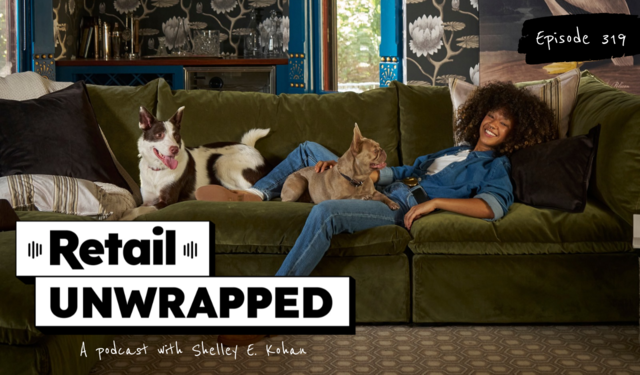

The home furnishings industry has spent five years struggling, and most of the industry is still waiting for the housing market to recover and bail it out. Lovesac isn’t waiting. Join Shelley, Shawn Nelson, Founder and CEO of Lovesac, and Kristin Cella, Associate Chairperson of the Home Products program at Fashion Institute of Technology, as they review the home industry through the filter of today’s consumers. People are cocooning, not selling their homes, and want furniture that reflects their evolving taste. Shawn discusses the company’s counterintuitive purpose: to inspire people to buy better stuff so they can buy less stuff, which rejects the usual growth playbook. Learn how Lovesac builds products to evolve alongside its customers, which explains why his fans are so loyal, and why the company keeps innovating while the rest of the category is stalling.
Special Guests
Shawn Nelson, Founder & CEO, Lovesac
Kristin Cella, Associate Chairperson of the Home Products Development program at Fashion Institute of Technology.
Transcript
Shawn David Nelson (00:00)
we’re a real products company at a time when it’s less sexy to be a real products company. Yet even the AI, you know, trillionaires come home and sit on a couch. So we’re we’re proud to be at
Kristin Cella (00:12)
Ha
Shawn David Nelson (00:12)
the epicenter of where life happens and we like to think that we’re we’re we’re doing it best.
Shelley E. Kohan (00:39)
Hi everyone. Thanks for joining our weekly podcast. I’m Shelley Cohan and I am thrilled to welcome Sean Nelson, founder and CEO of Lovesac. So we are thrilled to have you here. Sean, you actually started the company in 1995 and you grew it from a beanbag to a sectional and design for life company platform. So welcome.
Shawn David Nelson (01:04)
Thank you. Great to be here. It’s fantastic.
Shelley E. Kohan (01:07)
We also have with us Kristen Sella. She’s the associate chairperson of the home products program for Fashion Institute of Technology. And she actually comes from the industry, and you have a background in home furnishings and buying, e-commerce, merchandising, global sourcing, and on and on. So we are thrilled to have you here as well.
Kristin Cella (01:29)
Thanks, I’m excited to be here.
Shelley E. Kohan (01:32)
And I I think FIT has the only home products program in the country, correct?
Kristin Cella (01:38)
Yes, that’s correct. Very special.
Shelley E. Kohan (01:40)
So
that’s awesome.
Shawn David Nelson (01:41)
Cool.
Shelley E. Kohan (01:42)
Okay, so today we’re gonna kind of focus on a few things. LoveSach, you have an awesome new product launch that you’re gonna tell us about. We’re talking about a little bit about the home furnished industry. Um, Sean, you’re gonna touch upon some innovations that you’re working on. And of course, we have to talk about the conscious consumer because everything you’re doing, Sean, relates back to that. So we will go ahead and jump right in. So let’s start with your newest platform, Cush.
So tell us a little bit about that.
Shawn David Nelson (02:12)
Yes, thank you. The Love Sack Cush. We’re super proud of it. It’s like a bringing a new child into the world, seeing what it’s gonna grow up to be. Um Yeah, you nailed it. Love Sack began as a giant beanbag company uh 30 years ago practically. Um in my days at university, I had made a giant beanbag. But I as it was actually full of foam and it was so big it’d fill the back of a truck and everywhere I took it, everybody loved it. And so
You know, that’s kind of how we got started. I was selling them to friends and friends of friends literally while I attended college at the University of Utah. Down the road, we eventually opened Love Sack stores, and in that first store there was a couch just to look pretty and help make our giant not beam bags um look fantastic. And uh every day, besides buying a love sack, people would ask about that couch in the corner. That led us to the sactionals, which is our
Washable, changeable, modular couch you could have the rest of your life if you want to, because you can add to it and grow it forever. And we built the company for almost 20 years on the back of sactionals, became, I think, quite famous for our wildly modular, uh, washable sectional business. And now we’re finally expanding on that. We have a smaller model called Snug that came out a year ago, and now we have Cush, which is massive.
And so it kind of, you know, Cush is like if a if an original love sack and our uh sex our sactionals had a baby, I wanna say that’s that’s like what Cush is, right? It’s like uh our our tagline is when comfy is the aesthetic. And this is just a couch that exudes comfiness. We s we saw what was going on. Look, sactionals are great. They’ve become the best selling sectional platform in the United States of America by the numbers. I mean, you know.
Love Sack is the 17th largest home furnishings retailer in the United States on the back of really those two products, sacks and saxtionals.
Kristin Cella (04:15)
Yeah.
Shawn David Nelson (04:16)
But they’re not for everyone, right? Like you just they might be too upright for you. They they might be too blocky for you. There just might be the wrong vibe for you. And we saw in the category, unlike our competitors who often have 30 or 40 collections of sofas, we never want to do that because we want to stick with our
models so people can add to them and grow them, but we still want to obviously reach more homes.
And seeing this space, the aesthetic, the big comfy aesthetic, you know, you have the RH cloud, you have others like it, seeing that kind of footprint, you know, what can we do there with our own sauce? And that’s really the inspiration for Cush. And and I feel like in that realm of large format uh
Cushy sectional sofas, I I wanna humbly believe that we just made the best one. And you know, from a wood, foam, fabric, suspension, ingredients, durability, longevity, all these realms, Cush is just superior. And I’m really proud of it and we’ll see how it does.
Shelley E. Kohan (05:25)
Is Cush crushing it?
Shawn David Nelson (05:27)
Kush
is crushing it. I mean, it’s brand new. We’ve literally just launched it this week. Um, it’s we’re obviously off and running, selling, uh, selling it daily in stores and online.
Um, but it, you know, it’s gonna take a long time for the for the word to get out. It’s a it’s been a long time since Love Sack has really launched something uh so massive. We’ve we we have all these extensions to sactionals over the years. You know, you can now buy a recliner.
you can add into your sactionals. You can buy Stealth Tech or Surround Sound System you can add into your sactionals. Um but Cush is a whole new s you know, sectional platform. And um it’s off to the races.
Shelley E. Kohan (06:10)
My favorite thing about the sactionals is you when you would make your videos and you would like, okay, we’re gonna change out the sactionals. And it was so authentic, and I think that’s so important today for brands to really come across as being authentic. And I think that’s great about your brand.
I also think, and Kristen, I want to ask you, this whole idea of this comp you mentioned comfort.
Right. Comfort is showing up everywhere. And it’s kind of like your whole brand ethos has been comfort and cozy and warm. But person, what are you seeing from in terms of that and how is that showing up in home furnishings?
Kristin Cella (06:47)
Yeah, comfy is definitely a trend that we’re seeing. Of course, people always want to be comfortable, but we do see that, you know, in times of when the economy is not that great, people wanna come home to something cozy and comfortable and soothing. Um, there’s a lot of stresses in modern life. So we wanna kind of have a nice cocoon, a peaceful place that we can come back to.
Shawn David Nelson (07:10)
I’m gonna I’m gonna date myself, Shelley, and jump in because in our first Love Sack store, uh, which opened in actually in two weeks, November 17th of 2001. Uh, so 25 years ago almost to the day, this is right after 9-11. This is a few months
Shelley E. Kohan (07:31)
Oh, right.
Shawn David Nelson (07:32)
after 9-11. And I bring that up because I remember the headlines back then was this idea of cocooning.
So Kristen just nailed it like this
Kristin Cella (07:40)
Ha ha.
Shawn David Nelson (07:41)
I’m not joking. And uh there was this whole movement of cocooning because people were afraid to go out, people were nervous to be in public spaces, and there was this movement.
And and really part of I think our initial success as this is before we even had couches, um, was that movement of cocooning and nesting and being at home and s and what you know, take it Netflix had just gotten going, but on DVD.
How do you like that? And um that was the movement that we were a part of. And and obviously now 25 years of building on that movement back to today, where for a lot of the same reasons, uh people are cocooning and wanting to just be home and cozy and comfy. And uh, you know, that’s why, like I said, comfy is the aesthetic at LoveSec.
Shelley E. Kohan (08:32)
It’s so true, Sean. And I love I didn’t really connect the 2001 with the cocooning when you first opened your stores and everything.
But I think that there’s two things. One, I think the innovation that you are constantly showing is unbelievably amazing, especially in the home furnishings industry. I’m not the expert, Kristen’s the expert, but um it it just feels like you’re being very innovative.
And I think the second thing right now is you’re bringing a product to market when all these consumers are pulling back from technology and they’re pulling back. They wanna kind of just, you know, detox from tech. And so I think your timing again is perfect.
Shawn David Nelson (09:12)
I hope so. We’ll see. But I agree. I think um look, it’s been AI this and technology that. And uh
we’re a real products company at a time when it’s less sexy to be a real products company. Yet even the AI, you know, trillionaires come home and sit on a couch. So we’re we’re proud to be at
Kristin Cella (09:33)
Ha
Shawn David Nelson (09:33)
the epicenter of where life happens and we like to think that we’re we’re we’re doing it best.
Shelley E. Kohan (09:40)
I think that um so Kristen in the home furnishings industry, I know it was a little off going into this year. Uh my numbers show it’s down about one point seven percent, where retail sales are growing like five percent. Part of that is, you know, the uh cost of goods rising and the um higher prices. But what’s happening with the home furnishings industry and what can we expect going into holiday?
Kristin Cella (10:05)
So the market definitely has been a little slower, and in part that’s driven by the housing market. Um, you know, we’re seeing the headlines that, you know, new home purchases are just not happening as they did historically. So therefore, people are not outfitting their entire home. That being said, on the flip side, we’re seeing lots of renovations, repairs, small updates. How do you kind of interject some coziness, maybe a little bit of novelty to bring you joy?
And making your space adaptable. So maybe your space that you’re in, you didn’t expect to be in this long, but now you’re there, you may be entering a different life stage. So how do you kind of get products or maybe little updates that can help you kind of move to that life stage while remaining in the same space?
Shelley E. Kohan (10:53)
think Sean, as as the as the industry is kind of moving slow, I believe, correct me if I’m wrong, you just had your best quarter ever.
Shawn David Nelson (11:03)
Yeah, uh Q2 was record for us. I mean, we’re a we’re a public company, so we get to report out every quarter and and we keep, you know, breaking our own records. Of course, it only by a sliver. You know, this I will say it’s in the context of to build on what Kristen said, the last going on five years now, post COVID, have been the worst for the furniture and home category ever on record. And that’s so that’s not just LoveSack. I mean, LoveSack.
Thankfully, has remained kind of flat, which sounds pretty poor, but most of our competitors have had huge down years somewhere in between. And now they’re they might be growing again, but they’re growing on a lower base. And so we’re, you know, look, we’re we’re equally challenged and proud of of our results. But at the same time, it is a fight because the COVID pull forward was real. Everyone was stuck at home contemplating the state of their couch, their bed, their grill, their rug, and they were
Buying like crazy with a lot of times government money that was flying around during COVID. And so that combined with this housing market and interest rates that Kristen alluded to is a very real challenge. I don’t know when it’s gonna break. We’ve given up. You know, that we’ve had so many years where we said, it’s gonna be tough for the first half, second half’s gonna be okay. Year after year now it’s been tough. And so that’s why we’re innovating so heavily, and we’ve been innovating.
For three and four years inside, no one’s seen it. We’ve been investing millions and we’re just unleashing it now. So Kush, we cooked on for you know a couple of years. Because again, when we when we launch a product, it’s not just like, it’s a new couch. A lot of our competitors are in and out of couch designs all the time. For us, we’re trying to sell it for the next few decades, like we’ve done already.
Like I have sectionals in my home to speak of adaptability, Kristen.
That are 20 years old. My I have a picture of my daughter learning to walk, holding
Kristin Cella (12:59)
no.
Shawn David Nelson (13:00)
on to these. And now they’re mated with recliner. They’re mated with Stealth Tech, our surround sound system that can pack inside. All of the new, you they’re on their tenth set of covers and they’ve moved with me through four different states. There’s no other couch on earth that can do that. And
we’re very proud of that. But we commit to these platforms. So this Cush that we’ve just launched, we have the same commitment to. So it has to be dialed. Everything has to be right.
construction, the you know, size and scale of it, uh, the way that the covers operate, well, all of it. Um, but it’s hard. It’s a it’s a tough world. So we’re gonna innovate our way out. We’re gonna control what we can control. We’re gonna grow secularly, even as the category continues to just kind of bump along the bottom, because until the housing market turns, this industry is going to be more of the same.
Shelley E. Kohan (13:48)
I love how you’re saying, ’cause I I’ve been, you know, I’ve been listening to this for a while, this, it’s gonna get better, it’s gonna get better, it’s gonna be and you’re just saying,
it you know what, we don’t know what’s gonna get better. We’re just gonna keep we’re gonna keep going ahead. We’re gonna keep doing what we do, right? In fact, I think in your um recent investor call, you made a statement that blows me away, and I hope you can share details of it, but maybe not.
Second half of physical twenty twenty seven would be the most prolific stretch of product launches in the company’s history. What’s what are you
Shawn David Nelson (14:21)
Yeah.
Shelley E. Kohan (14:22)
thinking there?
Shawn David Nelson (14:23)
Well, we now have three sectional platforms. Snug is our small one. We we it began as just sofas and love seats. Now you can uh build everything from swivel chairs to full-on sectionals out of this platform, but it’s a smaller footprint, right? For great better for apartments. I’ve got it in my home office where sectionals would have looked a bit horsey in there. This is like the right scale for that. It’s got storage all the way through, uninterrupted.
Front rail.
It’s a very different platform than Sactionals. So we’ve expanded there. Saxtionals is getting this amazing innovation that we haven’t announced yet, so I can’t speak to it. But it too will be patented and I, know, for anyone paying attention to couches, which is like no one, um, it it will be groundbreaking
Kristin Cella (15:06)
Yeah.
Shawn David Nelson (15:07)
though. We really we’ve done something that in a thousand years of couchdom has never been done. And we’re really excited to bring that um just in the next month or so. And then of course, Cush.
That just launched the gushiest, ushiest, but but recoverable. You know, a lot of these big, cushy sofas, they they look really sloppy all the time. And I think that’s what we’ve solved with Cush is giving you that big hug, big platform seating, but the but the resilience of the suspension. I mean, we really put a lot of innovation into it. We have another stealth tech launch coming uh after the new year that
Again, years in the making.
And it’s this wasn’t intentional, to be honest with you. It’s just the way that things are coming out of the oven. They’ve all stacked up in this six months, which leads us finally to a new room. We’re where LoveSack has announced we’re launching into a whole new room of the home. Like so far we’ve operated only in the living room, anchored by the sectional sofa, right? We’re moving into a whole new room uh in the coming year. And and when we when we get there.
I think some of the things we’re doing there are are groundbreaking just the same.
Shelley E. Kohan (16:18)
Kristen, are you excited by this?
Kristin Cella (16:20)
I’m
so excited. I’m gonna be waiting to see. Can’t wait to go into store and feel the cushiness. That’s really awesome. Congratulations.
Shawn David Nelson (16:29)
Thank you. Thanks. It’s it’s been fun.
Shelley E. Kohan (16:31)
I love it. So um, so let’s talk a little bit about this shift in consumer behavior that’s been happening. Um, and one of the things I have to ask you both about is AI agents
doing the shopping for you. And I know there’s been a lot uh being said about that. So maybe you can talk, Kristen, a little bit about, you know, is sofa still high consideration purchase? Has that changed? And are you seeing AI agents kind of take on the home furnishings market like they are with like the fashion markets?
Kristin Cella (17:01)
Sure. So yeah, I mean we started out with it used to be just showrooms. You were going in and speaking to a knowledgeable sales associate. You could sit on the product, feel how great it’s going to be in your room, visualize it, examine the samples of the fabrics, and now we’re really seeing that, you know, it that maybe isn’t as relevant once we kind of really figured out e-commerce.
They realize that the product detail pages need to be detailed, it needs to be descriptive. So that way, if customers can’t or aren’t willing to go into the store, they could still kind of get that experience. But you are still missing the customer service. Now, as we look at more social media,
going from you know impulse shopping. It used to be, now people are buying things like furniture on these social media platforms, which is uh, you know, you would never think of that several years ago, where you’re really getting a look into someone’s home.
so I think AI is kind of just like maybe social media can be a tool to direct customers to e-commerce or showroom. I think AI can also, you know, be a tool in that way. Um, instead of maybe asking your friend where they got their sofa or growsing in the mall, you can tailor down to the specifications or desires that you specifically want. I do think though, it doesn’t really replace the tactile feeling of really testing out that.
product and for such a high ticket purchase like furniture, I think, you know, customers want to be smart with their money. They want to make sure they know. Um so I think it’s great for starting that shopping journey, but I think to finish it up, nothing can really be, you know, actually feeling the product.
Shelley E. Kohan (18:42)
I think a challenge, Sean, for you might be that your your product is very well made and it’s very technical. And like you said, two years in the making, that’s a lot of stuff going on behind the scenes. And it that’s what makes the
quality of the product. How how are you uh communicating that to a customer that may not be in a store?
Shawn David Nelson (19:05)
Yeah. It’s challenging. I mean, look, one of the blessings of being so old in the category now is we have three hundred stores. So there’s that that we didn’t always have. But to your point, people are uh cocooning and and staying at home, shopping on their phones. And it can be tough to sell someone a five, ten, fifteen, twenty thousand dollar sectional sight unseen. but we have to rise to that occasion. So um motion graphics.
Uh obviously everything Kristen said about descriptiveness and you know tight photography to really try to convey all of these um tactile elements. But you know, you brought up the LLMs. I think it’s worth noting. It’s really interesting because we’ve been living this in real time. And it’s uh the wild west there. And and if you asked an LLM, you know, six, nine months ago, what’s the what are the best sectionals, LoveSack wouldn’t even show up.
And that’s problematic because by the numbers, sactionals is the best-selling sectional platform for 10 years now in the United States. So that’s a problem. Why is that happening? Well, as it turns out, the LLMs as a scrape website our first of all, our website wasn’t even optimized for that. We we rectified that rapidly, started gaining, and then we had to reword everything to uh uh
somehow resonate with the LLMs. There’s a whole project there. And then by the way, in that process, kind of broke our website because the rewording for the LLMs, which which was kind of weird, wasn’t as good of language, I don’t think, to sell the product to people landing on the website. So you’re kind of serving two masters. And and we’re re right in the middle of dealing with all that. We’re finally scoring really high again in that realm, as we should, I think, but it’s not without a lot of
real time um tweaking and changing and listening and studying and you know this is the game at this point in time.
Shelley E. Kohan (21:09)
That’s unbelievable. I it’s I’m it I hear it’s incredible amount of work to go through what you just went through. And like you said, you’re kind of learning as you go right now, like everybody else is. So um that can be a challenge. So when we look at um another thing that I think is happening for you is are you redoing your production? Are you reshoring? Do you have commitments about um let’s let’s talk
Shawn David Nelson (21:33)
Yeah. Yeah.
Shelley E. Kohan (21:35)
about that.
Shawn David Nelson (21:36)
Yeah,
we’re really excited about that. So the basis for that. So yes, Love Sack is onshoring our most prolific SKUs. Let me let me put it in context for you because it’s just fun to think about. Right now on the water, there are probably five hundred container loads of sactionals. And if you and I tried to unload one of these containers, you know, in front of your home, it would fill the street.
You
know, you know what I mean? Because saxons are so tightly packaged, the seats go up inside the frames. And they would still we’d still, you know, so the scale of our business is is kind of mind blowing even to me. And I’m not saying that to brag, I’m saying that because when you’re moving that much product, you get the chance to see every breakage, every flaw for 20 years. And every time we ever had an issue, it was important to us to fix it systemically, not just like fix the problem, but fix
Shelley E. Kohan (22:29)
Right.
Shawn David Nelson (22:30)
it forever.
And so the product as we that we’re delivering today is wildly better than the sactionals we sold 20 years ago, even though you can interchangeably use them. Okay, because we just refined it and refined it and refined it and refused to compromise on quality. The reason I’m bringing that up is because that same scale. So it’s weird because like we’re not a bespoke, our stuff is not cheap, first of all. Like LoveSack is it’s not the highest in the market, but it’s certainly uh pretty high. The reason is the quality.
But what’s ironic is we’re not some bespoke seven-way hand-tied uh you know suspension North Carolina company. We’re making these in mass, even overseas. But that same scale now allows us to employ uh robotics to manufacture the sameness in our product because hopefully the saxonals we’re selling today will still be valid in 10 years and 20 years from now. And so to make that investment in robotics, redesign the product even out of new materials.
That are more robotic friendly than some of the materials we’re used in the past, and do that on American soil is what’s underway right now. That’s going live this month. And um, and of course we’ll we’ll have to crawl and walk and and run with it. But I think a year from now, that new skew will be our best selling love sack skew and will replace a lot of overseas business. And on on principle, forget forget like the patriotism of it or something.
Just the pragmatism, I mean, storms, pirates, wars, straights, navies, you know, all the things that you can avoid by not um doing it the old way should be pretty uh accretive to our stability in the marketplace.
Shelley E. Kohan (24:19)
my gosh, I love that. So um I think, and Kristen, you can speak to this better than I can, but are most home furnishings companies offshoring right now today? What’s that look like? The makeup of I I don’t know, is there a lot of companies that are in the United States doing production here in home furnishings?
Kristin Cella (24:41)
Um, not as many. as Sean mentioned, you know, down in the Carolinas we do see a lot of production in furniture, um, but that definitely raises the price point. so it doesn’t necessarily make it as accessible to everyone or to be able to do that mass production um that Sean is able to accomplish. So we’re seeing that we’re definitely seeing in general more diversification of where the product is coming from to protect exactly against those factors that Sean mentioned.
And just give customers different options, even within their own brand portfolio.
Shelley E. Kohan (25:16)
So Sean, if you’re doing the onshore, if I’m hearing what you’re saying, um, are you saying with the robotics you kind of have like I don’t wanna say mastered, but you’ve kind of solved the labor problem, the labor expense problem?
Shawn David Nelson (25:31)
We’re
working on it. I mean, you know, again, this is a heavy lift. And it’s not just, okay, we’re gonna bring the product to the states and make it with robots. We we had to redesign the product for that end, but still make the product reverse compatible with everything we’ve ever sold, because that’s our whole promise. It’s a big challenge. It’s an engineering challenge. I mean, this again a three-year project, both on the product side and the manufacturing side, hand in hand. And we haven’t, I wouldn’t say solved it, but
We definitely are doing it and we will do it at a c at a cost neutral basis. We would like it to be cost accretive, you know, in in terms of picking up margin and making them even less expensively. And we’re we think that’s possible, but in fact it was possible until the war in Iran spiked oil and steel and kind of threw a monkey wrench into that, right? So things are it’s a moving target all the time. But like this is the part of business that’s just so messy.
So frenetic, so fast paced, that and it’s never changed, honestly. Like it’s always been crazy like this. And you just have to, you know, pick your battles, uh, chase them down on principle. Because you know what’s funny about this is it was it actually wasn’t even driven so much by tariffs and by saving money or anything like that. It was it was initially, look,
I w I like to think we make the most sustainable couch on earth. Why?
Because it actually sustains. Like you can actually have it for 20 and 30 and 40 years, not just because it was well built. That’s half of it. Because it can literally shape shift. You can change the arm style, the cushion style, the fabric, all the accessories, add-ons, right? Forever. That’s our forever philosophy. We even make all of our upholstery fabric out of 100% recycled bottles on top of that. We’ve recycled more plastic bottles than all these t-shirt and shoe companies combined because our stuff’s so big.
Kristin Cella (27:27)
Yeah.
Shawn David Nelson (27:29)
Okay, what’s my point? How can we do this more sustainably? How can we not be chopping down trees in Canada to, you know, ocean freight them to Vietnam to use coal-powered electricity to turn them into furniture, to diesel fuel them back to Long Is you know, to to Long Beach, to rail them to Chicago, to FedEx them to your house. And that’s the way most of the crap in your life came to you, including Love Sack stuff up until now. And so
We were really driven to this through the lens of sustainability. But then of course with the tariffs and with everything else happening, it’s like, wow, we w we’re we’re excited to achieve this just for our own sanity on top of all this. So we’ll see how it works out. Um, but we’re we’re really following the, you know, these basic principles that we believe in.
Shelley E. Kohan (28:22)
think you know the design for life, I just love that idea. And I also think um it really plays into today’s consumer. They can change things up.
And I do believe that the consumers are being much more conscious about where things are made, the you know, the transparency in the supply chain and all of that. Um
are you do you think um Kristen from a consumer shopping behavior, this idea of buy less, buy better is resonating in the home furnishings market?
Kristin Cella (28:51)
So, you know, sometimes when you look at some of the turns of some of these retailers that, you know, turn products very quickly, it might not seem like they really enjoy buy you know, buy less, buy better. but absolutely in big ticket items, we see that more and more customers kind of do the math and realize that if they make one purchase that’s meaningful, that is, you know, maybe sustainably made and quality and durable products that can change with their life.
it’s worth the investment. Over time that investment will pay for itself.
Shelley E. Kohan (29:26)
Thanks Sean, you also are in the resale business, right? So you have Love Sack Resale.
Shawn David Nelson (29:32)
Yeah, we’re working on it. So we just went nationwide finally with uh with our resale business of our own returns. Before that it was haphazard and we had to use third party, you know, clearance houses where it went you know, when we had returns that were open box, that sort of thing, like any retailer does. Now we’ve opened not just a um an outlets store, which is fantastic in Chicago, but we have a whole national resale program.
Where we can resell our returns. Our ultimate goal is to allow you to tr you know, trade back in your sectionals pieces that maybe you’ve upgraded to recliner. You don’t need a bigger couch, so let’s trade back in a couple pieces and get the recliner. We would love people to be able to even peer-to-peer um trade in that way and get credit and resell those. We’re on our way toward that for all the same reasons, sustainability reasons, on principle. And we would love to be a leader in that space. I mean, you quoted
really almost verbatim our stated purpose, which is to inspire humankind to buy better stuff so they can buy less stuff. And I don’t think there’s a ton of retailers saying that. You know, like yeah, Apple is the biggest in the world. And congratulations, they win the biggest brand award. But they’ve somehow just convinced us to buy the same thing every other year.
And they they could have cured cancer already. They could have solved traffic already, right? And I’m not trying to criticize, I’m just stating the obvious. Uh we are innovating into the new room as I described because we kind of have to. Eventually, if if everyone buys my couches, everyone’s gonna have them. And and of course we have a big repeat business and we love that. But like we’re we’re innovating because we’re compelled to innovate and hopefully shrink some, you know, the the business books will tell you to grow the pie.
Like, okay, you’re a shoe company. Ooh, convince people they need uh pickleball shoes and tennis shoes and gym shoes and yoga shoes and wrestling shoes and basketball shoes. And I’m saying buy our couch, keep it the rest of your life if you’re willing to upgrade, maintain, maybe even trade it in, swap it out eventually. And our hope is that you will buy these better things and and buy less stuff. And so we have to innovate in these new realms.
Shelley E. Kohan (31:56)
I love that idea of longevity because that
Shawn David Nelson (31:58)
Mm.
Shelley E. Kohan (31:59)
sells better than just the green. And I think I really appreciate
your kind of um you you’re kind of saying you’re forced to innovate, but I I don’t believe that. I believe that it is it’s innate within you uh to be that way, that you’re always looking to innovate, to do better, to be better and to, you know, somehow improve the process.
Shawn David Nelson (32:20)
I hope so. You know, but but um I we believe in this. We’re not joking around. We want you to have your love sack for the rest of your life if you’re willing to. And look, y I’ve replaced all my back pillows at this point. They got tired. You know, we haven’t solved gravity. But by the way, we don’t we all just met. And if I challenge you, if I challenge you right now, if you don’t have a love sack couch to go get a new cushion for your sofa, could you? What model is it? Do they make it anymore? Let me give you another example.
You you come back in six years later and you’re like, my cat clawed up my my couch arm. And I yeah, I I should probably buy a whole new cover set. Like it’s I’m tired of it. But can I just get this one cover replaced? Cause then the couch feels new again. Don’t worry, we got you. We never drop our core fabrics for this purpose, for that exact purpose, right? We move them to sometimes to our custom program because they’re no longer in stock and grays out and browns are in, but we keep them around.
So we can do that for you. So we’re committed, not at the product level, at the systematic service level. And we’re not joking around. And I just don’t think this is an aspect that many people know about LoveSack or appreciate, but hopefully with time they will.
Shelley E. Kohan (33:31)
That you’re just building um tremendous trust with the consumer for sure. So
I’m gonna ask you both one last question. What is the living room gonna look like in five years? I’ll start with Kristen and I’m gonna end with you, Sean.
Kristin Cella (33:45)
That’s a good one. Um, I would say intentional. So smart features that actually provide value to the customer. Um, you know, design choices that are sustainable and durable, whether that’s from design or materials. And also personal. I think now we do have a lot of options to personalize product and really make things your own. So I I’d love to see kind of those three things together to shape.
the living room of five years from now.
Shawn David Nelson (34:17)
Love it. You know, uh besides hopefully more love sack in everyone’s living room, for me it’s adaptable. I mean, that’s really what we have hung our hat on, right? Is building products that are not just well built but can change over time because your life is gonna change, you’re eventually gonna move, you’re you know, you’re gonna you’re gonna downsize maybe, you’re gonna upsize maybe, you’re gonna just grow tired of tan now.
And and when you do that, you know, we’re there for you in a way that I think no other brand can. And so that you can then invest in the in the items that even some of my competitors sell, the decorative stuff and the little stuff that that really allows you to personalize in the way Kristen was saying. And that’s that’s really not our business. Our business is the core big stuff that you live your life on where you can benefit from being built to last a lifetime and designed to evolve.
Shelley E. Kohan (35:16)
Well, I couldn’t have said it better myself, Sean. I love your energy. I love what you’re doing. I love the innovation. I cannot wait to hear about these new products next year. So I will be watching it just like Kristen. Um and thank you both for being here. Uh it was really great.
Shawn David Nelson (35:32)
Thanks for having me.
Kristin Cella (35:33)
So nice meeting you.