
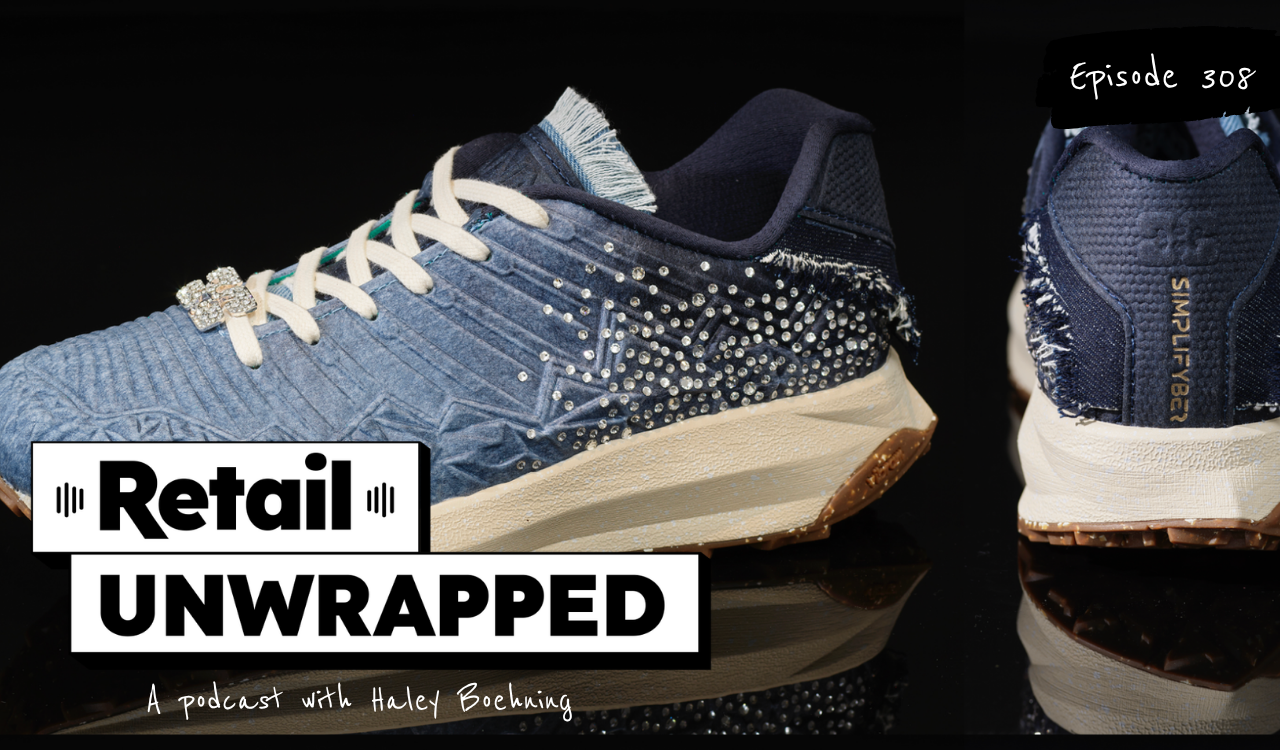

It stands to reason that emerging technologies should help engineer visionary designs, and new tools will enable new solutions to old problems. That’s how Maria Intscher-Owrang, Co-Founder and Chief Creative Officer at Simplifyber used her curiosity and creativity and looked to sci-fi to reinvent a supply chain. She and her team developed natural fiber liquids that can be molded with 3D technology into unlimited shapes and engineered to outperform or even replace traditional fabrics and/or plastics. This short cuts traditionally complex multi-step manufacturing and transforms the traditional supply chain in the process. They have engineered these materials for apparel, footwear and car interiors. Her latest invention is to mold Ganni moon shoes through a fusion of sustainable and compostable bamboo, sugarcane, and wood enhanced by crystals. Join Haley and Maria as they dig into her journey of developing bio-based engineering and design with tech advanced tools. Maria describes her passion to change an industry and find alternatives to fossil-fuel based fibers, expendable apparel that pollutes unregulated environments, and unsafe clothing manufacturing conditions. Listen, learn, and be inspired.
Special Guests
Maria Intscher-Owrang Co-Founder & Chief Creative Officer at Simplifyber
Transcript
Maria Intscher-Owrang (00:03)
my name is Maria Incher O’Ring. I’m the Chief Creative Officer at Simplifiber.
Haley Boehning (00:08)
So, Maria, you spent more than two decades in the design world, designing at some of the highest levels of retail. So you were at Vera Wang
Maria Intscher-Owrang (00:16)
Mm-hmm.
Haley Boehning (00:16)
and McQueen and Calvin Klein. So I wonder if you could take us back to those days when you were in the role of designer, in the luxury space. What were the first few things or insights that you had about what was wrong with the way we were designing and manufacturing?
and what might right look like.
Maria Intscher-Owrang (00:39)
Yeah, I mean, first of all, I just never liked sewing and knitting. I I I think that they’re a little boring and a lot of hand labor and a lot of like inefficient work. So I went into this whole thing not liking sewing. I like making clothes, but I always wish there were other ways to do it. And you know, over the decades you see the shift in an industry, right? You see
things gradually morph and what I was seeing was I was seeing a lot of people using natural materials at the beginning and then that changed and now most people are using polyester, fossil based materials, and a lot of that market is driven because of the price.
Haley Boehning (01:29)
cost of manufacturing we has driven people toward these non-natural materials.
Maria Intscher-Owrang (01:35)
Yeah,
because it’s a it’s a really inefficient system and you know there are so many layers to the supply chain that it just kind of pushes up the price and the only real lever that people have to make lower prices is to cheap out on the materials. So, you know, people were you know, they quickly realized that if you get the cheapest material possible, then that’s your best chance of lowering prices. And then there were also
a lot of people that were trying to get the price of hand labor down by moving to other countries to manufacture in and now we’ve got this global system of manufacturing that relies on hand labor and relies in in developing countries and relies on h on fossil based materials.
Haley Boehning (02:26)
Yeah. I think it’s as for people who are outside of the retail world, I think the complexity of that supply chain is kind of hard to see. what are the
Maria Intscher-Owrang (02:32)
Mm-hmm. Yeah.
Haley Boehning (02:34)
what are the impacts that you see from that traditional supply chain that you kind of
Maria Intscher-Owrang (02:40)
Yeah.
Haley Boehning (02:40)
in the industry and in the world?
Maria Intscher-Owrang (02:42)
Yeah, I mean the impacts are the globalization, right? And because of the globalization, you have a lack of oversight. So a lot of things get missed, a lot of things is like are over there and you can’t see And there are a lot of things that happen where like pollutants get dumped into environments that don’t have regulations and can’t really handle them. There’s a lot of waste that doesn’t get dealt with properly.
there are a lot of people that don’t get paid a living wage. There are in unsafe conditions to to make clothing in. So all of that happens and then there’s a whole there’s a whole fossil based materials problem of it with like not only creating waste but also s supporting an industry that, you know, is not necessarily the best choice of materials on the planet. So
Yeah, early on in my exploration of how to improve that, I found starting in two thousand six a couple of companies that were early pioneers of trying to create change within fashion.
Haley Boehning (03:56)
And what did they what were they doing that that unlocked this the insight for you? What did you see?
Maria Intscher-Owrang (04:02)
Yeah, I mean, really at that time it was so early that not a lot of people were really thinking that way. an inconvenient truth had just come out, like I think the year before or something, and and and people were starting to talk the whole about the whole notion of, you know, how can we make industry a little better? And in fashion that conversation had only just begun to happen. And especially in luxury fashion, you know.
‘Cause people assumed that you’d be making like these granola looking oat clothing and and hemp hemp sacks and that’s the only way to do it. But you know, the two companies that I worked for, one was called Lindaladter Milk in in Los Angeles, and she really researched which fiber choices could have a better impact and what should we naturally, you know, opt for.
If things weren’t available as in terms of like new gen fabrics and stuff, we we looked for organic cotton, we looked for linen, ham blends, all kinds of things like that, versus the fossil-based materials. And so we started doing our own research just to see what was a better choice. And we kind of had to write our own rules. And then the second company was Bono’s company, Eden.
which combined that idea of material sourcing with promoting production in Africa as an idea and kind of raising the bar for what you can manufacture in Africa because it had only been mass until then and we were really trying to raise that skill level.
Haley Boehning (05:43)
Right. So you you saw a few problems, impacts
Maria Intscher-Owrang (05:47)
Mm-hmm.
Haley Boehning (05:48)
on just on the industry itself and on the businesses that were manufacturing. So you mentioned quality,
Maria Intscher-Owrang (05:52)
Yeah.
Haley Boehning (05:54)
you mentioned the complexity of the supply chain, and
Maria Intscher-Owrang (05:57)
Mm-hmm.
Haley Boehning (05:57)
then the impact on the environment. and
Maria Intscher-Owrang (06:00)
Uh-huh.
Haley Boehning (06:00)
I wonder, was there one of those problems that you attacked first in trying to to come up with a solution, or was it was it all at the same time?
Maria Intscher-Owrang (06:11)
Yeah, I mean the most direct thing you can attack is which materials to choose. Unfortunately, that’s the thing that affects the price very much. we also, you know, manufactured as close to where we were as possible. So we we manufactured right in LA in that case. so that was how we treated it in the Los Angeles company. And then in Bonus Company, as I said, we tried to source those better options.
Natural materials and and then combine that with manufacturing in Africa. In both of those places, what I discovered was it was very good that we were raising the profile and you know having helping people understand this and speaking about it and all of that. But from a product level, I was not satisfied with the level of impact that I was able to have personally as a designer. You know, I felt that.
What was really broken was the entire system.
Haley Boehning (07:13)
T tell me more about that.
Maria Intscher-Owrang (07:14)
Yeah, so you know, it’s this whole s long supply chain in textile manufacturing. You start with fiber, then you spin yarn, weave or knit cloth, cut, and sew to create a three-dimensional product. Whereas, you know, instead of that, why don’t you just start with a basic building block and and try and shorten that pathway and limit all of those unnecessary steps.
And just think of it differently. You know, I I looked at, you know, a few years later, the whole 3D printing revolution was starting to happen. And I looked at that idea as well, that’s really smart because you’re going down to like the most tiny layer-by-layer way of thinking of everything, building it up from like the beginning, and just you know, canceling out the need for the other layers in the supply chain. And I thought, well, what if we could do something like that?
that in fashion using natural materials.
Haley Boehning (08:13)
Yeah, so not just finding ways in that existing supply chain to make each of the steps faster or maybe tweak each of the steps to make it more sustainable, but actually rethinking the the supply chain in its entirety. so
Maria Intscher-Owrang (08:26)
Exactly.
Haley Boehning (08:27)
these external these companies outside of retail that you were looking to for inspiration,
Maria Intscher-Owrang (08:34)
Mm-hmm.
Haley Boehning (08:34)
I imagine that as a designer, your design brain was kicking in.
looking at what
Maria Intscher-Owrang (08:39)
Uh-huh.
Haley Boehning (08:40)
what you were seeing produced, were there were there issues there that you had to kind of struggle with in terms of quality or or how that could be translated into fashion?
Maria Intscher-Owrang (08:50)
Yeah. And it’s I love that question because I I
looked for several years for a way to do something like that, something like 3D printing or additive manufacturing in natural materials that could be soft and like worn on the body. I didn’t find it. And you know, I always thought that you know, some smart people, some engineers, they’re working on it. But the problem is I realized.
Nobody even really realized what the problem was for this industry,
you know, and and that’s when I then that’s when I knew that like maybe I should try something because at least I am very familiar with the problem. And at least I’m very familiar with like what we need to make products. So that’s really where the idea for for Simplifiber came from.
Haley Boehning (09:43)
Great. So that tell me a little bit more about that. You have this unique insight into what’s needed because you have
Maria Intscher-Owrang (09:50)
Mm-hmm.
Haley Boehning (09:51)
been part of these large luxury manufacturing retailers, you have been a designer, you’ve seen the world through that lens. What are
Maria Intscher-Owrang (09:59)
Mm-hmm.
Haley Boehning (09:59)
those qualities that you were looking for, either from the product or from the kind of cost or margin pricing that you knew going in you had to be able to hit in order to make this work?
Maria Intscher-Owrang (10:12)
Yeah, I mean, I would say first there was the designer thing. Like I just wanted a new tool because I wasn’t satisfied with what existed. Second, I wanted it to be using natural materials. And third, I wanted it to be 3D and more efficient. So that’s really when I started looking for solutions with that were additive.
and I I had been I’d become aware of recent developments in cellulose. there’ve been quite a lot of developments in the last ten, fifteen years. And you know, it’s been used in textiles and paper and all of that. But I really thought, you know, you could use cellulose as kind of a building block. It can do so many things. It can it it’s kind of a wonder material and it’s abundant. It’s everywhere, you know, it’s the building block.
plants. So it’s one of the most organ abundant organic compounds on earth. And it just made me want to experiment like with can you use cellulose fibers and build them up and create shapes? Would you spray them? Would you print them? Would you mold them? So we tried a whole bunch of those different options. And what we landed with as the most scalable option was mold molding.
Haley Boehning (11:37)
Mm.
Maria Intscher-Owrang (11:37)
So
and the reason for that is it’s the quickest using existing technology. So like we’ve developed our own way of doing it, but like it’s built upon things that people are doing right now.
Haley Boehning (11:51)
So walk us through that. it’s it may be hard for some people who think of 3D printing as creating fidget spinners or or tiny little dinosaurs you can put on your desk. How does that process translate to to fashion?
Maria Intscher-Owrang (12:06)
Yeah. So essentially what we do is we start with our raw material, raw natural fibers. So these are fibers like a variety of different lengths. We can use up to like an inch long, or we can use very, very short ones like you use in paper. we put those fibers in a liquid and that liquid is water based. It’s got some additives and binders in it as well.
and what we do is we put a shaped tool with a vacuum head into that fiber bath and the vacuum s draws up the fibers into the 3D shaped part of the mold. The water is then pushed out and then the fibers start to interlock and set and then we do one more final press and it perfects the finish.
Haley Boehning (13:04)
You know, I was listening to one of your interviews and I I heard you mention that you liked science fiction and that you got
Maria Intscher-Owrang (13:10)
I love science.
Haley Boehning (13:11)
a lot of inspiration from that. And what you’ve just described sounds like Star Trek to me.
Maria Intscher-Owrang (13:16)
Yeah.
Haley Boehning (13:16)
so how do you when you’re talking to designers or to retailers who come from the tradition of traditional manufacturing, how do you talk
Maria Intscher-Owrang (13:28)
Mm-hmm.
Haley Boehning (13:29)
about the benefits of this this science fiction-like process?
for their kind of day to day of of running a brand and trying to produce a line and and get it out to their customers.
Maria Intscher-Owrang (13:41)
Yeah, I mean you come across various different types of people in fashion. I would say that a lot of the designers are very curious and technically curious as well. so we get a lot of people just kind of wanting to like see what it is and what it can do from the design side. And then from the business side, they love the efficiency of this. So, you know, you’re replacing a five step process with a one-step.
Process and your one-step process can happen in like one location, obviously. So they love the cost side of things and the time and the oversight side of things. And then, you know, I think the benefit really comes through to the customer because we can produce suddenly, you know, new very new kinds of things that have never existed on the market before. You know, we can shape plant fibers.
in much the same way that people use plastic. And and that opens up a whole new design space that people can benefit from. And then you’re not limited to, you know, a set of materials that was conceived for the last century. You’re limited to this new century’s materials that I think are going are going to be really the most powerful set of materials we have this century.
Haley Boehning (15:03)
So interesting. I can’t think of another innovation that I’ve heard of that pleases both the CFO and the head of design in the same moment. So that’s that’s kind of remarkable.
Maria Intscher-Owrang (15:11)
Yeah.
Haley Boehning (15:14)
tell me a little bit, you know, as you were developing this technology and trying to serve all of those requirements that you knew you had to serve, what was one of your most brilliant failures? What was something that that
It didn’t go well that you learned something really important about.
Maria Intscher-Owrang (15:38)
I mean, for the first I would say at least the first year, nothing went well. Like we we went into the lab and tried a bunch of stuff and you know, you could see the beginning of things that were maybe gonna start to work, but you could still rip everything and you could still you could still it it didn’t look nice and and then
Then finally one day the people our research team created this one material and like and they and I only had like a tiny little bit of it, but it was so magical and really beautiful. It wasn’t strong yet, but I could tell that it had the potential to to really be something. And that’s I would say that’s really where everything.
practically started and that’s when we kind of made our choice on the direction. and yeah, I don’t know if it was like a a failure that turned into a a a a specific good thing, but it was like a string of failures that we had to overcome to get to this like bright spot of a nugget of like what was going to work.
Haley Boehning (16:58)
Such a classic entrepreneurial story. It’s like you’ve seen the need
Maria Intscher-Owrang (17:01)
Yeah.
Haley Boehning (17:02)
in the world. You believe that you have some unique ability to fill that need, but you haven’t quite figured out how to match those two things. So that that sparked
Maria Intscher-Owrang (17:09)
Yeah.
Haley Boehning (17:09)
that moment. What did that feel like for you and your team?
Maria Intscher-Owrang (17:14)
it felt really exciting for me because you know, like I would say for several months before that the engineers around us were saying, This might not work at all. You know, like you have to kind of realize that there are limitations here. And then we just blasted through all of that. And like it’s since then we’ve we’ve made materials that were
Strong enough for clothing. Since then we’ve made materials that are strong enough for shoes. Now materials are strong enough for car interiors and they can really last and really be durable. So it was really just the realization that we we don’t have to be daunted if people say this is difficult slash nearly impossible. you know, sometimes that might be true, but in this case we were so persistent that.
it wasn’t. And luckily for us, we have a team of people that are willing to push through that and to great effect.
Haley Boehning (18:23)
You you mentioned a couple of things that you’ve developed recently.
Maria Intscher-Owrang (18:27)
Mm-hmm.
Haley Boehning (18:28)
Is there anything in that set that that you could kind of tell us the story of the of the need or the client’s need, the customer, and and how your process was able to kind of uniquely meet that need?
Maria Intscher-Owrang (18:43)
Hmm. Yeah, that’s a great question. I mean, originally we were kind of doing this to make clothing. but then we got put in touch with one of the big sportswear companies of the world and they said, Hey guys, we really need shoe uppers. We we don’t have enough natural op options that are durable enough to to be able to make a pair of shoe uppers.
And so that’s when we really thought, okay, there’s something there there, and like we dove into that. And then there’s another example that’s very similar. People started hearing about our shoe uppers in the car industry, and they were like, Hey guys, what about things for the car interiors? Because we don’t have enough natural material options to make car interiors. So we did the same thing. And
w in both cases at the very beginning we were worried that we wouldn’t we weren’t gonna be able to make the the requirements meet but get met but in both cases we have been and and it’s just you know for us when people ask us for things that is such a clear sign of the need of the market and like multiple people in that those categories were asking us for the same thing.
Haley Boehning (20:09)
That’s so interesting. So what is there anything that working in the the athletic shoe sportswear space and then the car manufacturing space that you think translates back to the fashion world or to the luxury world? Anything you’ve learned that that you’ll be applying in that space?
Maria Intscher-Owrang (20:28)
Yeah, I mean, well, just to, you know, how to make a good product that lasts. you know, and also different levels of our product for different applications and different needs. You know, you need different varying levels of durability or different levels of flexibility. So it’s taught us to be more versatile and we have a larger kind of breadth of materials that we can make because of.
Haley Boehning (20:57)
Think the luxury retail world is ready for this kind of change.
Maria Intscher-Owrang (21:04)
I think they’re gasping for it. I mean, because we’ve been sewing things like, you know, like Victorian’s for way too long. And you know, that’s also why you see a lot of these trends repeating and repeating and repeating, because we have the same set of tools, right? So if you get new tools, you can finally do something that’s like new. And you know, for me it makes me laugh whenever I see
I love science fiction books, but whenever I see a science fiction movie and I look at the costumes, nearly everything is sewn on a sewing machine. And I’m just like in thirty thousand years they’re not gonna be sewing on sewing machines. But like we that’s all we have. So I’m really excited to see what what this technology can build when when you know
a lot of teams really work into the idea. Right now we’re the just at the stage where we’re only discovering what it makes and what what what’s coming. But like there’s gonna be a huge range of new developments that I I’ve never even dreamt of. So I’m excited.
Haley Boehning (22:15)
So what if this becomes more of a standard for the retail industry to manufacture
Maria Intscher-Owrang (22:21)
Mm-hmm.
Haley Boehning (22:21)
this way, what changes do you envision in in the industry and in the world? What what what do you see the outcomes being?
Maria Intscher-Owrang (22:30)
Yeah, I mean I see the outcomes being the this the material switch from a fossil based system to a fiber based system and all the benefits that will come from that. So, you know, the the increase in value of plants and the decrease in value of oil and the decrease in power of oil. I also see the the raising of the of of hand labor.
as sewing. you know, I think it’s too driven by the cost of a cheap t-shirt right now. And that’s where you’re seeing, you know, people really get exploited. And I, you know, most importantly, I see a set of materials that are part of the circular economy rather than the linear economy. So these are materials that can be recycled back into themselves and, you know, or at the very least can degrade naturally in the environment.
and they come from the environment. So that’s even a circular system even when they’re waste. but you know, those three things primarily are really my goal for what we do.
Haley Boehning (23:41)
It’s interesting that you what I heard in that was a a possible future where the continued production or the new production of of materials and the, especially in the luxury fashion space, not only will decrease our reliance on the kind of fast fashion manufacturing that we’ve been used to, which is exploitive of people and exploitative of the environment, but also potentially elevating the traditional sewing.
and and and manufacture of clothing because it will have space in the market to to expand. Yeah, it’s really interesting. I’m
Maria Intscher-Owrang (24:19)
Exactly.
Haley Boehning (24:20)
So going back to science fiction as a metaphor for the work that you’re doing, you know,
Maria Intscher-Owrang (24:24)
Sheep.
Haley Boehning (24:25)
it is interesting to read some of these old science fiction, these old science fiction novels now and see how much is actually the the reality that we’re living in today. So as you look at this market, what’s real now versus what’s emerging or not quite there yet?
Maria Intscher-Owrang (24:44)
Yeah, I mean, well, one of the things that always kind of piqued my interest was I was reading one of the earliest cyberpunk novels in the nineties. I think it was written in the eighties, but I read it in the nineties, and it was Neuromancer. And there’s just a little point where he talks about lab grown fur. And we’re doing lab grown leather and and you know, there’s a lot more kind of bioengineering now. So
That’s one of the things and then it’s not a book, but the adaptation of one of my favorite sci-fi books, Brave New World. I think BBC did it or something, but that is actually one of the few sci-fi adaptations that you can actually see that they were like trying to think about how people would make things in the future.
And so they were like 3D printing their clothes, the it was all like molded origami kind of stuff. It was really interesting. And then also idiocracy. They they were printing their clothes off every day. So like you can start to see people were thinking about clothing production and how that would change. And you know, that’s been that that kind of stuff’s really inspiring for people like me.
Haley Boehning (26:05)
That’s that’s cool. Yeah, I’m not sure. I know that the the Robin report has a very significant base in the you know CEOs and leaders of retail brands. I’m not sure what our readership is in Hollywood, but I’m hoping that maybe we’ll have some of the directors and costume designers listening to this and you’ll get a few phone calls like you did from the automotive industry. So maybe we can help you expand your impact in
Maria Intscher-Owrang (26:28)
yeah, that would be great. I mean, love would love to do that. Yeah.
Haley Boehning (26:32)
that way.
so you talked about we we talked about what this means for designers and what this means for kind of CFOs and CEOs and retail brands. what does it mean for the supply chain? So when you’re talking
Maria Intscher-Owrang (26:42)
Mm.
Haley Boehning (26:43)
with people in the supply chain, what are some of those outcomes or impacts that you really want to see and that you can envision happening if we if we adopt this this method of manufacturing?
Maria Intscher-Owrang (26:54)
Yeah, I love that question. It’s one of my favorite topics actually about what we do. So, I mean, since this is a a one step process happening in one location, our our machinery fits into a shipping container. So the the end goal is not us to be manufacturing everything for everyone. We really just want to deploy these machines around the world. And the the you know, the machine doesn’t require
require any specific feedstock. It can just be a lot of different types of cellulose or waste. You know, so you can you get to the point where you can localize the supply chains and you can use the waste that is naturally in in your environment or from products that you’re making. You can use plants that are more local to where you are and you know get them in locally. And then you can manufacture the clothes in one place that could be
Kind of anywhere because it doesn’t depend on the price of la hand labor. So it you know, you can produce your clothing more nearer to where your customers are. And I think that we’ve learned, you know, especially from COVID and especially from the Strait of Hormones Closure, that like resilience in supply chains is the one thing that we really didn’t think of when
We started to globalize these supply chains. And you know, it it is a very serious problem when you encounter hang-ups like these. And so being able to produce everything in one location is a much healthier way. And then also when you’re when you’re localizing supply chains, you’re giving
Communities again the ability to to produce for their area, which they haven’t had so long. You know, they’ve been producing cheaply by mass for for as in the West for such a long time. And and the whole local ecosystem of their tailors and what they make is, you know, kind of destroyed by that.
Haley Boehning (29:06)
Yeah, interesting. And then there’s an interesting economic impact of that as well in the in those communities, you know, even in the US, keeping those tax bases here.
Maria Intscher-Owrang (29:15)
Mm-hmm. Yeah, yeah, for sure. Yeah.
Haley Boehning (29:18)
Well, you know, as as you’ve been talking, I was thinking back to probably 10, 15, 20 years ago, hearing that Honda, the Honda manufacturing plants in Ohio were able to change the color of the cars based
Maria Intscher-Owrang (29:31)
Mm-hmm.
Haley Boehning (29:32)
on customer demand, and thinking that that just
Maria Intscher-Owrang (29:34)
interesting.
Haley Boehning (29:35)
felt like a foreign science fiction moment of of someone
Maria Intscher-Owrang (29:39)
Mm-hmm.
Haley Boehning (29:39)
on the you know, I imagine people on that on that manufacturing line, you know, hitting a switch and going from
can we talk a little bit about what this means for the customer? So we we’ve talked about the design and and the the business itself, but what are the benefits to the customer from this kind of manufacturing?
Maria Intscher-Owrang (30:01)
Yeah, I mean, I think that for customers it’s first of all, it’s a different product. It’s like a new product that they haven’t seen before, which is, you know, I for me it would it’s exciting as a customer. and it’s also the ability to more easily kind of tailor the attributes of the material. So you ha you’re making what we’re doing is essentially making the material and the shape at the same time. So you don’t have all of these
gates that you would normally have. Like normally if you spin a yarn, it has to be spun somewhere that only spins yarn and they do like so many tons of it. And you’re limited because of that to certain colors or certain types of yarn, etc. We’re kind of the opposite of that. So you know you can just kind of pick and choose which colors or which fibers you want to use and make a new batch.
You’ve got your your mold set up and that’s kind of the the structure that you need to in place to be able to do the the product. But then within that you can you can control the material really directly and you can control what goes in it directly. And so there’s different things you can customize.
Haley Boehning (31:20)
That’s so interesting. I I wonder about the luxury customer. knowing
Maria Intscher-Owrang (31:24)
Mm-hmm.
Haley Boehning (31:25)
her and him as well as you do from your many years in in retail, do you think that customer’s ready?
Maria Intscher-Owrang (31:33)
Yeah, I mean I think some already part of luxury is newness. I mean, there are aspects of luxury that are about heritage and craft. And so those will continue to be about l heritage and craft. But now you can mix it with like new exciting things. So you can still sew our material, you know, like it it it sews like fabric, but it behaves like a molded material. So you can combine those things, which I think is really exciting.
you can also use our material to put inside of more traditional materials, like you could give structure to leather, for example. but it’s also, you know, I I like to think of fashion as a framework as a frame for culture and technology. And you know, part of the luxury market that I was in.
Is about modernity and keeping up with what’s happening in the world and reflecting that visually. And you know, finally having a new process to be able to work with that’s 3D, and you can make things in 3D instead of like sewing things together from flat, just kind of gives you a new spectrum of options to work with. So there might be some resistance from the very, very like traditional.
markets where you know they want you know they want something that could have been made 200 years ago. And that that that’s great, you know. But the more kind of trend oriented or you know free thinking or avant-garde aspects of the luxury market will will love to have new tools. And and me as a designer, that’s kind of why I did this, because
I wanted new tools. Like we all want new stuff to play with and new stuff to make things from. So yeah.
Haley Boehning (33:36)
so thank you, you know, for describing the the process so that we can get a sense of what it what the process looks like and this incredible new supply chain that you’ve created taking things out of that’s that supply chain, that manufacturing chain. can you help bring to life for us, maybe even in 3D, no pun intended.
the the products that you’re actually producing today
Maria Intscher-Owrang (34:01)
Yeah, yeah, happy to. So you know, as I said, we make everything from shoe uppers, which is kind of where one of our earliest products, and you can see kind of how 3D they are, to to bags. So this is a clutch. And we can have pretty extreme textures on there. And the cool thing is you can combine texture with shape, and you can even have textures on top of texture, so it’s really cool.
And then we can we can also do car interiors and then the car interior is too big, I can’t show you, but
Haley Boehning (34:38)
You don’t have one of those in the conference room?
Maria Intscher-Owrang (34:40)
no. And you can also, you know, the materials themselves can have a variety of different kind of flavors of how they appear. So, you know, n naturally they’re kind of matte and I I always comp compare them to kind of a cottony paper felt.
so they have a nice dry hand, but you can also, you know, make them shiny and and slick and exciting. You can play with fiber contrast, so you can make this kind of heathered effect
Haley Boehning (35:13)
Ooh.
Maria Intscher-Owrang (35:14)
visible. You can even put recycled content in there and you can kind of see this recycled stuff in there. we can make materials that that drape and you know are are pretty sewable. They’re almost like a leather.
And we can also make things that are really structural and really th thick and and strong. So you can have beauty and structure without having to have layers of materials that you usually normally have. So it’s designed to be a cost-effective way of making all of those things happen more directly. So you don’t have to like layer lots of flat things and shape them and sew them and all of that.
Haley Boehning (35:56)
Great. We’re so if we want to see your products, it can you point us to any any sh store shelves we can we can go to? Yeah.
Maria Intscher-Owrang (36:05)
Yeah, so
it’s still early. We’re we’re we actually are in production right now with a couple of things. the only things I can really tell you about are the Ghani shoes that went on the catwook in Paris. So these are from Ghani, the Danish company, who’ve been really supportive of na new materials. And then we also did a car with Kia, the E V two. so we’ve got a lot of other things happening and you know the the
lab and the production floor, but those are not going to be public for a little while, especially the car products. They you know they they tend to take a while to to really roll into production. But there’s a lot happening and in like a year or two you’re gonna start to see more and more things.
So we’ve got also a couple of direct to consumer project products. one has already hit the shelves. So that is okay, you know those little trees that you hang in your in your car in the window. I I mean in the mirror. So we
Haley Boehning (37:03)
Yes. Yes.
Maria Intscher-Owrang (37:05)
did a floor mat version of that. It’s really cute. They’re like in different flavors and and and they’re fun shapes. It’s called
Haley Boehning (37:12)
Yeah.
Maria Intscher-Owrang (37:12)
crush. So if you go and look in crush and sniff dot
you’ll find them. But no, we’ve got we’ve
Haley Boehning (37:17)
great. Do they smell like pine and the inside of a taxi cab? That’s what I want to know.
Maria Intscher-Owrang (37:21)
got cherry, we’ve got like orange creamsicle, we’ve got like pina colada.
Haley Boehning (37:26)
That’s great.
Maria Intscher-Owrang (37:27)
Yeah. So they’re they’re nice, like more modern flavors. But so that’s already available and that’s fully biobased and biodegradable. You can just bury it in your yard when you’re done with it. And then we’ve also got something up on the pipeline. So
This is a laptop pouch that we’re making for school children. And it’s gonna be really exciting, really fun. but yeah, just watch for that. It’s gonna be called Doodle. So
Haley Boehning (37:57)
That’s great.
And you, if I’m getting this right, you’ve just done a $12 million Series A raise. Is that right?
Maria Intscher-Owrang (38:03)
Mm-hmm. Yeah.
Haley Boehning (38:04)
So I I’m curious to know what what your investors are most excited about and then what you as an as an entrepreneur and the founder of this business are most excited about in terms of what’s next.
Maria Intscher-Owrang (38:18)
Yeah, you know, I think we’re we’re really fortunate because our investors have been consistently amazing. we’ve got a combination of investors that are climate focused or women-owned business focused or you know, just traditional investors that wanna go into manufacturing. And they’re all very helpful and they all have their own special realm that they help us with and they advise us with.
But I think a common thread is these are investors, they want their money to grow, right? And so they don’t want to invest in something that only has a good story, but like no chance of survival with without like serious help. They they want to invest in something that has a cost advantage, can be scaled, can get big, can can actually do the impact that it’s designed to do and survive as a company and thrive.
Haley Boehning (39:15)
I I have so enjoyed our conversation today, Maria. I’m even more
Maria Intscher-Owrang (39:19)
Me too.
Haley Boehning (39:20)
looking forward to speaking to you in a year to see how all
Maria Intscher-Owrang (39:22)
Yeah.
Haley Boehning (39:24)
of these amazing plans have kind of come to fruition and also just to check in on the changes.
Maria Intscher-Owrang (39:29)
Yeah.
Haley Boehning (39:29)
This industry is changing at such a clip right now. so I
Maria Intscher-Owrang (39:33)
Mm-hmm.
Haley Boehning (39:34)
think what we’re what we’re what you’re describing today and what we’re seeing today is going to be so different in 12 months. So I can’t wait to check in with you again. Thank you for your time.
Maria Intscher-Owrang (39:41)
Yeah, thank you so much. It was my pleasure. Really great talking with you. Thanks for having