
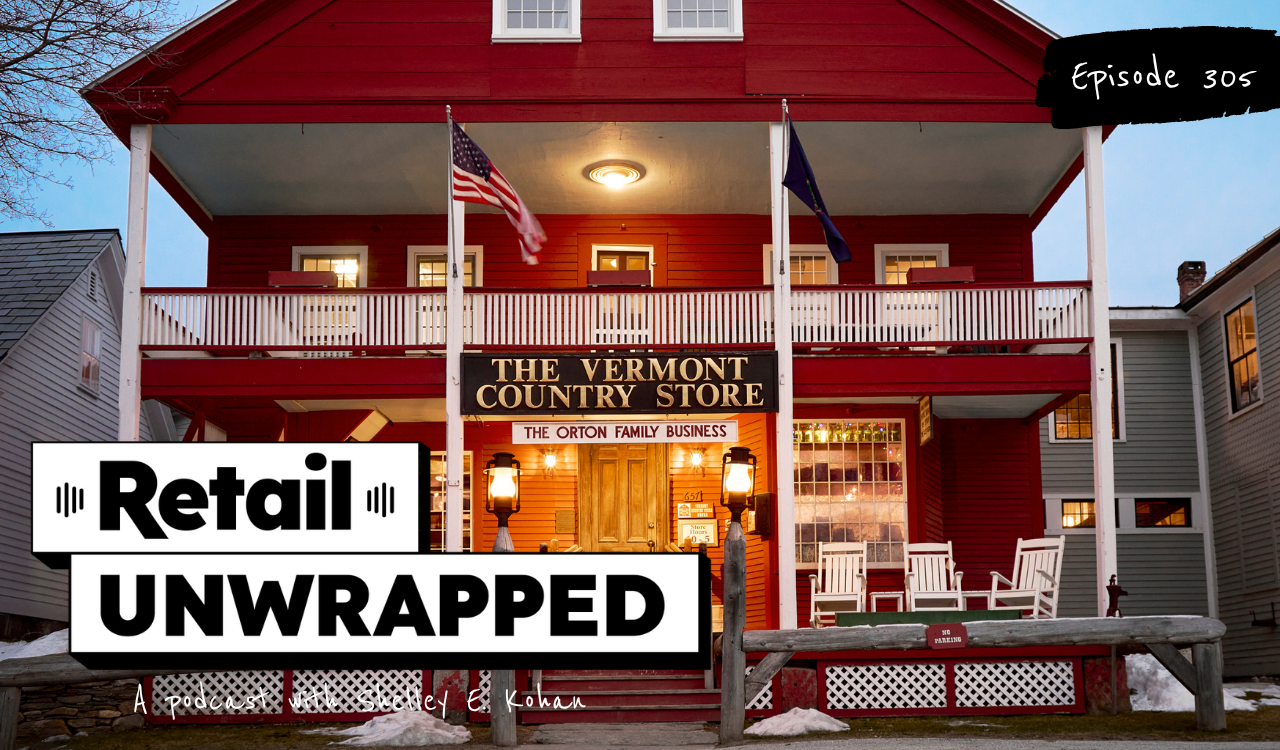

The Vermont Country Store is an 80-year-old retail icon that has sustained the charm that made it famous and the business expertise that has kept it thriving since 1946. We caught up with Eliot Orton, an 8th-generation Vermonter and 4th-generation Vermont Country Storekeeper to get some insights on how his family has bult a multimillion business anchored in two stores in rural Vermont. Famous for its old-school mail-order catalog, offering practical and “hard to find” necessities, this general store institution is a throwback to a time when retail was central to the life of a community. Listen in as Shelley and Eliot reveal how the Orton family has resisted the temptation compromise their values in a screen-driven, digital marketplace. Their conversation gives a voice to deeply held values, classic, wearable clothes, and a retail ethos (including a customer bill of rights) that survives the test of time.
Special Guests
Eliot Orton, Co-owner, The Vermont Country Store
Transcript
Eliot Orton (00:00)
Everybody has a nostalgia that’s a little different than the than the last generation. And so being in business for eighty years, I mean, we’ve constantly moved that along. The things that were nostalgic in the nineteen fifties are very different than what they are today. And we’ve continued to find those things that do spark a memory.
Shelley E. Kohan (00:43)
Hi everybody, thanks for joining our weekly podcast. I’m Shelley Kohan and I’m so thrilled to welcome Elliot Orton from the Vermont Country Store. Welcome, Elliot.
Eliot Orton (00:55)
Thank you, Shelley. Thanks for having me. I appreciate it.
Shelley E. Kohan (00:58)
It’s great having you on here and I kind of find this super interesting. The title, what you call yourself, is Storekeeper. And
Eliot Orton (01:05)
Yeah.
Shelley E. Kohan (01:06)
I think there’s a lot behind that messaging. And it is part of the authentic nature of the Vermont Country Store. So I you are eighth generation Vermonter, if I have that correct,
Eliot Orton (01:18)
Yeah.
Shelley E. Kohan (01:19)
and fourth generation store keeper.
Eliot Orton (01:21)
That’s correct. That’s correct. And I am a storekeeper.
Shelley E. Kohan (01:23)
Excellent.
Eliot Orton (01:25)
It’s I think at this point it’s it’s it’s in my blood. I don’t think I I don’t know if I I guess I had a choice, but I certainly always had a knack for it and and always loved being in our stores and always loved the energy around the fe feeling and retail and and and the energy around it and the response that we get from customers. And I think that’s just you know, there’s probably few
jobs where you get that instant feedback and you get folks who come in and they’re just almost breathless when they come in the door and they’re so excited to be there and they just are constantly giving us praise for what we do and that really fuels us and and makes us really excited to be storekeepers and and it’s a job that I take a lot of pride in being something that’s in our family and and as you said for generations and and now eighty years old this year, the Vermont Country Store and
I’m just blown away by it.
Shelley E. Kohan (02:25)
I I think it’s great and I just think it’s so interesting. I think your brother Gardner calls himself proprietor. I mean you guys could be CEO, C L O, CMO, all the C suite names, but I love that the just the how authentic you are with really seeing yourself as the storekeeper.
Eliot Orton (02:39)
Yeah. We we’ve always
called ourselves proprietors and that really came from our father Lyman and I think he always grounded us in that and you know said, Look, you got you know, after all, what do we do? We we run a country store. Yes, we’re known nationally, we’ve been doing it for a long time, we’ve been mailing catalogs all these years, so so many people know us, but it does really keep us grounded, I think, in what we do. and and remember first and foremost that we are there to look after.
the store and make sure that it is the best for our customers. whether it’s the physical stores, it’s the catalogs or our our website. And so it really is a it’s a it’s a moniker that we’ve held on to and I think it’s important. And and I think around the company, you know, we don’t use probably usually use the con conventional titles. I mean we’ve had people that we’ve called chief store keeper and we’ve had folks that have titles that are a little odd but it
It
you know, the whole idea is really meant to ground us in the small communities that we live and work. We’re in small communities Weston where the original store is a town of five hundred people, and surrounded by all these small villages. And you know, you can’t go into the grocery store and walk around, you know, I’m I’m the chief executive officer. I mean, at the end of the day, we all work together and everybody knows each other, so you really do have to keep your head and your feet on the ground a little bit.
Shelley E. Kohan (04:00)
I love that. And so for some listen, I can’t imagine some listeners wouldn’t know about the Vermont Country Store, because you have millions and millions of customers all over the United States. I think you do business in every single state.
Eliot Orton (04:11)
We do.
Shelley E. Kohan (04:12)
so I think our but just in case we have some listeners that may not be familiar, the company started in 1946 by your grandparents, and it’s been around, it started as a catalog first, then brick
Eliot Orton (04:24)
That’s right.
Shelley E. Kohan (04:25)
and mortar, then online. So tell us a little
Eliot Orton (04:27)
Yeah.
Shelley E. Kohan (04:27)
bit about the the stores and
Yeah.
Eliot Orton (04:31)
Yeah,
it so it started. My grandfather Vrest Orton was a he was a writer. and he had a print shop in his barn next to his home in Weston on the village green in Weston. And he he would do print jobs for local folks, put together pamphlets, and then he was writing small books that he would print on it. And it was an old peerless press, it was all typeset.
And he had the idea, he grew up in a country store in northern Vermont that was his grandfather and his father’s store. it was called the Teach Out Orton store, and he grew up in that store and he wanted to revive after World War Two, just at the end of World War Two, he wanted to revive the idea of a rural country store because that the country stores had sort of disappeared during the war. you know, people had
didn’t have the resources and stores had really kind of shuttered up. And so he wanted to bring that back, that small country store. but he did it through a catalog and because he was a writer and he wanted to talk about these items in the way that he did. And and so he put this together on his on literally on the dining room table with the help of my grandmother and mailed it out to their Christmas card list. And it’s it’s was probably the size of an iPhone today, a small little catalog. and they you know, they worked so hard those first years to really
make that work and they but it it’s funny they mailed it out and then they started to get people to write back to them and say, Great, we’d love to order a few items. We’d love to come and visit the store. And they said, well we better open a store. So they bought they bought a building on the other side of the village that formerly was an inn. And he had his mother and father move down and live on the second floor. And they got to storekeeping and and and then in the
In the fifties, in the early fifties, he p self published an article called The Happy Storekeeper of the Green Mountains and he submitted it to the Saturday Evening Post and they published it in 1952.
Shelley E. Kohan (06:35)
Wow.
Eliot Orton (06:36)
And it became nationally known i instantly overnight. This small little place in Vermont in a small little village that at the time was very hard to get to, practically surrounded by all dirt roads, and folks were starting to come from all over, and you know, our father
was was brought up in the business and he he he grew up tending store and our father Lyman came right into it after graduating middle middlebury college which wasn’t you know probably in those days wasn’t the prestigious college as prestigious college it is today but his parents said you better come back and get to work the day you graduated and he he our father Lyman really took a hold of the business that point and really
saw the power of the mail order catalog and really understood that and he he really kind of just took the business and really launched it at that point. And I think in the in the seventies, eighties and nineties, our father was really responsible for its growth and and and you know and then bringing us into it and and teaching us all of the lessons along the way about being great storekeepers.
Shelley E. Kohan (07:47)
I love it.
Eliot Orton (07:49)
huh.
Shelley E. Kohan (07:49)
So and I think I think I read a story somewhere that you remember when you were a child working in the store, right?
Eliot Orton (07:57)
Yeah, of course. a l a I mean it’s it’s not even really feels like a memory. It just feels like it’s part of me. I just I just was sort of always around it. The school bus would drop us off at the store. and and we just go in the store and then the f you know, the clerks would look after us and just put us to work, bagging up candy or filling jars and marking products and everything was done by hand. We didn’t have computers then, ringing up customers.
and just being around it. And I loved it. And I and I think it was great to also just be a family around it. So our father was always sort of just dropping those seeds and those lessons in us of, you know, don’t oversell things, don’t overpromise and underdeliver. You know, you don’t need you know, it was t tell it like it is, be straightforward about it, and be honest about what all these things are. Know your product, make sure that they solve a problem or that they have a reason for being.
that they have a purpose. and it was just a great place to be around that store all the time. And so we I always say to my kids now that you guys are lucky because you actually have school vacations. we didn’t really have school vacations, we just were in the store most of the time. but that was great and it was a really loved that and I have a great admiration for all of our folks that work for us because of it. I I think on eighty our eightieth anniversary,
I’m most proud of the generations of employees that that have worked for us and how hard they’ve worked to carry that that thing that we promised to the world. They make sure we deliver on it. And we have now over seventy folks that work for us who are related to one another in one way or another in the business. And it’s just, you know, it is a family business within a family business. And it’s it really has that spirit.
Shelley E. Kohan (09:48)
Great. I think I always think that any kid today, whether high school, college, they should work somewhere in the service business, whether working in a store, working in a restaurant. I just feel like you learn a lot by being in the service industry. When I was seven, I worked in my grandmother’s soda shop taking orders and clearing tables. So
Eliot Orton (10:07)
Yeah.
Shelley E. Kohan (10:07)
I think it just gives you this sense of serving that I think a lot of kids today would be much better off if they learned that aspect. so could
Eliot Orton (10:17)
I think and it makes them
feel it makes them feel good. I I you know, I think that’s you know, you don’t get that through a phone. And unfortunately most young kids are just kind of on a device most of the time. So actually to have that one on one interaction and have someone there actually complimenting them for doing something, and they don’t really get that a lot of the time. And so to have that and have a purpose and have that feedback in a service business. I mean our our son worked in a
in a restaurant during business busy Christmas season a few years ago a friend of ours has a great restaurant and I I luckily he came back and said, Your son’s great, he he what a hard worker and and I was like, Yay, he’s got it. And both
Shelley E. Kohan (10:53)
Yeah.
Eliot Orton (10:54)
the kids worked in our store for for just for three weeks last summer. But they really they really have it in They have that natural innate ability to talk with folks and not be shy. and we’ve sort of been pushing them all along to be that way.
And it is great. I think it’s great. I think young people should work in service businesses and be customer facing and and and it gives you an appreciation for how hard that job is. and so when someone’s waiting on you or taking care of you, you say thank you and you appreciate the job they’re doing.
Shelley E. Kohan (11:26)
That’s great. And I think I think you are now in a position, you and your brother, but you’re in this position now where you’re you’re very embedded in this
These values that have been passed along from generation to generation. So you want to preserve those values, right? But you’re also, I’m sure, thinking in the back of your mind, we also have to add in, you know, contemporary, you know, products and you know, we have to be like, you know, going online, for example. So how are you looking at kind of balancing, you know, preserving all the values and the things that the nostalgia and the things that people love about the Vermont Country Store versus being updated and modern?
Eliot Orton (12:05)
Yeah. I
mean we s nostalgia changes. It keeps moving forward, right?
Everybody has a nostalgia that’s a little different than the than the last generation. And so being in business for eighty years, I mean, we’ve constantly moved that along. The things that were nostalgic in the nineteen fifties are very different than what they are today. And we’ve continued to find those things that do spark a memory.
But a lot of times they’re also something that just sort of canoe a tradition, whether it’s around the holidays or or holidays throughout the year, things that are
more
traditional in construction or design and and in the in their form. and so I think that has never changed and I don’t think it will change. That’ll always be something that we’re we are just keenly aware of that really makes it fun for us. It’s it’s also the hunt because those things are really hard to find. Those nostalgic items, they’re just not sometimes they’re just not available anymore. You have to actually get them made or buy the trademark and get that product made again.
And then you know the other product that we sell that you would call maybe more contemporary, they’re things that are just still very useful to us that are just great products. So, I mean, we sell betting that customers probably wouldn’t remember or don’t feel nostalgic about it necessarily, but they might say that, well, why these sheets are not a thousand thread count, and maybe a thousand thread count means nothing to most customers.
Our sheets are actually a 250 thread count sheet, but they feel like they just came off of a clothesline. And then we designed them so that they would feel that way. Because a lot of customers actually really like that feeling of sheets when they come off the clothesline, the way they smell and the way they feel, they have a different sleep feel. So we we listened to customers, we thought about that, we developed this product. And so that those lines of products are sort of our contemporary products or our sleepwear, our LSMone sleepwear is very
It’s very nice, who’s actually named after my daughter Ella. you know, it does it’s very they’re very they have very nice touches in their finish, and the eyelets and the lace and the buttons and the the material and the cotton that’s used, 100% cotton. but by no means is it something that a customer necessarily remembers. It’s not a brand that they remember, but it’s something that does connote a way of life that’s sort of missing for folks, or something that’s that’s gone by. And so
you know, I think that’s what we they’re fun for us because customers really do write to us and and and express their love for these items, which is that’s what we’re going for. That’s what w why we’re in business. And we want customers to love these items more than just something that is just more just more consume, consume, consume. We’re not just we’re not just selling things that we think people are buying just for the heck of it and
And then getting rid of it quickly. We think they’re really holding on to these items for a long time. So we think more about heirloom quality. We think about things that last a long time, that wear like iron. and so that’s how that’s how we think about it. And we used to get thousands of customer letters a year before we had a website and before we were online. And we would paw through all of those and put them in spreadsheets and what are people looking for
Shelley E. Kohan (15:19)
my gosh.
Eliot Orton (15:20)
and go after things.
And now we just read customer reviews all the time. We get so many customer reviews on products, and customers will say, I wish this had pockets. And six months later, it has pockets. And we do things that just right on the spot. It’s so great to get that information. And and so that’s you know, that evolution into being a digital business is just more feedback, which I think delights my father Lyman because he always said.
Don’t
stop listening to the customer or make sure you read the customer letters. Well, I think you’d have a hard time hiding from it today, and you better not. it’s all out there and customers are brutally honest and they tell you right away what they think. But that’s a great thing because it keeps you honest again and keeps you refining what you do, getting better at what you do, and make sure you that you deliver on that promise again for the customer to make it great.
Shelley E. Kohan (16:17)
I I definitely think today’s customer wants to actually help you run your business. And so
Eliot Orton (16:23)
Yeah.
Shelley E. Kohan (16:23)
they feel like they’re part of the business in a way. And I also think so you have this very, very no, go ahead. What were you gonna say?
Eliot Orton (16:31)
No, I think you’re right. I think there’s that
there is that. They’ll say, this isn’t like the original. And that you know, maybe they’re right. And you gotta find out then why. What did what did we miss in that? What was it? Is it is it the weight of it, the feel? What was it that that that we missed along the way? And but that’s so important. If you’re really gonna get it right and it’s going to be successful, you have to.
Shelley E. Kohan (16:52)
yeah.
Point back. So I think you have this really deep loyal customers, and we’re gonna talk about your stores in a second because I think the stores are a really important piece of this brand loyalty that you have. But way back in 1946, you have these two customer policies. I don’t I hate to call them policies because they’re really not policies. I guess they’re the standard way of your doing your business, and one is the risk-free
Eliot Orton (17:14)
Yeah.
Shelley E. Kohan (17:15)
shopping, and the other is the customer bill of rights. So you want to t tell us a little bit about that and how it doesn’t feel like they they may have been tweaked a little bit, but I don’t
I don’t know if they’ve been changed for all these years.
Eliot Orton (17:25)
They really haven’t, and
I think those were things that again that our father took from our d so when the business started and our grandparents were mailing out small catalogs and that started to build. In the late nineteen forties and the early fifties, you had to really make a promise with that customer that you were gonna stand by that they’re gonna put a check in the mail or cash in an envelope and mail it to you in Vermont and you’re gonna actually get the pr the product delivered to them. And it took a
It took a lot of trust. So you had to build that trust. And I think our grandfather did a great job to to convey that in the catalog and let customers know that yes, it’s gonna get there and we’re we’re not scamming you. And I think there were a lot of scammers in those days, the early days that folks took advantage of the goodwill of folks and and so you had to work really hard. And then our our father really I think he expanded on that with the customer bill of rights. and he said that really happened for him when he would
Call a company to try to speak with someone and would I think the early days of getting an answering machine, and he’d have to go through the all of the buttons to try to get to somebody. And he just felt like, these people don’t want to help you. You know, I I’m trying to call and I need help. And I have to go through all this runaround. And he said, you know, we need to have a Bill of Rights that says if you call us, we’re going to pick up the phone. And and if we’re having a problem that day.
we’re not gonna blame it on the computer. This was early days of computers. and and he just felt like a lot of companies would give you the runaround. And he said, as to hold ourselves to a standard, hold our own customer service to a standard, and all the folks that work for us, he said, Look, we’ll have a bill of rights. It’s not just for our customers, but it’s for ourselves of how we’re going to treat the customer. And we’re going to do it with honesty, with respect. We’re going to treat that customer, and and we’ll we won’t.
We won’t run them around trying to solve a problem. So I mean if you call and and and an item has broken or hasn’t met your expectations, the person you get on the phone is going to take care of that that for you. They don’t say, hold on, let me talk to a manager. Let me find out if I can get a code to take care of you. They just we just take care of it. And you will get someone in Vermont when you call. All of our customer service folks are on the phone in Vermont. and they and and that just has lasted that that
That sense of customer service, I think, because we’ve had that Bill of Rights, it’s you know, we think customers see it on the website and in the catalog, but it keeps us true and it keeps a standard for all of our folks. And they do a great job living up to it. They know it’s what we want as a family, and that’s the higher standard for us. And you know I always use it as that we because we’re family-owned, and and I think we coined it at one point, it’s sort of the embarrassment factor.
You don’t want to be embarrassed about what you do at the end of the day. And you really feel that when you own something, when it’s been in your family for so long. And so I think everybody knows that who works for us. They really know that we have high expectations. And again, I thank them tremendously for all of these years for meeting that standard that we’ve set. You know, I know we set a high bar, and all these folks just keep rising to it. And and they make sure that when someone comes in, I mean we’ve had customers come into the store that.
You know, their car’s broken down and they go down and they get a charger and go out to the out to the parking lot and jumpstart their car and have it’s cold out, so they invite into the store and give a cup of coffee and take care of them. And it’s you know, they treat like neighbors and they don’t just they don’t just treat like any old folks coming off the street. And so there’s that real respect for our customers, I think, that’s so deep in in the business. And it comes back to that customer bill of rights and and having that all these years.
Shelley E. Kohan (21:06)
I think the other thing so I believe there’s a unique value proposition in your company
and they are just
thousands of retailers out there that are trying to do what you do instinctually and that is the in-store experience. So the Vermont Country Store only has two stores. And
Eliot Orton (21:24)
Yeah.
Shelley E. Kohan (21:24)
I I I hate saying only, I don’t mean only like only, but those two stores are so powerful. And that experience when you go into the store is what brings the loyalty because people come and visit the store and when they leave the store, you know, and they go back home or they’re on vacation, you know
They want more of that, and that’s how the business has grown, and that’s why you have
Eliot Orton (21:47)
Yeah.
Shelley E. Kohan (21:47)
so many customers. So, what I’d love for you to do is tell us a little bit about the in-store experience, and also you gotta tell us about Mildred, because I think the different Mildred’s the Mildred’s table, the dairy bar, the market, I just think that adds
Eliot Orton (22:01)
Yeah.
Shelley E. Kohan (22:01)
to that whole experience.
Eliot Orton (22:03)
Yeah. so that I mean I guess I’ll s
that and how we got onto Mildred’s, who Mildred Ellen Orton was my grandmother. and but the stores are really special, a really special retail experience. I think one because we only have two. So when you have a family that’s fairly obsessive over the details, we fuss over the details and we have continued to sort of never stop.
kind of just messing with the stores. And it it we’ve expanded them over the years. And then it’s just, I can’t go into the store without just not seeing something that’s not lined up. I I’ll say, give me a tape measure and I’ll measure a counter to the wall and I’ll see that it’s three degrees off square from the wall. And I’ll say that counter’s not square. And they’re like, how did you see that? And I’m like, I I have a problem. And it’s it it’s me, but I like everything to be
Very well laid out, very clean, very orderly, so that the I think the customer sees that. I mean my job as as a young boy at probably twelve years old was to go out first thing in the morning and sweep the front porch. But I didn’t just sweep the front porch, I swept the street and this what was inside the white line on the street, I had to sweep our entire frontage in this in the village of Weston. And I think it was that was I was my father was asking me to do that, not only just
That he knew I would learn that I’m there to make a presentation for our customer coming in. But I think he wanted the local folks in Weston to see the owner’s son out on the street sweeping away. and but it did instill in me that you have to really continue to look after these things. They can fall apart, they can get messy, stores can kind of become a little tattered and shop worn. And so we just are constantly.
evolving them and making them better, I think in our way. And and customers always come in and say it. They’re like, It looks so different in here. What did you do? And I’m like, A lot. We we we moved all kinds of stuff this year. And, you know, our folks go through and move departments sort of every year, several times a year. They’re they’re changing things up, which you would think in these old country stores you would never do. But we do because it we keep learning from it. We learn, you know, where customers go and where they don’t go. And
And what they see, and we see that feedback, and it makes it fun for us. If we just left it alone and stopped doing anything, we wouldn’t have any more work to do, and everybody would get bored and they they wouldn’t have any more fun. And at the end of the day, that’s what it’s about. You know, I I want folks who are working in the stores when they make a change. Well, in three weeks, four weeks, how did it do? Did it did we sell more of that item or less? How did you make an did you affect change? And was that was that a rewarding process?
And
I think that’s important for everybody to feel like they’re doing things that you know that make a difference at the end of the day.
Mildred Allen Orton was our grandmother. And our grandmother I think from her job in the business first was she looked after the books. and she was she went to business school locally in Vermont right out of right out of high school. She went to a local business school, the
The headmaster of the Rutland Business School talked to the headmaster at Burton Burton High School in Manchester and said, We want Mildred to come up and go to business school. She’s really good with numbers. And so when my grandfather wanted to start the business, she said, one, you’re not gonna have any partners, want you to do it your way. And then she looked after the books. and so she kept the business on track. And right from the get-go, in the early years,
You can see in photos that she had a little lunch counter in the back of the store. And we if customers came and it was a long trip to get there in those days, as I mentioned, a lot of dirt roads and there weren’t highways that still aren’t highways in Vermont. So it’s still kind of hard to get to Weston and Rockingham. and so she would make sandwiches. she would bake ham in her oven. and she would always she had a wood-fired oven in her house and she would bake hams.
And then she would say, and she would always tell us it’s kind of funny because I’m allergic to ham. It makes I get snuffy nose and I’m allergic to I don’t like it, but I would make it for customers and she would make ham and cheese sandwiches in the store. And then years later, we bought a building next door and we opened a restaurant there called the Bryant House. And the Bryant House was named after the family that lived there for generations, the Bryant family, and we kept the name. And so we had a restaurant there for years. and
When my brothers and I came into the business, the the Bryant house was sort of ready for some change and we felt like we wanted to bring Mildred into it. So we changed the name of it to Mildred’s table. And we and it really started with the dairy bar in the back. Off the back of the Bryant house, there was a there was a shed. Someone told me it was an outhouse at one point. and I just saw that one day and I said, I think we could have a dairy bar back here. And Mildred Ellen grew up on a dairy farm.
The Wilcox Dairy Farm close by, and she was a farmer’s daughter, and they made ice cream, and they still make ice cream today. It’s called Wilcox ice cream. And so we thought, well, why not have a dairy bar and we’ll serve Wilcox ice cream? And her nephew came up and made a recipe for us, a special recipe for a maple creamy, which we still serve today. A creamy is the soft serve ice cream that I feel like Vermont is famous for.
you can
Shelley E. Kohan (27:42)
Course.
Eliot Orton (27:43)
come to Vermont and there’s a creamy passport where you can go around to all the different creamy stands and get your passport stamped. And so we started the dairy bar and it did really well. Customers loved it. It was quick and convenient, and you could still go inside for sit-down service at Mildred’s. But it was just the idea was to just carry on her spirit of taking care of customers. And she was the kind of person that let really, if someone just walked up to her home, they could be a complete stranger and she would invite them in.
She wa she was just incredibly nice. And I think that spirit of nicety and being genuinely kind to people was what we wanted to be there. And it was for customers, but also for all of our employees to see that and say we’re we’re paying tribute to that spirit. And we want that to be around in the business forever. So and then we have a line of baked goods. we have a bakery and we bake cookies and we bake loaf cakes and we make fruit cakes.
Fruitcake cookies. and we’ve been c baking crackers, the Vermont Common Cracker out of our bakery since
Shelley E. Kohan (28:46)
That’s right.
Eliot Orton (28:48)
nineteen eighty-two or something. we’ve been baking Vermont Common Crackers. or maybe it was even before that I lose my days. But it, you know, we have the we’ve always had, and Mildred wrote a cookbook about cooking with whole grains. So that that whole bakery business and baking things and having food in the business, that all came, I think, from our
our grandmother’s influence and we still lit we still do it today.
Shelley E. Kohan (29:14)
Well it’s definitely working because in Vermont your two stores are some of the most visited attractions in Vermont.
Eliot Orton (29:23)
They are. They are. I mean,
we we they come by the busload sometimes and you know, customers have been getting the catalog for years. Maybe their mother, their grandmother shop with us and now they’re maybe second or third generation customer and they come and they you know, I like I said, they’ll come in the front door and they’ll just they’ll they’ll walk in and they just sort of gasp and they go, my god, I’m finally here. Like they just have this sort of emotional reaction to finally coming to see the real place.
And that’s why we’ve we’ve never mind having just two stores. You know, if we if we took it national or had some reflection of what it was like and tried to make a watered down version of it and just make it everywhere, it wouldn’t it wouldn’t have that same feeling of authenticity. And we’ve looked at maybe opening other stores in Vermont. We always just we just shied away from we said, well just let’s just keep working on the ones that we have and and and and and we never saw the right opportunity to to try and expand beyond the two.
And but customers, yeah, we c we have customers come that, you know, regionally from New England, that take day trips. and then we’ll have travelers from overseas, we’ll have visitors from other countries come and be amazed by it. And yeah, it’s really they are sort of institutions and I always tell customers if you can, you know, the best most beautiful time to come is in foliage and we love it when you come then, but it’s also really busy.
And you might have a hard time moving around the store. There’s so many customers. So if you can come on a a snowy Wednesday afternoon in July, you will think you have stepped back into a Norman Rockwell painting. It is it is the most picturesque, beautiful little village in Weston. And even if you get to Rockingham, which is a little closer to Interstate 89, or I’m sorry, Interstate 91, it’s that’s an easier trip for some folks just driving by. But it I mean
It is like stepping back in time. and we it’s funny, at one point we we did a interview with Mike Leonard from he was from CBS. And Mike Leonard said if humans were powered by batteries, the Vermont Country Store would be the ideal charging station. And it does kind of feel like that. You
go in there and you can get lost for a couple hours and you really do feel kind of charged up.
Shelley E. Kohan (31:43)
What a compliment.
Eliot Orton (31:45)
Yeah, amazing, right?
Shelley E. Kohan (31:47)
So let’s talk a little bit about for a second. So you went from catalog to physical retail to online. How has that shift changed your relationship with the customers? We talked a little bit about the reviews and getting the feedback more quickly, but what else has
Eliot Orton (32:01)
Yeah.
Shelley E. Kohan (32:01)
changed?
Eliot Orton (32:04)
you know, I would say certainly expectations and and just speed to get things. customers certainly want items right away. and that’s certainly more competitive. but I think we’ve just found a good spot where we continue to do what’s possible for us, and I think our customers realize that that we’re probably not gonna get it to the speed of Amazon. I mean, Amazon has a distribution center in like
every zip code in America. So and I and I think customers sometimes are okay that I would say all the time our customers don’t really seem that they’re they’re willing to wait for these things because they mean something to them. So when they place an order, they’re okay with that. I think that again, like I said, the just getting more reviews instantly about product and not having to shuffle through so many letters that are handwritten and find the the little nugget of gold.
And the feedback that we really need to get so make something better. We really kind of get it more quickly. and I think it just it’s you don’t we don’t have the seasonality barriers that we had with mailing a catalog only. So we can try things and put them up on the website. I mean, right now we have a lot of our Christmas decorations and our all of our Christmas stuff’s up on the website right now, most of it. We have a lot of new stuff that’ll be coming in as we get closer to to the fall, but
folks can buy that right now and we wouldn’t have put that in the catalog only. we would still be into summer seasonal items right now and then going into fall and then Christmas. So we’re able to to offer more things throughout the year on the website and sprinkle things throughout the year that customers just want all year long or or will shop for them all year. so that’s really fun and I like that as a as a merchant and being able to offer things more often and not have the barriers of the catalog. and
Yeah, I think that’s about it. That really feels like the major changes. And there’s certainly more competition, but I
Shelley E. Kohan (34:03)
I love that.
Eliot Orton (34:06)
I would say that just excites us more, just continuing to find things that we really are are different. and it we probably have less new introductions on product because it really does take a long time to develop something. so sometimes that’s really good. The customer won’t might not see something.
Really new for a little bit. And then we’ve worked really hard for a couple of years to develop something and we finally are able to bring it forward and and offer it to the customer. So there’s that pace of it that’s changed a little bit, which is great. I I don’t I I think the the competition of the web or you know, the catalog has changed where there’re just not as many businesses mailing catalogs. So that we’re probably one of the few catalogs in the mailbox now. And that’s okay. And we we still like.
having the catalog and our customers love it. And we I bet a lot of new companies that are startups today wouldn’t even know how to put one together. And we still do all of it in-house. We do all of our own photography. We do all of our own layout. We do it all ourselves. And you know, I always wonder what would a new company today who can just do a website very easily using a a host company that can just kind of load everything in and put bam it’s just instantly up there. But I I’d love to see them try and come up with a catalog. I don’t I don’t even know what they would do.
Shelley E. Kohan (35:21)
That’s so funny. That’s so true too. I yeah. so
Eliot Orton (35:22)
Yeah. It’s an art form.
Shelley E. Kohan (35:25)
it is an art form, and I believe every CEO in America should could come and visit your store. because I think it’s a very unique experience, and I think a lot of retailers today are trying to get back to some of the basics that you’ve been doing for 80 years. So congratulations
Eliot Orton (35:42)
Yeah.
Shelley E. Kohan (35:44)
on 80 years.
Eliot Orton (35:45)
Thank
you. I appreciate that. And we’re very fortunate and we thank all of our customers and all of our employees in our community so much for supporting us and helping to keep us honest and keep us working hard and keep us moving ahead and and and just so grateful to to be where we are as a family business and and still doing well at it and successful and pleasing a lot of customers and and we’re gonna continue to do it.
Shelley E. Kohan (36:15)
Well thank you so much and thanks for spending so much time with us today. We greatly appreciate it.
Eliot Orton (36:19)
You’re welcome.