
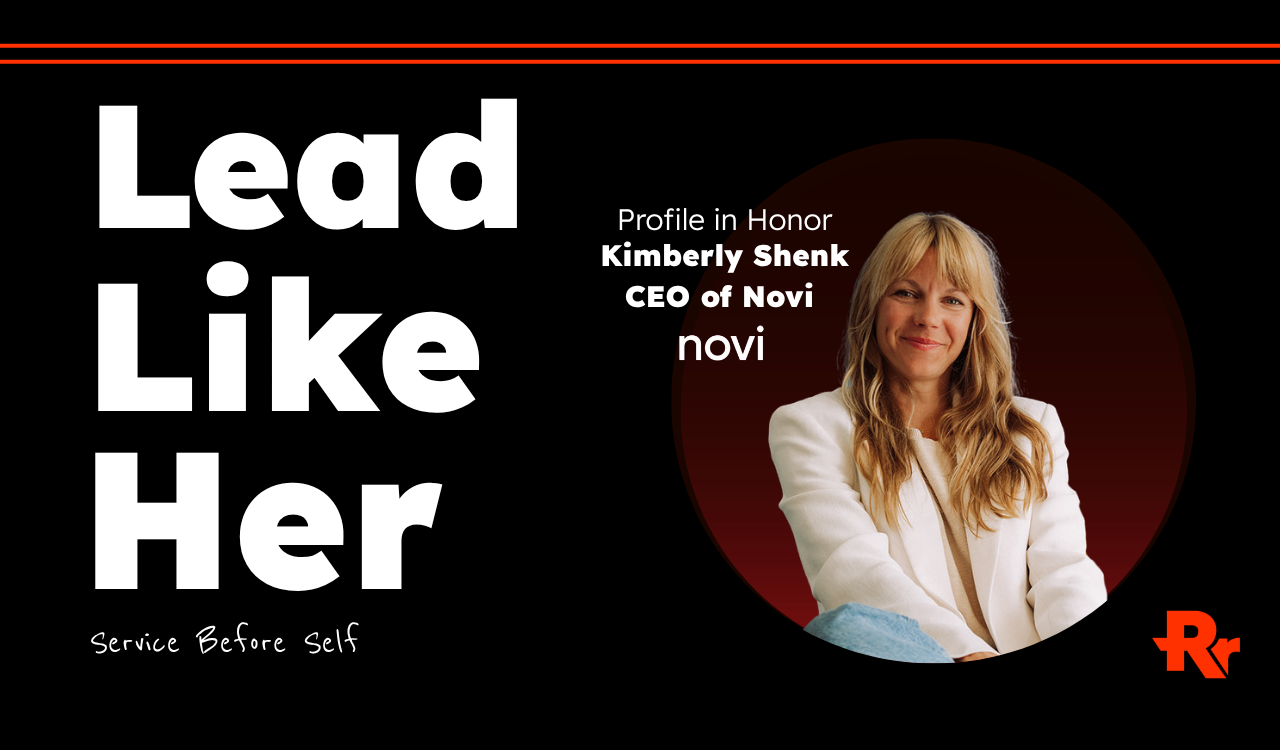

Being trained at MIT as a data scientist and as a former captain in the Air Force is a unique pathway for a woman who has achieved entrepreneurial success in the male-dominated, tech-bro culture of big tech. Only two percent of venture capital funding of the billions and billions of dollars deployed every year goes to female-founded companies. Kimberly Shenk is co-founder and CEO of tech brand Novi, a trustworthy commerce company that helps consumer brands make their products visible in AI search.
Is the number of women owned tech companies growing? And the answer is: No! Female founded tech companies receive only two percent of venture capital funding.
Discipline and Accountability
Kimberly explains that her military career has been foundational to her business ethos. “I attended the Air Force Academy and learned about discipline and excellence not as a singular act. It’s a habit that you develop over time. So, for example, it’s mastering small daily acts like having to make your bed every day with hospital corners, ironing your uniform to perfection, and pushing through grueling physical challenges that you’re not excited about. But each creates discipline so that when you have discipline for the small things, you can tackle much larger, complex tasks. And I think from my perspective, retail is very similar. You start from something that might feel like a menial job, working on a tiny little piece in merchandising or in my case, marketing data science, where I was analyzing email lists. Doing that to perfection and showing up every single day builds a discipline of excellence. Then you start to take on larger and bigger roles that have more responsibility, weighted with rigor. Discipline allows you to be able to tackle those things and accomplish goals that you never thought were possible.” That has been her secret weapon learned from the military.
In one significant way, civilian work is different from the military. “Leading a company and hiring and firing are things that I definitely was not able to do in the military.” She adds that her training prepared her for leading a company. “There are really difficult bets that you have to make as a leader. You need to make investments and decide how to place people and resources against problems to make sure that those problems lead to the outcomes that you’ve signed up for. And the first thing that you learn, especially in the military, is if you make an investment and it’s not working, then you have to make tough decisions quickly and iterate. In business, this has been an emotionally challenging point for me.” She says that as difficult as it is to make certain decisions, “If it’s right for the business, it’s right for your stakeholders, and it’s right for you as a leader. You have to embrace that and say, ‘Well, I’m in this position for that reason so I have to carry that burden; that’s my responsibility.’”
She adds that core to her work as a leader is her attraction to the big problems. “I think this goes back to why I even joined the military in the first place; big missions are not necessarily about me; I just want to be part of solving them. Showing up and continuing to be resilient reveal personal moments of what’s possible, and it unlocks something in you mentally and psychologically; I’ve proven to myself and others what’s possible.”
Service Before Self
Kimberly believes one of her military legacies is resilience. “It’s continuing to show up even though you may not want to. You might not be excited about it sometimes, but you learn to have discipline to do things even when you don’t want to. It teaches you a level of resilience where you see the fruits of that labor and you say, ‘wow!’ That leads to something that’s great. So, even when you have setbacks, things aren’t going your way, or you don’t hit a metric, goal or target, you can lean back and be okay knowing ‘I’ve been here before, this isn’t great, but I can continue to do those things and show excellence and not give up.’”
Kimberly also credits the military’s core belief of service before self as a standard for leading a business, serving a mission that’s greater than yourself. This belief has been a mainstay of Kimberly’s personal life. “My husband was also in the military, and I had to uproot my life every two years to be stationed at another base or endure really long deployments; he was gone 320 days one year.”
Service is a North Star as a business strategy. She says, “In my journey in leadership, the sacrifices weren’t about personal glory; it has been about contributing to something bigger. It’s really inspiring when you are able to find others that are motivated by that same sense of shared purpose around problems with the resilience and determination to push forward even when experiencing setbacks.” She says respect and curiosity are keys to good teamwork. “You can respect another way to think about a problem, ensuring the open space to allow dialogue that ultimately gets to better outcomes. Intellectual honesty around the best answer wins. Ultimately, service before self is better for the company, your team, and the betterment of the larger picture.”
She adds, “What I learned over time from employees, investors, and stakeholders is that they yearn for a leader. They are going to be excited to join that journey with you, but they aren’t waking up every morning with that same vision. You’re constantly having to remind them of your vision, the journey, and the objectives you’re trying to hit because they don’t think about it day in and day out.”
Kimberly’s perspective for emerging leaders is optimistic: “There are many categories that lend themselves very well to having women in leadership because they are primarily women-adopted products. Those are ripe for female leadership. But I don’t think we’ve made a lot of progress having women in the highest leadership roles on the board and executive staff.” She is working toward the day when female leadership is the rule, not the exception, paving the way for her two young daughters.
Trustworthy Commerce
“I’ve aspired for my entire later professional career, especially in the companies that I’ve been working in and founding, as an advocate for trustworthy commerce. I’ve always found advertising and the marketing lens to be a little bit misleading and sometimes a guise for pushing crappy products. I’ve always wanted to break that rule, and I have a lot of personal passion for giving consumers the best and helping the best products stand out. I’ve been working on this problem since 2017, which is why I co-founded Novi.
I get excited believing AI is a place where consumers are starting to do discovery to find products. And I get really excited because I’ve been trying to bend that rule forever. I do think this is an opportunity where new rules will be written, and companies will legitimately build better products and be able to stand out. The models are built purely on language. And a large language model is just about language. And language is validating the claims about a product to know if it’s the right product to recommend. So, this is the first time trustworthy commerce is actually possible.”
Leading Others
“Right after getting out of the military, I strongly believed that you should be really focused on your own personal development, and I infused that thought process into my teams. I advised them not to take a role unless it’s going to advance their careers. No business is going to think about you and your progression and invest in you in the way that you are going to invest in yourself. And so, you do have to be selfish in that way. There’s another layer to add onto that; there has to be an alignment of what’s good for you and what’s good for the business. For me, it’s what am I deeply passionate about solving, what I’m uniquely skilled to do, and how that moves the business forward. And if all three of those things line up, that’s like gold and exactly where you want to live. But if one of those things is off, then it’s actually not the right thing for you and how you’re resourcing and building.”
Kimbery explains that she didn’t start a company just for a company’s sake to make money. “That was definitely never on my radar. For me, I uncovered a problem, stepped into it, and started to get really passionate about it. Then I started to see that I was uniquely set to solve it. And then I saw that there was a real marketing opportunity around it. So, I felt really excited to take that risk and I took the leap.”
She says that success comes from being very, clear in your vision in what you’re trying to build and communicating that consistently. She adds, “When you become a leader, you try to say, okay, I’m directing all of you and saying this is what you should all do. And then recognizing that people are not always going to agree with you. Yes, other people are going to be excited to join that journey with you, but they aren’t waking up with that same understanding of what you’re building. And this can be true for your employees, investors, and stakeholders; you’re constantly having to remind them of what your vision is, what the journey is, and what the objectives are you’re trying to hit because they don’t think about it day in and day out. I always come to the table with a deep belief in the need for lack of ego. At my company, we prioritize intellectual honesty around the concept that the best answer wins. Everyone at the table is there to solve the problem. The problem is the most important thing, and we don’t care who comes up with the answer. We’re just going to get to the right answer together. That humility is really important. We don’t have a lot of drama around this.”