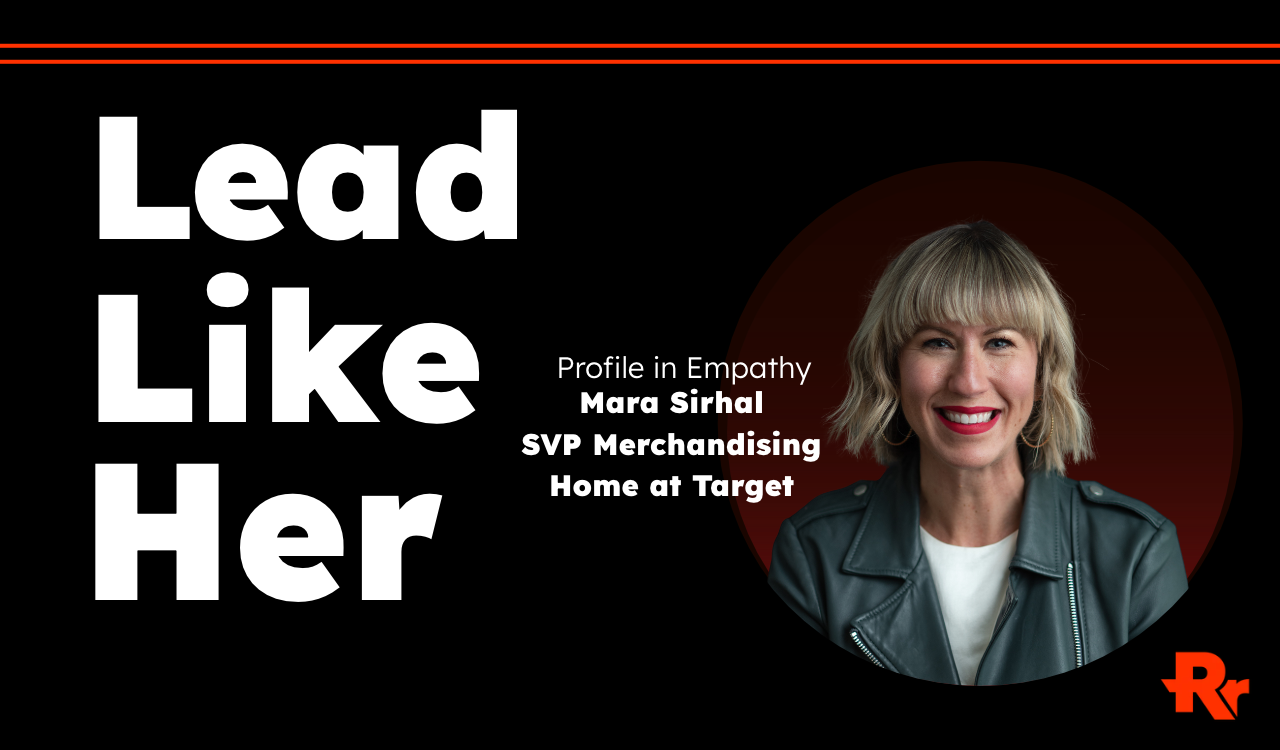

Retail is at a hinge point. Mara Sirhal is Senior Vice President of Merchandising Home at Target and candidly describes the retail business as tough; consumer count is declining, leadership teams often aren’t aligned, and friction points develop in a very volatile industry. She adds it is heavily impacted by macroeconomic factors. So, how does a leader manage these conditions? “If you spend a lot of energy wallowing in what might feel like a difficult or miserable situation, and you’re not focusing on what is within your control and what you can learn from it, then it’s all for naught,” she says. The skills leaders need are “resiliency, stamina, discerning right from wrong, and being able to understand how you hold your values in place during a tough situation.” She describes powerful leaders as individuals who, when their integrity is tested, stand firm.
Awareness and Reflection
Mara describes her career success: “Self-awareness is crucial; who are you, what motivates you, and where you gain your energy. I am a self-described hyper extrovert; I get all my energy from other people, and I don’t like to spend time alone. Competitive, ambitious energy has always described me.” As a team leader she says, “When leading a team, for me to be authentic is investing time with the individuals on my team. Doing that early on is finding opportunities to visit stores and go to dinner together, because not everybody’s a hyper-extrovert. Really learning and listening to the stories of a lot of my team members and seeing what it feels like for them and what motivates them to go forward inspires me”
She adds, “I think it is non-negotiable to build trust, and you have to show genuine interest in the other person, what makes them tick, and what excites them. How do you shine your light on that individual, giving them credit and recognition? The true mechanics of good leadership is being self-reflective, like the age-old ‘treat others how you want to be treated yourself.’ The energy, excitement and joy of seeing my team succeed is just perfect. Those moments are important for total team togetherness.”
Training Ground
Taking a few steps back, Mara started her career with a love of fashion and the vision that she would be the next Donna Karen. “But It turns out I have zero artistic talent!” she says. When she realized fashion design was not going to be her path, she pivoted to retail management. “I have loved it ever since I started working in stores, being directly with the customer, then pursuing the career track. For my first job out of college, I was fortunate to be recruited on campus at Syracuse to join the executive development program at Macy’s when it was Federated before it rebranded as Macy’s Inc. I was on the product development side. It was an amazing opportunity to start my career with a cohort of peers, and the executive training program was a cross-section of individuals from all different universities, places, and spaces. It was a unique way to bond and build friendship and teamwork early on, and then having that support system. It opened the aperture to what retail is.” She recalls, “My first boss was tough, and she made a big impact on me because she held me to a standard that I needed to elevate to at the time. When you’re still growing up and quite young, you’re out on your own for the first time grappling with insecurity and over confidence, and she got me really on my toes. I also had a really amazing HR mentor; someone who was really invested in me. “
Lattice Not a Ladder
Mara believes that a career is not a straight line. “I started out in product development and sourcing, but I always had this hunger to be a merchant. To move from sourcing, I needed to technically take a step down to learn buying. So, I went from a director level to an associate buyer. To get ahead in the long term, you often need to sacrifice in the short term. I’ve always coached about thinking of one’s career as a lattice versus a ladder. Many, many, many times I’ve taken what would be considered a lateral move or even a step down to get a new experience, and it helped me develop into one of the first omnichannel merchants at Macy’s looking at merchandising as a holistic function that serves all channels. It positioned me to move quickly up to a level of leadership that was unique. I think the lattice approach is the long-game approach.”
Being open to learning and new experiences is supported by understanding oneself. As Mara says, “Having a lot of humility, acknowledging being vulnerable, and accepting feedback is my leadership style to success. Also knowing that a misstep is not a failure. Learning about myself professionally is being able to advocate for myself; if you understand how you operate, what motivates you, what scares you, and what creates a potential a backslide of confidence, then you’re able to advocate with both your supervisor and peers. Nobody’s a mind reader.”
Humility and Openness
Mara believes, “Whether you are the pyramid leader of a big business or just starting, people should be themselves with a good balance of humility and openness to feedback. Also, you cannot underscore the importance of learning from the experts. If you’re not the expert, but you’re being called on to bring a leadership perspective and drive change, you have to know who to trust, who are detractors, the fence-sitters, the promoters, who’s open to change, and who’s a sharer to lean on the right people.” She adds, “I think a lot of leaders struggle when they can’t pivot to lead the collective. They don’t ask the questions they need to ask versus thinking they have all the answers. One thing I’ve been working on is how to transition from a leader and the protector to being the guide. A guide mentality is asking the right questions. It’s also being patient. The journey can sometimes be hard so it’s a good reminder that you don’t have to be the expert; there’s no way you can.”
Unlocking the Conversation
“In retail, it always comes back to the customer who unlocks the conversation to find solutions. What is the customer telling us? How are they engaged with what we’re doing today? Where are they not engaged? Where are we losing? Market share and competitive edge are based on how we measure those things, which are unilateral in any sort of consumer and retail business. I think we have an opportunity as an industry to leverage technology so much more deeply in the craft of retail. Take merchandising; it takes at least eight months plus from conception of a product to delivering it to the sales floor. How are we leveraging technology to shorten that timeline while also using it to fortify what we know about our customer? “
She adds, “Retail is a big business that’s very reliant on connected systems that become outdated so quickly. The agility we need in technology is to move faster. If we’re using outdated technology, we’re not learning in real time from the customer what they want and why they want it.” She says that fast fashion had such an advantageous approach ramp because it was designed to respond to insatiable needs and trends.
A New Balance
In reflecting about the success of women in business, Mara believes, “It first starts with the board, because ultimately, a governance board, whether it be a private or a public company, is responsible for CEO succession. We do not have enough diversity on boards to allow for the right balance of voices.” She believes a good guideline for board composition and employees in a retail business is to reflect the consumer base. “Are we mirroring who’s serving at the senior level to make sure it’s reflective of the customer base, embracing differences?”
Mara concludes, “I see a lot of responsibility on how board candidacy is evolving from a demographic, gender, and race standpoint. Also, since a female leader is more comfortable being vulnerable, comfortable, and emotionally connected with the organization, it in a way that may be different, it may be uncomfortable. So, I think there are many ways that we can do a better job, but ultimately, if we want more women in the CEO role, we have to plan for that.”