

TikTok Shop is crushing it. It has driven $64 billion globally in GVM—nearly $12 billion in the U.S. alone, according to Capital One—since its official launch in September 2023. It has been a game changer, with billions more in spending that it has influenced across the retail ecosystem. The engine behind all that ecommerce is built for speed, not substance. The 20-30 second video is the TikTok sweet spot—the same length as a TV commercial. Only a fraction of creators venture into the two-minute zone that conveys richer content with peak engagement, according to SocialInsider.
How did Adidas and Nike break the advertising mold? And the answer is longform storytelling that resonates and is relatable.
Tell Me a Story
A recent Ipsos meta-analysis of 15,000 ads found that half remain rooted in traditional product-benefit messaging without narrative-driven story content. The other half that tells stories are three times more memorable and twice as effective in driving sales.
“With one in two ads focusing mainly on selling product features, rather than delivering an experience, we see this as a hugely missed opportunity,” said Adam Sheridan, Ipsos head of global products and analytics. “Our research found that ads that put stories at the heart of the experience are significantly more likely to increase sales.”
Marketers are rapidly reaching the storytelling limits of the 30-second video ad format. As Seth Godin observed, “Marketing is no longer about the stuff you make, but the stories that you tell.” And telling real stories—the kind that build trust, tension and emotional engagement— takes time. Short-form videos can grab attention, but they rarely sustain it. They are disposable content, fleeting, and unmemorable.
Think about the story of The Three Little Pigs. The tale takes only a sentence or two to read. But the eight-minute Disney cartoon has become a classic—a shared cultural memory—because it has suspense, humor, character development and an emotionally satisfying resolution. That’s the gap marketers are facing now; the difference between content that flashes by and storytelling that stays with you.
Beyond the 30-Second Limit
Some brands are taking video commercials to the next level, borrowing Hollywood-grade production values and often featuring the current celebrity roster. At the luxury level, Gucci produced a 30-minute film called The Tiger — co-directed by Spike Jonze and Halina Reign and starring Demi Moore, Edward Norton and Ed Harris—to premiere the Gucci “La Famiglia” collection. It only got a 5.7/10 rating on IMDb, proving that it takes more than big names to score a hit.
LVMH is using a different tactic: it’s stand-alone 22 Montaigne Entertainment group under Anish Melwani, chairman and CEO of LMVH North America, extends the conglomerate—which owns over 70 luxury brands—beyond product placement into content creation through full-scale audio, television and film production. “At LVMH, we view each Maison as a house of stories, a distinct creator of culture. We embrace the belief that these narratives are meant to be experienced rather than simply told,” Melwani said.
L’Oréal released a 30-minute documentary, “Meeting the Moment” featuring Olympian Noah Lyles and soccer player Jule Koundé. Heineken also took the documentary route with its 10-minute “The Pub That Refused To Die” video. Following a different path, United Airlines teamed with Hallmark for a four-minute holiday mini-movie built on the network’s proven rom-com formula.
E.l.f., through its in-house entertainment group E.l.f. Made, has produced numerous long-form spots, including “Cosmetic Criminals” and “Vanity Vandals,” both shot in true crime “mockumentary” style. Red Bull and Mailchimp also have their own in-house entertainment arms. And the list of brands stretching into long-form keeps growing: CashApp, Uber, Gushers, Tecovas, Texas Pete, Garage Beer and more.
And the pioneer of them all, Chanel has been producing evocative stories since Baz Luhrman directed the three-minute N°5 The Film starring Nicole Kidman in 2004, and Karl Lagerfeld wrote and directed his first cinematic project in 2008—a 10-minute silent film about Coco Chanel. More recently, A$AP Rocky and Margaret Qualley starred in the quixotic and captivating “engagement” video directed by Michel Gondry.
Watch Party
The key to the success of long-form hinges on whether the story is strong enough to hold an audience. New York Times Advertising senior vice president of creative and strategy Vida Cornelious explained, “The ultimate test of success is, if you removed the logo, would this be a film you would watch? If the answer is no, it’s just a very long ad.”
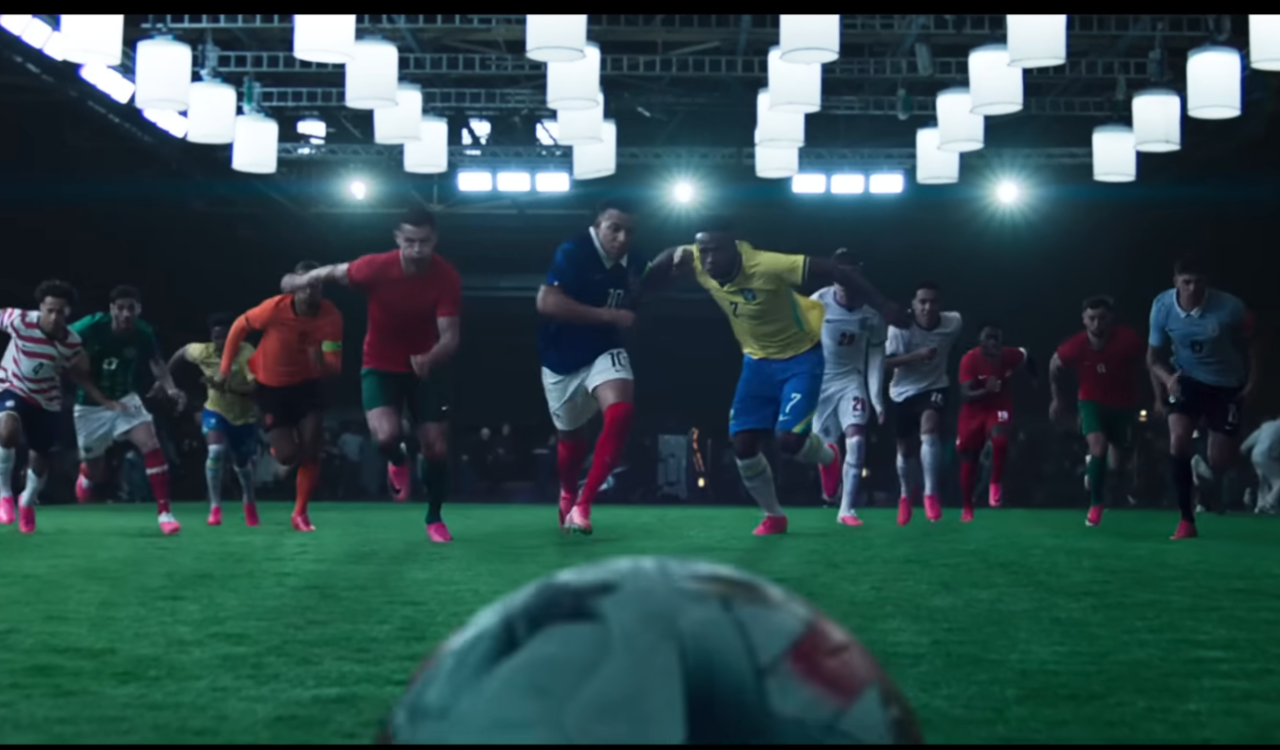
Nike and Adidas have just released long-form videos for the FIFA World Cup which pass that test. Each brand demonstrates what long-form video requires: a compelling story arc and characters worth following. But for my money, Nike’s “Rip the Script”—a six-minute delight—takes the trophy. It’s a film that invites replays.
Full disclosure: I know nothing about soccer, a.k.a. football, or the names and faces of any players, with the exception of David Beckham, who appears in Adidas’ “Backyard Legends” five-minute video. Yet, I found both films thoroughly engaging and highly entertaining with meaningful stories.
Adidas’ “Backyard Legends” takes to the city streets, where three neighborhood kids—including one girl—challenge any three-person team to a match on an urban asphalt basketball court serving as the soccer pitch. The film, starring Timothée Chalamet (channeling Marty Supreme) traces the pickup team’s journey from the 1990s to today, tapping into the nostalgia trend popular among Gen Z. The street-smart kid face off against professional ringers, including Lamine Yamal, Jude Bellingham, Trinity Rodman, Zinedine Zidane, Alessandro Del Piero, and Beckham. And pop-star Bad Bunny and Argentinian footballer Lionel Messi appear in the stands. The film’s ultimately satisfying kicker: The kids never lose. It’s a clever, relatable, feel-good story.
Nike brings out more than just its roster of footballers; it features (if you pay attention) other cultural icons, including Serena Williams, Channing Tatum, Travis Scott, LeBron James, Kaitlin Clark, and Kim Kardashian, who does a cameo as a typical soccer mom alongside son, Saint West. As marketing pros, the film’s vignette structure is intentional: each Nike moment can be spun off as a standalone short take.
Ostensibly, the film introduces the new high-tech Mercurial Superfly and Vapor soccer cleats, but it is really a foundational pillar of what the company calls the “Universe of Nike Football.” Helena Thornton, vice president of Nike brand management, explained the strategy in a behind-the-scenes podcast: “We had to be really clear about how people consume stories and how they engage with brands. It’s not just a linear journey around one particular story. It was about managing the idea that Nike has a clear identity—creative, attacking, instinctual, and joyful. The power of the universe allows us to talk about different things but never go far away from who we are at our core—the values, the discipline and the principles that have built Nike football.” Andy Walker, Nike vice president and creative director, brand design, said, “It’s the biggest thing we’ve ever done.” “Rip the Script” is not just a long Nike commercial—it’s Nike asserting brand leadership through powerful, compelling storytelling.
More Than a Movie
Each iconic brand demonstrates what long-form video requires: a compelling story arc and characters worth following. Both films draw comparison to Apple’s “1984” Super Bowl commercial. That one-minute spot didn’t simply launch the Macintosh computer. It positioned Apple as an indomitable cultural force and raised the bar for the entire advertising industry. “Backyard Legends” and “Rip the Script” have the same potential as watershed moments for both brands’ momentum and the continued evolution of long-form advertising. But most importantly, for Nike, which has been struggling, it puts the brand back at the center of the conversation around sport as a growing cultural and commercial force.
“Rip the Script”— and the strategy behind the Nike universe—could just be the beginning of Nike’s return to greatness under CEO Elliott Hill. But Hill is not taking any victory laps yet, despite the video garnering over 75 million views as of this writing. He’s letting his brand team take the glory now and will have his moment soon in upcoming earnings calls—year-end fiscal 2026 is scheduled for June 30.