


In the late 2010s and early 2020s, Glossier reigned supreme. For influencers and wannabes alike, there was no better indicator of status or relevance. Their products became cult favorites, their millennial pink branding was instantly recognizable, and they transcended their market, becoming not just a makeup and skincare brand, but a way of life.
You Look Good
Glossier store visits were social experiences as much as retail destinations—fodder for Instagram stories and ways to generate serious clout. Their products were synonymous with popular fashion and influencers, and when Timothée Chalamet stepped out in that infamous pink hoodie, Glossier logo emblazoned on his chest, the girls went wild.
Glossier was clean girl before clean girl. Their products were beginner-friendly and relatable to consumers, pioneers in the field of barely-there, “no makeup” makeup. But now, that category has been overwhelmingly dominated by other brands. Influencers look to brands like Rhode, Ilia, and Summer Fridays, where Glossier once would have been the clear choice.
The house that Glossier built has new occupants. Somewhere along the way, the brand was edged out of the niche it established and is now facing major reconstruction. The brand that once set the standard for effortless, minimal beauty is now playing catch-up, forced to adapt to a market preoccupied with its replacements.
Will Glossier get its relevance back? And the answer is: Once trust and brand promise is gone, the brand may never regain its footing.
Origin Story
Glossier was founded in 2014 by Emily Weiss, a Vogue employee and popular blogger. Weiss’ blog, Into the Gloss, was a forum for sharing personal skincare and makeup routines. The inclusivity and authenticity of the blog influenced Weiss to form the brand, which she marketed with the philosophy, Skin First. Makeup Second™.
Glossier started selling products DTC before transitioning into a more wholesale model. Its first offerings were relatively bare bones, but the brand eventually expanded its offerings. The company initially received seed funding from Forerunner Ventures, a San Francisco-based venture capital firm. They opened their first in-person store in 2018 and started selling through Sephora in 2023.
in February 2026, CEO Colin Walsh laid off about 30 percent of Glossier’s workers to increase profitability. This past March, the brand announced the closure of nine of their 12 locations, with only the New York City, Los Angeles, and London locations remaining open. Reportedly, the strategy was to focus on the most profitable locations. The announcement came around the time new CMO Nicole Solorzano, formerly with the haircare brand OUAI, was hired to “manage the brand’s next phase.”
What Went Wrong
Glossier’s meteoric rise to fame matches its equally volatile plummet. Once valued at over $1 billion at its peak, the brand has since faced a notable drop in valuation of 50 percent from its peak valuation of $1.8 billion in 2021, despite efforts to cut costs and regain profitability. The company’s decision to close 75 percent of its retail locations further underscores the bleakness of Glossier’s future.
The brand’s financial fragility reflects a perfect storm of a revolving door of executives, the challenge of DTC to transition to physical retail, loss of trust, and the devolution of the original philosophies that defined Glossier. All told, these developments paint a picture of a brand not just losing cultural relevance but grappling with deeper structural and financial challenges.
Product Flux
As a Gen Z, I can vouch for Glossier in its better days. Its former cult-favorite status was largely driven by the efficacy and approachability of its core products. Consumers didn’t just like Glossier, they swore by it. The brand cultivated emotional loyalty from its customers by delivering reliable and effective products.
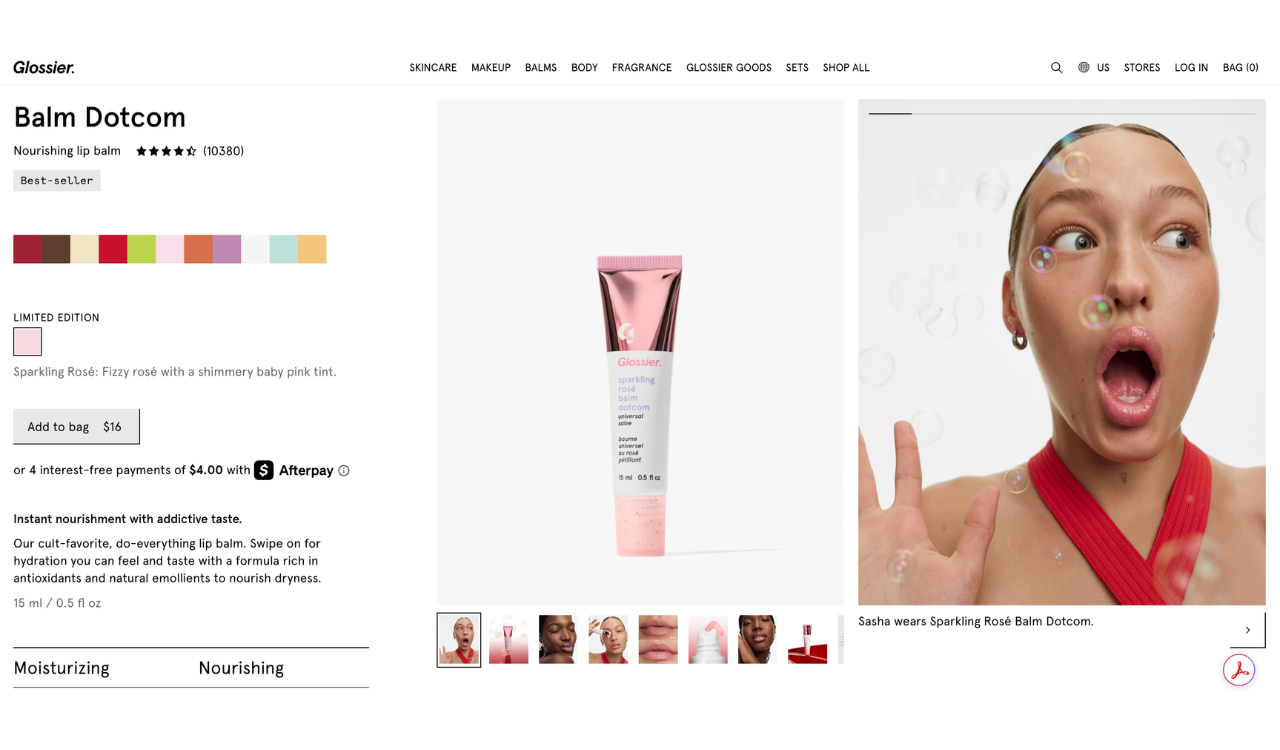
However, over time, shifts in product formulation and design began to disrupt that trust. One of the most notable examples is their Balm Dotcom, a multipurpose lip and cuticle balm. The removal of lanolin—a key ingredient that contributed to the product’s consistency and effectiveness—significantly altered the formula. While Glossier responded to backlash by reverting to the original formulation and relaunched it in new packaging, the results failed to replicate the original experience. The change wasn’t just functional; it impacted the sensory and nostalgic connection consumers had with the product, and even when the original formulation was reinstated, that disconnect remained.
Similarly, Glossier You, a perfume from the brand, underwent reformulation, leading many long-time customers to claim that the scent no longer smelled the same. Because fragrance is so deeply tied to identity and memory, even subtle changes can feel significant. For a product marketed as a “skin scent” that adapts uniquely to the wearer, this shift felt especially personal.
These reformulations and packaging changes alienated Glossier’s most loyal customer base. The very products that once served as entry points into the brand, and helped define its identity, no longer delivered the same experience that customers had come to love and trust. Ultimately, by messing with its core products, Glossier weakened the emotional connection that fueled its original growth. When a brand built on loyalty and word-of-mouth changes the products people evangelize, it doesn’t just update a formula—it drives a wedge between the brand and its audience.
What Now?
Glossier remains a recognizable name in beauty, but its position in the market has significantly shifted. The brand still maintains brief moments of relevance through seasonal, limited releases, and branded accessories, which continue to generate short-term interest and nostalgia among previous and existing customers.
However, despite these efforts, Glossier no longer holds the same cultural dominance it once did. At its peak, the brand went hand in hand with both mainstream and underground aesthetics and was often the first choice for beginner makeup users seeking a natural, effortless look. Today, that positioning has been overtaken by newer competitors such as Rhode, Rare Beauty, and Summer Fridays. These brands have successfully co-opted the beauty industry, offering products that feel more aligned with contemporary consumer preferences and trends
For a Gen Z like me brand trust and aspiration can be built quickly through viral social media trends or influencer campaigns. Brand legacy isn’t what we prioritize; current perception is. When we see a TikTok of a peer trying out a product, we are influenced to try it ourselves. Short-form content feels more relatable and accessible than a staged campaign and allows us to see how a product performs on a real user. Peer validation and advertisement heavily sways us and helps build our trust in a product. Singular viral products can be a gateway to a brand for us, but if that product disappoints, the entire brand is rejected.
We also want transparency and authenticity from brands, but there’s a fine line. When a brand tries too hard to be trendy or relatable, it drives younger consumers away. When they don’t try hard enough or use their platforms to advocate for our values—such as sustainability, inclusivity, or advocacy—they also lose their audience. Gen Z isn’t focused on the financials of a brand or who they’re hiring. They want to see alignment with their own consumer values. If a brand feels inauthentic or too profit-focused, they will call it out and move on to a competitor.
Glossier started as a minimalistic, community-first space for sharing beauty tips. As it scaled up, it lost that relatability and personal element. When influencers stopped featuring Glossier in their content, it stopped being an aspirational brand, even if its offerings remained the same. The brand was no longer linked to Gen Z icons and so stopped being an investment in trendiness and social status.
Gen Z has the power today to make or break a brand. Loss of core values and virality, like in Glossier’s case, kills cultural relevance. Once a brand falls out of everyday conversation, especially in Gen Z’s social media landscape, it’s incredibly difficult to recover. As a result, it is unlikely that Glossier will return to the scale of influence it once had. While it can continue to operate successfully as a throwback or niche favorite with a small but dedicated customer base, the brand has largely been replaced at the forefront of the beauty conversation. In the beauty industry today, Glossier is no longer the it-girl—it is the has-been.