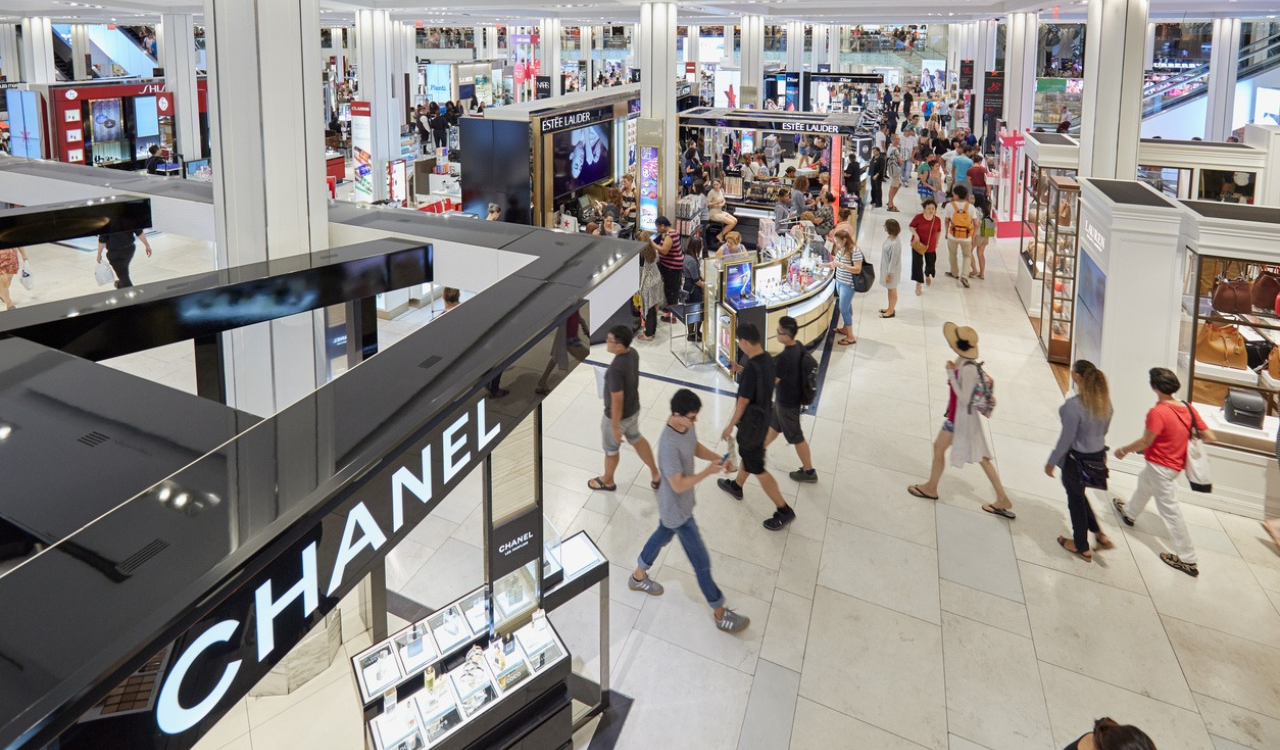

In the Paris headquarters of the International Association of Department Stores (IADS), retail expert Christine Montard has been busy. From her perch as Director of Market & Events for the 98-year-old global organization, Montard has been cranking out messaging that shines a not-always-flattering light on beauty retail around the world.
Be it Galeries Lafayette Haussmann, John Lewis’s Liverpool location, Tryano in the Middle East, or Chile-based Falabella, department stores have long since ceded their traditional authority as destinations for beauty discovery, but paradoxically, the category remains integral to both store identity and the bottom line. “Beauty is no longer simply a category,” Montard wrote in April. “It has become a strategic cornerstone for department stores, as the category is booming but is also highly challenged.”
Why have department stores lost their lead as a beauty destination? And the answer is: Ulta and Sephora make the discovery experience easier and more interesting.
Beauty Business Reset
I reached out to Montard in July and asked her for the biggest takeaway from The Great Beauty Reset. “Wellness is still an ill-defined category overseas,” she responded, “with each department store proposing, or not, its own version expressing its DNA, whether it’s Harrod’s with a high-end, results-driven clinic or Galeries Lafayette building a broad wellbeing destination. I would add John Lewis, as they unveiled new sports and wellness spaces combining sportswear, wearables, recovery, AI-powered fitness and expert services, offering a third perspective on wellness.”
Six months later, Montard is back with more dire headlines asking, “Is Department Store Beauty as We Know It Dead?” As much hype as the “wellness” category gets, it turns out it isn’t proving to be an automatic slam dunk. As a bellwether, Montard cites a percentage of discontinued services at Galeries Lafayette’s 3000 square-meter Wellness Galerie as just one example of the way the category may not hold as much promise in the department store sector as it does in the world at large. Opened in 2022, the retailer initially dedicated a whopping 60 percent of space to services. Clearly, that old adage “if you build it, they will come” didn’t pan out exactly as the French retail giant had originally hoped.
The fact that the estimated $6.8 trillion global “wellness” category is still finding its sea legs in traditional department stores is one thing; watching it not capitalize on the massive uptick in interest in skincare, makeup and fragrance in recent years is another tragedy altogether.
Traditional Retail Beauty Decline
From 2022 to 2023, the global beauty market climbed 10 percent, to $446 billion. And last year, McKinsey predicted the market would grow by 5 percent for the next five years. If only shoppers were heading to department stores to buy all that beauty merch, only 24 percent of U.S. shoppers visit a department store to discover beauty newness. Instead, 71 percent head straight to Sephora or Ulta Beauty to discover what’s hot.
Even worse, the prestige/luxury tier—which has been on fire in recent years—is getting wobbly, especially in the skincare category. Blame it on inflation, the influx of relatively cheap Korean brands, or the popularity of a well-priced category killer, The Ordinary, but the hyper-expensive stuff is losing its luster among skin-obsessed consumers.
To recap, the department store beauty business is fading for six key reasons. Bluntly stated, they are the result of:
- Lack of foot traffic
- Inflation and price resistance, especially in luxury skincare
- Competition from specialty retailers
- Social media purchases on Instagram and TikTok
- Holding onto the old-school model of brand-centric fixturing and shelving units, while the more modern way to merchandise is via product category
- Confusion and skepticism around the wellness category
Glimpses of Optimism
In the interest of being upbeat about a market sector I adore and have written about for decades, I want to point out a handful of bright spots Montard uncovered.
First up: Beauty F by Falabella. Serving up what Montard describes as a “specialist beauty format,” Falabella has basically created a store-within-a-store format with a separate entrance that functions as a standalone retail business. Getting the thumbs-up from Montard: Open shelving that incorporates testing and staff consultation areas.
We also circle back to Galeries Lafayette. Yes, the same legendary retailer currently taking it on the chin for its foray into wellness. Montard is impressed with the way the store has created, as she calls it, “a vertical journey” spanning three floors. Rather than the old-school, outdated model of packing every ounce of makeup, skincare, and fragrance onto the first floor, Galeries Lafayette is breaking it all up: a truncated version of the slightly struggling Wellness Galerie on the lower level, fragrance and makeup on the ground floor, and luxury beauty and fragrance mini boutiques (think Dior, Chanel, and Maison Francis Kurkdjian) on the second level.
For U.S.-based retailers, it’s heartening to learn that the rest of the planet is also struggling to capture and keep the increasingly sales channel splintered beauty consumer. An honest assessment of the difficulty department stores are having capitalizing on the massive wellness category is undoubtedly a breath of fresh air for any retailer wondering why it’s cleverly merchandised display of lymphatic drainage tools isn’t moving. That said, through a global lens, beauty may not be the easiest sale in department stores these days, but it’s well worth the trouble of sorting out. Consumers are clearly beauty driven; but not every retailer is as adept at capturing those hard-earned bucks as category killers Ulta and Sephora.