
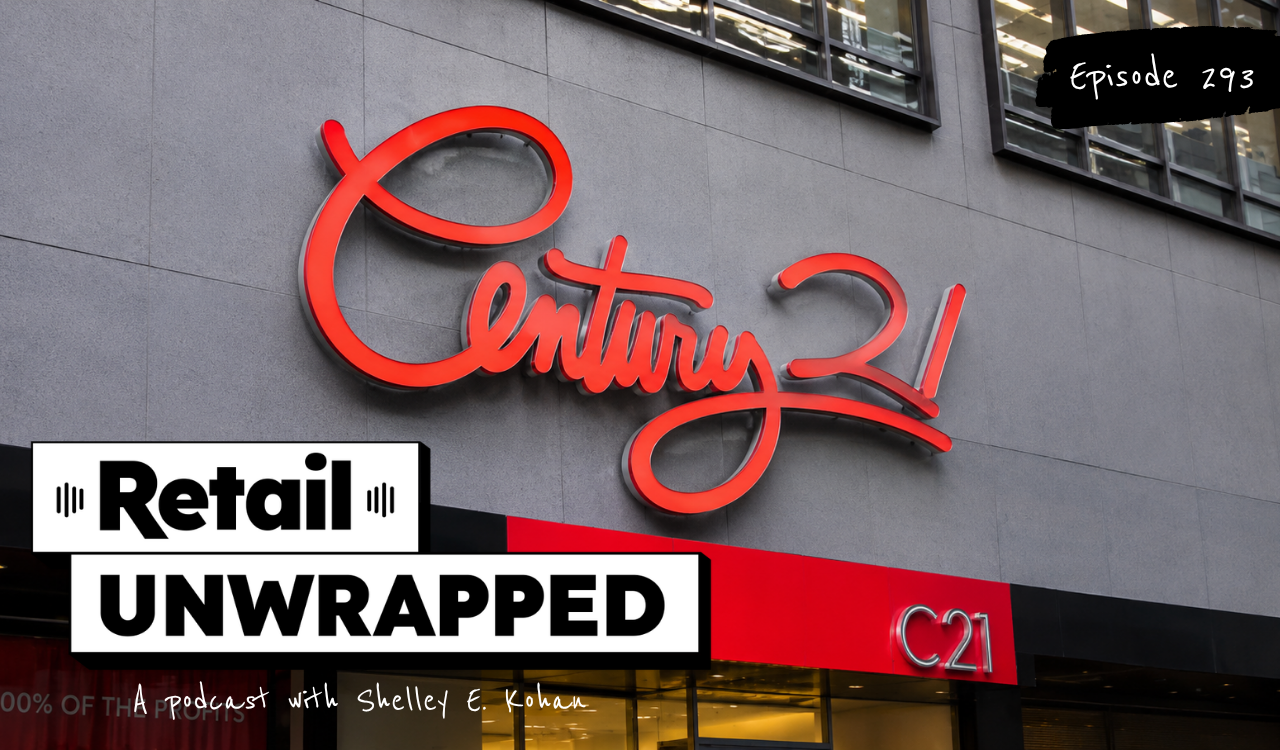

Iconic Century 21 closed its doors in 2020, not the first retail victim of the fallout from the pandemic. Five years later the brand’s comeback story marks a page in retail lore. Join Shelley and Larry Mentzer, COO of Century 21 NYC as they tell the story of the courage it takes to learn from mistakes and protect a legacy. They discuss second acts, managing a balance sheet, competing in physical retail and the dramatic shift in shopper behavior. In a frenzied digital marketplace, they reveal that FOMO is no longer a tactic, it’s a survival strategy. Creating urgency inside a physical store based in lower Manhattan, particularly without an ecommerce safety net, is now a core operating discipline to win Gen Z and rebuild a heritage brand.
Special Guests
Larry Mentzer, COO of Century 21 NYC
Transcript
Shelley E. Kohan (00:03)
Hi everybody and thanks for joining our weekly podcast. I’m Shelley Cohan and I’m very excited to welcome Larry Menzner, COO of Century 21 New York City. Welcome Larry.
Larry Mentzer (00:14)
Thank you, it’s a pleasure and really an honor to be here. I’m excited.
Shelley E. Kohan (00:18)
I know it’s great having you here. We kind of were talking a little bit beforehand how Robin Lewis and you go back many, many years as well as the founders over at Century 21. So it’s great to have you here with us today on Retail Unwrapped. And today we’re going to talk about a probably one of Retail’s most iconic comebacks. And it’s great because Larry, you were at Century 21 pre-pandemic and probably through 2020 and now you’ve come back. So
It’ll be really interesting to hear from you, your perspective then, now, and kind of what we can look forward to in the future. But before we jump into the of the meatier topics, maybe you can give a overview of what Century 21 is, why it’s important, the New York City heritage.
Larry Mentzer (01:05)
Sure. Well, we get a lot of a lot of that based on our name. Unfortunately, clearly we share a name with another company. But Century 21 is really the original off price retailer. We launched in 1961 in New York City by the Gindy family. They were inspired by a trip to the World’s Fair, actually, that year. And the fact that having everything available to everyone was one of the messages that they took away from that and thought, wouldn’t that be great if that was
true
in retail as well, that everyone could afford great things, that everyone could get a great value and get a great deal. And that was really the founding of the company that that how can we bring today? We talk about designer brands at amazing prices. That wasn’t the message back in 1961. Certainly we were selling different items, but it’s evolved into really how do we make what is often not accessible accessible to everyone?
We started in New York City. We lived through the financial crisis. We lived through 9-11. We lived through COVID, came out of that as a slightly different company, but still in New York. We believe in New York. We were born in New York ⁓ and we think our future is there as well. So we’re a fashion company. We’re a trend company. We’re a retailer. We’re an employer and we’re a neighbor to everyone in New York and quite honestly around the world. We’re a destination for tourists.
⁓ It’s really an amazing place.
Shelley E. Kohan (02:38)
so interesting. So first I have to tell you that both my sons, one is 21 soon to be 22 and the other one is 18, love Century 21. My son lives down in Phaidi now, the older one, and he’s always saying, mom when you come down let’s go to Century 21. I’m like okay let’s go, but it’s really a
Larry Mentzer (02:46)
That’s great to hear.
Well, that’s amazing. We’re
trying to become a neighborhood store. It’s funny you say that, that he lives downtown because it’s, you know, post COVID, it’s become such a different environment downtown with a lot of folks relocating to downtown versus just working down there. So becoming a neighborhood store is one of our initiatives and it’s great to hear that it’s working or happening, especially with the younger demographic.
Shelley E. Kohan (03:18)
Yeah,
definitely. And he’s definitely fashion forward and he thinks you offer a great value and diversity of products. The other interesting fun fact is every time I’m in the store, it’s kind of funny to me. I’m sure you love this, but I find it kind of funny. know, customers are walking around with suitcases in the store and I, I, it’s the tourists, right? They come in and they…
Larry Mentzer (03:24)
Amazing.
It really varies with the exchange rate of the dollar and the euro. But the more advantageous it is for European tourists and even those from South America, not as much lately, but they will fly to New York with nothing and first go to our luggage department and buy a 29 inch suitcase or two and then start their shopping journey and leave with suitcases full of designer brands at amazing prices. Just really great product that they can’t get wherever their home country is.
at the same prices that we offer it at. So it’s exciting and it’s fun to watch.
Shelley E. Kohan (04:14)
love that. So I mean you’ve been around retail a long time. You’re like me a retail warrior. You were with Century 21. You left in 2020. What pulled you back in now? What was that inspiring, motivating thing that pulled you back in?
Larry Mentzer (04:19)
Yeah.
Well, I didn’t leave by choice. ⁓
None of us left by choice. I came to Century 21 in 2011 from Macy’s. I had spent 20 years there. ⁓ Loved my time at Macy’s, learned a lot, worked with amazing people. ⁓ Really was a great laboratory for, I think, folks that wanted to learn. ⁓ But it was time for me to go and I wanted to do something different and I was recruited by a recruiter to go to Century 21 in 2011. At the time we only had six stores. It was a very small, inclusive, privately held company. ⁓
very happy with what they were doing. And over the course of ⁓ at that point, nine years there, you we had doubled the size of the company, doubled our volume, launched an e-comm site, took the brand from just a New York, New Jersey ⁓ company to opening a store in Philadelphia, opening a store down in Sawgrass, Florida, really driving our international business online. And it was exciting. And then COVID came. ⁓
and clearly disrupted our company. We were very heavily dependent on tourists in New York. Our flagship store was in New York. It was doing a third of our business. And as we saw the tourists start to evaporate in late 2019 and then January and February of 2020, you could really see what was happening. We closed in March of 2018, as all companies did based on mandates from the government just for public health reasons, thinking it would be a few weeks, but unfortunately it was a few months.
and reopened our stores in a phased approach based on what local communities were allowing starting in June of 2020, but it just quickly became not sustainable. And unfortunately in September of that year, did file for bankruptcy and the…
family made the decision to close all of the stores. I stayed on until December 6th of 2020. And even during that time, you know, the conversation was, you know, when will we be back? So we always knew we would come back. I didn’t know if I would come back. I then relocated to Florida, where I where I live now. ⁓ And after about six months of trying to figure out why you work your whole life thinking you want to retire within didn’t really have anything to do. ⁓
in a phone call with with one of the owners of Century 21, said, you know, let’s try to get the band back together. And ⁓ I was very excited to come back in a different role. had been the chief revenue officer and came back as the chief operating officer ⁓ in a very different, much smaller company. But ⁓ our work wasn’t done. That’s what got me to come back. I commute back and forth now from Florida to New York. A little different than from New Jersey to New York, but. ⁓
Shelley E. Kohan (07:11)
Ha ha.
Larry Mentzer (07:17)
I love it. I love retail. love the family. I love the brand. I think we’re doing something that’s not as unique in retail as it used to be with off price. It’s clearly the channel to be in now. But we’ve been in it for well over 60 years. ⁓ And it’s great to continue to learn and evolve and bring the message of designer brands at amazing prices and great value to a new generation of shoppers. So it’s exciting. It’s exciting. And I’m happy to be there.
Shelley E. Kohan (07:45)
It’s
exciting. I love the Heritage brand story because I met the Gindi family and they’re just like so gracious and they’re just amazing family. So I can imagine how you wanted to come back and and work with them and quite honestly, you know back in March of 2020 there were a lot of retailers that were in the same situation and the bankruptcy but we don’t have to go down that road. So now you’ve been open three years I believe so how’s it looking?
Larry Mentzer (07:51)
Yeah, yeah.
Yeah,
Yeah, yeah.
It looks good. It’s it’s it’s we reopened May 16th, 2023. So it was just three years last week. Thank you so much. It’s great to be three. You know, we continue to learn. We continue to to.
Shelley E. Kohan (08:24)
Happy anniversary.
Larry Mentzer (08:33)
really research the business and the brand and who our customer is today because it’s not the same. ⁓ I think
we all thought, myself included, that when we closed in 2020 and we reopened three years later and it would be the same. ⁓ It’s not the same. The world has changed. New York has changed. The customer’s changed. Quite honestly, we’ve changed as a
Shelley E. Kohan (08:51)
Yeah.
Larry Mentzer (08:56)
⁓ And it took us a moment to kind of relearn the business. ⁓ You people shop differently.
today than they did in 2023 and certainly versus 2020. Hybrid work schedules, the casualization of America, ⁓ the, I hate to call it the death, but the decline of the traditional department store, the growth of off price and fast fashion ⁓ has really changed the business. I will say, think for the better. ⁓
But it’s been a bit of a learning curve. You we opened as we closed thinking that was the right thing to do, but quickly realized while there’s good sold and the results were amazing that we were noticing trends in the business that taste had changed. You know, it’s not so much about suits and ties and professional work attire that it really became more about trend and where now not fast fashion, but where now ⁓ must haves ⁓ great value, which is what
Shelley E. Kohan (09:51)
interesting.
Larry Mentzer (09:57)
we’ve
always been known for but ⁓
FOMO, while it’s all that whole fear of missing out, like if I don’t buy it today, that urgency has always been a piece of what we did well. But it’s now what we have to do well, ⁓ especially without an online business. We’ve got to grab the customer when they’re in the store and get them to hold that item, whatever it might be and think, I got to have this today. I’ve got to take it today. ⁓ So it’s been a bit of a learning curve. We’re happy. ⁓ You know, we’re growing. ⁓
But it’s definitely different. It’s definitely different. It’s still retail, but it’s just not the same.
Shelley E. Kohan (10:36)
so inspired and humbled by what you just said because when you think about it and you think about the amount of experience in that room and the Gindy family with you to say that we had to relearn the business wow that’s really like good for you guys because I do think it’s changed
Larry Mentzer (10:49)
Hmm.
I just. Yeah,
once you stop learning, you stop growing. And I know it might sound like, well, no kidding. But, you know, we could continue to do what we had always done.
in the same location under the same brand name, Century 21, although we added NYC to our name going forward. But you got to keep up with the customer. You have to meet them where they are. And I think that’s true for every anyone who’s selling anything, whether you’re a restaurant or a retailer or any kind of service provider. It’s important to meet the customer where they are and learn from them and grow with them or else they’ll find someplace else to to take their wallets. And we want them to bring it to us every day.
Shelley E. Kohan (11:12)
Nice.
Of course,
and I’m sure it’s like a balancing act because you have this very strong identity like people in New York and people that have shopped Century 21. They’re very branded and I think they’re very loyal to Century 21 yet you’re also trying to reshift, rethink, pivot, change. So to me it seems like a balancing act between the two.
Larry Mentzer (11:52)
That is one of the big challenges. just finished a project with ⁓ the Columbia School of Business, actually, where they came in and did a deep dive at Century 21 with a whole group of, know, Gen Y, Gen Z, Millenniums, Gen Alpha, everyone under the age of probably 27. And it was painful, quite honestly, to hear their take on our business. ⁓ And we had to keep reminding ourselves that we invited them in. We said, come tell us what we’re not doing right. And, and…
hearing from a group of young folks that are all definitely under 30, mostly under 25, you ⁓ know, New Yorker students, people who are who are in New York, not all fashion folks, but definitely trendy younger generation. What they liked about our store and what they didn’t like ⁓ was an amazing learning experience. ⁓ You know, we can continue to try to address people like myself that are 60 and above, but your needs change. Many of those folks are retired. As I said before, they’re not getting dressed
up. Career wear is not what it used to be. ⁓ Shopping is not what it used to be. We don’t want to lose them as a customer and we don’t want to lose the tourist as a customer because we know we’re a destination, but we’ve got to.
And we are figuring it out. So I’ll say we’ve got to figure out how to attract the next generation of customers. How do we capture them while they’re between the ages of 20 and 30? So when they’re in their prime income earning years of 30 to 50, that they’re bringing their wallet to us because the folks that right now are 40 to 60 in the next 20 years, if they’re not shopping a lot now, they’re going to shop even less in the next 20. Attracting that next generation, becoming relevant to them, driving awareness
to them, meeting them where they are, which is not where I am as a consumer, but it doesn’t matter, ⁓ is really what’s going to guarantee us success in the future.
Shelley E. Kohan (13:47)
so true and I have to say Gen Alpha shockingly just started working last year. So they’re the next big you know bucket that that we have to chase and they’re completely different from what they’ve grown up in. So I love that and you mentioned you’ve lived through some major cycles. You did miss one which I’m going to point out because Larry you and I lived it together and that is the Ecom boom. Remember that?
Larry Mentzer (13:53)
Yeah. Definitely. Yeah. 100 percent. Agree. Agree.
Which one? Definitely, definitely I do.
Shelley E. Kohan (14:13)
Econ
boom. So you were at, you and I were both at Macy’s at the same time. I was Macy’s West though. And you were Macy’s East back when it was called, you know, East and West. But you, so you had the econ boom, then we had the recession, then you went through the Amazon disruption, COVID. ⁓ What is, what is staying nimble look like today? I mean, you’ve, you’ve lived through some pretty massive disruptions.
Larry Mentzer (14:19)
Okay. Always yes, yes, yeah, yeah.
I think you have to have a passionate team. I think you have to have great leadership.
someone that knows how to navigate and really steward the business, not be distracted by shiny objects because there’s a thousand of them coming at you every day. Everyone’s got a great idea that they want to convince you about. And there are a thousand great ideas, but only maybe one of them is actually able to be implemented and it’s got to be right for your business. But I think what I’ve learned through all of that is don’t get distracted. Have a strategy, get great alignment from the team.
Be a great communicator. ⁓ Get people to buy into it, to trust you and to trust them. And for everyone to kind of hold on as the ship is rocking a little bit, some of those influences are created inside and some of them are outside influences and it really doesn’t matter where they come from. Everyone needs to hold on and kind of row together. ⁓
or else you’re not going to get through it. And it takes a team. really does. To keep the boat from sinking. ⁓ Everyone’s got to understand where we’re going, why we’re going there. What am I responsible for? ⁓ Motivation, trust, belief. ⁓ Everyone focused on the same strategy. That’s what keeps it moving. Yeah.
Shelley E. Kohan (15:56)
Absolutely. Larry, you
said something really important with these younger generation workers. So the workers that the millennials, the Gen Zs that are working, they do want to know the why part. They want to know why and how what they’re doing adds value to the big picture.
Larry Mentzer (16:07)
100%.
I think what’s happened is, you I grew up ⁓ before you did, I’m quite sure. But but there was there was a time where leaders were tellers, where they just told you what to do and you did it. You didn’t question it. And then that evolved into maybe coaches where the leaders were kind of the coaches trying to get you to do it to. think leaders now are really mentors. And that’s what I try to be. ⁓ I think you always need to some people need to be told. Some people need to be taught. But everyone, I think.
Shelley E. Kohan (16:26)
Ha ha.
Larry Mentzer (16:45)
can learn and grow through a great mentor, whether they want one or not. And I think this younger generation needs all three of those differently at different times. But being a mentor, someone that explains the why, let me tell you the story. Let me explain how we got here. Let me show you why this is important versus just telling you to do something. Makes a big difference with everyone, but most definitely these younger folks and ⁓ Jen Alpha, without a doubt.
Shelley E. Kohan (17:13)
sure. Okay let’s talk about Macy’s just for a second and Century 21. So Macy’s, I love what Tony Spring is doing. They’re doing great things there. He’s amazing. ⁓ But you know Macy’s is a very public company. You and I, we grew up in Macy’s. ⁓ How does that compare to working with the family-owned business of Century 21?
Larry Mentzer (17:16)
Sure.
Me too. Yeah.
Well, it’s not that different, quite honestly. ⁓
Yeah, there was an actively involved executive committee ⁓ communicating a message, cascading a message. You I was in New York City. I was the regional vice president for the New York Metro. So I had all of the big stores in New York. So there was always someone in there, always someone giving me a new idea, ⁓ complimenting, criticizing, redirecting. ⁓ So my experience might have been a little different than folks that might have been out in a suburban market. ⁓
But at Century 21, it’s a little different because the owners are actively involved in the business, but but in roles, not not as I’m an owner. Do this. It’s it’s I’m an owner and I’m in this with you. So while they do act as a board of directors, similar to what you might get from a board of directors at a public company or an executive committee at a Macy’s, they know the business, they know the brand, they know the customer and they’re passionately involved in a good way.
in a mentoring way, not in a telling way at all. So I I enjoyed my time at Macy’s and learned a lot from that experience. ⁓ But I have, along with other folks, really been able to grow as a leader, grow as a manager, because at end of the day, we’re all managing other other people or processes because of the involvement of the Gindy family, because they care so much really about protecting the brand first.
And I want to say the business second, but the brand is important to them, which is why they relaunched the brand. Like when we closed, unfortunately, sad as that was, we didn’t have to come back, but it was important to them that the work was not finished. Their legacy was important. ⁓
And I don’t know that you get that feeling as much in a public company as you do in a private company, especially when you know the owners. It’s a little it’s a little bit different. If I needed something at Macy’s and had to put in a capital request, it was like, OK, well, it’s a public company and they have money. If you need something, we want to open a new store in a private company. It’s like, gee, can you write me a check for X? Because I think we need to do this. It’s a little different. It’s a little different. But ⁓ I think both are good. I’ve I’ve learned and grown a lot through both experiences.
experiences.
I couldn’t say I prefer one over the other. But I came back to Century 21. It’s. It leaves a mark on you somehow. I don’t I can’t explain it when you talk to people that have worked or still work for Century 21 and just about everyone that came back for the relaunch were old century employees.
Not because they needed a job. Many of them had another job by then. Remember, we closed in 2020, didn’t reopen till 2023. Most folks had to or just did find other employment.
They left that other employment to come back and take a chance on a one store operation with no website, which is really not where the business was going. But because of their love of the Century 21 brand, that feeling of our work is not done here and the passion and the involvement that the family brings to the business. It’s a unique place.
Shelley E. Kohan (20:51)
Yeah, I totally agree. Everyone I’ve met there who worked there then and now, I get the same feeling from them. It’s amazing. So it’s a great culture. So let’s, I want to shift back to something you said early about shoppers and how the shoppers have changed. And maybe if you could kind of, I know you gave us some examples, but if you could talk a little bit about off price specifically, what it was then, what it is now, and why is this such a big opportunity for you?
Larry Mentzer (20:59)
Yeah, yeah, it is, it is.
Sure.
Well, I don’t think it’s any different than it’s ever been, to be honest with you. I think that if you look at the big guys, the T.J. Maxx, Marshalls, Home Goods, Burlington, Ross, ⁓ they’re not new. Their growth trajectory is relatively new. ⁓ I think a lot of that comes from changes in consumers’ preference for game playing. ⁓ I think the…
The old days of what a Macy’s would have done, for example, or any high low retailer, you know, was today it’s regular price, tomorrow it’s 25 % off, then it’s a markdown. You know, buy it today, pick it up in two weeks. That’s just not how people shop today. It’s not. So ⁓ I lived through all of that. I did it very well. Macy’s continues to evolve and do it well today. But the customers really move to something different. Mission shopping is important.
FOMO is important to them. ⁓ Simplicity is important to them. And if you think about, you know, the big guys that I mentioned, TJX, Burlington Ross, and if you’re a size small and you’re looking for a woven top, you walk in, woven tops are here and smalls are there. And these are the 30 shirts you have to pick from. Flip, flip, flip, flip, grab two and go. ⁓
Shelley E. Kohan (22:34)
That’s me.
Larry Mentzer (22:37)
That’s not the experience at a traditional retailer today or any store that merchandises by brand. We also merchandise by brand. ⁓ So I do think younger folks and shoppers today ⁓ don’t have the time to invest in shopping like they used to think. You mentioned Ecom or you could go on to any website, set the filters, have it return exactly what you’re looking for and check out in under 30 seconds and it’s at your door potentially the same day or tomorrow. ⁓
But mission shopping today is what I think makes off price different.
I need a pair of pants. know my size. I know where this store is at. I can park right in front of it. I can run in, go to the store is 20,000 square feet. It’s not a five floor, you know, 200,000 square foot box. You can really go right to what you want. It’s a quick and easy checkout and you’re done. And if they don’t happen to have what you want in that super edited curated selection of woven shirts in your size, ⁓
your time investment was not great. You you were in and out. So I think the customers just changed. think Ecom has changed the way people shop and their expectations of a physical retailer are sadly the same as they are of a digital retailer that when you walk into a store, there are no filters to set. You are the filter. You’ve got to go on the hunt. So getting a customer to do that, I think, is a challenge.
Shelley E. Kohan (24:04)
So, Century 21 put a lot of time, effort, and money into this anniversary sale that you had for May, your third anniversary sale. Tell me a little bit about why this was such a big deal
Larry Mentzer (24:15)
Well, having now been open for three years and having some of our old customers come back and we’ve acquired some new customers, it’s really an opportunity for us to thank and recognize our old customers as well as the new ones that we’ve acquired and really try to drive awareness and gain new customers. That’s really what it’s about. It’s a great marketing moment for us to remind folks that we’re here, remind folks about what you can find at Century 21 and then reward them with, I think we have
had, you know, tote bags we had, we partnered with Italy and we were giving away pizza. We’re doing a full month of double points and really trying to give value and something different and a little bit of entertainment to our customers as a way of giving back to the existing customers, as well as building loyalty going forward. It’s been three years of learning, as I mentioned at the beginning of our of our conversation, and we really want to continue to learn. And in order to do that, we need to listen to our existing customers as well as attract new
So it’s really just been a great moment to say we’ve learned a lot over the last three years. Come and check out what’s in store today. It’s not what it was in 2023 or 2024 or 2025. It’s better. It’s evolving. And we’re trying to evolve with our customers.
Yeah, definitely. We are always on the hunt for a new great location for our second store. We talk about it a lot. We are committed to physical store retailing. We think that’s the right way to grow the brand, specifically an off price retailer. So there are more stores in our future, nothing to announce today, but we definitely want to continue to grow the brand and bring it back to all of the folks that made it really what it was in its first 60 years of business and try to not duplicate the results from the first
60, but ⁓ bring it back to where it was. We feel we feel committed to that, that we owe it to our customers to bring a Century 21 back to them since not everyone can get to lower Manhattan.