

The city never sleeps, and neither does the con. I’m no Philip Marlowe but I’ve been working the grocery beat for more than 30 years. I’ve walked every aisle, shaken hands with every brand manager from Bentonville to Dubai and watched the supply chain twist itself into knots that would make a sailor blush. But lately, something darker is moving through the food world — and it’s not a new pathogen or a supply disruption. It’s old-fashioned true crime that shows up as shocking greed.
Let’s call it what the FDA regulators call it: economically motivated adulteration. Huh? Let’s not pretty it up with bureaucratic language. What we’re talking about is fraud. The kind that steals money from the consumer’s wallet, trust from the table, and, in some cases, puts our health at risk. And it’s everywhere.
What are the most fraudulent products in supermarkets? And the answer is: Honey, olive oil and seafood.
The Wine Racket: A $97 Million Ghost Collection
Every good detective noir story starts with a body, dead or otherwise, and a crime to unravel. In this one, the body is a collection of extremely rare, extraordinarily valuable wines that never existed.
James Wellesley, a London-based operator who went by aliases including Andrew Fuller and Andrew Templar, was sentenced in April 2026 in a Brooklyn federal courtroom to 10 years in prison. His crime? Swindling more than 140 investors out of $97 million tied to phantom bottles of fine wine. Judge Pamela Chen called it a ‘brazen crime.’ The sentence, while less than prosecutors requested, still represents one of the more spectacular wine investment frauds in recent memory.
Wellesley is merely the latest name in a long line of wine grifters. Before him came Rudy Kurniawan, the man who turned counterfeiting into an art form, producing and selling an estimated $20 million in fake top-vintage bottles, fooling major auction houses and sophisticated buyers for years before the feds caught up with him.
And those are just the ones who got caught. The International Wine Challenge put it plainly earlier this month: The industry is locked in an arms race with the global criminal fraternity. Some organizations — Interpol, the World Trade Organization — estimate that roughly 20 percent of wine in circulation may be counterfeit. Authentication expert Maureen Downey of Chai Consulting has long suggested the real figure may be even higher.
As Downey has noted, the merchants and auction houses that looked the other way, those who didn’t care to authenticate the bottles flowing through their hands, put millions of dollars of fake wine into the marketplace for decades.
The geography of wine fraud is global. In China, investigators estimate that up to 70 percent of imported Lafite Rothschild bottles are counterfeit. In March 2026, the UK’s National Food Crime Unit seized tens of thousands of fake bottles, including carbonated wine passed off as Prosecco. French, Italian, and Swiss police busted a gang in 2024 netting over $2.3 million in fake fine wine. And in a world where QR codes and blockchain are supposed to be insurance, fraudsters are adapting just as fast as the technology advances.
The Olive Oil Files: A Crime as Ancient as Rome
If wine fraud is the glamorous caper, olive oil fraud is the workingman’s hustle and a lot less flashy, but it’s more pervasive, and arguably more dangerous.
Let’s start with the numbers that should make every grocery executive sit up straight: Some reports estimate that 62.5 percent of extra virgin olive oil products sold in the United States are fraudulent. And that includes up to 80 percent of Italian olive oils. Every bottle of EVOO on your shelves is a potential crime scene.
Italy’s food fraud prevention efforts in 2024 revealed vegetable oils in more than 8,200 of 54,000 food inspections and found discrepancies in nearly 15 percent of samples taken. In Umbria, EU-origin oil was passed off as Italian. In Tuscany, investigators shut down counterfeit extra virgin olive oil made from seed oil and pomace which was colored with chlorophyll and beta-carotene to look the part. In Campania, 8,000 liters of falsely labeled EVOO were seized, adulterated with sunflower oil and synthetic colorants. In Bari province, 340,000 kilograms of unregistered oil worth approximately $3.5 million were confiscated.
In June 2025, four people were sentenced to prison in Spain for selling low-quality oils, including sunflower oil, as extra virgin and organic olive oil, using a false geographical origin in the brand name. A joint Europol operation targeting counterfeit and substandard foods across 29 European countries dismantled 11 criminal networks, issued 104 arrest warrants, and found adulterated olive oil at the center of the action.
The con is simple: Transparent seed oils, tinted green with chlorophyll and yellow with carotenoids, look just like olive oil to most consumers. Some operations alter products at the molecular level, beyond the detection capabilities of standard lab techniques. The Calabrian mafia,‘Ndrangheta‘s Piromalli, is an organized crime mob we read about but don’t think it touches us, that has been linked to schemes labeling low-grade, adulterated oil as extra virgin and exporting it directly to the United States. As Arsen Khachaturyants, CEO of Arsenio, observed in a Food Navigator investigation, fraudsters see a half-liter bottle of olive oil selling for between 20 and 70 euros and they see opportunity. This is a market where the price difference between real and fake can be enormous.
The Honey Trap: Sweet on the Outside, Rotten at its Core
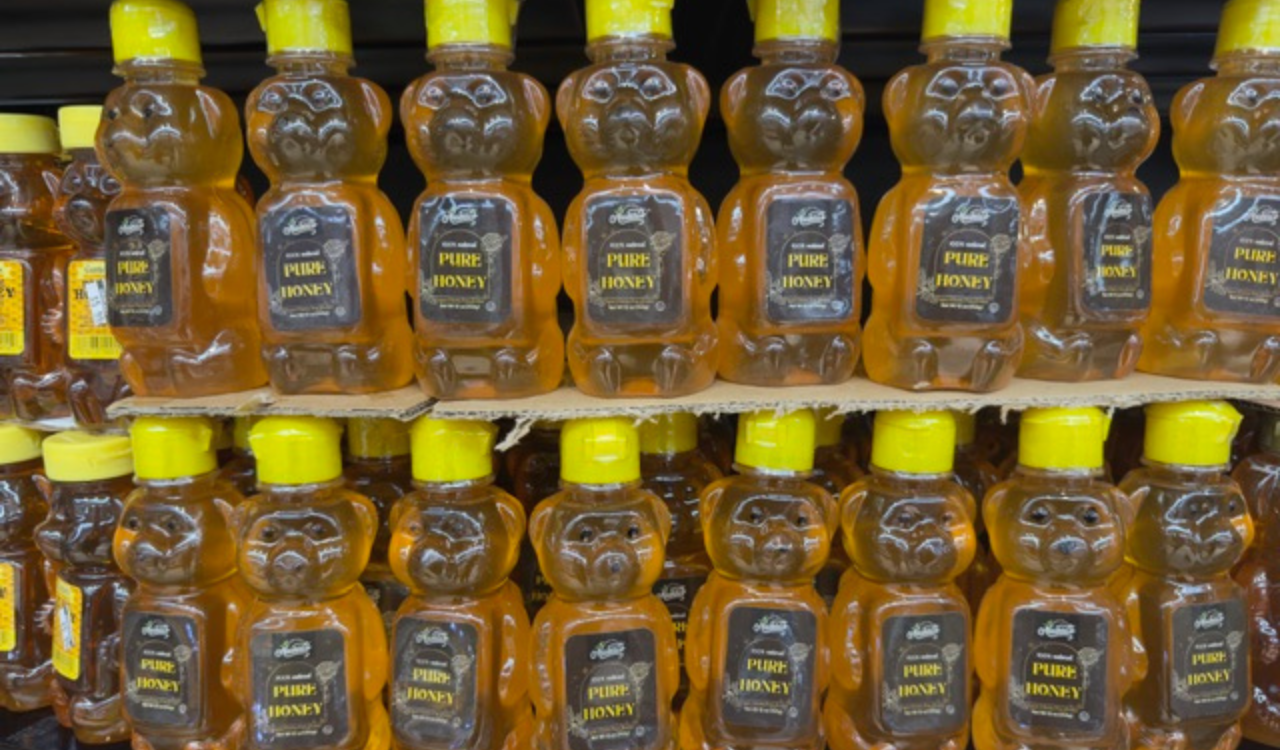
Honey is, by design, one of nature’s most perfect foods. It’s also one of the most adulterated products on the planet.
In 2025, the FDA tested 102 honey samples — 54 domestic, 48 imported — for economically motivated adulteration. The agency found that four samples came back violative, the overall violation rate landing at approximately 4 percent. That sounds manageable until you remember that this follows a 10 percent violation rate for imported honey the FDA found in 2021-2022. The direction of improvement is good; but the scale of the ongoing problem is not.
What are fraudsters putting in your honey jar? Cheaper sweeteners including syrups from sugarcane, corn, rice, and sugar beets that lower production costs while selling the product at honey prices. The FDA uses a stable carbon isotope ratio analysis to detect the substitution, but the fraudsters are keeping pace. In late 2024 and into 2025, testing laboratories began detecting a novel syrup marker, a previously unknown adulteration method that the industry’s standard tests weren’t built to catch. By early 2026, mandatory testing updates were in the works just to keep up.
The FDA was blunt in its assessment: Honey “continues to be a commodity susceptible to economically motivated adulteration.” It’s no secret, the industry will tell you, that honey ranks among the most adulterated foods worldwide. Adding syrups, falsifying origins, mixing in cheaper components, feeding bees outside of good beekeeping practices are all common practices in global bulk markets.
The Seafood Masquerade
Of all the food frauds operating today, the seafood con may be the most brazen and the least prosecuted.
A landmark report published in February 2026 by the UN’s Food and Agriculture Organization put the number at roughly 20 percent of the global seafood trade — a $195 billion industry — subject to some form of deception. FAO researcher Esther Garrido Gamarro described a ‘bait and switch’ operating at global scale. A 2026 FAO study found that one in five of more than 25,000 seafood samples tested were mislabeled across 55 countries. A more recent meta-analysis of U.S. studies found an overall mislabeling rate of 39.1 percent.
NOAA’s seafood inspectors have found fraud in up to 40 percent of all products voluntarily submitted to them. The FAO estimates that as much as a third of aquatic products sold in the United States may not match what’s listed on the packaging; the problem is that less than one percent of seafood imports are actually tested.
The scallop caper is particularly instructive. Scallops, priced at around $45 per pound on average in 2024, are one of the most frequently substituted seafoods in America. The common switch involves surimi which is a minced white fish blend also used in imitation crab that is then pressed into perfect cylinders and sliced into convincing rounds. Sometimes it’s pollock, sometimes it’s whiting. Occasionally it’s shark or stingray. Alkaline compounds are added to mask the fishiness. Scallop flavoring is sprayed on. Bread it, fry it, and most consumers will never know.
The substitution playbook includes selling tilapia as red snapper (with a price difference of up to 244 percent between the real fish and the fake), passing off farmed Atlantic salmon as wild Pacific salmon for nearly $10 more per 35 ounces (one kilogram), and labeling escolar as white tuna at sushi venues where, in some markets, the mislabeling rate hits 58 percent.
The industry’s complexity makes enforcement nearly impossible. More than 12,000 aquatic species are in global trade. Supply chains wind through dozens of countries, jurisdictions, and inspection systems. Fraud occurs at every stage of the value chain: on the boat, at the dock, in the processing plant, at the distributor, at the restaurant.
The BIG Picture: $40 Billion Food Fraud
The 2025 Food Fraud Vulnerability Index reported a marked increase in criminal activity across all food sectors. Wine, olive oil, honey, and seafood are the marquee cases — but fraud extends far beyond them.
Spices are routinely cut with cheaper fillers. For example, paprika extended with Sudan dye, oregano padded with myrtle and olive leaves, and saffron is adulterated with safflower or corn stigmas. Parmesan cheese sold in the U.S. has been found to contain cellulose filler at levels well above what regulations allow. Ground coffee gets extended with chicory, fig, and cheaper robusta beans. Fruit juices are diluted with water and sweeteners. The pattern is always the same: find a premium product, find a cheaper substitute, and hope that the consumer doesn’t look too closely.
The economic damage is enormous. The reputational damage to brands, categories, and the entire food industry is incalculable. The impact on trust is enormous. And for certain consumers, the health consequences are real: Adulterated oils containing undisclosed allergens, fake honey with undetected contaminants, seafood substitutes can cause illness. It’s a food safety and food allergen nightmare!
What Food Retailers, Brands, and the Feds Must Do
Here’s where I hang up my Philip Marlowe detective hat and put on my food analyst’s lab coat. The food industry cannot afford to be passive about this!
Retailers need to demand supply chain transparency not as a marketing talking point, but as a purchasing requirement. Traceability systems, DNA testing for seafood, blockchain, isotope analysis for honey, independent certification for olive oil — these are not nice-to-haves. They are table stakes for any brand or retailer that wants to be trusted by the shopper.
The companies that invest in authentication technology, put harvest dates on their olive oil, use the new GS-1 QR codes with verifiable supply chain data, and test their products proactively are the companies that will retain consumer loyalty when the next fraud scandal breaks. And mark my words, it will make the headlines.
Consumers need to understand that price is a signal. Real scallops sell at $25-$60 a pound and cannot be sold at $8 on a casual seafood menu. Real extra virgin olive oil cannot cost less than vegetable oil. When a deal looks too good to be true in the food world, it is.
And the regulators? Less than one percent of seafood imports are tested. There’s. no routine FDA testing of olive oil. The enforcement gap is an invitation to the food fraud criminals, and they are responding enthusiastically.
I started my career selling meats and cheeses in the Bronx Terminal Market. I’ve watched the food industry evolve toward transparency, quality, and consumer trust. However, fraud is the shadow that stalks every step of that progress.
As another Philip (Marlowe) says: The evidence is in! The grocery industry has fed the world through wars, pandemics, and supply chain chaos that would break lesser businesses. It has the tools, talent, and reach to end food fraud as a viable criminal enterprise. Put on your detective hat and help flush out the fakes.