
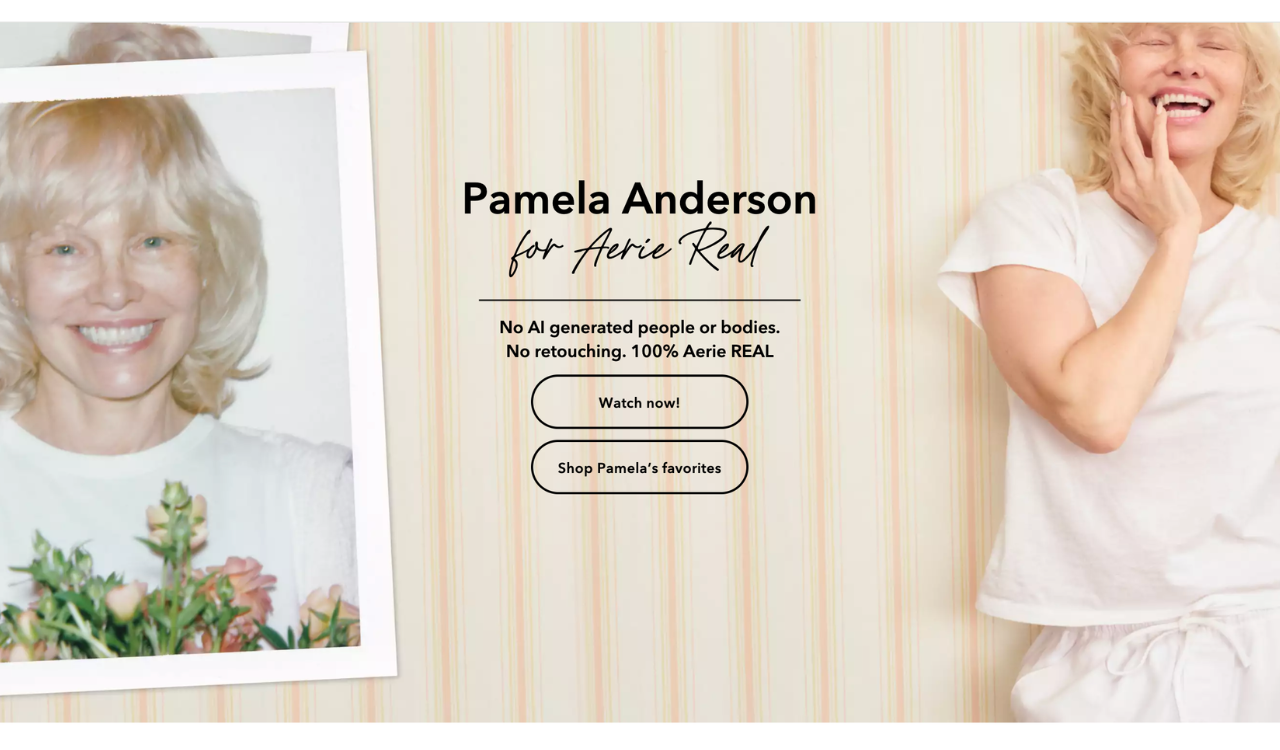

Who would have thought that a phenomenally successful label of the brand that launched Sydney Sweeney’s “Great Jeans” campaign would take a stand against AI-generated imagery just a few months later? And that the celebrity mouthpiece for the campaign would be none other than former glamour girl Pamela Anderson, who is now considered an “untouched beauty advocate” by not wearing makeup since 2023? In October 2025, Aerie expanded its “100% Aerie Real” anti-retouching pledge to prohibit the use of AI-generated models in its campaigns.
Anti-AI Campaign
Aerie’s anti-AI film was made for social media, produced in digestible 30 and 60-second slots. The ad shows three models being tweaked by verbal and written prompts, followed by said models having an at-home frolic with Pamela Anderson. In a time where consumers and politicians across partisan divides are banding together to protest the construction of AI data centers, even consumers who are pro-AI take umbrage when it comes to computer-generated models. So, the subject matter of the “100% Aerie Real” campaign is a relatively safe bet.
This raises important questions: Can a parent company and one of its brands take different socio-cultural stances? And what’s the impact of an American president commenting on an apparel advertising campaign? There’s much to unpack.
Will Pamela Anderson reverse American Eagle’s advertising gaffe with Sydney Sweeney? And the answer is: The Anti-AI campaign seems to try to bridge the divide between cultural memes.
Proof that Playing to Politics Pays Off
These days, bipartisan issues are few and far between, and customers rally behind brands that support their values. American Eagle boosted web traffic by 100 percent and added an estimated $400 million in market value when the “Great Jeans” ad spoke to a self-selected audience last year. Rather than backtrack on the ad campaign’s controversial rhetoric, American Eagle doubled down on working again with Sweeney. The brand just launched its second ad blitz featuring Sweeney with the (surprisingly genderless) title of “Syd for Short,” where she hawks low-rise shorts and micro skorts without any controversial jargon.
American Eagle CMO, Craig Brommers, calls the decision to feature Sweeney in a second campaign after last year’s controversies “brand consistency.” A recent Ipsos study found that 57 percent of consumers believe that brands should stick by their decisions when they take a stance, regardless of consumer backlash. Fans of the brand could say American Eagle is doing just that.
In actuality, however, American Eagle’s choice to play the middle road by featuring Sweeney in a new innocuous ad campaign is open to interpretation: It can be seen as doubling down on last year’s controversial messaging without directly incensing any customers that haven’t already abandoned the brand. Things get interesting when we look at how American Eagle through Aerie is targeting customers with two opposing ideologies at the same time.
Anderson and Sweeney’s Similarities Are Surface-Level
American Eagle is clearly counting on customers to perceive Aerie as a sovereign brand. Anderson’s ad blitz smacks of intent to attract customers that may have been turned off by its parent company’s highly politicized Sweeney blitz last year. Pamela Anderson seems similar to Sweeney at first glance––she’s blonde, buxom-and-not-shy-about-it and built her fame catering to the male gaze on Baywatch. But the similarities end there. For every issue that Sweeney weaponizes her “dumb blonde” image to avoid, Anderson takes up the yoke to fight for human and animal rights, providing a mature counterpoint to Sweeney’s ambivalence.
Anderson, now 58 years old, is a much different woman than in her “Pam and Tommy” very public Hep C diagnosis days. She’s an honorary director and longtime public face of PETA, spending time and resources to actively petition against animal cruelty for over 30 years. She launched the Pamela Anderson Foundation in 2014, which is dedicated to “human, animal and environmental rights,” and supports causes like Help Refugees, Cool Earth and the California Wildlife Center. She’s recently captured headlines by attending events without makeup and without apology; a far cry from the conspicuous plastic surgery and shellacked faces favored by certain celebrities.
Sweeney, on the other hand, was called out for her “Mar-a-Lago Makeover” last year. Sweeney is a registered Republican in Florida, but she downplays her political presence. She told Cosmopolitan, “I’m not a political person. I’m in the arts. I’m not here to speak on politics.”
Can a Sub-Brand Have a Different Stance than Its Parent Company?
The question remains whether American Eagle is intentionally using Aerie to counterbalance the position of its parent company. Aerie’s website is just a click on the menu away from American Eagle, but neither spokesmodel is the first thing you see. Aerie’s states, “We believe in REAL people & REAL life (. . .) We believe transparency isn’t a trend. It’s our promise to you. No retouching. No AI. Because REAL MATTERS.” It’s odd, then, that there is a disconnect with this brand that takes a different stance from its parent company.
Next Gens are confronted with opposing political and global ideologies daily. In the U.S., the lines are starting to blur in terms of which side of the political divide people identify with. We see MAGA devotees turning on AI datacenters while the President supports them. So, Aerie’s Anti-AI model campaign could be seen as a refreshing bipartisan position. That said, the choice of Anderson as spokesperson could be criticized as an intentionally disingenuous way to court ‘woke’ consumers. We will see if such wokesters overlook American Eagle’s past advertising gaffes.
Customers Make the Final Decision
Nothing surprises us anymore in 2026. American Eagle was accused of promoting eugenics and then doubled down on its controversial spokesperson. Then it hired her opposite to represent its subsidiary. The 100% Aerie Real campaign begs the question: How much research is the average consumer doing? Are consumers so bogged down trying to survive economically in the face of tariffs, the potentiality of World War III, and the threat of being replaced by tech bro-run artificial intelligence that they’ll see Anderson’s bare face and click add-to-cart? Only time will tell, but one thing is for certain: Consumers’ response to the Aerie Real campaign will be a case study in brand accountability and customer forgiveness.