
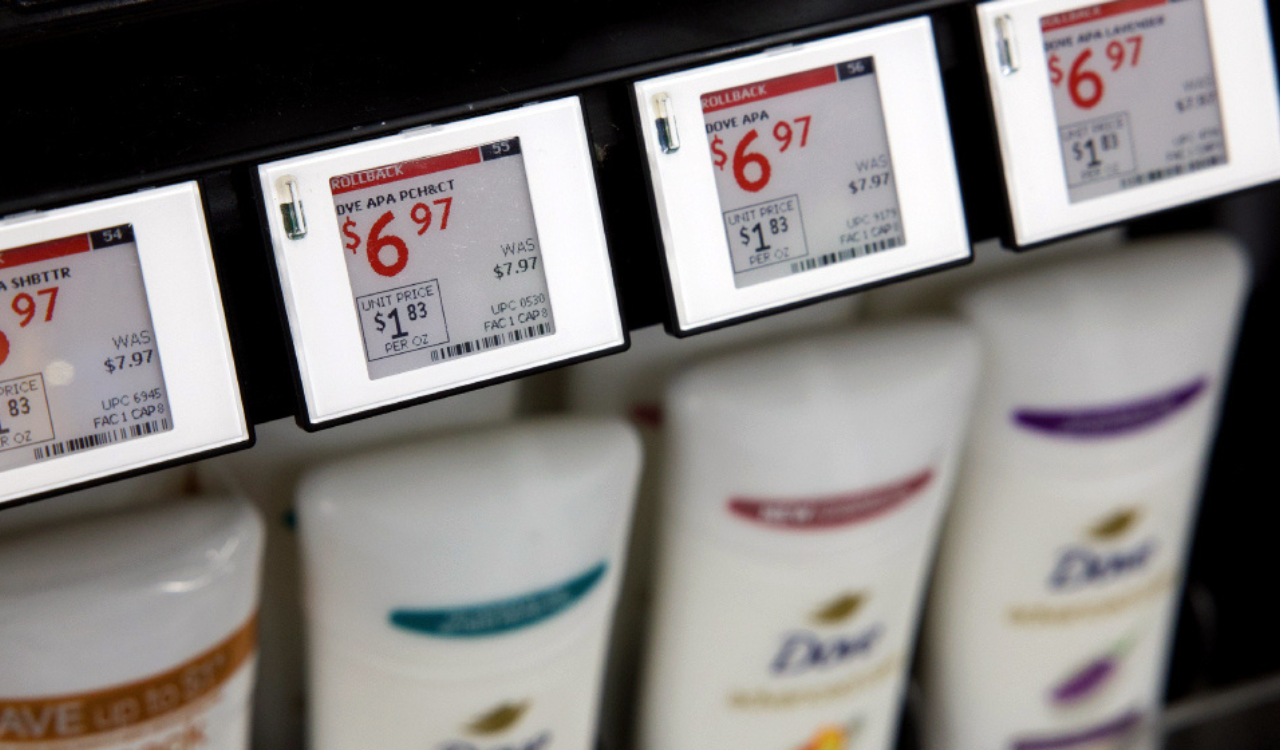

Lindsay Owens was interviewed on NPR’s Life Kit, and it’s worth listening to the whole episode. Owens is an economist who runs the Groundwork Collaborative, a progressive policy shop, and her new book, Gouged: The End of a Fair Price, makes the case that retailers are quietly building the machinery to charge each of us a different price for the same thing. Her Exhibit A is the electronic shelf label, which is now being installed (or planned to install) in many chains including Aldi, Schnucks, Hy-Vee, Lidl, Whole Foods, Sprouts, and in all Walmart stores across the country.
What did Lindsay Owens say about Walmart’s pricing strategy in her book, Gouged: The End of a Fair Price? And the answer is: Owens asserts that Walmart uses sophisticated digital tracking, algorithms, and patent filings to move toward high-tech, individualized pricing while publicly denying it.
Contentious Assertions
They say timing is everything and Walmart didn’t wait for the book to pop up on Amazon to refute Owens’ assertions. On September 25, just days before publication, CEO John Furner posted an open letter to customers that read like a direct reply to Owens. In the post, he promised that a shopper’s income, shopping history, urgency, or perceived ability to pay won’t change what they’re charged, and that the time of day won’t change prices either. He extended the same pledge to Sparky, Walmart’s AI shopping assistant, saying what customers share with it won’t be used to raise their prices or bury cheaper options. Walmart associates will continue to oversee pricing, he wrote, and the company will test its technology against those commitments.
The question is: Who is telling the truth?
The Walmart Patent
The basis of Owens’ evidence is a patent Walmart was granted in 2023. You may have seen it described in the media as a “smart cart” patent. It isn’t; the patent covers the remote control of electronic shelf labels, and it describes changing prices based on what a shopper already has in the cart. Somebody at Walmart (who may not have a job any longer) wrote this into the filing: A shopper with tuna in the cart might get a different price on mayonnaise. (The assumption is that the shopper is planning to make tuna salad, and mayo is a prime ingredient.) The same document also contemplates changing prices with supply and demand.
Furner’s open letter did not address why it would patent something he says it won’t use. I’ll offer the industry’s usual explanation, which is that big companies patent all kinds of things they never build, partly to keep competitors from owning the idea. Fair enough, but I’ve read a bunch of patents, and the tuna-and-mayo line is oddly specific for a defensive filing.
On October 6, Walmart again responded. “A patent isn’t a plan,” they wrote, adding that the company won’t use the patent and won’t renew it. That same day, Dan Bartlett, Walmart’s executive vice president of corporate affairs, sent Owens a letter asking her to “correct the record.” He wrote that her public statements leave people believing Walmart uses, or is getting ready to use, their personal information or even changes in the weather to charge them more. Owens then responded, saying Walmart “says one thing in its damage-control letters to customers, another to its investors behind closed doors, and a different thing entirely to the United States Patent and Trademark Office.” Groundwork also released a new report, written with Elizabeth Pancotti, that lists several more Walmart pricing patents.
Walking away from the tuna-and-mayo patent is a real concession, and Walmart deserves credit for it. I’d still read the fine print carefully. U.S. patents aren’t renewed as much as kept alive by paying maintenance fees three-and-a-half, seven-and-a-half and eleven-and-a-half years after they’re granted. Stop paying, and the patent will lapse well before its April 2039 expiration. That keeps Walmart out of cart-based pricing, but once a patent lapses, any competitor or pricing software vendor is free to build what it describes, and I’m sure that will happen!
What the Shelf Data Actually Reveals
Researchers from UT Austin, UC San Diego, and Northwestern looked at five years of prices at Schnucks, the St. Louis-based grocer, before and after it installed digital labels. They found that short-term price increases touched 0.005 percent of products on a given day before the labels went in, and that number barely budged afterward. Discounts actually became slightly more common.
Economists call it “menu cost;” the expense of physically changing a price. I learned what that meant long before I heard the term, working as a cook and then assistant manager at a Howard Johnson’s on the Garden State Parkway when the price of the fried clam plate (which came with fries, tartar sauce, and coleslaw) was just $1.75. The price on the menu was the price because reprinting menus cost money and took a long time, and the directive had to come from corporate, not the store itself. Paper shelf tags work the same way. Furner made that point himself, noting he’s changed plenty of paper tags by hand. Eliminate the cost of printing the tags, get rid of the high cost of labor to pop them on the shelf, and you remove the friction that keep prices steady. Digital tags take the hassle out of changing a price and ensure that when a promotion ends, the price at the register matches (just ask Kroger about those issues). What Walmart does with the technology is up to the people in Bentonville.
Kieran Shanahan, Walmart’s U.S. chief operating officer, told reporters in June at their shareholder meeting that surge pricing isn’t the company’s approach, and that prices are still set centrally by merchant teams in Bentonville. FMI, The Food Industry Association, and NGA, the National Grocers Association, made a similar argument to the Senate Judiciary Subcommittee on Crime and Counterterrorism in August, telling lawmakers that digital tags don’t set or adjust prices based on the individual shopper.
So, What’s Different Online?
The study that worries me the most is about Instacart. Last December, Groundwork, Consumer Reports, and More Perfect Union put 437 volunteer shoppers in four cities on Instacart at the same moment, adding the same items from the same stores. Nearly three out of four items showed up at different prices, with gaps averaging 13 percent and reaching a high of 23 percent. For example, one dozen Lucerne eggs at a Safeway in Washington, D.C. appeared at five different prices, from $3.99 to $4.79.
The researchers found no evidence that Instacart was setting prices based on a shopper’s income, ZIP code or history. These were price tests, randomly assigned. And within two weeks of the report, Instacart said it would stop supporting item price testing altogether. So, Owens was right that shoppers were being shown different prices for identical groceries without being told. Her book and research haven’t shown that those prices were tailored to the individual shopper.
Follow the Data
Walmart’s Sparky is growing fast. Walmart said on its August earnings call that Sparky users were up 70 percent year over year and spend about 40 percent more per order. Walmart also happens to own Vizio, which it bought in 2024, and Walmart U.S. CEO David Guggina spoke at a Goldman Sachs conference last month, and said he could imagine Sparky showing up on your television in real time to help you shop.
Walmart knows what’s in your cart. Through Vizio, it can know what you watch. And it can change a shelf price in seconds. Furner says none of that will be used to set your price, and I will take him at his word…for today. But I do agree with Owens’ point about what happens when a future CEO faces a bad quarter and all the technology is in place, ready to trigger dynamic pricing.
The States Aren’t Waiting
New Jersey, which I wrote about this summer, went further than the first law in Maryland that banned grocery surveillance pricing. Gov. Mikie Sherrill signed the Fair Price Protection Act in July, banning surveillance pricing, letting consumers sue, and freezing new digital label installations for a year while the state studies them. Notably, New Jersey left demand-based dynamic pricing and loyalty discounts alone. The corporate law firm Skadden counts more than 50 surveillance pricing bills pending in 26 states. Meanwhile, the federal government has stepped back, with the FTC’s surveillance pricing inquiry dropped by the current administration. I don’t agree with putting a moratorium on ESLs; we have a real labor problem, and the issue with mismatched prices on the shelf and at the register is a very real one. Our legislators need to put in guardrails now.
A poll released alongside the New Jersey signing found 61 percent of the state’s voters believe digital labels will push grocery prices up, and 67 percent say the same about surveillance pricing. That poll came from the United Food and Commercial Workers Union (UFCW), which has been fighting ESLs from the beginning, claiming it will threaten retail jobs. I’ve seen enough focus groups to know those numbers feel right.
My Bottom Line
I believe John Furner. I also think his promise will only be worth exactly as much as the next CEO decides. The best independent data show digital tags haven’t produced surge pricing in grocery stores, and nobody has documented Walmart charging one shopper more than another. On the other side, Owens is closer to the truth about where the industry could go, and the Instacart episode proves that price experiments on unsuspecting customers aren’t hypothetical.
The reality is that a CEO’s letter doesn’t buy the trust it used to. If Walmart wants its promise to be taken seriously, it should make it something any outsider can check to verify, with independent audits of shelf and app pricing, and a public commitment not to use or license the cart-based pricing in that 2023 patent.