
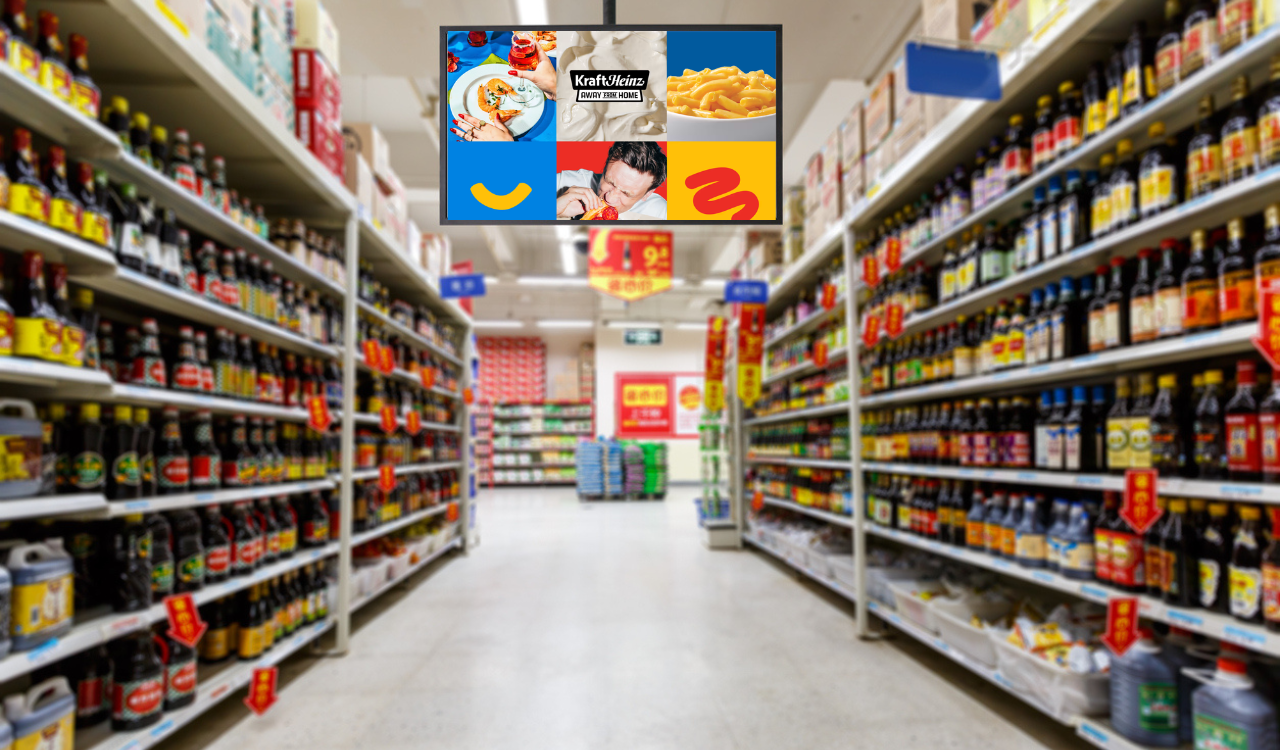

When does ubiquity mean invisibility? I notice it every time I walk a grocery store: video screens. They’re at the entrance, above the deli case, at the checkout lane, and there are more of them being installed every day. Nothing about this is an intentional network to entertain shoppers or teach them something important about the foods they are about to buy.
Why is retail media making its own headlines? And the answer is: Retail media news is self-serving; retailers rake in advertising dollars, but customers often feel like unwelcome targets.
Money Grabs
Grocers (and mass retailers) found a new revenue source and they’re pushing it hard. U.S. retail media spend is on pace to hit close to $70 billion in 2026, the fastest-growing category in digital advertising. It’s for a reason; 76 percent of purchases still happen in person and retailers view an entire store as just waiting to be monetized. To be fair, it’s a rational business decision.
Grocery margins are thin, so it makes sense that retail media networks became the industry’s newest obsession. Albertsons is scaling its digital screen network from an 80-store pilot up to 800 of its 2,200+ stores this year. CVS plans on about 11,000 digital screens nationwide by 2026, including checkout ads running through point-of-sale systems in roughly 7,000 stores. Hy-Vee has already installed more than 10,000 screens across over 400 locations. Paul Brenner, SVP of retail media at Mood Media, told Modern Retail that he’s juggling 20 proposal requests right now from retailers planning screen rollouts this year, some running into the thousands of units per chain. What supermarkets figured out quickly: They can charge CPG brands rent for this new real estate on top of the money they already collect for slotting, promotions, end caps and sampling. In two words: money grab.
Walmart’s $2.3 Billion Bet
Nothing shows the size of this opportunity better than what Walmart paid for Vizio, a deal that closed in December 2024 for roughly $2.3 billion. Everyone assumed Walmart bought a TV system. What it actually bought was a data pipeline. Vizio’s SmartCast software runs on millions of opt-in television sets in American homes and lets Walmart tie what you watch to what you buy. This enables layering streaming-ad dollars on top of Walmart Connect and on roughly 170,000 in-store screens spread across some 4,600 stores. The payoff? Walmart’s global ad business pulled in $6.4 billion in fiscal 2026, up 46 percent year over year. Advertising, plus Sam’s Club and Walmart+ membership income, now make up roughly a third of the company’s operating profit. And Walmart hasn’t stopped there. On August 4, it closed its acquisition of Vibe.co, a self-serve streaming-TV ad platform, folding it directly into Walmart Connect. The same week Amazon struck its own shoppable-CTV deal with Samsung. If Vizio handed Walmart the hardware and viewing data, Vibe.co hands it a new marketing tool: a way for smaller CPG brands without dedicated media teams to buy streaming TV ads tied directly to Walmart’s purchase data.
I repeat, a third of Walmart’s profit now comes from selling access to shoppers rather than selling stuff, and that share is destined to only get bigger.
It’s All About Scale
The logic behind all this becomes obvious once you look at scale plays like Kroger’s pursuit of Giant Eagle, or the Kroger-Albertsons deal that ultimately died. Ken Fenyo, a former Kroger VP of loyalty and digital, told GroceryDive back in 2022, when the proposed merger was first announced, that the “data is the real gold in the deal.” Had it gone through, a combined Kroger-Albertsons would have rivaled Walmart as the country’s largest in-store media channel. Instacart, meanwhile, has built a multi-retailer ad network spanning over 1,800 retail banners and 100,000+ store locations, reaching 95 percent of North American households with more than $1 billion in 12-month ad revenue as of Q3 2025. Whether the checkout screen delights anybody isn’t intended to be part of the conversation at these companies.
Site-Specific
Grocery TV’s 2026 In-Store Shopper Perception Report surveyed more than 1,000 U.S. grocery shoppers and found screens at the entrance, checkout, deli and pharmacy all scoring between 84 percent and 88 percent favorable. Why so high? Those are dwell zones, spots where shoppers are already stuck standing still, waiting, or deciding what to buy. Place screens onto freezer doors and open shelving and you get the opposite result with more friction than any other format tested, because the screen is interrupting the shopping experience rather than enhancing it.
CVS’s own numbers back this up. Its front-entrance and pharmacy-waiting-area screens blend real-time local health alerts, flu outbreaks, and allergy warnings, with sponsored messages from health and beauty brands. The company reports 54 percent of shoppers find them useful, with 20 percent who say they’ve acted on what they saw. That’s the real lesson to be learned; it’s not about the number of screens, its where they are and what’s on them.
It’s Just Noise
Yeah, but. I’ll call this what it really is: A money grab dressed up as innovation. The industry likes to talk about enhancing the shopper journey, but what actually gets these programs funded is squeezing incremental trade dollars out of CPG brands already stretched thin by tariffs, climate changes affecting supplies, a war in Iran that is increasing transportation and farming costs, and a retailer’s own margin pressure. No shopper ever asked for more screens in a store. Retailers want more revenue, so that’s why we see some stores with 50 or more screens all playing commercials for CPG brands.
Here’s what worries me: Putting screens into every aisle, on fridge or freezer doors, and endcaps will make them invisible. Shoppers, already fatigued by in-store distractions, will stop seeing them. The screens and the messages on them just become wallpaper. After all we are a nation addicted to TikTok, YouTube and Reels, so it makes sense to extend our always-on screens into our supermarkets and stores, right? Wrong. The Grocery TV survey shows how fragile goodwill is; grocers must treat every screen as valuable information first and ad revenue second. Otherwise, shoppers see clutter and tune it out. Others start shopping somewhere less bombastic.
My Bottom Line
Retail media is real money, and none of these companies is walking away from this goldmine anytime soon. Walmart didn’t spend $2.3 billion on a TV manufacturer on a whim, and no grocer running on thin margins is giving up a business line worth a third of its profit. Screen count won’t decide who wins this next decade. Success will be to treat every screen as legitimate entertainment or education (or what I would like to call edutainment) for the shopper before it’s ever sold as inventory to a CPG brand. There needs to be a balance between making money and building trust among customers.