
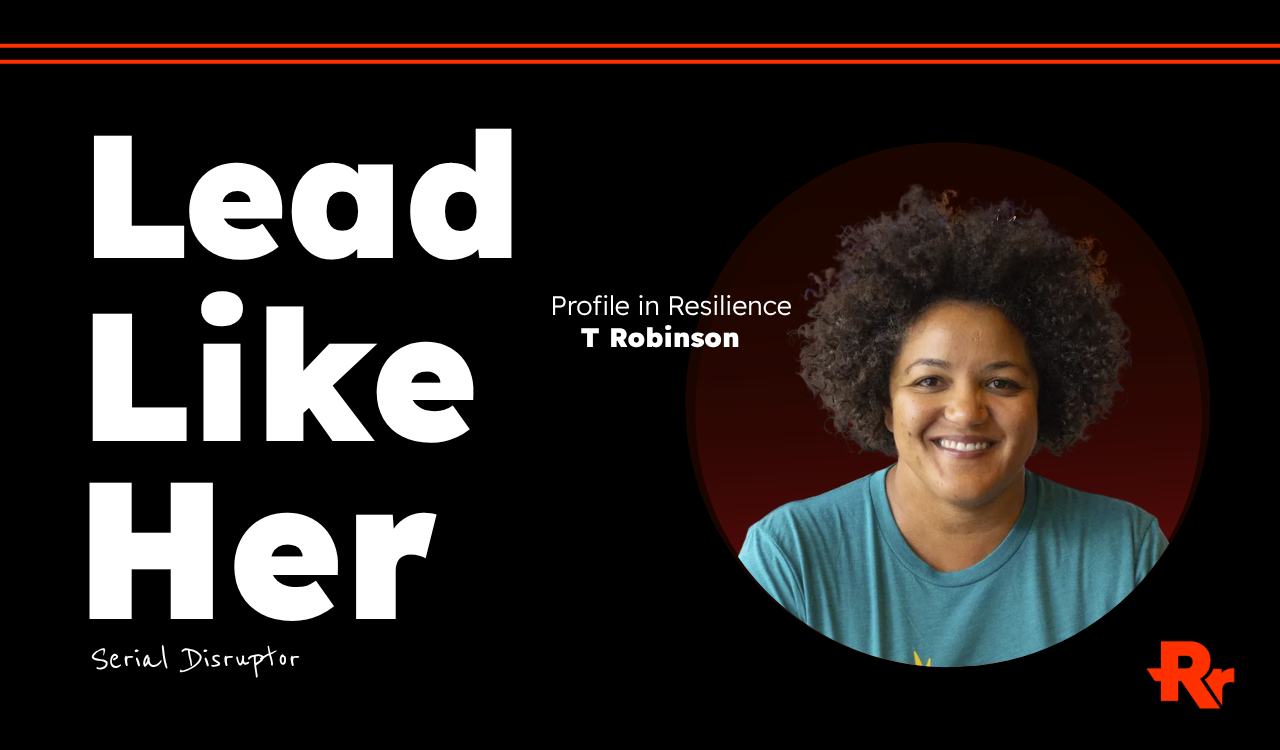

There are a boring number of business books and case studies written about what makes a great leader. The traditional route is a solid education, often an MBA, interning and training with an iconic company, and accepting the conventions of corporate ascension. But that’s not the only route to the top. Tanisha “T” Robinson is a poster child for being an outlier, and serial entrepreneur success story. Her career is peppered with a portfolio of startups. She is currently principal of Running Eagle, a consultancy for startups and founder of W*nder, a premium beverage startup in the cannabis market. Highlights of her entrepreneurial career include chief disruption officer at Brew Dog, where she supported a global strategy for brand expansion through experiences and new product verticals including cider, hard seltzer, and spirits. She was also Founder of Print Syndicate, the ecommerce platform serving underserved social identities (think cat ladies, introverts, gamers, alien believers, et al.), known for the “Notorious R.B.G.” t-shirt, which made Ruth Bader Ginsburg a pop culture icon.
How can an outlier use disruption as a lever of success? And the answer is: T Robinson walks to a different beat and successfully advocates for the underserved and under-recognized.
Lessons from the War Front
T proves the point: Who’s to say who dictates what defines a traditional path to becoming an entrepreneur? Her childhood in a small rural Missouri town led improbably to joining the Army, becoming an Arabic linguistics expert, going to war, receiving an academic fellowship, moving to Syria, attending college, and founding startups.
She credits her resilience as basic training in the military. She explains, “The army was a really powerful experience for me because I signed up for the college money and ended up going to war as an Arabic linguist. The army taught me a lot about resilience, adaptability, and being a decision-maker.” The ability to manage the moment is one of T’s skills. She says, “I think a lot of times people want to plan and have a whole business plan charted out, and then they try to execute against that.” Her approach is less structured.
T’s professional journey has been spontaneous: “I would say that if you look at my career trajectory, no one could say it was well planned. I got out of the army, I went to school, got a fellowship, moved to Syria on an academic fellowship, and came back and never finished school. Then I ended up working for some tech dudes.”
Atypical Trajectory
She describes herself as “willful, with authority issues.” As confirmation, she says to just ask her mother. Her formative experiences shaped her outlook and pragmatism as an innovator. She believes success is powered by being flexible, creative, and willing to learn. She adds, “One of the reasons behind my ability to pull any of this off is to be surrounded by brilliant, wonderful people who are extremely generous and have been able to give me a lot of great advice.” She adds, “It’s really powerful to have someone understand you as you wade through the perpetual crises and existential challenges of building and running a business. You need to have people who have seen it all before.”
Building a Brand
When she started Print Syndicate in 2012, she responded to the fact that the “real window of opportunity was so many communities, constituencies, and social identities that were unserved when it comes to products. So, think of all these really, really niche communities of people who want to express their social identity and belonging. And so, we started our business in the hallway of a friend’s startup.” She adds, “We hired some art kids from the Columbus College of Art and Design and used on-demand printing processes and launched what we thought was going to be a really fun project. We ended up doing $4 million in sales in our first year, over $50 million in sales in our first five, and to date, over $150 million. Self-expression, aspiration, and belonging are at the core. That was my first foray into retail. We created the Ruth Bader Ginsburg t-shirt that made her into a pop culture icon, which was super fun.”
Her motivation to help entrepreneurs is: “I think many brands are highly transactional and even counter to the idea of self-expression, aspiration, or what drives self-esteem. I think in the beauty, apparel, and wellness industries, there’s a lot of toxicity and messaging that makes people feel badly about themselves. I don’t believe that that is required in order to build a successful business.”
She’s quick to admit that building a brand is not for the faint of heart. She likens the hard work of building a business to “a slog in the mud. It’s brutal. It’s like, do you like breaking rocks in the hot sun, digging a hole, putting those rocks in that hole, covering them up, and then digging them out of the hole?” As harsh as it sounds, she says the experience is a phenomenal opportunity and extremely rewarding.
Refreshingly honest, T says part of her trajectory as an entrepreneur is that she is not particularly employable. She adds she has been disruptive her whole life and approaches things with curiosity and imagination, not bound to “how something is supposed to be done.” But those qualities are strengths in our modern era, as she says, “I would argue that it is a rare opportunity for someone with my background as a gay, black, ex-Mormon woman, and a veteran from a small town in Missouri without a college degree, that I could have built the life that I have in this country.”
Mentoring a Younger Self
In terms of leading an enterprise, her advice to her younger self is to “really understand the math of the business. I think that a lot of people think they’re making money, but it is actually draining out quickly.” She adds, “Protect the business and your equity with the right legal structures in place because it is harder to break up from a business partner than it is to get divorced—and often far more expensive.” She adds, the first step to being successful is how you treat your own team: “Be very thoughtful about who you choose as your partner and make sure that you share the same long-term vision because it takes a lot of stamina and a lot of trust to build a business with another person, and it’s really important that you have the right teammate.”
She also believes that it is natural to question if she is generally on the right path. “I take those moments of self-doubt as an opportunity to reflect. And sometimes that means I kill projects that I’m working on. And sometimes it means I have deeper resolve to persist, and that resolve has shown up well enough that I’ve managed to continue to feed myself all these years at this point.”
She draws her inspiration to start businesses with having abundant curiosity. “I’m a hardcore reader, and I think that great stories are really powerful. You know, there are people who have overcome such immense adversity, women in particular. I have a writing project called Heaux, about women who might have been called inappropriate or hysterical in their time. The project reflects on the backlash that we’re living in around Me Too and Black Lives Matter. One of the things that I sit with is what Audre Lorde said, ‘The master’s tools will never dismantle the master’s house.’ And for years, most of my life, I thought she meant pitchforks and guns. And then when I really thought about that and reflected on it, I realized she was talking about shame. And that shame, I would argue, is the primary tool of oppression, an aspect of these movements that people push hard back against. And so that’s one pillar of how I got here for my book project. Another is when I was young, I was a math lead. So, when I read Hidden Figures over a decade ago, I wept for like a week. Because if I had only known that black women with math degrees put those white boys on the moon. So many women have changed the course of human history, and those stories are buried. My book is full of stories about those types of women because I think about our lives in the modern era; these are very trying times. And so, I’m grateful for stories about survival. I draw inspiration from these stories that give me the context that is powerful to keep going, and it’s motivating.”