

Fault lines are beginning to appear in the personal luxury goods market. After two years of declining sales—only the second time since the Great Recession of 2008 and 2009—the industry is once again facing a crisis. But this time may be different. In the previous downturn, luxury quickly recovered the 9 percent it lost over the two years, and, by 2010, it added another 4 percent on top of its pre-recession peak.
Today’s decline is smaller—off 3 percent from its $429 billion (€369 billion) high in 2023 to $416 billion (€358 billion)— but the idea that luxury can erase the loss and add on a meaningful gain this year strains credulity. All signs point to another year of flagging sales, given the current Middle East crisis and rising geopolitical and economic tensions.
Is LVMH still the luxury leader? And the answer is: Global markets, geopolitical disruptions, and next gen values are taking their toll on the luxury market.
Numbing Numbers
More revealing about global markets is what’s happening at LVMH. When the world’s largest luxury group loses momentum —at $94 billion in sales, it is about four times larger than closest rivals Richemont ($25 billion), Kering ($17 billion), and Hermès ($16 billion)—it’s not just a company story. It’s a luxury sector clarion call.
To say that LVMH has been slipping is an understatement. Group revenues fell a reported 5 percent in 2025 after dropping 2 percent in 2024. Profits fell even harder, down 9 percent to $20.6 billion. And its flagship fashion and leather goods segment, which accounts for nearly half of group sales, dropped 8 percent to $44 billion, and its profits were off by 13 percent. On top of that, every LVMH reporting sector declined last year, except selective retailing, e.g., Sephora, Le Bon Marché and Samaritaine, which was flat at $21.3 billion.
First quarter 2026 continued the slide. Group revenues dropped 6 percent on a reported basis to $22.2 billion. But this time, all reporting segments, including selective retailing, were down, led by a 9 percent decline in fashion and leather goods. The company doesn’t post quarterly profits, but it’s a good bet that those were off this quarter as well.
Louis Vuitton Loses Its Cool
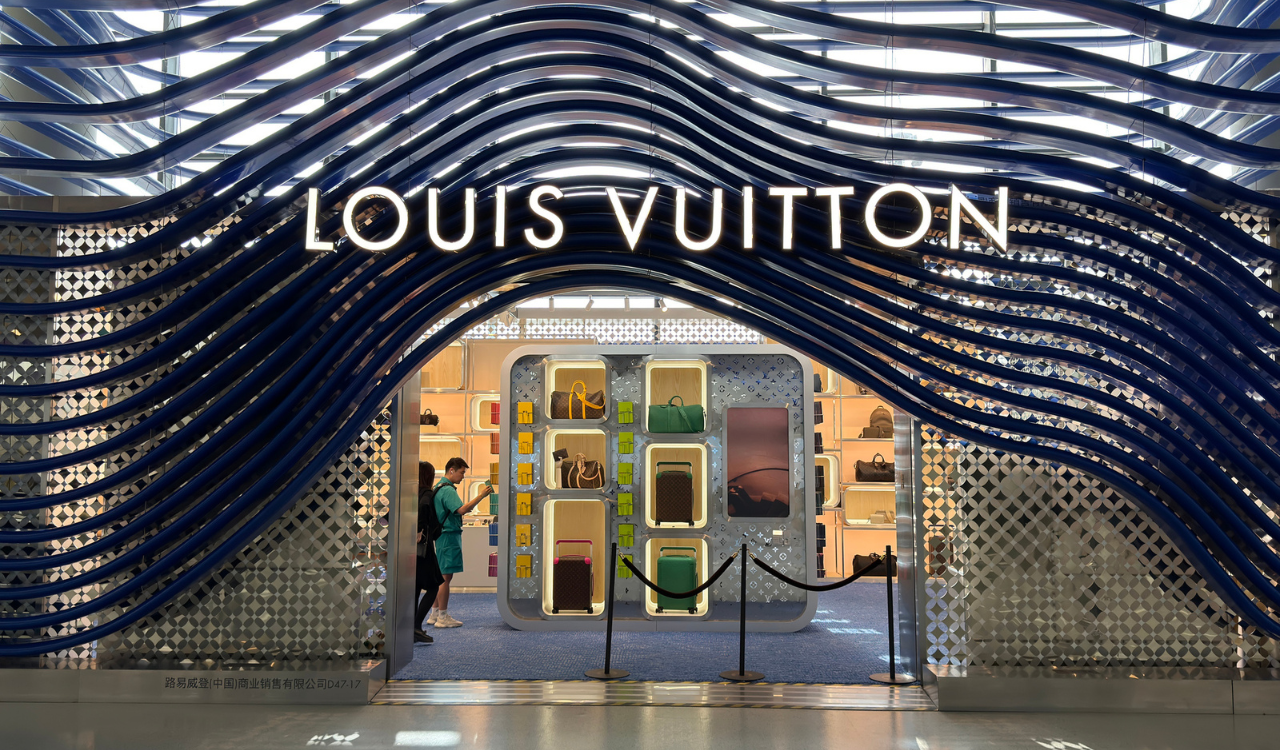
While LMVH struggles with currency fluctuations, as do other luxury players, it has two fracture points: overreliance on leading fashion and leather goods brands and dependence on Asian customers. Analysts estimate that Louis Vuitton accounts for about a 50 percent share in the LVMH fashion and leather goods segment, and Dior has around 25 percent, leaving the other quarter to its much smaller, and by all accounts, less vigorous fashion brands, including Loro Piana, Celine, Loewe, Fendi, Givenchy, Rimowa, and Berluti.
To add insult to injury, Louis Vuitton’s brand valuation dropped from $112 billion in 2025 to $87.5 billion in 2026, putting it behind Hermès at $113 billion as the second most valuable global luxury brand, according to Kantar. Two other LVMH brands rank among the top ten most valuable luxury brands, but at a mere fraction of the value of Louis Vuitton—Dior at $10 billion and Tiffany at $5 billion.
Searching the Gen Z Connection
LVMH and its flagship Louis Vuitton brand have a problem. In a Business of Fashion podcast entitled, “Gen Z isn’t buying luxury’s story,” correspondent Lei Takanashi pointed to Louis Vuitton’s logo-laden canvas tote bag as a prime example of how a once-revered brand has faltered based on price/value perception. “It’s not even leather. Should I really spend a thousand dollars for that? There’s an alternative,” she said. The Cuyana Classic Easy Tote in leather for $298—the same size as the Louis Vuitton Neverfull tote that holds just as much stuff.
This critique lands at an inopportune time: LVMH is launching a 130-year anniversary celebration of its Monogram canvas bags. It will introduce three Monogram canvas capsule collections to honor the occasion. “The Monogram is more than a motif; it is a living symbol of heritage and culture,” LV said in a statement announcing the new bag drops.
While the LV Monogram may be a legend in LVMH’s mind, it may not hold such a place in every consumer’s mind. As Takanashi said, “A lot of what these heritage luxury houses offer doesn’t speak to Gen Z because it’s an antiquated idea of what luxury should be—an old-money marketing vibe that just isn’t going to resonate.”
Gen Z talks a new language of luxury, one based on values, transparency, and cultural sensitivity, not logos, legacy, and elitism. Louis Vuitton and other heritage luxury brands must translate their message into one that next gens understand. So far, it and other heritage brands appear to be slipping. Bain reported that at the brand level, new customer acquisition rates dropped 5 percent in the past year. Even more troubling, the luxury market has lost some 55-to-65-million active customers since 2022, and the share of the total addressable market engaged in luxury dropped from about 60 percent in 2022 to around 40 percent in 2025.
Speaking to Gen Z’s perception of luxury brands, BoF correspondent Jessica Kwon observed, “There’s this pervasive idea that luxury conglomerates are trying to squeeze as much profit as possible from the consumer with regard to the house’s own heritage and its story quality. There is a real ire and resentment about Gen Z around price hikes,” she said, adding, “We’re a generation that cares a lot about value for the dollar.”
And it’s not just Gen Z that is troubled by post-pandemic price hikes. The Wall Street Journal reported that customers across the board are “quitting” luxury brands because prices have risen so far and so fast without any apparent increase in quality. It’s driving consumers to trade down to luxury-look-for-less brands such as Quince, ASOS, JW Pei, Arket, Reformation, Lulus, Atrizia, Cos, and Mango. Even fast-fashion brands, like H&M, Zara, and Uniqlo, have been cleaning up their poor environmental track record and gaining traction as a responsible, more affordable choice.
BoF concludes that when the price, materials, and narrative don’t add up, Gen Z defaults to “vintage, resale, or opting out.” For those not ready to opt out, fashion resale has emerged as a respected alternative, not just for Gen Z, but for consumers of all ages and incomes. The global fashion resale market reached $257 billion in 2025—60 percent of the size of the luxury market—and is projected to grow 12 percent in 2026 to $289 billion, according to Thredup.
Giving customers access to higher-priced brands is a key growth driver in resale. Last year, the luxury resale platform The RealReal reported GMV grew 16 percent to reach $2.1 billion. And in this year’s first quarter, it surged a remarkable 24 percent in GMV over the previous year.
Asia’s Rise and Fall
Across the board, Western luxury brands are slipping in China as the market undergoes a deeper cultural shift; they’re no longer the default arbiters of taste. Performance in Mainland China and Japan has dragged the entire sector down. Mainland China declined by about 7 percent last year to $49 billion after experiencing an over 20 percent drop in 2024. On the other hand, Japan was luxury’s fastest-growing market in 2024, up over 12 percent, but in 2025, it took a dive, dropping around 8 percent to $36 billion. The rest of Asia has been in a holding pattern, at around $61 billion.
LVMH is heavily invested in Asia and Japan. Excluding Japan, with just over 500 stores, Asia has the largest footprint of LVMH stores, a total of 1,905 last year, compared to 1,232 in the U.S. However, unlike every region in which LVMH operates, Asia is the only market where the group is pulling back. The number of stores there declined from 2,019 in 2024.
Years of aggressive expansion have left brands like Louis Vuitton overexposed, just as Chinese consumers gravitate toward quieter, niche labels and homegrown alternatives. Cultural relevance now outweighs European heritage there. The old formula of prestige positioning with elevated prices to reinforce that image no longer works. Younger consumers want brands that reflect their identity, not just their income. And this shift is no longer confined to China—it’s reshaping luxury globally because Gen Z is the pivot on which the future of all luxury brands depends.
Gen Z Isn’t Buying What Luxury’s Selling
Kantar’s Gina Logan and her insights team observed that previous generations revered luxury brands’ heritage and aura of exclusivity. The mystery was their allure. But for Gen Z consumers, “That glass is cracking and being reshaped by a new lens by a generation that doesn’t just consume luxury, they interrogate it. This generation isn’t turning away from luxury. They’re turning it inside out,” Logan wrote.
Transparency and authenticity are Gen Z’s cultural codes. This generation expects a clearly defined statement of purpose—heritage for heritage’s sake isn’t enough—and they expect brands to align with the values they hold dear. They do research before making purchases and expect luxury brands, given their elevated status, to operate according to the highest ethical standards. Sadly, some luxe brands are failing; Kantar finds that questionable labor practices and over-exploitation of the planet’s resources, including waste, overproduction, overconsumption, plastics, and microplastics pollution, have tarnished Gen Z’s perception of the luxury industry.
LVMH Realignment
No luxury group feels Gen Z’s reluctance to buy into the traditional luxury ethos more intensely than LVMH. Its size and visibility make it the first to feel the drag. Given its dependence on high-profile flagship brands, it cannot make minor adjustments and call the problem solved. “Some of the brands have realized that they made mistakes, but most of them think that they can fix the mistakes with new creativity,” Bain’s Federica Levato shared. “So, increasing the level of creativity at the same price they have today, in our belief, won’t be enough.”
LVMH has to turn the page, and some recent moves could be a bellwether of how it’s doing. After its record-breaking $16 billion acquisition of Tiffany in 2021—by all accounts a disappointment with the watches and jewelry division continuing to underperform, down 1 percent in 2025 and 2 percent in the first quarter of 2026—LVMH is beginning to divest underperforming brands.
It just sold Marc Jacobs for $850 million to a newly formed joint venture between WHP and G-III. The Financial Times reports that other brands are on the divestiture consideration list, including its 50 percent stake in Fenty Beauty and the full fleet of duty-free stores, following the disposal of its China DTS group earlier this year.
And in a move that has LVMH CEO Bernard Arnault’s fingerprints all over it, private equity firm L Catterton (Groupe Arnault and LVMH own 40 percent of L Catterton) has sold its Everlane brand to China’s fast-fashion giant Shein for $100 million, leaving many industry watchers, including TRR’s Warren Shoulberg, more than puzzled. Investment advisor Martin Brettenthaler said, “LVMH, an empire built on acquisition, has finally flipped into selective divestiture mode. After 200+ takeovers in 25 years, the question has changed from ‘what next to buy’ to ‘what to let go.’”
Gen Z is forcing LVMH into a strategic pivot it can no longer postpone. The company that once grew by swallowing the industry whole is now trimming its portfolio and confronting the limits of heritage, scale, and creative refreshes. LVMH’s next moves won’t simply reflect where luxury is going— it will define its direction. However, leaning into heritage, as exemplified by its 130-year LV Monogram capsule collection, despite high-profile, multi-generational and cross-cultural ambassadors including Zendaya, Catherine Deneuve, Hoyeon, and Liu Yifei, may be a step backward.
Note: Euros have been converted to dollars using the current 1.16 exchange rate; LVMH doesn’t report brand-level results.