
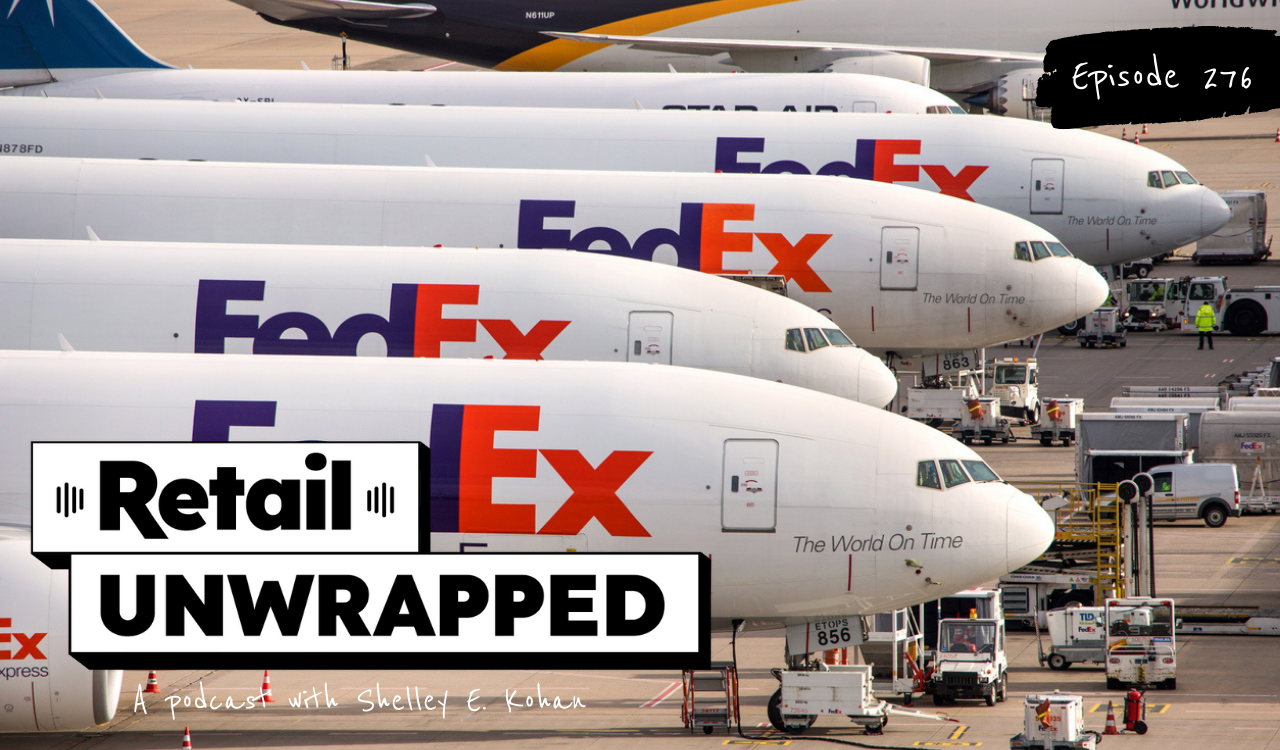

Customers have high expectations in their transaction experiences that do not end with the purchase. Today’s empowered and convenience-focused consumers want easy returns, and FedEx is on a mission to make that a reality using AI as a tool to improve the experience. Join Shelley and Jason Brenner, Senior Vice President Digital Portfolio at FedEx as they delve into the fascinating world of returns logistics and how the process has evolved. Jason says consumer familiarity with ‘no box, no label’ returns jumped from 37 percent to 48 percent in just one year. He attributes the increase to consumers’ perceived value around the experience. “Nearly half of U.S. customers say they’re now familiar with ‘no box, no label’ returns and the usage continues to increase year over year; the reason is that once shoppers try it, they understand how convenient and how low stress it can be,” he adds. Their conversation deconstructs shipping logistics and reveals why confidence comes from predictability and visibility that is grounded in a simple UX supported by reliable communications with thoughtful updates throughout the post-purchase journey. As with any customer service, trust, reducing stress and anxiety and managing expectations are crucial. Listen and learn how this iconic logistics organization continues to push the envelope to deliver better customer experiences.
Special Guests
Jason Brenner, Senior Vice President Digital Portfolio, FedEx
Transcript
Shelley E. Kohan (00:03)
Hi everybody and thanks for joining our weekly podcast. I’m Shelley Kohan and I’m very excited to welcome Jason Brenner, who’s Senior Vice President Digital Portfolio at FedEx. So welcome, Jason.
Jason Brenner (00:17)
So great to be here, thanks for having me.
Shelley E. Kohan (00:19)
Absolutely. So I know FedEx just came out with their big return survey and I was really fascinated by it because it shows a lot of AI-powered support along with the consumer growing demand of no box, no label options. So I’d love to get some insight from you about that and also love to hear about returns overall. So coming out of Christmas, I don’t know if you, it’s only what, three weeks?
⁓ But can you tell us a little bit about how returns wore this Christmas volume wise compared to last year or expectations as a starting point?
Jason Brenner (00:57)
You know, we’re still in it, but the returns volume is actually meeting expectations. ⁓ Our volume was up slightly year over year from a ⁓ overall shipping perspective, and returns are ⁓ trending in line with that volume increase. But for us, what we’re really focused on is improving and empowering our customers.
to make sure that that returns experience is great for their consumers. And we’re doing that through improving visibility, simplifying the experience, and pretty excited to see how that’s panning out this peak season and post-peak season. So excited to talk more about that.
Shelley E. Kohan (01:41)
interesting is that, ⁓
so the survey showed that like 53 % of consumers found AI, quote unquote, customer service, more satisfying than human agents. And I think that’s pretty cool and remarkable because I’m not sure the consumer’s quite there yet with AI agents.
tell me a little bit about that and ⁓ how is that working? How are they becoming more comfortable with this technology?
Jason Brenner (02:06)
It’s so funny you picked that out. To me, that was one of the most surprising things that we found in that survey as well in the research we did. I take during returns, most customers really just want quick, straightforward answers. You think about your experience ⁓ doing a returns process. What are you looking for? You’re looking for what are the steps? What’s the timing? What’s the status? And AI power tools are getting better literally by the week.
at delivering information as quickly as possible and doing so consistently and doing so in a human tone and doing so that’s grounded in trustworthy data. So from our perspective, it’s less about AI, it’s less about the technology itself, it’s more about how do you just keep pushing the envelope on reducing friction, driving speed to resolution or speed to information. ⁓ So when customers can get good answers right away, ⁓
the experience just feels easier and customers or consumers feel more in control. So I think that’s kind of what that 53 % number was getting at, to your point.
Shelley E. Kohan (03:13)
So what I find really interesting is that, you know, I always said, you know, consumers have always been a little bit ahead of retailers, right? And then the retailers kind of adapt to where consumers are. But I think with returns, it’s the, it’s opposite. Like I think the industry has been ahead of the consumer offering like no box return labels and that type of thing. So customers are used to packing stuff up and dropping it off at FedEx already in an envelope or a box or a shipping label. But what’s also interesting in your survey,
this year is consumers are actually more familiar with no return labels and no boxes. So tell me a little bit about that.
Jason Brenner (03:52)
Yeah, I think we saw that ⁓ the familiar familiarity. I messed up that word, but ⁓ with no box, no label returns jumped from 37 % to 48 % in just one year, ⁓ which is a big jump. And I think it goes back to the when you’re prioritizing work, you’re really thinking about how are you driving the value prop for customers and consumers and it’s oriented around experience. So.
If nearly half of US customers say they’re now familiar with no box, no label returns and the usage continues to increase year over year, the reason for that is once shoppers try it, ⁓ they understand how convenient it is, how low stress it can be, ⁓ and they don’t need to think about printing a label, packaging an item, taping it up. They simply need the item, the QR code, and they need to find a location where FedEx ⁓ has a ⁓ lot of locations that are really conveniently placed for the
broad ⁓ for most of the US population. So we’re pushing the envelope on experience, on convenience, ⁓ and consumers adapt onto that. So that’s where you see ⁓ that adoption curve really increasing year over year. I’d say when we look ahead, ⁓ we expect more retailers to keep scaling these solutions and continue to look for ways
to simplify the returns process. So ⁓ we’re going to continue pushing the boundaries of that value prop for sure.
Shelley E. Kohan (05:28)
think it’s great and it certainly makes it a lot easier. And the other thing from a retail perspective, if you think about it, if you’re relying on the customer to box it, label it, pack it, you know that’s gonna add time into that return getting back in the system as opposed to your code product and you go to the FedEx place drop off because that has to shorten the return time. is that like, are you seeing that?
Jason Brenner (05:53)
Yeah, and the fun thing is get to, know, our job is to, again, to push the value prop convenience, simplicity, ⁓ price, experience, etc. And then, yes, these operational considerations are second order, sort of second order effects from that. But then our job is to plan and react to it. And again, back to the value of AI and data. ⁓ Any changes that come
from our offerings that we create that impact our operations, we then have to study those ⁓ and see what the impacts are to our operations, to our retailers’ operations, and then plan for it and react. But the important thing is starting with the customer and starting with the consumer, and then managing the downstream effects of it, and ideally turning those downstream effects into areas of differentiation.
if you could capture it, study it, and plan for it, and change your operations around it. So we are seeing it, and we’re adapting. We like to say that we have the smarter supply chain, and we help our customers make their supply chain smarter. ⁓ So this sort of falls in line with that, from my perspective.
Shelley E. Kohan (07:09)
that’s great. And I think for retailers, if you can shave off two or three days from that return, getting back into their quote unquote inventory, that’s got to be tremendous for them.
Jason Brenner (07:18)
Absolutely, absolutely yes.
Shelley E. Kohan (07:21)
So the other thing that’s really interesting is that, know, consumers, when they’re doing in-person returns, they have a very, very high confidence level. And so I’m not sure it’s as high with shipping. So there’s like a gap between the confidence going in and returning something and the gap between shipping it out. So what is FedEx doing to kind of close that confidence gap between the two?
Jason Brenner (07:25)
you
Really, really good question and very top of mind for me right now. ⁓ So where does confidence come from? It comes from predictability from visibility ⁓ and visibility has to be grounded in sort of a simple UX, ⁓ simple communications, all of that. So whether a return happens in person ⁓ or through the mail, customers just want to know where their item is and what’s happening next. So our focus is on
reliable delivery, clear tracking, proactive, thoughtful updates throughout the post purchase journey. ⁓ So customers and consumers can easily see the status of their return and trust that it’s moving forward as expected. And that has to apply for returns and for shipping. So ⁓ those are two end to end journeys that we look at constantly and say, how do we drive
incremental improvements, then how do we also radically transform the experience to make it simpler and more trustworthy for our customers and consumers? ⁓ I think we did a lot of great work there going into Peak, and we’re seeing some of the output of that right now. ⁓ But we also have a lot more work to do. if you’re driving towards visibility and simplicity, it’s kind of like your work is never done.
⁓ So there’s always opportunities for us to improve there for sure.
Shelley E. Kohan (09:14)
And I think Jason, you’re right. I think what consumers worry about is that when they do a shipping return, it goes into a black hole. And then they have to sit and wait and wait and wait, right? And so I love getting those notifications saying, hey, we received your return. Hey, your return’s being processed. Because now I don’t have to worry about it. It’s one less thing I have to worry about as a consumer. So I think that’s great.
Jason Brenner (09:21)
Yeah.
Absolutely, I mean the key to great customer experiences is exactly what you just described. Put yourself in the seat of the customer and say what friction points come up, what creates stress, what creates unknown or anxiety, and then how do you solve for those and then even delight within those moments. So that’s what a lot of our team is focused on here.
Shelley E. Kohan (09:59)
Well, I think the other thing that’s really on the top of mind for consumers is this idea of businesses, retailers are now, some of them are starting to charge for returns. I think it’s like 40 % or something based on the information that was collected from your survey, it is 40%. But so that’s it, that’s a lot of businesses that are starting to charge for returns. And when you think about it, it makes sense because with all the other cost pressures, high labor costs, tariff costs,
Jason Brenner (10:00)
out.
Shelley E. Kohan (10:28)
cost of goods increases, et cetera, I can see how retailers are finding it that they have to do that for some customers. But what’s happening is consumers are actually making a purchasing decision based on whether or not they can actually make a return. And this is more so online than in-store shopping. So what are you doing to kind of balance ⁓ that in terms of customers making choices about
how what the return policy is based on what they’re purchasing.
Jason Brenner (11:00)
Yeah, let me let me add to your point there. So you mentioned 40 % of businesses are now charging for returns and on top of that specifically 59 % of consumers avoid retailers that charge for a return. So this is this is this is the conundrum. So that’s what our survey just kind of came out with recently. So we really encourage retailers to be intentional and transparent. Convenience.
Shelley E. Kohan (11:15)
Wow.
Jason Brenner (11:28)
does not mean that the retailer has to absorb every cost. ⁓ But I think what really breaks down the trust is surprises in the experience. ⁓ So again, being intentional ⁓ and being transparent with your customers upfront, ⁓ we see nets the best results from a lifetime value perspective. ⁓ You’re not just trying to win this purchase.
You’re also trying to win the lifetime value of the customer and the repeat rate and delivering on a strong customer experience. So ⁓ I think, again, we see trust breaking down the most on when surprises come up later in the journey at the time of return. So ⁓ the data shows that shoppers value that simplicity, that clarity. I guess when policies clearly communicate and are easy to understand,
then retailers have more flexibility to manage the costs without jeopardizing experiences. So ⁓ I don’t think there’s a silver bullet here. This is about balancing your customer experience versus the reality and the economics of your business. But the most important thing is being transparent with the customers.
Shelley E. Kohan (12:44)
No, that’s great. And let’s talk for a minute about the bad actors, the bad actors meaning fraudulent returns, because I do believe that there are sometimes when you have bad actors that are trying to return things fraudulently. And when you talk about businesses, they have stricter policies, shorter windows, and they’re trying to of curtail that fraudulent. So are you able to use ⁓ AI? How can you help retailers with the fraudulent returns?
Jason Brenner (12:59)
Yeah.
Shelley E. Kohan (13:14)
concerns.
Jason Brenner (13:15)
I appreciate the line of questioning because these stricter policies, the tighter ⁓ charging, all that reflects real pressures that retailers are facing to manage costs and returns fraud, is very, very real. ⁓ But I’d say net, our perspective is that that friction, that may be healthy friction, should be very targeted rather than universal.
⁓ And the good thing is the visibility and the data are key ⁓ to enable that and they’re becoming more and more mature. So what do I mean by that? ⁓ I’ll give you a very specific example. We support our customers by providing tooling that improves shipping tracking. One example of that is picture proof of delivery. ⁓ So that shows retailers and customers exactly when and where a package was delivered. ⁓
That extra visibility helps retailers reduce fraudulent replacement claims and associated costs. And there’s also in that process, ⁓ we are rolling out more and more ⁓ data points to help validate that the shipment was delivered, like GPS proof of delivery, ⁓ attempted proof of delivery. ⁓ All these data points add up within the retailer’s arsenal to help validate ⁓
that the delivery was made, the attempt was made, it was made to a specific address. ⁓ In addition to that, we are rolling out some enhanced post-purchase digital offerings coming very soon, ⁓ which will continue to simplify the returns process for both customers and businesses. So we have in-market, live, ⁓ we’re using predictive models, we’re using enhanced data points, ⁓ and we’re furthering that value prop.
which is really exciting to empower our customers to reduce their incident of fraud.
Shelley E. Kohan (15:16)
That’s great. And so can you, I know you probably can’t tell me what you’re doing yet because you haven’t announced it. Is that a good guess on my part?
Jason Brenner (15:23)
That’s a good guess. We’re announcing something
very, soon ⁓ regarding a post-purchase solution and a post-purchase suite. Yeah.
Shelley E. Kohan (15:30)
That’s awesome.
Okay, so my quote, I know you could probably answer this question. So when I think about the fraudulent returns, I’m with you. think creating all these rules and policies for the 10 % that affect the 90 % that are good returns, you know, just doesn’t make sense to me. So you have to figure out a different way to deal with that 10%. But in this new stuff that you’re doing, the predictive analytics using AI, that type of thing, do you think that you’re able to more quickly make a decision about returns that are fraudulent, which are not
thereby, you know, what we want to do is reduce the amount of time it takes to authenticate a return.
Jason Brenner (16:10)
And that’s exactly what we’re doing. What we’re doing is we’re providing our retailers, our customers ⁓ with more data ⁓ and showing them, here’s the use cases where others are identifying, this is how you leverage this data to make informed decisions. ⁓ We are not in the business of singling out individual customers or anything along those lines. We’re in the business of…
Hey, we have a tremendous amount of data at our fingertips. ⁓ Our network produces two petabytes of data a day, which is really crazy on the 17 million packages that we deliver per day. So we’re in the business of saying what data do we have available? Where are we seeing folks leverage that data to make informed decisions to improve their KPIs? ⁓ So that’s where we keep ⁓ trying to push the boundaries on.
Shelley E. Kohan (16:44)
Ha ha.
No, that’s great,
that’s great. And I’m going to impress you with my knowledge of petabytes and gigabytes. Isn’t a petadite a million gigabytes?
Jason Brenner (17:14)
I believe so, yes. Yeah. It’s a tiny effort for yes, it’s it. It means a ton of data we had. We have. We have some funny stats on, know, it’s it’s you know the classic the football fields, etc. It’s to the moon back, etc. But I’m forgetting the specifics of it, but net it’s a ton of data. But but the data in itself is the most important thing is what you do with it.
Shelley E. Kohan (17:15)
or something like that. Yeah. So that’s a lot. That’s a ton of data.
Yeah. So the other. Yeah.
Of course, definitely. So the other thing is, I don’t anticipate, and reading your survey, I don’t think you anticipate either. I don’t anticipate consumer behavior changing and returns becoming either obsolete or less. think the behavior we’ve seen, returns are going to continue. But what can change and what you guys are working on is how we deal with returns to reduce the friction points and to keep…
inventory in our systems at a more, at a quicker rate, right?
Jason Brenner (18:14)
Exactly. I mean, if I look at my own house, I don’t think returns are decreasing. I think from our survey, it showed that 40 % of consumers expect to return the same amount or more in the next year. yeah, think returns are just becoming increasingly a routine part of doing business, which means that we, as the supply chain providers and retailers, have to design for them intentionally.
⁓ It’s no longer an anomaly. ⁓ It’s just part of doing business. I think what that means for us is the experience has to be more connected. It has to be more predictable. It has to be more data-driven. ⁓ And it has to, back to the point of ⁓ transparency, ⁓ it has to reflect the voice and the values of the retailer ⁓ if the retailers want it to drive lifetime value for them.
So I think, yeah, it’s just, it’s a part of doing business.
Shelley E. Kohan (19:16)
I love all the stuff
that you’re working on and I love the fact, Jason, that you are absolutely putting the consumer in the center of this equation, which is what I think you have to do. So what are you most excited about in terms of designing for the emotional experience of returns, not the logistical one?
Jason Brenner (19:36)
Yeah, I think if you see in our language, it’s oriented around when we talk about our no box, no label solution called FedEx Easy Return, it’s all about convenience, being straightforward, being stress free. So you’re hitting on the point around the emotional experience for returns. All of that is very intentional. ⁓ Returns are often the last experience that a customer has with your brand. ⁓ So how that moment feels really matters.
It could be make or break whether or not they repeat with you and all retailers and brands are orienting around lifetime value of a customer, which a key part of that is that our customers repeating with us. Are they buying? Are they coming back to us again and again? And do they have a positive experience? So. You mentioned emotion. I that’s exactly right. We have to make this process simple. We have to set expectations clearly. We have to make sure customers feel informed.
We have to make the stress and the anxiety of a return, as you described, sort of like the black box. We have to make that go away. ⁓ So the emotional experience plays a big role in whether the customers come back to the retailer and the brand time and time again. So we think about it a lot.
Shelley E. Kohan (20:50)
That
is so true. Absolutely. So I’m going to close with two thoughts. One is I had a favorite retailer that I would buy from every single year for my whole family, my husband, my kids and me. And I had a bad return experience with them. I have not shopped them in seven years. I refuse to shop them.
Jason Brenner (21:04)
Yeah.
my goodness.
Shelley E. Kohan (21:10)
So when you say there’s an emotional attachment, that’s what happens and I won’t bore you with the details, but I’ve never shopped there ever again. I won’t even wear their stuff in my house anymore. But… ⁓
Jason Brenner (21:21)
Yeah, that’s That’s what we so you know
we are trying to make sure that we empower our customers that that doesn’t happen. ⁓ Yeah, you unfortunately. ⁓ When you you think about NPS, there’s you know this delight moments. There’s there’s the detraction moments and both. They’re both equally powerful, so we have to sell for both.
Shelley E. Kohan (21:31)
Of course!
That’s right. And the last thing, here’s a fun fact about me that you don’t know that will impress you, is I’ve actually toured your Memphis facility back in, yeah, I’ve been there. I toured it with your team. I’m gonna say 2004 or five-ish when I was with Saks Fifth Avenue. So I had a great experience and I really enjoyed looking at the facility there in Memphis.
Jason Brenner (22:07)
Yeah, it’s an unbelievable facility. What do you think? were your impressions?
Shelley E. Kohan (22:11)
I’m blown away about the amount of packaging proficiency and efficiency that takes place in that warehouse. It’s just unbelievable. I should say multiple warehouses, but the whole logistics and the planes and it was quite fascinating for sure.
Jason Brenner (22:26)
Yeah, I mean it really blows your mind to see it. I hope I get this right because we’re being recorded, but I believe 1.5 million packages goes through that facility every evening every night. 1.5 million packages every night through the Memphis Hub. ⁓ It’s just mind blowing ⁓ when you think about the scale of what we deliver. It’s amazing.
Shelley E. Kohan (22:51)
It is amazing and also I got
to visit Graceland too so that was fun too.
Jason Brenner (22:58)
That’s an added perk of coming down to Memphis.
Shelley E. Kohan (23:01)
It is. But thank you, Jason, so much for being here and telling us a little bit about what’s headed for customer returns. And we look forward to what’s being announced soon.
Jason Brenner (23:11)
Awesome. Likewise, speak to you soon. Bye.
Shelley E. Kohan (23:14)
Thank you.