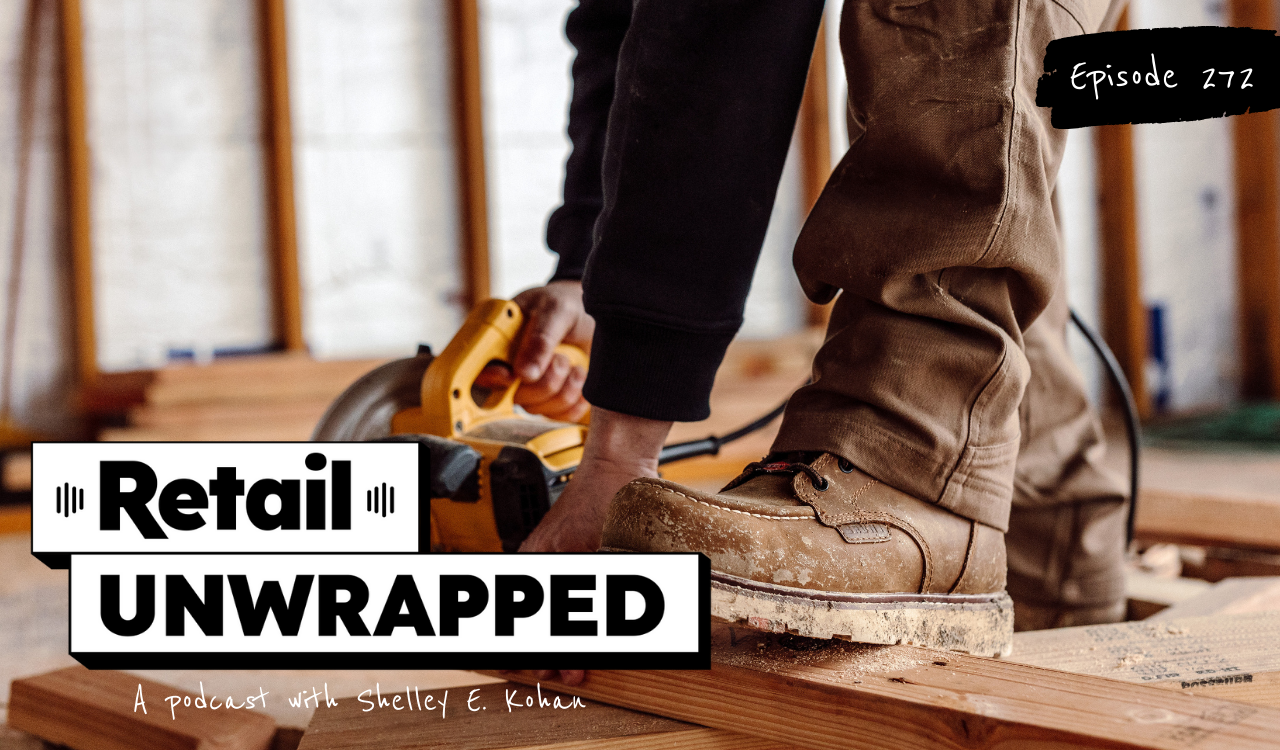

Here’s an interesting fact: 1.6 million tradespeople trust their friends over impersonal brands. And here’s why: Most workwear brands claim they understand their customers, but they’re designing products by committee in the boardroom and based on their P/L. Join Shelley and Eric Girouard who discuss how he built his BRUNT Workwear brand with the people who actually wear the work gear. They reveal how BRUNT was launched with the encouragement of childhood friends who were brought up in a blue-collar manufacturing town. Unlike Eric and his colleagues, the workwear industry has forgotten who it serves and would be better served by paying attention to what happens when customers help design their own products. BRUNT eliminated PFAS from water-resistant fabrics before regulations required it, positioning the brand ahead of market demands while legacy competitors are still scrambling to reformulate. BRUNT stays close to its customers, outfitting the New England Patriots field crew this season, partnering with unique talent like Diesel Dave who tricks out trucks and professional motocross athlete Travis Pastrana. It’s also a mainstay in rally racing, NASCAR, and automotive stunt performance. BRUNT’s Bucket Talk is “a monthly podcast that takes listeners across America to meet the “most badass tradespeople, industry leaders and personalities.” Growing from an initial 110 stores to 858 doors nationwide while maintaining its brand integrity proves that authentic products are relevant and can scale when you understand your local communities and customers.
Special Guests
Eric Girouard, Founder + CEO at BRUNT Workwear
Transcript
Shelley E. Kohan (00:01.826)
Hi everybody, and thanks for joining our weekly podcast. I’m Shelley Cohen, and I’m very excited to welcome Eric Gerard, founder and CEO of Brunt Workwear. Welcome, Eric.
Eric Girouard (00:13.928)
Thank you for having me, Shelly. I appreciate it.
Shelley E. Kohan (00:16.66)
Absolutely. So I actually am going to start off with a fun little story that you are going to love. So a week ago, it’s pouring down rain in New York City and the dog has to be walked. And my husband says, I don’t have any good rain boots to walk the dog in. And I said, I know the perfect boot for you. I know it’s a great boot because it sold a million already. And so I went online and I got him a Marlin.
Eric Girouard (00:42.825)
Yep.
Shelley E. Kohan (00:46.21)
boot from brunt. So.
Eric Girouard (00:48.5)
Appreciate the support, that means a lot.
Shelley E. Kohan (00:51.176)
Absolutely. So I’m excited because I think you have a great brand and I always love great brands. But what I love better than great brands is the story behind the brand. you actually started Brunt. Tell us a little bit about the brand and then tell us how you actually started the brand with your childhood buddies. How did that come about?
Eric Girouard (01:11.72)
Yeah, it was a pretty, pretty organic story. I had grown up with my childhood buddies in a small blue collar town where our parents worked at least one blue collar job, a couple of them two blue collar jobs. My dad worked third shift and then we’d roof during the day. And so it’s kind of all we knew. I happen to have a knack for business and was.
didn’t have formal training, and even though my parents didn’t go to college, they were like, maybe you should go and get some foundational stuff. And I ended up going off to college. All my buddies went right into the trades or the military, for the most part, right out of high school. But we stayed really close. And,
I spent about 10 years working for a serial entrepreneur, which was great training. And finally, after 10, 12 years, my buddies and I were at my bachelor party. And they said, why don’t you start a brand for us? You’re doing all this stuff in kind of fashion and coffee and shoes. And I said, well, what would that be? They said, well, we wear the same work boots, the same pants that our fathers did, our grandfathers did. How about a new modern?
workwear brand that looks like we look and talks like we talk and that was where the idea came in 2015 and three years later in 2018 I finally decided to leave my job and start start building grunt.
Shelley E. Kohan (02:34.574)
I love that. And what I love about the story is, and I’m sure you know this story already, so you’re creating a brand by people that actually are gonna be using the products. And Levi, that’s how Levi invented the first gene is that the founder would go out and look at the gold miners and take notes about what they were doing. they needed a tool in the pocket. They needed this, they needed that. So it kind of throws me back to
Eric Girouard (03:01.363)
Love that.
Shelley E. Kohan (03:03.33)
You know, you’re making something and building something for something you know about and your childhood buddies, I’m sure, gave you lots of feedback. In fact, I think a lot of your products are named after them. Is that correct?
Eric Girouard (03:13.885)
Correct. Yeah, yeah. It’s a very unique situation. Obviously, getting the business off the ground, made a ton of mistakes along the way. I’d say there’s two things that we did right that it kind of fundamentally changed the trajectory of the business. The first was from a brand perspective.
My buddies didn’t have training on how to build a brand and so on and so forth, but they understood what they wanted and what they felt and what they believed in and so on and so forth. And so I worked really closely with them when I was working on the actual brand itself, our identity and our being and what we stood for. On the phone with them asking very pointed questions, does this get you excited? I knew if it got me excited, it didn’t get them excited. Didn’t matter because they’re out in the field all day long. If it got them excited, then I knew it was a winner.
They helped, they helped really create the brand and, um, and the whole goal of we wanted our product to bear the brunt of the workday for them and our boots to bear the brunt of the workday and now our apparel. And then the second thing was the product, the first four products that we launched, the first four boots. I, at that point had been on the trades for 10 plus years. I hadn’t been wearing work boots 40, 50 hours a week. Times had changed. Technology had changed. So I worked really closely with those guys, Matt Maron, Dan Bolduck, Skyler Ring, Jeremy Perkins.
They create the Marin, the Perkins, the Bulldog, the Ring, and they gave me the most detailed feedback imaginable from what they did for their specific trade to create those first four boots. And those four boots are still all in the line today.
Shelley E. Kohan (04:47.413)
I love that. I think that’s great. And the other thing that’s interesting about the design process is that, okay, so I saw your video. I love the fact that you put videos on your website that explain the design process because I think as consumers today, it’s important for them to understand the story, the brand, you know. And so I watched your fantastic video on the Chevlyn hoodie and the whole design process fascinated me. So can you talk a little bit about that? And also,
Eric Girouard (05:10.695)
Yes.
Shelley E. Kohan (05:17.279)
I think you’re very forward thinking because you designed that PFAS free. So tell us a little bit about how that came about too.
Eric Girouard (05:22.407)
Mm-hmm.
Yeah, so when we knew we were going to enter the apparel market early in our life cycle, but we knew we couldn’t just slap a logo on another sweatshirt and it had to be different. It had to bring some type of value to the consumer. so similarly, we started from the ground floor and started looking at sweatshirts. I remember looking at some of my buddy’s sweatshirts where they were breaking down, where they were ripping, where they were tearing, what was happening. And from the every
every stitch, every seam, every feature, every functionality is completely purpose-built and we took
what could have easily been just a generic hoodie and really ramped it up. It’s got a big, you know, from the fabric, which is PFAS free. has DWR in it, so water will beat off to keep them dry in the snow and the rain, but it’s also PFAS free, which is hard to accomplish. And the market’s been moving there over the past few years and in the future it’s going to be required. So we figured let’s just jump to the end point and do it earlier than most. And so obviously a lot of people appreciate the PFAS free for those that understand what that means.
you
Eric Girouard (06:32.499)
So that’s that. And then the hood, oversized hood, it’s hard hat compatible, can go over a hard hat if needed, over a hat. No drawstrings. So drawstrings are dangerous on a lot of job sites. They can get sucked into tools and circular saws. And so it has neck snaps instead. So it can be snapped up right underneath the chin and to basically kind of turn into a turtleneck on those really cold days. Left unsnapped when you don’t need it. And then a very large oversized belly pocket that has a cell phone holder in the inside.
That’s a good example of like normally people put the cell, if they put a cell phone holder and they put it sideways and then the phone kind of falls sideways, we angled it so that it couldn’t fall out. And then we put catch corners in the bottom corner. So guys have nuts or bolts or you change or screws floating around in the bottom of the sweatshirt. It doesn’t fall out of the left to the right. And so every feature, every functionality has to have a purpose for us to put into our product. we’ve sold hundreds of thousands of the Chevrolet hoodie.
people that get it just absolutely love it.
Shelley E. Kohan (07:33.133)
It’s a very mindful design process, which is what I love about it. And I have to imagine with all this do it yourself, working at home stuff. mean, those are great, great examples of why the secondary market, I know your markets really tradesmen, but there’s a secondary market of people that are doing jobs at home. And you just mentioned like six safety features that people working at home should be thinking about.
Eric Girouard (07:48.231)
Yeah.
Eric Girouard (07:53.735)
Yeah.
Yeah. And the core difference there is we’re happy to serve either customer is the hardcore tradesman that’s out there five days, know, five, six days a week, 40, 50 hours. They’ll probably go through one or two sweatshirts a year, whereas the DIY kind of weekend person that might last them three, four years. It’s just the extended life of it, which is the benefit, I guess. So, yeah.
Shelley E. Kohan (08:17.345)
That’s great. OK, so the work where landscape has actually changed. We’re actually seeing growth in trade workers in the US. I think there’s over 30 million trade workers now. And you kind of mentioned something I’ve read in the past about Gen Z’s becoming the quote unquote tool belt generation. Can you talk a little bit about this new generation that’s kind of your target market?
Eric Girouard (08:42.055)
Yeah, so obviously the whole US market’s got about 30 million folks that work in these trade slash blue collar jobs, however you define them, and the Bureau of Labor Statistics actually classifies these things. what’s unique is…
Two things are happening. The amount of Gen Z that is applying to trade schools is up 20 % year over year. It used to be pretty flat, sometimes down. really this past year. It’s been up 20%. So it shows you a lot of the younger folks of the Gen Z population are actually raising their hand and saying they want to go to these trade schools. And it’s a unique.
you can be good or you can be lucky. Five years ago when we started Brunt, we didn’t see this coming and we just kind of got lucky that this is happening. But you see the investment from the government into construction and infrastructure into the country. That money means there’s going to be projects. Those projects need people to build them and bring them to life and build the buildings that we work in, the houses we sleep in, the roads we drive in, the electrical that powers everything. And so there’s more demand for that.
type of skill and work that’s out there. think that Gen Z population is starting to realize, wow, this could actually be not only potentially lucrative and create a lot of success, but also a lot of flexibility and freedom and entrepreneurship. If that’s the path they want to go down, they can choose when they want to work. They could work their own hours. There’s a lot of freedom that comes along with that. And I think they’re starting to realize that. so yeah, we’re just happy to be here to kind of…
be the brand that’s supporting that generation that obviously they’re loving by the droves and the fact that the kind of wind is behind our sails. We’re grateful for but I can’t say we strategically planned that five, six years ago.
Shelley E. Kohan (10:37.922)
Well, here’s some more good news. think Gen Alpha, which enters the workforce, I believe next year, like it’s crazy that Gen Alpha is already coming in the workforce. But the Gen Alphas are going to have that same kind of mentality of really wanting to work with their hands, with the trades. And I think it’s a great sense of feeling of contribution.
Eric Girouard (10:46.696)
Right.
Eric Girouard (10:59.997)
Right, right, exactly. Yeah, and it’s interesting because…
You know, as I was as I was growing up, definitely my father’s generation, but as I was growing up, especially with my buddies that I sort of the brain with, there was kind of the trades were if you don’t go to college, you go into the trades. And it was kind of somewhat looked down upon. And what’s really happened recently and it’s been kind of Brun’s, you know, unspoken mission is to really shine a light on the positive side of the trades, the success factors, the
all the benefits that come along with it. And I think that you’re starting to see that shift, generational shift where people are like, whoa, why would I go to, you know, rack up $100,000 of debt and go to school? I’m not really sure exactly what I want to do yet in life. How about I go right into the trades? can make really good money, so on, so forth. And so I think people that there’s a perception and a stigma that’s starting to finally change in a positive way.
Shelley E. Kohan (11:59.915)
It’s great and I’ll tell you a quick story. One is my son who’s choosing the college route said to me I do not want any debt coming out of college So I have to pick a college that I will have zero debt and three of his friends are actually going the trades Worker route and so what nice what high schools are doing now. I don’t know if you know this but at least in some of the New York schools that the actual high schools now have classes you take to learn to be the trade in
Eric Girouard (12:15.933)
Yep, yep.
Shelley E. Kohan (12:29.684)
in high school. So they leave the high school, they go to a facility, a vocational school, and they’re learning different types of trades. So it’s fantastic. So when they graduate high school, they’ve already been trained and they’ve docked some work hours. So I think you’re going to see growth in this as well.
Eric Girouard (12:30.974)
that’s great.
Eric Girouard (12:37.575)
Yeah.
Eric Girouard (12:43.495)
Yeah, that’s great. Yeah, that’s fantastic. Love to hear that.
Shelley E. Kohan (12:48.706)
So let’s switch over to marketing. Did you go to school for marketing by any chance?
Eric Girouard (12:52.623)
So I went to a very, this business school I went to is up here in New England, very small business school called Babson and it’s, you really only, yeah, Babson College, yes. So you really lead there. They don’t have, you leave with a bachelor’s of science in entrepreneurship. So it’s pretty general. Obviously marketing is a key component of entrepreneurship, but marketing is kind of my, if I had to do one thing in life, I’d say I’m a marketer at my core.
Shelley E. Kohan (13:00.719)
I know Babson. Yeah.
Shelley E. Kohan (13:10.797)
Yeah. Okay.
Shelley E. Kohan (13:20.75)
Oh my God. And so the reason I asked you if you went to school for it, but now it’s just innate within you, I’m learning, is that the marketing you’re doing is crazy. It’s kind of like a different playbook for a new brand coming into the marketplace. So I’d love for you to talk a little bit about, although I’m going to be transparent and honest, I am not a Patriots fan. I’m a Steelers fan, but I love the fact that you’re from New England.
Eric Girouard (13:31.112)
Mm-hmm.
Shelley E. Kohan (13:47.011)
and you are supporting the patrons. Tell us a little bit how all that came about because it matches perfectly with your brand ethos.
Eric Girouard (13:54.996)
Yeah, the first few years we weren’t able to partner with NFL league level teams and things of that nature. And we had a very different playbook. This was the first year the business got to a size where we were able to even entertain those conversations.
Eric Girouard (14:35.571)
That’s really representative of Brunt, those guys that are out there on the field crew in the snow, in the rain, in the heat, in the summer, just putting in the work, making sure those players can have a top tier field to play on. And the conversation quickly shifted to we want to actually sponsor the Gillette Stadium field crew team. And yeah, and here we are. We are an official sponsor of the New England Patriots, Gillette Stadium, and then obviously the Gillette Stadium field crew.
Shelley E. Kohan (14:42.638)
Shelley E. Kohan (14:56.397)
I love it.
Eric Girouard (15:05.491)
about nine or so folks that were.
Shelley E. Kohan (15:09.058)
I love that. That’s fantastic. And I know you have work, you’re doing some stuff with the Bruins and some NASCAR stuff and motocross, right?
Eric Girouard (15:15.963)
Yeah. Yeah. So we have a big partnerships consortium of folks. And obviously there’s the New England Patriots, there’s the Bruins through the TD Garda Bull Gang. Some of the folks that flipped the court to ice and ice back to court during the night. And then we’re in NASCAR, we’re in Snowcross. We have partnerships with folks that we know our customer really loves and enjoys following on social media like Travis Pastrana.
Seroni, Hannah Baron, and so we’ve got this great group of partners. And we use that to amplify the Bernstein. We always tie it into what we do and how we do it, and the blue collar kind of trades work. And it’s been great for the business, for the brand, for the community, and the customers love it.
Shelley E. Kohan (16:05.862)
I know. I think it’s great that you’re doing all that work. you said something really important was community. as you know, consumers today, they really want brands that are contributing to the community. And you do that in a big way.
Eric Girouard (16:18.983)
Yes, yes, we do. We do what we can and as we grow we continue to do more, but our biggest initiative has been we’ve donated today. We have a boot donation program and we’ve donated.
Shelley E. Kohan (16:32.519)
No.
Eric Girouard (16:34.099)
Just a couple weeks ago, we donated our 20,000th pair of boots to students at trade schools. And our goal is by 2030 to donate 100,000 pairs of boots to students in trade schools. And so it’s very, very unique. We partner with.
either the head of the trade school, sometimes called the principal, sometimes director, whatever it may be. We partner with them, we get the products delivered to them. If it’s in our area, we send someone from the company, whether it’s myself or other folks in the team, to talk to the students about.
right their futures are and so on and so forth. what’s even more shocking is a lot of the times these are these students’ first pair of actual work boots, safety rated work boots that they’ve ever had. And they’re actually in school learning the trades. And so it’s kind of a, we don’t ask for anything in return. We don’t know quid pro quo. just, I believe you put good out into the universe. It’ll come back to you in other ways.
Shelley E. Kohan (17:31.468)
Yeah, definitely. I think that’s great. And thanks for supporting students. I love that. So let’s let’s talk about holiday. We have talked about holiday. So I hear from the grapevine that you did like over three million dollars on Black Friday. And then over the course of the whole Black Friday weekend, it was very positive for you. The numbers I have are that you’re you did like over 15 million. So how’s holiday going for you?
Eric Girouard (17:35.335)
Yeah. Yeah.
Eric Girouard (17:49.768)
Yeah.
Eric Girouard (17:53.266)
Mm-hmm. Yeah, so this this holiday was interesting because of
because of what was going on in the macroeconomic, you know, kind of US at the time, right? And so we’re always from a brunt perspective, we always feel pretty safe and pretty comfortable because we’re not a discretionary purchase. People need work boots and work pants and work hoodies to do their job at the best of times and at the worst of times. And so when you see the economic shifts of, you know, some businesses, software businesses take off when things, you know, during COVID and others obviously
don’t do as well, we’re pretty stable. And so this is the first time going into holiday where we weren’t sure where the consumer sentiment was. There’s a lot of skepticism of what was going on. And so.
hunkered down we stayed disciplined, stayed focused and yeah it was our biggest holiday period ever from record-setting selling days to the number of products that we sold. We ended up actually selling more units of apparel than we did boots in that that period and so that’s the first time that’s ever happened for the business which just shows you how the growth of the apparel side of the business is going in.
Yeah, and it’s incredible. It was just incredible to see the team works all year for it. We start prepping for it. We have a lot of limited edition products that come in and sell out really quickly. And at the end of the day, we participate in a little bit of that holiday feeder, so to speak. we understand we serve a very important purpose. We’re getting people products that they need to do their jobs to keep them safe, to get home to their families at the end of the day. And so.
Eric Girouard (19:37.627)
have fun but we also understand the seriousness of the product that we make.
Shelley E. Kohan (19:44.692)
that’s amazing. I know that last year I believe you launched wholesale, correct?
Eric Girouard (19:49.716)
Correct, yeah, so we launched wholesale in February 15th of 2024, and because we were online for the first three years only, you you could go to bruntworkwear.com to buy our product, couldn’t get it anywhere else, so we wanted to launch in the physical retail world because…
About 65 to 70 % of customers that buy this product still like to go into a store to touch it, to feel it, to try it on, to smell the leather. And so we knew if we wanted to be the most dominant workwear brand in the next few years, we were going to have to be in that channel. Otherwise we were ignoring too many people. And so we launched.
Shelley E. Kohan (20:13.327)
Yeah, me too.
Shelley E. Kohan (20:22.873)
Mm-hmm.
Eric Girouard (20:25.875)
and tested in 110 stores with 20 different retailers that carried our product. And it absolutely, we had no idea how it was going to do. It absolutely exploded. We were sold out of most of our retail accounts within the first week. They wanted more inventory and we.
kind of caught a tiger by the tail and the team stabilized the business, got more inventory, the open up more accounts. We’re now in 858 doors across the country in every state and the business that holds the wholesale part of the business is growing 345 % this year. So it’s an absolute rocket ship. And we love it because our partners that carry our product, obviously they’re in their local communities. They’re in, you know, we’re in.
outside of Boston, they’re in California, in Texas, in Florida, in places that we can never cover that much ground for, and they’re able to service the customers the way they want.
Shelley E. Kohan (21:19.641)
Yeah.
That’s awesome. And can you just name some of the retailers? Like what type of retailers?
Eric Girouard (21:26.995)
Yeah, so there’s a couple different pockets. There’s the national retailers. I think of like, Shields, Boot Barn, come to mind.
So they have kind of a national presence. Then there’s the regional folks like whistle workwear and shoot area on the West Coast or super shoes in the East Coast. They cover a region of the country. Then there’s the farm and fleet channel Midwest. I think of Blaine’s farm and fleet. You can buy a tractor in your horse, your horse tranquilizer and brunt boots in the same store. There’s the independents that are really authentic. Like I think of Frank’s in Pittsburgh, they have just two stores
Shelley E. Kohan (22:01.731)
Yeah.
Eric Girouard (22:07.645)
but it’s the place you go if you live in Pittsburgh to get your workwear and your work boots. And then last but not least is the shoe truck mobiles. There’s this network of truck mobiles that have relationships with the biggest manufacturers in the country and they go there and service them and the employees are reimbursed. There’s kind of five different. They’re slightly different and it’s a little niche, yeah. yeah.
Shelley E. Kohan (22:28.783)
Love it, yeah.
that’s great. So what can we expect in 2026? Do you think you’re going to eventually open up a store, a physical store?
Eric Girouard (22:40.019)
So yeah, so we are working on, we just actually started actual construction yesterday on our first ever flagship store. Demo had happened over the past few weeks, but construction officially started yesterday morning. And the goal is it’s gonna be a mile from our headquarters so we can keep a.
pulse on it and it’s much as it’s gonna be our first flagship retail store, it’s gonna be an incredible experience and show the brand head to toe in its own environment. It’s also gonna be a great place for the employees and the team to really see the brand in the physical world and play with merchandising and how things fit together. And then I’d say third, it’s gonna be a really powerful place for the community. It’s right on Main Street in North Reading where we’re headquartered.
It’s a small town, small blue collar suburb, a lot of hardworking folks. We’re have a lot of events there and to kind of add a little bit of life to downtown Main Street that was a seafood restaurant that closed down a few years ago. So it was kind left behind and we are completely, we brought it down to the studs and are gonna build an incredible Brent branded experience.
Shelley E. Kohan (23:50.159)
Well, that’s great. Eric, you have to do me a favor. You have to invite me to the grand opening because I cannot wait to come and check out the store and see how you kind of merchandise everything together. I think that’s great. And I also want to thank you for serving over 1.6 million tradespeople in every state. So thank you for your contributions to the industry and all the work that you’re doing in the communities.
Eric Girouard (23:53.743)
I will. I would love to have you.
Eric Girouard (24:06.823)
Yes.
Eric Girouard (24:12.093)
Thank you. We appreciate it. We’re proud to do it.
Shelley E. Kohan (24:15.703)
And thanks for being here. Our listeners, I’m sure, are thrilled to hear your story. So thanks for being here today, especially during a busy time. So good luck with the rest of the year and good luck in 2026. I’m sure we’ll have you back.
Eric Girouard (24:27.38)
Thank you. Looking forward to it.