
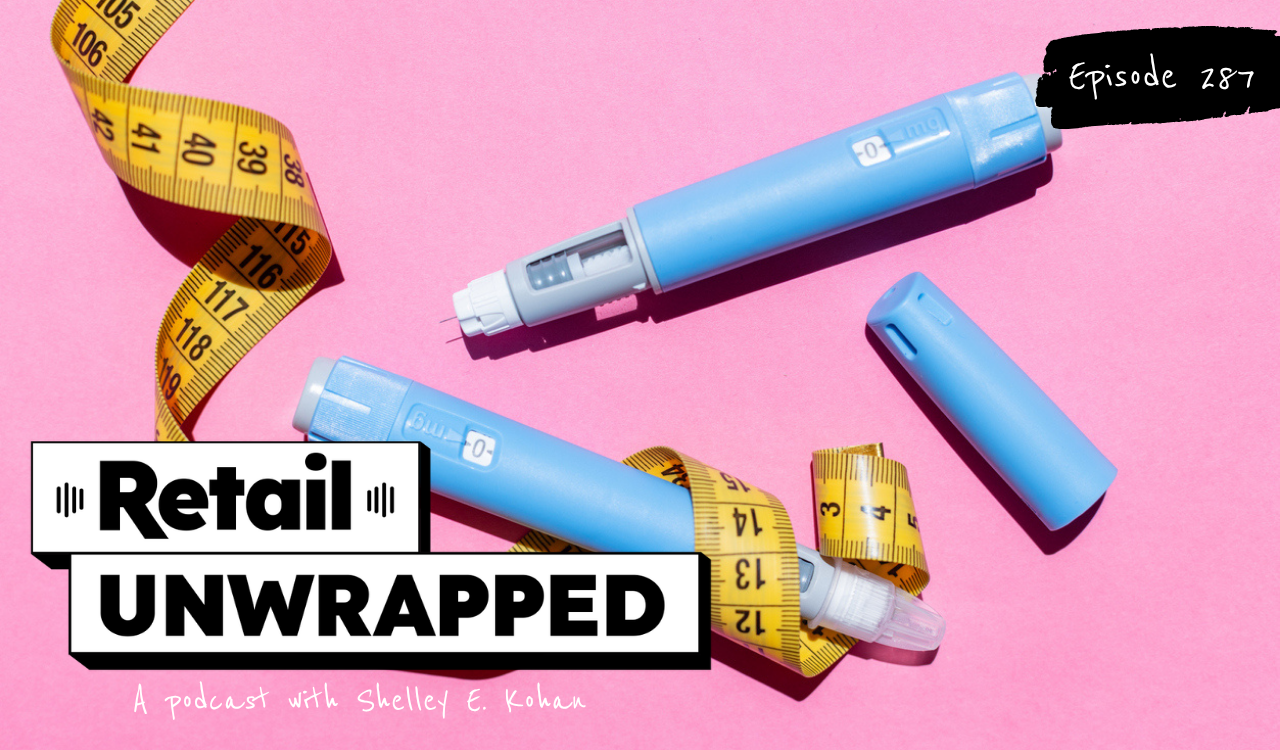

The fastest-growing consumer behavior shift isn’t driven by a trend, a digital platform, or a fickle generation: it’s a weight loss drug. GLP-1 adoption is accelerating so fast that Ozempic is outpacing iPhone adoption curves in the same timeframe. Retailers (both grocery and apparel) are treating this trend as a passing diet fad. Join Shelley with Liza Amlani, Founder of Retail Strategy Group and Ali Furman, PwC’s Consumer Markets Industry Leader as they challenge retailers to confront how to serve customers when body sizes change faster than the systems built to serve them. One outlook? Up to 400 million apparel units could be misaligned with actual demand by 2027, with retailers facing up to a $5 billion margin hit from oversized inventory, returns, and markdowns. Listen and learn why the GPT craze is an opportunity, not a transaction, for retailers who build trust with consumers whose bodies, wardrobes, and identities are all in flux. That loyalty will outlast the drug itself.
Special Guests
Liza Amlani, Principal and Founder, Retail Strategy Group
Ali Furman, Consumer Markets Industry Leader, PwC
Transcript
Shelley E. Kohan (00:03)
Hi everybody and thanks for joining our weekly podcast. I’m Shelley Kohan and I’m super thrilled. I have two guests on the podcast today. Liza Amlani, who is the chief merchant. She’s also principal and founder of Retail Strategy Group. So Liza, welcome.
Liza Amlani (00:21)
for having me.
Shelley E. Kohan (00:23)
And Ali Furman, who’s PWC’s U.S. Consumer Markets Industry Leader. Ali, we’re thrilled to have you here with us.
Ali Furman (00:31)
Thank you, I’m thrilled to be here.
Shelley E. Kohan (00:34)
So I believe we’re covering one of the hottest topics out there, the GLP-1 drugs, and actually not so much of people taking the drugs, because that’s been in the news for a long time, but this ripple impact, the ripple effect that’s happening in our industry, specifically in apparel industry, the retail industry. So we’re gonna cover the scale of adoption, what’s happening to consumer identity.
And we’re also going to talk a little bit about what’s the impact of the future for our industry, especially on the apparel side. welcome both of you. let’s first talk a little bit about, Ali, I know you recently authored a piece in HBR, Harvard Business Review, I think October 25. And you had reported that 14 % of consumers are currently using GPL1 and that another 24 % are considering.
So tell us, how are retailers actually kind of tracking this usage and are they watching this in like returns of merchandise, sizing curves, something else entirely?
Ali Furman (01:39)
Yeah, so that study that we published in October has actually increased since in terms of adoption. So now as of December 2025, we estimate that 20 % of US households have at least one GLP-1 drug user. That’s up from 9 % just 12 months prior. And that’s before you had two oral pill formats on the market.
and you had all these direct-to-consumer channels making it easier to access and more affordable, right? That was end of calendar 25. Fast forward to now and some of those barriers to entry have fallen. So we anticipate significant increase in adoption into this calendar year and beyond, not to mention there’s clinical trials going on for new formats of the drug, like a once a year annual injection.
Some experts predict we will see 50 to 75 % of the US adult population on this drug within the next decade.
So this is a big deal. We call it a physiological disruption that impacts people’s brains and their bodies and every aspect of their holistic
So, you know, I just want to set the stage with the bigger picture here. This is a seismic shift. When you think about consumer adoption of major disruptive trends like the iPhone, when you look at the adoption curves in the same time frame, ⁓ consumer interest in ozempic actually far exceeds that of the iPhone.
which is one of the greatest technological disruptions of our time. So big deal, major P &L implications for retailers, obviously food and beverage companies, travel, airlines, ⁓ hospitality industry, wellness, fitness, you name it. There’s tremendous ⁓ impact, both on the positive and the negative side, right? But the key is to stay close to this trend and understand what’s happening so that you can navigate it and ideally capitalize on some of the opportunities.
Shelley E. Kohan (03:27)
definitely think there’s been a massive impact both on the retail buying cycles and also just demand forecasting. So Liza, mean you’re the expert here, you’re the chief merchant of all things and what is this doing to our industry in terms from a merchandising perspective?
Liza Amlani (03:45)
Well, I think it’s really uncovering a lot of challenges that planners, designers, merchants have been facing, but we just haven’t been talking about it. So I know you had asked the question earlier around the pandemic at Leisure Boom, and that was a category shift. You could chase it with more leggings, right? GLP-1 is a body and fit shift.
So the same customer is moving across multiple sizes in a timeframe the system was never built for. So that hits size curves, return patterns, replenishment logic, markdown exposure, and the role of the fitting room all at the same time. And I call this condition fit volatility. And what makes it structural is that GLP-1 is the only
is only the most prominent accelerant. There are at least six simultaneous drivers changing bodies, right? And they affect men and women differently. They concentrate in different regions and they operate at different speeds. And you know, by the way, fit volatility doesn’t stop at fashion. In construction and industrial work wear, where fit is a safety requirement, the same structural problem produces a much more consequential failure.
mode.
Shelley E. Kohan (05:15)
It’s amazing and we just had the CEO of Burnt on our podcast a few months ago and they specialize in the workwear gear. I’m wondering if they’re seeing this kind of same type of shift.
Liza Amlani (05:19)
Mmm.
Ali Furman (05:27)
Yeah, I can speak to some of what we’re seeing in the data as far as apparel categories that are being most significantly impacted by what ⁓ was just described. So we’re seeing apparel spend rise about 4 to 6 % amongst GLP-1 households, primarily driven by wardrobe replacement, a move towards more form-fitting clothing. And this isn’t just about a size change. This is about a newfound, more confident
identity. This is about how people are feeling about themselves and their bodies. And we’re seeing early in the journey specifically, intimates, swimwear athleisure, and off-price retailers, and alteration and tailoring services benefit the most in kind of that first 12 months of being on the drug. ⁓ Particularly intimates and swimwear, ⁓ we’re seeing bras.
Bra spend rises 14.4 % in the first 12 months after starting GLP-1, with shoppers increasing volume of bra purchases by about 9%. And ⁓ certain brands are benefiting a lot from that. Athleisure, to your point, Liza.
⁓ GLP-1 prescribers are actively encouraging patients to increase their physical activity to mitigate muscle density loss. In particular, they’re being encouraged to go on to strength training routines. So users aren’t just buying smaller clothes, they’re buying workout clothes and workout shoes.
⁓ We see women’s sneakers and athletic shoes spend rising almost 16%, as well as major brands with spend growth of 12 % and 13 % in brands like Nike and Adidas. And then off-price retail is interesting because while the body’s changing, many consumers are reluctant to pay full price for a size that will be transitional for them. So we’re seeing off-price serving as the transitional wardrobe engine. And then alteration, you know, a customer who just dropped two sizes may not want to invest in a brand new suit
or a tux, but they may be willing to get a former version of that taken in. So we’re seeing some quiet acceleration spend in that area too.
Shelley E. Kohan (07:31)
So I want to ask both of you a question. So you talked about confidence and how that’s impacting, and I want to stick to fashion retail. So in fashion apparel, when you say confidence, are we saying that consumers are buying differently in terms of styles?
Ali Furman (07:50)
Absolutely. So when you feel differently, you dress differently. So we’re seeing a clear move from form-fitting clothing to match a newfound, more confident identity. So what that means practically is a woman who may start reaching for a fitted dress, structured denim, swimwear, a body-confident silhouette that she would never have considered before.
So these are new categories that people are venturing into for the first time. They’re looking at occasion pieces. these are, remember, a lot of these drugs are used for obesity treatment. So these are people that, you know, historically, prior to using the drug, may have been avoiding events or dressing up. And now they’re eager to go out to weddings and galas and reunions, you you name it, saying yes to things they used to sit out, which drives formal wear, occasion wear.
even perhaps aspirational brands that they never shot before because they never felt that they fit them quite right. So yeah, it’s a fascinating shift really. It’s a societal shift as much as it is an appetite and a consumption shift.
Shelley E. Kohan (08:58)
And Liza.
Liza Amlani (08:58)
And I think, you know, I’d love to
add to that. Yeah. You know, as we’re seeing more spend around occasion wear, ⁓ swimwear, body conscious clothing, we’re also going to see that shift towards that spend in beauty, in wellness, in shape wear, right? And we’re going to see that ⁓ as consumers feel more confident and they’re going out more, of course they’re going to need that pairing.
Right. And speaking as a merchant, we’re going to have to lean towards more outfitting, ⁓ more, you know, almost like a one-stop shop. So we are seeing that as well. And it’s something that merchants and anyone who’s building an assortment should be leaning into is like, how do we complete that outfit? How do we incorporate that ⁓ style mentality and methodology into what we are assorting?
Ali Furman (09:55)
I love that point. ⁓ sorry. I was just gonna add one. Yeah. No, that it does, that the change doesn’t stop at the closet is what I was just gonna emphasize. Beauty and wellness is a huge part of the story and there is an opportunity to do collaborations and partnerships and to think about, know, styling ⁓ people because when the body changes this fast, you know, your skin elasticity changes.
Shelley E. Kohan (09:55)
So Liza, yeah, I was just gonna ask Liza, yeah, you add a point and then I’ll ask Liza why. We’re like so excited we can’t stop talking.
Liza Amlani (10:07)
No, it does not.
Ali Furman (10:24)
There’s a hair loss side effect that comes with these drugs. You your face and your body look very different. So there is opportunity to support people from a beauty and wellness standpoint as well.
Shelley E. Kohan (10:34)
And that leads perfectly into my…
Liza Amlani (10:34)
Yeah, I’ll add one more thing.
I love it. Sorry, I just want to add one more thing because as we’re thinking about fashion, I think we also need to really look at the data. Ali, thank you for sharing so much of it. ⁓ You know, what’s happening across gender because it’s not only women’s fashion that’s being impacted. Many men are also on the drug. And, ⁓ you know, we’re seeing that.
whether you are looking at who’s attending the fashion shows all the way to who’s shopping in the malls. We’re seeing a lot more men taking the drug and the impacts on apparel, fitness, footwear, all of it.
Shelley E. Kohan (11:16)
So Liza, I have a question for you. So both of you, Ali, Liza, you’re both talking about sizing curves, you’re talking about style changes. So typically in a buying organization, these are a year out, but how are you like, this weight loss is like months, six weeks, right? So how are buyers, how’s the industry supposed to respond so quickly?
Liza Amlani (11:39)
So when we think about inventory systems and how we’ve been planning, the fundamental assumption underneath most size curve planning is that the body distributions are relatively stable. And you know this as a former buyer, Shelley, that when we would buy into size curves, we wouldn’t really look at the impacts of how that customer is shopping because we are buying 52 weeks ahead of the season.
And then we couldn’t react to those things. because the, there’s no, there’s no true certainty within that market in the segment. What we’re seeing is that customers are moving around in size and this is creating that business volatility. So what I’m seeing is this mismatch between static planning systems, which we’re very used to.
many of them archaic and dynamic bodies and fit volatility introduces three things that the system was never designed to handle simultaneously, compressed speed, nonlinear direction and regional variation. So the shift from seasonal size planning, continuous size sensing to continuous size sensing, integrating that fit related returns data, size sell through at store level.
customer review language, and digital fit tool feedback into an ongoing signal rather than an annual assumption, that’s where brands are going to change the game.
Ali Furman (13:16)
Yeah, I’ll just echo this. The inventory misalignment risk is real, and we believe it has the potential to become systemic.
Liza Amlani (13:21)
Mm-mm.
Ali Furman (13:24)
There are estimates that up to 400 million apparel units could be misaligned with demand by 2027, with retailers facing up to $5 billion margin hit from oversized inventory returns and markdowns, all while missing demand for smaller sizes. So to Liza’s point, know, something needs to change about the traditional system around how inventory is forecasted. We believe that plus-sized retailers are probably in the most immediate risk category.
⁓ Given that people that start the drug often are wearing a double XL or a triple XL and very quickly go down to an XL and the average size of a GLP-1 user on the drug for a year is a medium. ⁓ So there’s definitely different tacks that need to be taken related to the data and not necessarily prior seasons or prior annual methods of forecasting. It’s about trying to get ahead of it versus react to it.
Shelley E. Kohan (14:24)
super interesting and I so the statistic I saw was that 68 to 78 percent of Americans wear plus-size clothing and if that’s the case Liza how how are retailers and brands gonna correct without over correcting?
Liza Amlani (14:43)
Well, some brands are already narrowing their plus size offerings. We’ve seen that, right? Even as the market is projected to grow. And that’s a textbook over correction. I call this rebound exposure gap. Clinical data shows that 60 to 70 % of weight rebounds within a year of GLP-1 discontinuation.
So brands that cut extended sizing will have no inventory for that second wave because they are over-correcting, right? Swinging the pendulum all the way to the other end. And we’ve seen this time and time again. So this is where we need to start thinking about using better fit intelligence so that we can plan dynamically within extended size ranges across genders, reading actual demand signals.
As I mentioned earlier, men are also on GLP ones. So their body changes, they present differently. Concentrate in the midsection, creating proportion shifts with the same size band. So men’s suiting, workwear, uniform categories face a version of fit volatility that nobody is actually talking about.
Shelley E. Kohan (16:02)
Interesting. Ali, I want to go back to, I want to talk about the physical retail store and I want to go back to something ⁓ you had said in your ⁓ study that you did and that was this, physical retail has a opportunity and that opportunity lies in the fact that a lot of the GLP-1 users, you know, they are emotionally connected, they want to be in the store, they’re unsure of what sizes to buy and so there we have a golden opportunity for physical retail.
Ali Furman (16:32)
For sure. I thank you for bringing that up because that’s human part of this narrative, right? ⁓ The shopping journey and changes in shopping behavior move away from just a transactional one to much more of an emotional one.
while people are going on this holistic health journey catalyzed by GLP-1s. So GLP-1 users much more often browse in-store because they need to physically try things on. They can’t just trust what size they were last month, and they don’t necessarily want to go through the hassle of a big mass return if you buy things online. So there’s an opportunity for physical retail that online first brands may be slower to recognize. ⁓
And the opportunity is to cater to this growing demographic and become a destination that they want to go to. ⁓ There’s a huge opportunity for this in the grocery space as well. know the average GLP-1 user goes to seven different grocery stores to meet their nutritional needs. ⁓ There’s an education gap as well. When you think, I like to talk about it as a holistic health journey because people…
Shelley E. Kohan (17:26)
What? What?
Liza Amlani (17:30)
That’s interesting. Yeah.
Ali Furman (17:37)
are focused on, of course, losing weight, but sleep, nutrition, exercise, the mental aspect of newfound confidence and what that means going through the world. And right now, there’s a disparate ecosystem that’s kind of addressing.
each of these needs. And there’s many different players addressing each of these needs, making it challenging for the patient going through this holistic health journey to navigate, you know, who do I listen to? Where do I find my information? What’s the best option for me? So from a fashion and retail perspective, you can target this demographic in a really supportive way, in an authentic, genuine way, and tap in with empathy towards what they’re going through and train your associates to your
associates on the front line can really help these people, especially when you consider the first part of what we talked about, the categories that are most implicated, intimates, swimwear, body, I mean, we know all the great associates who help us with that type of journey, but adding on this layer of empathy towards what they’re going through can really help and probably make a brand more trusted and make folks more loyal to brands.
Shelley E. Kohan (18:31)
Mm-hmm.
So Liza, do you think that based on the emotional side, I just want to stay here for a second, how should brands thinking about their messaging? Should it be changed? I mean, this is, I think, a great opportunity. And again, I want to just emphasize what Ali said. It’s genuine empathy, right?
Liza Amlani (19:07)
Yes, exactly. So this is not a before and after marketing opportunity. It is a trust opportunity. And any brand that treats GLP One as a transformation narrative is misreading the moment. Think about the customer in motion reality. Her body may be changing, her wardrobe may not fit, and her relationship to how she presents herself may be in flux all at once. And the brands that win will make change feel
less overwhelming and not celebrate a narrower ideal. So the messaging framework, replace aspiration with empathy instead of transform your body, say, you know, find your fit through change instead of your new you, you know, say, close that meet you where you are right now. And instead of smaller sizes, you know, better life, say better fit, better confidence, less guesswork.
So it’s really meeting that customer where they are on that journey because we know that journey is like this. And we don’t know if that customer is going to come off of that drug and what does that mean for them for their body shape and size? ⁓ will they want to go into that store? So Ali, I love your point around training your sales associates because it is about building that relationship with the customer so that you can help them.
through this journey.
Shelley E. Kohan (20:38)
any points that you want to make in terms of what I would call confidence marketing or confidence building driven marketing?
Ali Furman (20:46)
I think Liza just used the word I was going to use next, was retailers who treat this as a relationship, not a transaction, are the ones who are going to win and capture loyalty for the long haul because people do go on and off this drug and their body may continue to change and they’ll go through different aspects of their journey. And it’s about trust. It’s about relationship. And ultimately, hopefully that fosters loyalty. It’s a tremendous opportunity to meet this consumer on the journey where they are.
Shelley E. Kohan (20:51)
you
Ali Furman (21:15)
in an ecosystem where they’re having to do a lot of legwork and it’s not easy. So making it easier for them and more frictionless is a tremendous opportunity.
Liza Amlani (21:26)
Yeah. And I would add, you know, doing that without judgment, because the reason why many, many customers, no matter their size, if they’re not comfortable, they’re not going into a store. So now suddenly they’re going into a store. So taking that opportunity of building that trust with a customer whose bodies, wardrobes, identities might all be in flux at all at the same time for a period of time. So not having judgment, but also being
as authentic as you possibly can with training and how you’re interacting with that customer. Like a fake relationship goes nowhere. So, you know, be authentic when on the shop floor.
Shelley E. Kohan (22:07)
And Liza, I’m gonna ask you a question. You do tons of consulting all over the world. And so you get to ⁓ interact with lot of brands and retailers. What would be the single most important piece of advice operationally that you would give to brands that they should make in the next 12 months?
Liza Amlani (22:28)
They first and foremost, you know, build a fit intelligence capability and be specific. So not a fit ⁓ tech platform for purchase. know there are so many out there, but one, just one shared organizational view of fit demand that sits across merchandising, planning, design, digital operations in store and
What I’m seeing is that right now, most brands have fit living inside design and size living in planning. So those two functions rarely talk and the customer bears the cost of that disconnect. Every time she returns or he returns something that doesn’t fit. And then the second thing is fit intelligence. So fit intelligence means one team, one signal, one language.
cannot stress that enough, and one decision loop that integrates return reasons, ⁓ reviews language, sizing sell-throughs, and even the fit tool data. That capability lets you respond to fit volatility as it is happening and not 18 months from now after it shows up in your markdown ⁓ rack or in your excess inventory or your aged inventory, which you never want.
So just stop treating fit as a design issue and size as a planning issue because they are the same issues, right? So build one capability.
Shelley E. Kohan (24:04)
love that. Ali, you want to build on any advice that you can give? Because I’m sure you meet a lot of brands and retailers out there too.
Ali Furman (24:11)
I sure do. Yeah, I
love that question. So listen, this is a long game and it’s an opportunity. So despite near term disruption, we believe this is a structural shift, not a cyclical one. And there’s few genuine growth drivers in an otherwise constrained fashion market and brands that adapt will be able to get positioned to capture this particular opportunity. The spending opportunity is real and large.
⁓ Those who stay on the drug for over a year could generate up to 13 billion in incremental apparel revenue. And users that stay on it tend to show the largest increases in overall apparel spend. The longer the commitment, the bigger the wardrobe investment, right? That makes a lot of sense. ⁓ From a, what’s the winning formula to address some of these transitional sizing issues, confidence-driven marketing, long-term commitment to the overall full size range.
I think a key point is this is not going to hit every retailer the same way. If you’re an athleisure brand or a department store with a broad size assortment, you’re probably going to see tailwinds right now. But if you’re a retailer whose core customer skews toward extended sizing or plus sizing, or you’re heavily concentrated in categories like intimate swimwear, denim, where fit is everything, this is something you really need to be actively planning around. A lot of those recommendations that Liza made are
you know, very astute and I would agree. ⁓ So if you’re a retailer, I think about it in kind of three buckets. Evaluate your current size curves, make it easy and affordable for, you know, these patients to shop or where their body is changing. And don’t forget that empathy and human aspect to this, how important that is, the relationship aspect, it’s a journey. And third, you know, market to how this consumer is feeling, not what size they’re wearing.
⁓ So it’s not a moment to panic and slash extended sizes overnight to Liza’s point that would be swinging the pendulum way too far, but it’s a moment to recalibrate gradually and stay really close to the data and build relationships with these consumers while they’re in motion on their journey.
Shelley E. Kohan (26:16)
love that.
Liza Amlani (26:16)
It is
really an opportunity for process innovation, isn’t it? Shelly, you know how I love to talk about process innovation. And the way that we have been planning assortments and size runs and how we work with our vendors on sizing, these are all things that need to be examined, examined and innovated.
Shelley E. Kohan (26:37)
I think that’s great and it’s so funny you mentioned virtual sizing apps. You won’t believe this but I wrote articles about virtual sizing.
20 years ago. And so now I think about 20 years ago and now and what the difference is. And I think both of you are right, you know, being able to collect the data and look at it real time and really understand what’s happening with your own customer base. Right. The one last question I just want to kind of throw out there is it’s kind of funny because we don’t really have size standardization in the U.S. As we know, there’s no such thing as a standard size. But how do we long term is
Liza Amlani (26:47)
Now.
Shelley E. Kohan (27:15)
This kind of sizing standardization gonna change? What’s gonna happen down the road? Five years out maybe.
Liza Amlani (27:22)
I would say that the bigger change may not be in fashion at all. The future is not universally smaller size runs. It’s smaller fit systems. So GLP-1 adoption will accelerate, but the rebound exposure gap hits simultaneously, right? Strength training reshapes composition, right?
Cosmetic surgery creates regionally concentrated shape changes. think Wall Street Journal reported on that back in January. this is permanent, like multi-directional fit volatility. So the most consequential application may be outside fashion, construction, manufacturing, healthcare, right? Any industry requiring PPE. ⁓ If a harness doesn’t fit because a worker lost 50 pounds on GLP-1, that’s not a return, that’s an incident.
And those industries face fit volatility on two fronts. GLP-1 changing existing workforce bodies plus women entering industries like construction with equipment designed around male assumptions. So that’s a whole other conversation. So if fashion gets fit intelligence right, that model exports. It becomes the blueprint for how any industry manages fit. In a world where
Bodies are no longer stable, right? So again, the future is not smaller size charts, it’s smarter fit systems. And brands that understand fit volatility is permanent. It’s not a one season adjustment, right? Well, they’re gonna own the next decade of customer loyalty.
Shelley E. Kohan (29:06)
Thank you, Liza. Any closing comments? It’s Ali, Liza, anything else you wanna add before we close out? You guys have been a wealth of information.
Liza Amlani (29:16)
I think we can talk about this for hours.
Shelley E. Kohan (29:19)
I do too.
Ali Furman (29:19)
There’s a lot here. mean,
Liza Amlani (29:21)
There’s a lot.
Ali Furman (29:21)
we get refreshed data quarterly on this and the materiality of that data is quite significant just on a quarter to quarter basis and some of the spending implications we’re seeing across multiple categories. There’s both decreases in spend and reallocations of spend that are really important for business leaders to pay attention to. When we first started studying this drug and the implications three years ago, the majority of clients we tried to talk to about it
dismissed it as a passing diet fat. Well, it is definitely not a passing diet fat. And that’s really, really important to get your head around. ⁓ It is a seismic shift in consumer behavior consumption with broad reaching societal implications and categorical implications that hit the P and L of almost all businesses. I love your PPE example. That’s, that’s one I hadn’t thought about and spoken about before, but I love that one. Airline fuel efficiency is another one that you might not think about, right? But
Liza Amlani (30:17)
Mmm.
Ali Furman (30:18)
1 % less overall weight on planes. It’s going to have a positive impact on airline fuel efficiency. mean, when you, we say that when we talk about it as a physiological disruption akin to technological disruptions of our time, like the iPhone, when the iPhone first came out, no one anticipated Uber or Netflix or TikTok. That is where we are with this GLP-1 drug phenomenon.
Liza Amlani (30:37)
Mm-hmm.
Ali Furman (30:45)
we can only begin to fathom the broad reaching implications that this drug is going to have on business and society. So my parting comment is, stay close to the evolutions happening in this space. Develop a network of people that represent this topic holistically. There’s tremendous work being done in the academic research community, the medical community, ⁓ the MedSpot community is very close to this. chief merchants like Liza, I’m a consumer expert and some
at a large professional services firm. Make sure you have a broad network of folks that you can get information from so that you can make the right business decisions as the space continues to evolve.
Shelley E. Kohan (31:28)
Excellent. Well, Liza, Ali, one thing I want you to make a commitment to me with, you got to come back in four to six months. You have to.
Liza Amlani (31:37)
We will. Yes, definitely. I’d
Ali Furman (31:38)
Yeah.
Liza Amlani (31:41)
be excited to see how brands think about the design issue and the size planning issue because that’s something I think there’s this huge opportunity not only to innovate the process, but to get to market faster with the right product at the right size at the right time. And really an opportunity to increase full price sales, right? Which we are in the business of retail.
So we do want to do that and it is an opportunity to reduce markdowns and excess.
Shelley E. Kohan (32:12)
Well, thank you. Thank you both for being here. And I look forward to our next conversation.
Liza Amlani (32:18)
Thanks, Shelly. Thanks, Ali.
Ali Furman (32:18)
Thank you,
Thank you, Liza.