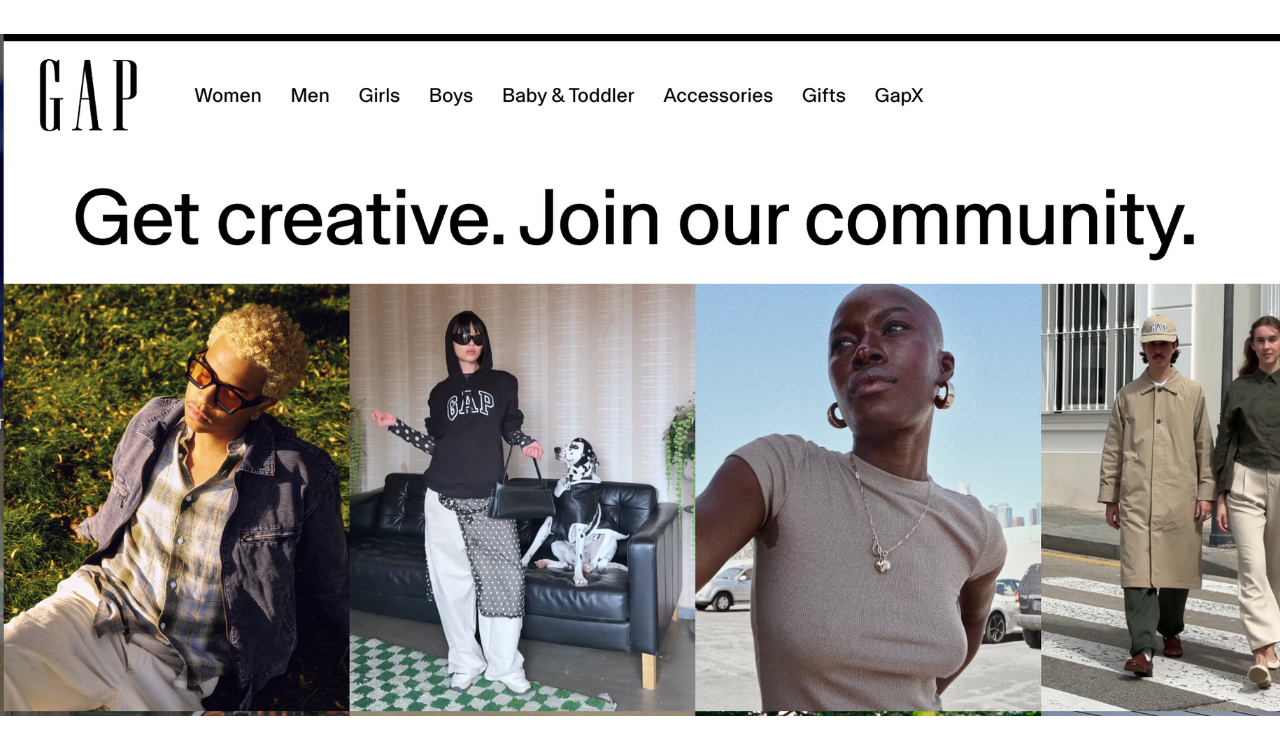

Gap Inc. has been busy. The conglomerate just launched its new “Fashiontainment” strategy alongside a multi-year partnership with the boy band Just Your Type (JYT). The collaboration will include a docuseries about the band’s success, a national mall tour, a capsule collection co-designed by members of the band, and a whole lot of social media content.
But don’t think new plans are isolated to esoteric Gen Z boy groups. Just a few weeks ago, Gap Inc.––which manages brands Old Navy, Gap, Banana Republic, and Athleta––announced plans to extend its affiliate program to employees.
Let’s talk about why this is the perfect cultural moment for an employee affiliate program, and how Gap’s JYT collab puts them ahead of the curve in targeting Gen Alpha.
Why did Gap start a program to make all employees affiliate influencers? And the answer is: Employees are more honest and relatable than paid professional influencers.
Tapping Into Consumer Interests
Gap Inc.’s initial creator program launched for external influencers in October 2025, reaching 154 million users before opening to internal influencers. The Creator Affiliate and Advocacy Program was launched as a cross-brand platform that allows U.S.-based creators aged 18 and older with at least 1,000 followers on a single social platform to earn sales commissions, receive product gifting, and gain early access to campaigns. Now all employees across corporate offices, retail stores, and distribution centers will be eligible to earn commissions on sales by sharing personalized affiliate links and product stories on social media. Gap says, “The employee program marks the next phase of the platform’s evolution, extending advocacy across Gap Inc.’s own community and further strengthening the connection between its brands, employees, and customers.”
While consumers sing elegies of “the death of fashion,” Gap Inc. is angling to become a part of next-gen consumers’ cultural DNA; not through nostalgia or aspirational luxury, but by harnessing the raw, human moments that resonate with consumers living in our digital age. Whether consumers enjoy witnessing the day-to-day style of employee brand advocates or connecting with the music of one of the fastest-growing musical acts this year, Gap is offering connection and inspiration.
No More Fourth Wall
Savvy modern retail employees are interdisciplinary. Store associates aren’t just calling their personal clients begging them to come in for a denim event or an upcoming promotion. Now they’re becoming human micro-brands within their communities––sharing styling tips, promos, and how-to videos, then inviting the customers to come to them.
The world of constant connectivity has, quite naturally, extended to how customers interact with the staff at their local store. The same drive for authenticity propelling next-gen customers to forego flaw-covering concealer for an expressive pimple patch drives them to connect with real local store associates online. Think about it: Employee affiliates are the opposite of a repetitive AI chatbot. They’re real people customers can personally connect with in-store, who can also provide their expertise and inspiration digitally at the touch of a button.
A Harris Poll found that 78 percent of adults say that social media posts from everyday employees feel “vastly more authentic” than official corporate accounts. But Harris also found that 80 percent of adults believe that employee social media advocacy should be optional, not a job requirement. The question, then, becomes whether Gap will begin to recruit employees based on their social media presence and willingness to produce content. If it becomes the main recruitment criteria, it could have an unintended but possibly devastating impact on in-store customer service.
Early Adopters
Now that 17.1 percent of retail sales go to ecommerce, retailers have had to digitally empower associates to keep up with consumer shopping and product research patterns. And today, that requires a multimodal approach, especially when courting younger, middle-class consumers who may not resonate with the lavish lifestyles of traditional influencers. It should surprise no one that these customers relate more to employees than the C-suite.
While the Gap Inc. affiliate program launch is one of the largest, Gap isn’t the first major brand to launch an employee affiliate program. Adobe Experience Cloud and Starbucks were some of the first to dip their toes in. Gap Inc. isn’t even the first major apparel retailer to launch an employee affiliate program: ASOS pioneered the employee-influencer model with “ASOS Insiders” back in 2014 and, despite a pause during the height of the pandemic, relaunched the program in 2024 to great acclaim.
While most brands launch external influencer programs that eventually open to internal employees, Macy’s followed the opposite pattern with Macy’s Style Crew. Macy’s influencer program, Macy’s Style Crew, started with employees in 2017 and expanded to external influencers in 2020. Macy’s Style Crew performance was incredible last year, achieving a 315 percent boost in revenue and a 327 percent traffic increase! The initiative now includes over 600 influencers, which Macy’s projects will grow to 1,000 affiliates.
Why wouldn’t a major retailer harness the power of employee ambassadors to make their brand feel accessible and human? Well, to run a successful employee affiliate program, a company first needs to have some happy employees. Without them, a retailer’s employee ambassador program will only serve to spread lore of the company’s worker mistreatment. Amazon learned this the hard way.
When It Tanks Brands’ Value Perception
Not all online employee advocacy is beneficial, or even actual advocacy. Back in 2018, Amazon elevated a few warehouse employees to paid influencer status in hopes of rustling up some positive press amidst concerns about working conditions at its fulfillment centers. The broadly ridiculed initiative was called “FC Ambassadors,” and consisted of fulltime warehouse employees going on Twitter to respond to everyday users’ tweets saying positive things about the company.
The plan backfired spectacularly. An employee shared an internal Amazon document with The Intercept in 2021 that contained scripted responses to counteract reports of workers peeing in bottles. “FC Ambassadors” were given Twitter replies such as, “No, that’s not right. I worked in an Amazon FC for over four years and never saw anyone urinate in a bottle. There are easily accessible bathrooms in every one of our buildings I’ve ever been in.”
Then reports from actual “FC Ambassadors” emerged, saying they get paid $15 an hour whether they’re stocking shelves or tweeting positive things about Amazon––not exactly a generous or loyalty-inducing sum. Then, online comedians began creating spoof accounts to parody the strange tweets from Amazon employees. Oh, and Amazon tried to deny that its employees peed in bottles but had to rescind the statement. The ambassador program was also rescinded in late 2021.
Takeaways: What Not to Do
Amazon’s failure demonstrates that, for employee ambassador programs to work, a brand needs to have positive-thinking employees. An ambassador program where minimum wage employees churn out scripted replies feels dystopian. In Amazon’s case, it furthered consumer concerns about warehouse working conditions; it didn’t abate them, especially when the program was created in response to negative press and consisted of canned replies that don’t even sound like actual warehouse workers.
Gap Inc. is doing things a little bit differently. Rather than hand selecting employee ambassadors to sit in a room churning out packaged responses on “X,” Gap’s ambassador program is open for all employees to apply. Workers earn commissions from affiliate links in their posts on social media, so they’re fiscally benefiting from the promotional work they do for the company. Gap employee ambassadors can inspire customers through their individual creativity with Gap products, not by uniformity and corporate dictates.