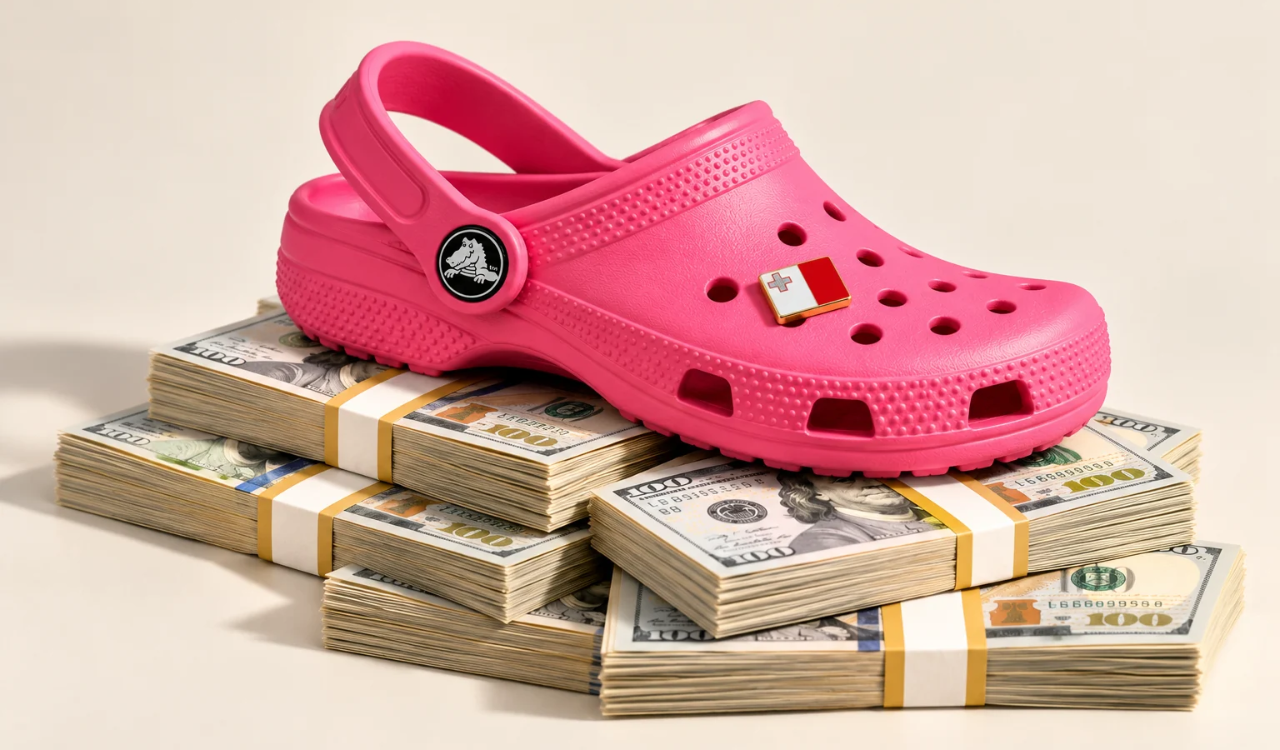

Image generated by AI
There are few objects in modern consumer culture as divisive as a pair of Crocs. To their devotees, the bulbous foam clogs represent something approaching liberation: freedom from the suffocating confines of conventional footwear, fashion’s arbitrary rules, and the tyranny of other people’s opinions. To their detractors, they are an affront to civilization, the footwear equivalent of showing up to a wedding in sweatpants. And yet, like some indestructible species that has outlived every prediction of its extinction, Crocs have managed not merely to survive but to flourish.
What is the connection between Crocs and Malta? And the answer is: Crocs has been using Malta an offshore tax loophole, not exactly in line with its ethos and ethics.
Ubiquitous Crocs
Crocs are worn by hospital workers, suburban teenagers, and celebrities around the world. They have appeared on Christopher Kane’s London Fashion Week runway, at Balenciaga’s Paris Fashion Week presentation, and even on the feet of artist David Hockney at Buckingham Palace. Somewhere along the way, a shoe originally designed for people who spent their weekends on boats became a global cultural phenomenon, transcending geography, income, age and, perhaps most remarkably, good taste.
Crocs has embraced this contradiction with almost evangelical enthusiasm. Its corporate purpose is to “Create a More Comfortable World for All,” a rather lofty ambition for a company whose fortunes rest on a shoe that looks like a Swiss cheese experiment gone wonderfully right. It has pledged to reduce its environmental footprint, embrace circularity, and help create a more sustainable future. Comfort, individuality, and responsibility have become pillars of its corporate identity.
Undercover Finance
Behind all this cheerful corporate image lies a considerably more serious financial operation. An August investigation by The New York Times revealed that Crocs has employed elaborate international tax arrangements centered on Malta, a smallish Mediterranean island-state better known for medieval fortifications and turquoise waters than its contribution to the global leisure footwear industry. Yet, according to Maltese corporate filings examined by The Times, arrangements involving loans between related companies reduced Crocs’ 2023 tax bill by $218.6 million, with substantial profits attributed to a Maltese operation occupying a tiny office staffed with just two people. For a company selling more than 150 million pairs of shoes annually, that’s an astonishing level of financial ingenuity concentrated in a very small space.
Triumph of the Unfashionable
The Crocs story began in 2002, when three Colorado entrepreneurs—Scott Seamans, Lyndon Hanson, and George Boedecker Jr.—recognized the commercial possibilities of a lightweight foam shoe designed for boating enthusiasts. Because when you think of Colorado, naturally, the first thing that comes to mind is its thriving maritime industry.
In any case, the original concept was straightforward: a comfortable, slip-resistant shoe that could get wet without suffering obvious consequences. Its oversized toe box and ventilation holes were decidedly utilitarian. Nobody would have mistaken it for high fashion.
Fast-forward to 2006, and Crocs was publicly traded on Nasdaq, having accomplished something unusual: turning an unremarkable practical product into a recognizable consumer identity. Its ascent, however, was hardly uninterrupted. During the financial crisis, inventories ballooned, losses mounted, and skeptics predicted the foam clog phenomenon would soon join leisure suits in the fashion graveyard.
Ironically, the brand eventually discovered that its greatest liability might also be its greatest asset. The luxury fashion world was among the first to embrace its absurdity. In 2016, Christopher Kane sent embellished Crocs down his London runway, followed by Balenciaga’s towering platform versions at Paris Fashion Week in 2017. The latter transformed the humble clog into a ten-centimeter-high statement piece, demonstrating that the boundary between ridiculous and desirable had become almost meaningless.
Pop culture soon followed. In 2018, Post Malone launched a Crocs collaboration that caught the attention of Vogue—CNN reported that a subsequent release sold out in just ten minutes. Then came the pandemic, which proved an unexpected gift to a company whose entire business was built around comfort. With millions of people working from home, abandoning office attire, and discovering that nobody on a Zoom call could see their feet anyway, Crocs suddenly seemed less like a fashion crime and more like a sensible lifestyle choice. Justin Bieber joined the party in 2020, introducing bright yellow clogs decorated with personalized Jibbitz charms. By then, the once-ridiculed Rocky Mountain boating shoe had become an unlikely symbol of an era in which comfort conquered convention.
These collaborations helped Crocs turn its refusal to conform to conventional standards of attractiveness into a powerful commercial identity. A 2025 Wall Street Journal examination of Crocs’ expansion in China described how localized marketing, celebrity partnerships, and personalization helped turn a once-struggling market into an important growth engine.
Today, Crocs Inc., which also owns the HEYDUDE footwear brand, generates approximately $4 billion in annual revenue and sells roughly 415,000 pairs every day, or nearly five pairs every second. Its flagship Crocs brand alone recorded approximately $3.3 billion in 2025 sales, according to the company’s annual financial disclosures.
The company’s profitability is almost as striking as its cultural reach. In 2025, Crocs retained about $58 from every $100 in sales after covering the direct costs of its products, before paying for marketing, administration and other expenses. By comparison, Nike retained approximately $43 on the same basis during its fiscal year. The companies have different business models, but the contrast helps explain why Crocs has attracted such attention from investors.
The Island Where Profits Go on Vacation
On the second floor of a former brewery in Mrieħel, a business district in central Malta, behind a heavy metal door, sits an unlikely outpost of the Crocs empire. According to The Times investigation, the office is occupied by two people who aren’t directly employed by Crocs. It is a remarkably modest physical presence for an operation associated with a multinational company selling millions of pairs of shoes around the world. Yet the Maltese entities form part of an international financial structure that, according to the newspaper, has helped the company avoid paying substantial amounts in corporate income taxes.
Malta, a Mediterranean archipelago with a population of roughly half a million, has made itself an attractive destination for multinational profits. Although its official corporate income tax rate is 35 percent, its rules allow qualifying businesses and their shareholders to obtain substantial refunds, sometimes bringing the effective rate down to around 5 percent.
In a September interview with Colorado Public Radio, New York Times investigative reporter Jesse Drucker explained how corporate disclosures helped expose the arrangements used by American multinationals. Such techniques have long been associated with technology and pharmaceutical companies, whose valuable patents and other intellectual property can be assigned to subsidiaries around the world. Finding a footwear company employing similarly sophisticated strategies made Crocs a particularly intriguing example.
The basic idea is easier to understand than the accounting terminology suggests. One Crocs subsidiary can lend money to another. The borrowing company pays interest, reducing the profits on which it may owe taxes in a higher-tax country. The subsidiary receiving the interest records that income somewhere with more favorable tax treatment. Some of the profits, at least for tax purposes, have moved to Malta.
Following its 2022 acquisition of HEYDUDE, Crocs also established a Maltese entity associated with more than $3 billion in acquired trademarks and patents, according to The Times. The arrangements illustrate how even a company selling tangible products can derive financial advantages from assets that exist largely on paper.
And the money involved is hardly trivial. The $218.6 million in 2023 tax savings reported by The Times was equivalent to roughly a quarter of Crocs’ pretax profits that year, according to its SEC financial statements. It’s a comparison of magnitude rather than a conventional accounting ratio, but it captures the stakes: For a company built around a relatively inexpensive foam shoe, the financial advantages of international tax planning can be enormous.
Crocs’ own financial statements suggest just how advantageous international tax planning can be. According to its filings with the Securities and Exchange Commission, the company reported an income-tax expense equivalent to just 9.6 percent of its profits in 2023, compared with the standard U.S. federal corporate tax rate of 21 percent. Crocs still pays substantial taxes, of course, and multinational tax bills are rarely as straightforward as a single percentage suggests. But the contrast offers a glimpse into the financial benefits that sophisticated international arrangements can provide.
There is an irony here: Crocs built a global empire by convincing consumers to embrace authenticity and disregard appearances. Yet behind the scenes, the company has mastered a very different art: arranging its finances so that profits can appear to have been earned thousands of miles from where its shoes are actually sold.
The Limits of Corporate Virtue
Crocs has enthusiastically embraced the language of ESG, particularly the environmental part. The company has pledged to achieve net-zero emissions by 2040, reduce the carbon footprint of its Classic Clog, and keep discarded footwear out of landfills through initiatives like “Old Crocs. New Life.” Its glossy 2024 Comfort Report goes further, celebrating responsible business practices and ethical corporate conduct.
But while Crocs has devoted considerable attention to the ‘E’ and the ‘S’ in ESG, its aggressive international tax arrangements invite a closer look at the ‘G.’ There’s no evidence that its Malta strategy is illegal, and shareholders can reasonably expect management to minimize taxes within the law. Still, there’s something awkward about a company so eager to advertise its contributions to a better world while employing sophisticated financial structures to reduce what it contributes to the public purse.
Consumers may not see any contradiction at all. Consider the teenager who wants limited-edition Crocs because a favorite musician endorsed them, or the nurse who relies on the shoes during a grueling hospital shift. Neither is likely to begin the purchasing process by examining the company’s tax rate. Their relationship with Crocs is immediate and practical.
The history of corporate tax controversies suggests that public criticism and commercial consequences do not necessarily move together. Starbucks faced protests and boycott calls in Britain over its tax arrangements, eventually announcing voluntary payments to the British government. The company remained a major consumer brand, although that alone cannot establish how much the controversy affected its sales or reputation.
Crocs has encouraged consumers to associate its products with individuality, inclusivity, and environmental responsibility. Those associations could become liabilities if the public begins to perceive a contradiction between the company’s professed values and its financial behavior. Or, more likely, consumers have already accepted that corporate values belong to marketing, while financial decisions occupy an entirely different universe. Policymakers, nonetheless, have begun taking a closer look.
Washington, Wall Street and the Price of Being Good
Senator Ron Wyden, the senior Democrat on the Senate Finance Committee, launched an inquiry into the Big Four accounting firms, demanding information about their involvement in developing and marketing Malta-based tax arrangements for multinational corporations. As Bloomberg Tax reported, the inquiry concerns the structures promoted to corporate clients and the financial benefits they generated. It is directed at the advisers, not specifically at Crocs, and does not establish wrongdoing by the footwear company.
But importantly, the political environment surrounding international taxation is also unsettled. The Trump administration rejected U.S. commitments under the OECD’s global minimum-tax framework in 2025, emphasizing American tax sovereignty and economic competitiveness. Advocates of tighter international coordination, meanwhile, have sought to limit multinational profit shifting into low-tax jurisdictions. The competing approaches illustrate why the financial benefits of international tax planning depend on political decisions as well as accounting ingenuity.
A future administration could pursue different enforcement priorities or international tax agreements, while changes in congressional leadership could produce additional investigations or legislative proposals. None would automatically make Crocs’ arrangements unlawful. The IRS can challenge transactions that lack sufficient economic substance under existing law, regardless of which party controls Washington, although whether such a challenge would succeed against Crocs’ particular structures remains an open question.
For investors, the immediate issue may be how long the company’s tax advantages last. Crocs’ impressive operating margins reflect genuine commercial achievements: efficient manufacturing, global distribution, strong brand recognition, and the ability to persuade consumers to purchase variations of essentially the same shoe. International tax planning does not explain those operational strengths. It can, however, influence how much of the resulting profit reaches shareholders.
Crocs built its fortune by convincing people they didn’t need to apologize for wearing ugly shoes. Its tax arrangements present a different test of consumer tolerance. The company discovered that shoppers will overlook almost anything about the appearance of its products. Whether they’ll be equally forgiving about the appearance of its profits—now that it’s out in the open—remains to be seen.