
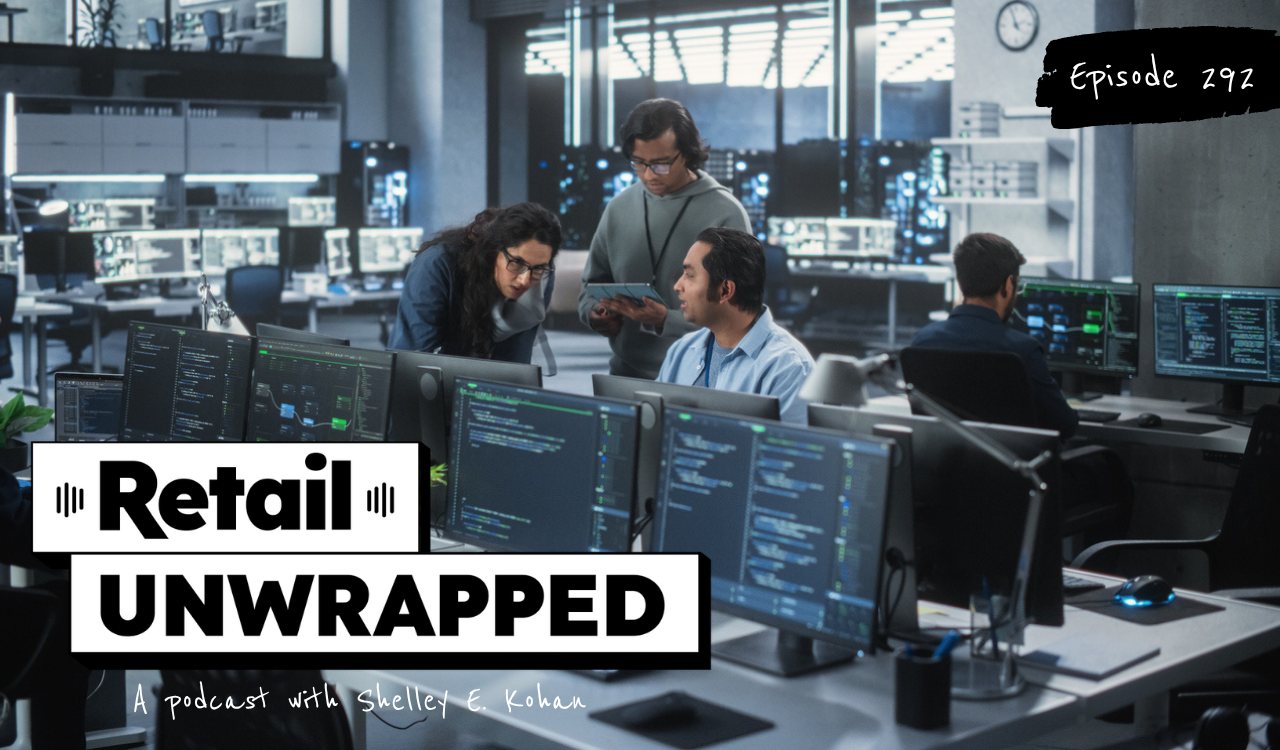

Conversations in C-suites about AI typically bring up cost efficiencies, job cutbacks, competitive edges and workplace transformation. What leaders don’t discuss is being human in an AI era and what fundamental human skills and talents are not replaceable. Often the human being gets forgotten and people become numbers. What should retail executives be focusing on with their workforce? Join Shelley and Dominick Miserandino, CEO of RTMNexus, as they challenge the current conversation with what employees really want to hear: You are part of the journey and we’re going to help you with the AI that we’re implementing. They talk about taking a 30,000-foot viewpoint about the many impacts and implications of AI led by a map charting where you’re headed. They emphasize how conversations that matter pave the way for successful AI integration. Listen and learn how to build trustworthy relationships by listening and understanding and how to communicate in relatable and relevant ways with any organization’s most important resource: its employees.
Special Guests
Dominick Miserandino, CEO, RTMNexus
Transcript
Shelley E. Kohan (00:01.944)
Hi, everybody. Thanks for joining our weekly podcast. I’m Shelley Cohen, and I’m very excited to welcome back Dominic Miserandino, CEO of RTM Nexus. So welcome.
Dominick Miserandino (00:15.772)
Thank you for having me, my friend.
Shelley E. Kohan (00:18.475)
It’s great to have you back and I literally think that’s the first time I smoothly said your last name. So, kudos.
Dominick Miserandino (00:23.752)
I wrote it down in my calendar as a day to celebrate from now forward.
Shelley E. Kohan (00:28.718)
Anyway, so we have a really interesting topic today, still human leading retail in the age of AI, which quite frankly, I don’t think is getting enough conversation. We hear all about AI, the tools of efficiency, automation, retail executives are being pulled in every direction from investors asking about savings from AI resources, promising revolution to operations, and all these things are really great and the numbers don’t lie.
But here’s the thing, I just keep coming back to, we forgetting about the people that are actually running retail? So, which is what we’re gonna talk about. I mean, the real competitive advantage is not choosing between AI and people, but it’s knowing how to lead both. So let’s jump right in here.
Dominick Miserandino (01:05.532)
Yes, we are.
Dominick Miserandino (01:17.116)
I agree. I absolutely agree with everything you said. First of all, I’m honored, especially in my role with CEO of RTM Nexus. also an advisor for quite a few different retailers. Dell is one of them on my profile.
With every retail or every business, the human gets forgotten the most. I hate saying it, but especially with AI, people just become numbers. And I’ve seen this sadly for 30 years. It’s always that way.
Shelley E. Kohan (01:51.214)
And are you seeing more of a rise of this like over, think over the past six months, you know, are you seeing more of a rise of this that we’re pushing so much forward and AI we’re kind of forgetting about the humans in the background.
Dominick Miserandino (02:04.722)
I would agree with that because it is tempting to…
see the excitement of a new Shiny tool. I hate aging myself with that, but you see the Shiny tool of social media, Shiny tool of video streaming, Shiny tool internet as a whole. And whenever those things happen, we go all in, go crazy, go over the top, and then we kind of re-regulate ourselves back to what actually works. And in the process, we’re focused so much on the Shiny tool, like any business, you forget.
Well, what is making this business run? The people behind the darn thing.
Shelley E. Kohan (02:45.262)
It’s true. I think that, you know, I love your, uh, shiny. We’ve always chased the shiny, shiny objects in retail. So I think that’s great. I think what’s a little different about this one is the shiny object isn’t really shiny. It’s kind of in the background. And the other thing that I’m thinking about is that, you know, when employees hear, we’re going to implement AI. Do you know what they’re hearing? They’re hearing, and you’re going to lose your job.
Dominick Miserandino (02:52.295)
Yeah, yeah.
Dominick Miserandino (03:09.352)
You’re gonna lose a job. Yeah, yeah. First of all, absolutely. Second of all, it’s funny, it’s not not funny. It’s not just retail. It’s every business is doing this. And I think the, there is also something to be said for the things that humans do that they can’t in the sense of loyalty.
Shelley E. Kohan (03:20.057)
yeah.
Dominick Miserandino (03:37.81)
the backstory, the…
If you operate with people in a business context purely of just AI function, et cetera, things get lost. I’m thinking how you and I would text each other, how’s it going? That is not at all anything but human. How’s your daughter doing with Kyle’s Dom? And all these questions are not AI. But I would argue, inadvertently,
Shelley E. Kohan (03:59.564)
Right, right.
Dominick Miserandino (04:10.504)
Well, not inadvertently. Every time you raise the human relationship, things work easier. Things flow easier. You see it now also in how many times a day do I get messages that are clearly written by AI. There’s no relationship. There’s no anything. I mean, I’m talking 10 to 20 a day. You could identify now pretty quickly. You’re like, nope, that’s AI. We’re done. You know, so.
Shelley E. Kohan (04:34.926)
You can.
Dominick Miserandino (04:35.912)
That human loyalty is such an underrated factor at times. It really kills me and I see it so many businesses so many times.
Shelley E. Kohan (04:48.11)
think what’s amazing is that, you when we think about employee retention and keeping employees and humanizing the leadership qualities, you know, when we look at why people leave, people don’t leave usually because of lack of money, shockingly. It’s over 30 % of employees leave because of poor leadership. So what, when you talk about lead with humanity, what’s that look like, Dominic?
Dominick Miserandino (05:12.774)
I think you have to know who the person is. And it’s a dangerous road because you don’t want to come across without understanding the person. Well, there’s two parts. You want to understand the person themselves. I need to know who is Shelly, what makes her tick. And that’s important to me. I can…
teach Shelley how to sort a spreadsheet or how to record a podcast and how to run Riverside, those are skills that I would actually argue with the advent of AI, you don’t even need to teach anymore because they’ll just go on AI and learn it. But the personality is Shelley the type person like who…
I mean, sometimes the questions I ask is, do you like me to communicate with you? Do you like direct? Do you like to figure it out on your own? Are you a caller? Are you a scheduler? Are you a texter? Are you a videower? I’m listening towards, do they receive the message better with firmness, with aggression, with anger, with… But that’s identifying the person. And I think that is critical.
But the second part I find in all these organizations, I do a lot lately of corporate facilitation where you’re helping the C-Sweets talk. And I did one for a very well-known brand. And it was fascinating to me how the room…
Shelley E. Kohan (06:29.687)
Hmm.
Dominick Miserandino (06:40.09)
had to be translated from CMO to CTO to CIO to CEO. There’s a different language within each person. But that’s again part of the understanding. It’s not merely the function of where the spreadsheet gets sorted.
It is who is the person, where are they coming from? I know who Shelly is, I know the personality, and I where she’s coming from. know, or she’s coming from her role as podcast, or she’s coming from her role as editor, or coming from her role of FIT expert. You know, like, you need to know those two parts, I think, to really lead as effectively as possible.
Shelley E. Kohan (07:20.322)
think also that when you talk about this, you know, different ways of communicating and how messages are received differently, I think that also builds into a culture. So when you talk about leadership at the C-suite and you talk about all those positions you just mentioned, there’s a culture of how the company is receiving those messages. And when you kind of layer in this AI conversation, I think what employees want to hear is that we’re going to help you
with AI that we’re implementing, we want you the person to be part of the process. It’s not, you know, we’re going to implement all these things and you all have to figure it out. But I think employees want to feel like they’re part of that journey. And I think
Dominick Miserandino (08:04.42)
I love what you said because the function implementation of AI is one story, but the methodology is so vital. One of the things I try to do is I’ll tell people in meetings, I’m okay being wrong. I will admit when I’ve made a mistake. I like admitting it. I had one employee who I reprimanded because I said, I screwed up.
and you knew I screwed up. And you didn’t tell me. So I’m in trouble with myself for screwing up, but you’re in worse trouble because you didn’t tell me. And then I actually went for a walk with her and said, dude, what did I do to make you feel uncomfortable enough to tell me? So you have to really figure out how that message is coming across. Like you said, it’s perfect. We are implementing AI. That message is scary.
Shelley E. Kohan (08:35.8)
Yeah.
Dominick Miserandino (09:02.652)
but we are implementing AI to help you and here’s training classes because we just want to make your lives easier and faster and more productive. That’s such a different message. But I think at times that is something I’ve seen with so many C-suites is, which is good. The goal orientation is wonderful, but at times, how do you translate that message to the people? Because that is to me getting more lost over time.
Shelley E. Kohan (09:02.796)
It’s so scary.
Shelley E. Kohan (09:30.936)
think the other interesting thing about what you said about this two-way communication is unlike the past in retail where a lot of the implementation really comes from the top down, but right now employees, they’re using AI and every, and they’re in total everyday life. And so while the company might suggest rolling out AI to do this or AI to do that, they should listen to the employees because
Dominick Miserandino (09:47.4)
Yes.
Shelley E. Kohan (09:58.496)
I know companies think that like less than 10 % of AI is being used by employees, but I have to say it’s probably three times that. And so getting that input from the employees on how they think AI should be implemented into their roles at the company would go a way.
Dominick Miserandino (10:06.888)
All right, absolutely.
Dominick Miserandino (10:15.376)
No, when I was CMO of Adirondacks, I was proud of the fact I talked to every employee in the team over like the first week or two and it got to the point one of the guys made fun of me. spoke to the janitor.
And I said, yeah, because the janitor told me when he cleans your office. And when he cleans your office is when you leave the office. So now I know when you are working from and to, because that’s when he cleans your office. I think you do need to talk to everybody. I very much an advocate sit with everybody, say, show me what you do. Show me how you do your job. I don’t know anything. You show me. And I think by doing that, number one, they’re feeling heard, which everyone wants to feel heard.
But getting those details, you know, I had someone say once, you need to look from the 30,000 foot point of view. And I said, yeah, that’s true. But you still need the map of where you’re flying. And if you don’t see on the ground, you don’t know where you’re flying. And it’s good to regularly do that. And I try so hard. Very often I’ll even just call people on my team and say, what’s going on?
Shelley E. Kohan (11:10.348)
Ha ha.
Dominick Miserandino (11:23.462)
Just talk to me, open-ended, what’s going on? Because they’re going to see something different than you will. Do you know what saying?
Shelley E. Kohan (11:29.026)
Yeah, for sure. I think the other thing is, you know, that all the technology companies, they’re very good at this. They for many, many years, they have these innovation teams, they work in these clusters to get ideas generated that bubble up. So I think the technology companies are really good for getting ideas at the ground level and moving them up where retailers are the complete opposite. And so if retailers really want to be successful, really understanding
the use cases for AI in those roles at the ground level and thinking about how they can, you know, implement them company-wide or scale them, I think is essential in terms of, you know, retaining great employees and making them feel valued.
Dominick Miserandino (12:11.08)
Well, know, while you’re talking, was thinking of a mutual friend of ours, Marie Driscoll. I’m working with her on something and I was super proud of finding something technically. And I found this thing technically. It was not something of which Marie understood the technical part, but what was brilliant, she asked questions, really good questions, which made me better. You know?
Shelley E. Kohan (12:16.322)
Yes!
Dominick Miserandino (12:39.932)
Do you think anyone else could have found this, Dominic? Yes, like this. No, like this. Do you think it will affect our market if people see this? And I remember at the end thinking the questions she asked of me were so brilliant, it made me better. I liken it to like, need always to work with people. I laugh like Lenny McCartney.
I don’t think individually they were as good because you needed somebody to say to each other, like, I like that, I don’t like that, let’s talk. And creating that culture of communication where you could just say, like Marie did, she kept asking questions, I was like, thank you. Why do we though have a corporate culture where questions are bad, admitting yourself wrong is bad, these are good, you know, is my preaching. Let’s.
Do things where you can ask questions, not feel judged, be wrong and learn from it. And by having this kind of growth mindset, I do think the net result in this example I gave is better than the net beforehand.
Shelley E. Kohan (13:44.63)
Yeah, I think that when we talk about kind of the pillars of employee retention and keeping great employees as trust, collaboration, support, fairness, I mean, these are all key things that employees are looking for. And I think when leaders do more listening than talking, especially now, and this kind of this reminds me of, you know, if you go back, I don’t know, 10 years, when a lot of the social media stuff got started coming out and a lot of the legacy companies.
instead of trying to figure out the social media, they did reverse mentoring. They took a bunch of young executives in the company who were using social media and they mentored them with the seasoned executives that have been around for a while. And I think this case today would be the same and something that a lot of retailers should be thinking about. Get the young executives who are using AI every single day and get
their input on what should be implemented, how should it be implemented, how can we improve the customer journey, the revenue, the operations, all those things.
Dominick Miserandino (14:49.202)
Well, something you just said struck me in that, take it back to the beginning of our conversation too, people leaving not for salary. I think it is so valuable to build that culture of communication, reverse mentoring. People, when they talk about a job, they’ll say, I don’t want to leave, we have such a good team. I am honored that I’ve had some people work for me in four different companies, five different companies, literally.
And it strikes me because it’s such an honor that they want to work for somebody. They don’t ask how much are you paying for this role? I’m five companies, no one has that. They just want to work together. And I love it. You know, I honestly think it all came out of, by the way, my first boss, I was on Wall Street and he needed somebody to help train on the systems after I left.
Shelley E. Kohan (15:29.166)
That’s so funny. Isn’t that funny? That’s amazing. Yeah.
Dominick Miserandino (15:49.127)
And of course I went back to the office. I helped train the systems for two weekends in a row after I was gone. I had to get snuck in the office or something just to help. And for me, the motivation was Ed. I wasn’t getting paid. I literally worked for free for two weekends. I wasn’t paid. Ed was the type, like, I’ll take you out to lunch, let’s talk. me and Ed are closer than ever.
Shelley E. Kohan (15:55.127)
Mm-hmm.
Dominick Miserandino (16:16.456)
He’s a father figure to me to this day. But would that ever have occurred? Maybe if Ed did say, I’ll pay you 20 bucks for the day, a hundred bucks a day. There’s no number that would convert that emotion that came now. And I think that is so also relevant where loyalty keeps people, authenticity, humanity keeps people. I’ve had ex-employees call me up
Shelley E. Kohan (16:30.338)
Yeah.
Dominick Miserandino (16:46.67)
asking for advice and wisdom and you’re like wow you still trust but it’s never been the dollar no one’s ever called me because they were the most or least paid they were calling me because they said I value our conversation and that’s really means a lot to me at that point.
Shelley E. Kohan (17:05.067)
Yeah, I think the other thing that employees really want to feel and you’re I’m sure the people that work for you feel this way is they have to feel like they’re growing, they’re learning. And I’m not saying they have to get promoted all the time. I’m just saying that employees in general want to go to work. They want to be up skilled. They want to be re skilled. They want to know how they can do their jobs better. So if retailers can help with those tools, especially in the
Dominick Miserandino (17:22.492)
Yes.
Shelley E. Kohan (17:30.804)
era of AI help them become up skilled in how to use these tools and help them to re skill if they don’t know how to use these tool that that that goes a long way and that’s not financial that’s just rewarding people for their own growth.
Dominick Miserandino (17:45.385)
Well, you know, it’s funny, hate to quote Ed again, but while I was on Wall Street at the time, Ed knew I wanted to learn more and allocated for me X amount of hours a day, like half an hour a day to ask questions to the traders. Probably did it for whatever it was, a year and a half every day. I really, but I think that paid with loyalty more than any salary could pay at that point.
When I’m having teams, I’m always saying, what do you want? What do you need? One editor of mine, really wanted to interview, it was a mainstream publication, he really wanted to interview some metal bands. So I called some people I knew and got some heavy metal bands in. It wasn’t my taste and it wasn’t the full-on direction, but I knew that particular story might generate a little more loyalty than the loss of that one bit.
So I think it should be built in. It should be given. you’re not telling your employees, like, how can I help you? What can I do to make things better for you? That to me is more important than salary at times. I don’t want to say it, you know, but it’s a big factor in there.
Shelley E. Kohan (19:01.422)
People, yeah. Yeah, I think the other thing is that I think AI right now, mean, retail in general has always been relatively siloed. And I think we’ve come a long way over the past, you know, five, six, 10 years about being less siloed at the C level suite. But what we have to get better at is, being less siloed on the ground, on the frontline workers. And what I mean by that is if you think about AI and you think about how can we really scale this?
If you can get cross collaboration on the ground with the frontline workers, mean, that would really go a long way to help companies scale some of this AI.
Dominick Miserandino (19:44.453)
I think what you’re saying is a nice needle thread through what we’re talking about throughout. If you can have C-suite leadership, walk to the store and say, what are you doing? What do you need? How can I help you? Do you need more classes on AI? God bless, we’re going to do that. What else do you need? Building that culture to me is good business. Someone else I’m advising.
one of my friends, Father Larry, ordered their product and we did a three-way call and she interviewed Father Larry literally on how he understood the product. But they said, my God, this interview is so much better than anything because we’re forgetting that. I do think I’ve certainly seen it quite a bit in retail, but it’s a symptom of business where once you get C-suite,
the plane starts going up thirty thousand foot point of view mentality and i’m not denying one needs that you need the map to see everything you need to also just saying how does work you know only other thing i’m just thinking is when i was running one company i just work in the factory once a month but do you need to conflict it just got you thinking how are they experiencing it how people you feel what you need
Shelley E. Kohan (20:42.915)
Yeah.
Shelley E. Kohan (20:47.406)
that.
Dominick Miserandino (21:08.516)
There’s a lot times also I will, whenever someone reaches out to me on LinkedIn, I will respond to them with, how can I help you? What do you need? We don’t have that dialogue, and I’m doing it because it tells me something, and it shows me something, and what do you need? How can I make your life easier? Let’s just do good as much as you could.
Shelley E. Kohan (21:28.524)
No, that’s good. Okay, before we leave, I do want to touch upon two things because I think it’s in the mind of the employees. And that is sustainability and ethics. And so when we think about AI, and there’s a lot of pushback on using AI, because it’s not eco friendly, and there’s a lot of, there’s a lot of resources that are used. So I think companies have to be very transparent and forward about what they’re doing to make it more sustainable. And I also think probably
too much for one kind of question at you, Dominic, but the other side is ethics. Are we being ethical about how we’re using AI? So to me, that’s kind of two different things, but very important in the eye of the employee.
Dominick Miserandino (22:11.592)
I that ties all together with pride. I have had this, I think you need to always be proud of what you’re working on, what you’re selling. That is a part of it. Like if we had to chart out in this conversation like what retains an employee, the loyalty, the communication, the feeling of value, the feeling of importance. But you also have to feel pride on what you’re working on.
RTM Nexus we’re doing these webinars and events and I will make sure they work and Why do I do that? I want to make sure there’s a value if there’s not everyone the team is going to say Why are we doing this? Like this is just a waste. It doesn’t help anybody. No here is the result It does help it makes this difference and we see it and it’s tangible You have to always in my opinion consider that that employee
wants to leave that business day and feel valued, important, and they’re not wasting their time.
Shelley E. Kohan (23:17.038)
Definitely. Anything else you want to add? Thank you so much for being here today. I think we really uncovered a lot of interesting points about employee retention and leading in the era of AI.
Dominick Miserandino (23:27.964)
Yeah. No, the only other thing there is thank you for having me and I love what we discussed is that thread. It’s all these things. It’s not one specific trick. It’s treating people like a human being. That’s it.
Shelley E. Kohan (23:44.046)
That’s right. And I hope I’m seeing, like, I’m not seeing this conversation being talked about enough in our industry right now. So I’m hoping that maybe this will start more companies thinking about it.
Dominick Miserandino (23:55.705)
I love doing it. love having these conversations. If anyone wants to reach out, this is what I do when I talk to the retailers and brands I work with is just saying, let’s get this communication going. You know? Thank you.
Shelley E. Kohan (24:07.212)
Love it. Well, thank you so much.