
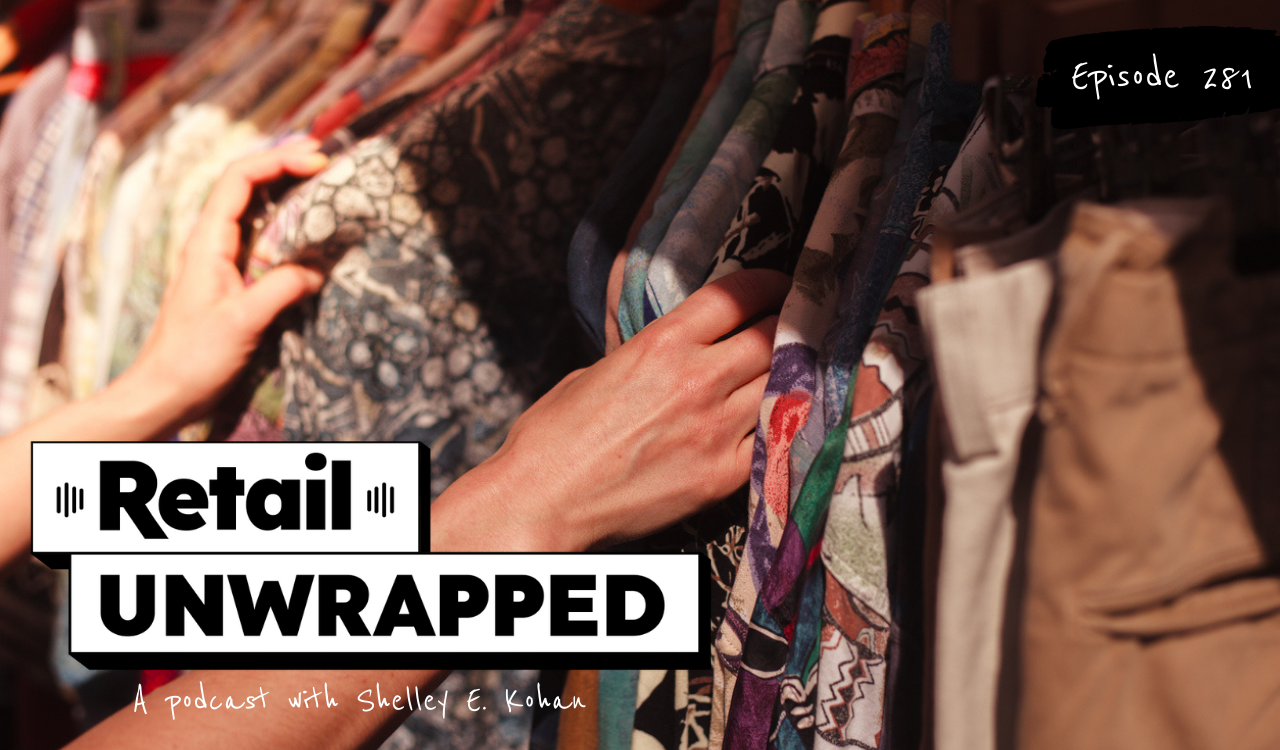

The consumer movement to invest in secondhand is led by values: meaning, provenance, and sustainability. Re-commerce is not a niche; it’s a $180-$200 billion global, parallel economy growing up to five times faster than traditional retail. The brands that get this right think beyond the first sale and plan for the lifetime value of a product, including multiple sales. Join Shelley and Romain Fouache, CEO of Akeneo, as they discuss why eBay’s acquisition of Depop for $1.2 billion strengthens its core business and marks a structural inflection point. A data expert, Romain makes the case for the power of transparency. Secondhand operations are logistically incompatible with firsthand retail models. Every resale item is its own unique SKU, its own story, condition, and context. Brands that attempt to glue re-commerce onto traditional operations without rethinking their infrastructure are setting themselves up for expensive failure. Listen and learn how the brands that will win in re-commerce will be the ones with the richest, most comprehensive product information, including materials, origin, manufacturing details, and use history.
Special Guests
Romain Fouache, CEO, Akeneo
Transcript
Romain Fouache (00:00)
our study shows that even as of this year, 44 % of customers have actually purchased secondhand. So we should assume that everything that can become a secondhand most likely will.
Shelley E. Kohan (00:38)
Hi everybody and thanks for joining our weekly podcast. I’m Shelley Kohan and I’m thrilled to welcome Romain Fouache ⁓ I’m sure I didn’t pronounce that perfectly well, but you can tell our audience how to properly pronounce it.
Romain Fouache (00:52)
There’s
no way to pronounce it if you’re not French native, so I always say if I know you’re talking about me, you said it well enough. So that was perfect. Thank you very much, Shelley for having me today.
Shelley E. Kohan (01:04)
my gosh, I’m so excited. So you’re the CEO of Akeneo and ⁓ we have a very hot topic that we’re going to talk about. think that retail in our industry is being reshaped, not just by price and product, but by value. So a lot of consumers today are really looking for those values. And so we’re going to talk about kind of two massive forces that are colliding at the same time. One is the consumer demand for transparency.
and also the explosive growth of secondhand shopping. And so we’re going to start with a fascinating deal that was recently announced where eBay has just acquired Depop. I think it was $1.2 billion. So tell us a little bit about your thoughts about what this means for the industry and for resale.
Romain Fouache (01:53)
Yes, indeed, 1.2 billion. That’s quite a transaction that took place in that space. And I think it just shows the shifting expectations of buyers. Secondhand was maybe a secondhand topic just a few years back. But now we are seeing eBay itself acquiring the deep up business. I do think we are seeing a shift of consumers that are thinking differently about the way they consume. And it’s a combination of the two.
traditional factors of secondhand, the first one being of course the element around pricing and cost. Yes, something that is secondhand can be just as usable as first hand but at a significantly lower cost. I do think as you say it also connects to another topic which is the topic of sustainability, which is the topic of consuming differently. And these two elements collide. People want to buy for less and
start to be more regarding of where things are coming from and the sustainability of their behavior. And that makes one big bang on the clear topic, which is secondhand ends the deal between eBay and Deepop.
Shelley E. Kohan (03:02)
Yeah, it’s a pretty big deal and I could tell you that. So my son who’s now 18 has been thrifting for probably six or seven years now. And it’s not just about the looking for value or the price. It’s that they really want to try. Why would I buy something new when I can buy something secondhand? So that’s a real generational shift in terms of how consumers are thinking about, you know, purchasing products, especially products that are
⁓ lightly used and or are in the higher-end market, the luxury sector. I know that’s been a big growth as well.
Romain Fouache (03:37)
Indeed, and you know, we launched, we did a survey fairly recently with consumers from the US, more than a thousand consumers. And what we did see is that ⁓ that question of sustainability is actually now top of mind. We’ve got more than three quarters of shoppers who actually look at how they consume and the sustainability comments of what they do when they’re actually buying. And I think that that is…
completely linked to what you mentioned, which is there is an appreciation for second hand because it does give a different perspective on how to consume. And overall, ⁓ 60 % of customers say they are actually interested in the sustainability ⁓ or e-commerce. And that’s a significant change in behaviors themselves.
Shelley E. Kohan (04:25)
Yeah, that’s tremendous. I know your survey, I your customer survey data. It was really awesome and excellent. It provided a lot of great points. And one of the things I was going to ask you, are you seeing this shift of consumer behavior in some categories more than other categories?
Romain Fouache (04:41)
Yeah, of course luxury as you mentioned is a big one. We are seeing it ⁓ in fashion. I the traditional models of e-commerce, I do think it is something that’s going to be expanding in less traditional industries. But for now, it’s fashion and luxury are clearly the ones that are taking the lead. But as it becomes more mainstream, we should expect that it takes place somewhere else. second hand is different type of business. For businesses, it’s a…
it’s not trivial to get into. When you sell first-hand, you have categories of products. If you sell a jacket in that size, all of them are exactly the same and you can sell them. When you sell second-hand, each item is its own category. They’re all different. They all have that little different wear, little different edge. So it can quickly become fairly complicated for companies to manage and to navigate such a change towards second-hand.
Shelley E. Kohan (05:38)
It’s very interesting. Well, first of all, I forgot to mention. So my jacket I’m wearing today is secondhand J Brand denim jacket, which I love. And I’ve never saw this anywhere. So I’m like, this is awesome because I wasn’t looking for secondhand or big value, but it’s a jacket I couldn’t have otherwise purchased because I don’t make it anymore. So there’s that. But when you look at these big brands, like you just mentioned, I know a lot of them are starting to do secondhand and resell, but I it’s so complex. Like how, how does a company take that?
Romain Fouache (05:47)
Nice.
Shelley E. Kohan (06:08)
And should they? Should brands be taking on secondhand?
Romain Fouache (06:12)
With the gross… So first, on your previous comment, I think that’s also an aspect of second hand, which is the amazing feeling you have to find a unique item that you know could not ever find again. I don’t think that’s the driving force behind the whole of second hand in itself, but it still is something that feels good. The thrifting aspect of it and looking at hundreds of thousands of things and…
not feel like you’re falling into fast fashion but on the contrary that you’re doing something sustainable but at the same time that makes you feel unique ⁓ while being at a good price I think is the good combination to explain to explain second hand but as to what you said yes for brands for companies it’s difficult it’s difficult because first it’s a force to be reckoned with I mean it is a completely different market and it does capture part of the market so we’re seeing more and more brands
trying to manage that second life of the products by themselves, but it is a logistical nightmare. At K &EO, we help companies manage product data, their product catalog. And just from the product catalog standpoint, it is an extremely complicated task for companies to be able to manage items that become unique items that are all extremely different from one another and to be able to do that.
And it still is just a fraction of the complexity of secondhand because typically the logistics aspect of it and collecting them and then sorting them and then putting them on sale and then selling them is in itself something that is completely ⁓ different from the traditional business. So yes, it is a significant opportunity. do think it’s also a
Something you cannot pretend doesn’t exist, so there is a component of risk that is attached to that firm’s brand, so that’s also why many of them are actually moving into the secondhand market, but there is a huge complexity that is ultimately fairly different from how most businesses actually operate.
Shelley E. Kohan (08:13)
Yeah, and wanna go back to something you said, which I thought, Romain, was really important, and that is that you said that instead of dealing with thousands of a unit, so when you make new products, you have thousands of them, you can do a product description, you can do product attributions for many, but I can’t imagine doing, especially now, product attributions now.
to even put stuff online is there’s like hundreds of thousands of product attributions to be able to have that item picked up, you know, with the various, you know, different, you know, websites and, uh, agentic commerce and all of that. So I can’t imagine for one piece, you’re going to do this, you know, 20,000 times. Like I just don’t know how it’s even doable.
Romain Fouache (09:02)
I mean, you mentioned some of the driving forces of shopping in the recent days. So you mentioned the price pressure. You mentioned e-commerce. AI is clearly one of the big things that is happening in our market these days, too. And I think AI is both a change in the market itself, agent e-commerce and the rest, but it’s also a change in the technology and how companies can actually go through what used to be very
work intensive type of activities and automate and facilitate them. So when they get into this type of e-commerce, we have quite a few customers at Ekenio that are actually managing ⁓ secondhand electronics ⁓ and secondhand apparel. AI plays a big role to be able to manage the complexity and the combinatorial of all of the articles they might be able to collect. And it starts from
being able to get data from the sellers themselves and actually be able to extract from that data the key descriptors of the products that they’re selling and then being able to enrich that because the seller themselves will only know a small part of what they’re selling. They’ll be able to take a few pictures to show the overall state to say what it’s about but then indeed leverage AI to enrich that information to make sure you have a complete
a story as possible because in e-commerce, maybe even more than on a traditional type of sale, the story is a key element for the decision making.
Shelley E. Kohan (10:40)
read in your survey that 72 % of consumers say that they’re looking for this strong supply chain transparency. if you couple or just just getting the product back logistically and just getting it on a website and just getting it out there, that’s complex enough. But how how are brands dealing with the transparency and supply chain for secondhand?
Romain Fouache (11:02)
Well, mean, it’s one level of logistics further. First, you need to be able to manage the transparency and origin of the things before they were first sold, and then add the second element. So you’re still one layer removed. So you’ve got all of the complexity of the standard type of sale where people want to know what they’re buying is coming from, plus this step. So ultimately, the same type of approach. You need to understand what is or what was the product. And we see many brands keeping
information about older products thinking that one day they might actually be able to or might need to reuse it and you know that’s one thing usually when you you you have a collection and your collection is over let’s just throw the data away who cares you know it’s done but with that tendency towards re-commerce towards having items being back to be sold there is a stronger intensive to have a treasure trove of product information where even old products you can know
what they were, where they were coming from, how they were done, so that you’re ready to be able to engage in a re-commerce type of activity if that need comes in the future.
Shelley E. Kohan (12:13)
So tell me, Romain, are there any companies that are really doing it right? Do you have examples or can you talk about, you know, who are the standouts that are really getting all of this right?
Romain Fouache (12:24)
⁓ I wouldn’t want to play favorites on any of them. My customers will probably not be that happy to do that. I think the ones that are doing it right are the ones that do two very important things. It’s one, how do they make it as easy as possible to gather the information from the seller itself? There are companies where when you want to sell something back, you’re going to have to go through…
five pages of forms where you need to add lots of information everywhere. mean, users drop out after a few seconds. The companies that do it well or great are the ones that allow people to register items with as little effort as possible. And it’s typically and ideally taking a picture of your item, then it will automatically recognize what it is, in what state, potentially even price it and help you move forward. Then the next element is
once you’ve collected the item, how do you actually reconnect that or the information on the item? How do you enrich that with further information on that piece of apparel or technology and the rest? And for that, you need to actually know your market. You need to actually know that these specific jackets, this is how it was described by the manufacturer when it was initially sold. This is where it was coming from so that you can, as I said, number one,
collect seamlessly information from the sellers so that the selling experience is easy and second enrich it as comprehensively as possible with the original information from these various products so that the buyer can then benefit from the best experience possible on the product that they are looking for.
Shelley E. Kohan (14:06)
Do you think that, so it’s really interesting. So you talked about the target market. would imagine that the target market, different, sustainability means different things to different target markets, right? So depending on the brand, sustainability could be environmental, or it could be ethical sourcing, or it could be something else. So I guess you have to understand that, brands must understand, right?
Romain Fouache (14:30)
Yes, you need to understand, it might even mean different things just for different people, even in the same market. I think that’s also one of the big elements with the rise of AI is that we used to work in a mode where you had maybe a few keywords and then one product page. Now, with conversational AI, with agent e-commerce, we’re evolving into a mode where we have an infinite number of potential intents.
everybody might want to buy for a different reason. Maybe you want to buy because it’s sourced from the right place, maybe I want to buy because it was ethical in the way it was manufactured. so companies now need to be able to capture intents regardless of where it’s coming from and from where it’s coming from. So I think thinking that just buy market is sufficient, it’s no, it has to be almost buy individual. And for that,
The only way to do it is how you’re able to capture as many signals as possible regarding your article. And yes, where it was sourced from, what type of material, what all of these things might be of interest, because maybe someone will say I want an ethically sourced jacket, or someone will say I want it that it’s in that specific hypoallergenic fiber that is grown in the forest of Latin America.
And it’s only if you actually have been able to collect all of these signals around your product that you’ll be able to capture all of these intents. So the evolution of the way people interact ⁓ with digital commerce is in my view creating a huge push towards having more accurate, comprehensive and trusted information on the product.
Shelley E. Kohan (16:12)
So I think what I heard you describe earlier is it’s almost as if you want the product to help with some of that history, the product itself, right? And if we’ve been properly attributing products from the day of production, which we haven’t been doing for 20 years, but maybe for the past 10 years, maybe five years, ⁓ then the product can speak for itself. Is that what you’re saying, essentially?
Romain Fouache (16:35)
There is some
of that indeed. Whatever we sell today will become a second hand product in the future and we might as well make it easier for ourselves by making sure that at least these we know well. And as you say, 10 years ago we were already, I’m not going to say good, but a bit better at getting information on the product. Yes, the things from 20 years ago, it’s going to be very difficult to get that information back. But we can help ourselves today by making sure that whatever we sell today is ready for…
the next life that is going to go through because yes,
our study shows that even as of this year, 44 % of customers have actually purchased secondhand. So we should assume that everything that can become a secondhand most likely will.
And that as distributors of brands, we need to be ready for the next stage of life of the products that are being sold.
Shelley E. Kohan (17:27)
That’s amazing. So if you had advice to give to brands to tell them, okay, if you’re thinking about re-commerce, here are the top three or four things that you need to be thinking about, what advice would you give them?
Romain Fouache (17:39)
Well, I do think that’s…
The trend of recommers is just a manifestation of the trend of people wanting to buy into something that is more the article in itself as we said. When people buy in recommers there is an element that is around pricing but today you can find anything at no price. You can just go on any fast fashion and buy things for half a dollar.
So price is not just an element. What you want is to feel that you have gotten something that potentially has its own history, that’s one. And second, has more value than the price you’re paying for. So it’s not just about paying a low price, it’s having an opportunity to have something that’s more valued than the price you’re paying for. And then it opens the question of what’s the value of a product that you buy? And there is potentially the functional value, but at its heart.
I’m deeply convinced that the purchasing decision is about the experience you feel with a product. And the more comprehensive it’s going to be, the more you’re going to be able to get people to feel value when they experience the product, and the more you’re actually able to sell them in that type of environment. So as you mentioned, yes, there’s the product description, there’s where it’s coming from, there’s the potentially sustainability element that may speak to some people, but maybe the specifics of how that specific product was being used or the activities it can be used for.
And so getting ready to actually enrich the experience you’re going to be offering on your product by making sure that you have a comprehensive view of your product from before it was manufactured to after it was being used is in my view almost the only way to be able to demonstrate that this product has more value than the price at which it’s being offered to as a secondhand type of object.
Shelley E. Kohan (19:34)
love that. And so that relates exactly back to my story. Now know you’re joining us from Paris, France, so thank you for joining us from far away. And I actually bought my re-used, gently used jacket in France. So, and I have to say everything that you just described about this, the value of the product being more.
than what I was looking for in price, I wouldn’t care what it was priced at because as soon as I saw it, I had this emotional attachment, one of a kind, I love this brand, I want this, and so you’re exactly right. So when you think about brands getting into the re-commerce space, you have to have a pretty solid acquisition story, right? How are you gonna procure or curate a resell that really is attractive to your target market, right?
Romain Fouache (20:00)
you
Yes, and how you’re going to be telling the story because from what I understand of what you said, actually had a… you were physically in store when you saw that jacket, so you can create a type of emotion when you’re in store, but a large part of that e-commerce is actually done online, so how do you recreate this type of feeling online? The only way you can do that is by having as clear and comprehensive information around that.
Shelley E. Kohan (20:32)
Yes.
Romain Fouache (20:50)
product and then having people experience it for whatever means you can so that they have some level of that connection. Because I I do believe that brick and mortar offer an experience that will never disappear. It will always be there. But yes, part of it is being captured by online websites. I’m deeply convinced that part of that is going to be captured by agent e-commerce. ⁓ But ultimately, we need to be ready to
make up for the limitations of each of these media. When you’re online, you don’t have the ability to touch the product, so how do you actually replicate for that experience? When you’re on an agent e-commerce or conversational AI environment, you don’t have the look and feel of your website anymore, you don’t have the specificity of your user experience, so how do you make up for that? And making up for that is just making sure that you can offer a view of your product that is more comprehensive, that is…
better ⁓ tailored than what others might be doing. I don’t believe in product slope. AI makes it very easy to generate content today. so yes, I can take a picture of your jacket and generate 50 pages of content on the jacket. But it’s just going to be lukewarm content because it’s the content that’s made up out of a very limited amount of information that is the picture. But if…
Shelley E. Kohan (21:59)
Yeah.
Romain Fouache (22:14)
you can actually find out who made the jacket, where it’s coming from, what was the material, how it’s been used by a famous singer on stage, what people are seeing of that jacket online and actually package the data in the right way, even when you don’t even have a website and you’re on agent e-commerce, you’re going to be able to offer an experience that might create that wants to buy. That emotion, that… ⁓
what’s the best way to describe it but that’s moments where you feel like yes this is what I want to buy this is what I want to have as my own
Shelley E. Kohan (22:55)
love that and one of the reasons I invited you on the podcast is because Akeneo is known for what we would call the new retail currency which is data and transparency. And so ⁓ what you just said is so perfect because you you have to create these brand stories. There’s too much product, there’s too much you can get at every single price level so you really have to create that story. So is there anything else that you would like to add before we end our conversation today?
Romain Fouache (23:23)
Now I just want to say thank you very much for that very insightful conversation. mean, we’re monitoring closely how consumer behaviors are changing towards transparency, towards sustainability, towards secondhand and pricing. And yes, it is quite challenging to be ready for it, but we’re definitely here to help all of these brands actually manage these changes.
Shelley E. Kohan (23:44)
That’s great. And I think our listeners can get your survey from the Akeneo website, right?
Romain Fouache (23:49)
Yes, the Akeneo
website actually has that survey available, so don’t hesitate to look at the consumer survey for first quarter of 26 that has just been released a few weeks back.
Shelley E. Kohan (24:00)
Thank you so much, Romain. Thanks for being here.
Romain Fouache (24:02)
Thank you very much, Shelley.