

Key Retail Realities Heading Into 2026
Common sense strategies worth repeating:
- Expect uncertainty with continued government reversals, regulations and changes in policies
- Plan for disruption from new entries in retail markets and desperate moves from struggling existing players
- Diversity your supply chain to protect your operations from unexpected, externally enforced change
- Rethink whether overstimulated environments in-store and online are too much for overwhelmed shoppers
- Don’t ever forget who your real customers are…and don’t chase the ones who will never shop with you
- Your employees are your single most important asset and must be treated that way
The biggest surprise is that the economy is still chugging along as strong as it is. You’d think that the consumer would be shutting down with higher and higher prices. You’d think this Christmas would have seen a lot fewer goods. And it didn’t happen. Americans are still shopping until they drop.
To cap off a tumultuous year for retailers (many profited, many faced serious challenges, and all had to negotiate the impact of tariffs on their businesses), we gathered four Robin Report contributors to weigh in on what happened and how 2025 could influence retail in 2026.
If there were a single word to define retail in 2025, it would be uncertainty. What began as a year that looked fairly stable devolved into something somewhat out of most retailers’ control. In a wide-ranging conversation, contributors Mark Cohen, Warren Shoulberg, Phil Lempert, and Jasmine Glasheen made the case for retail’s 2025 fragile business model. There was also a consensus that we may be experiencing a return to essential and nonessential retailing in terms of consumers’ ability to weather their own economic situations. Our experts are pragmatic realists, trained skeptics and objective analysts of the retail industry. They identify the high-level early warning signals, both economic and consumer behavior-related, that retailer executives should be paying attention to. Here are excerpts from their conversation. You can watch the entire webcast here.
Tariffs Redefining Retail
Mark Cohen set the tone early on: “So 2025, as the year opened up, looked like it was going to be a pretty good year. Unemployment was low. Inflation was seemingly increasingly under control. There was the expectation that it would be another year of recovery from the 2020-2021 pandemic that we all struggled with. But then in April, the president dropped his trade war bomb, which evolved into a worldwide catastrophe. It’s Covid Redux as far as I’m concerned.” The conversation detailed that what retailers experienced in 2025 was not a normal cycle, but a rolling crisis—rules changing “every hour and a half,” vendors frozen in place, and CEOs unable to forecast even a quarter ahead. The April escalation of the administration’s trade war didn’t just rattle supply chains—it paralyzed businesses’ ability to effectively plan.
Phil Lempert added, “Never in the 25 years that I’ve been covering supermarkets have retailers been this uncertain. Everything from CEOs getting thrown out and tumult about the tariffs to uncertainty about the supply chain. And then we had the report that California is suing 11 major CPG companies for unhealthy processed foods. And that’s going to have a major effect on retailers because 70 percent of the products that are in a supermarket are ultra-processed foods.” Warren Shoulberg called 2025 a year of suspended animation: “I characterize 2025 as Waiting for Godot. Everybody was sitting around waiting for 1,400 shoes to drop.”
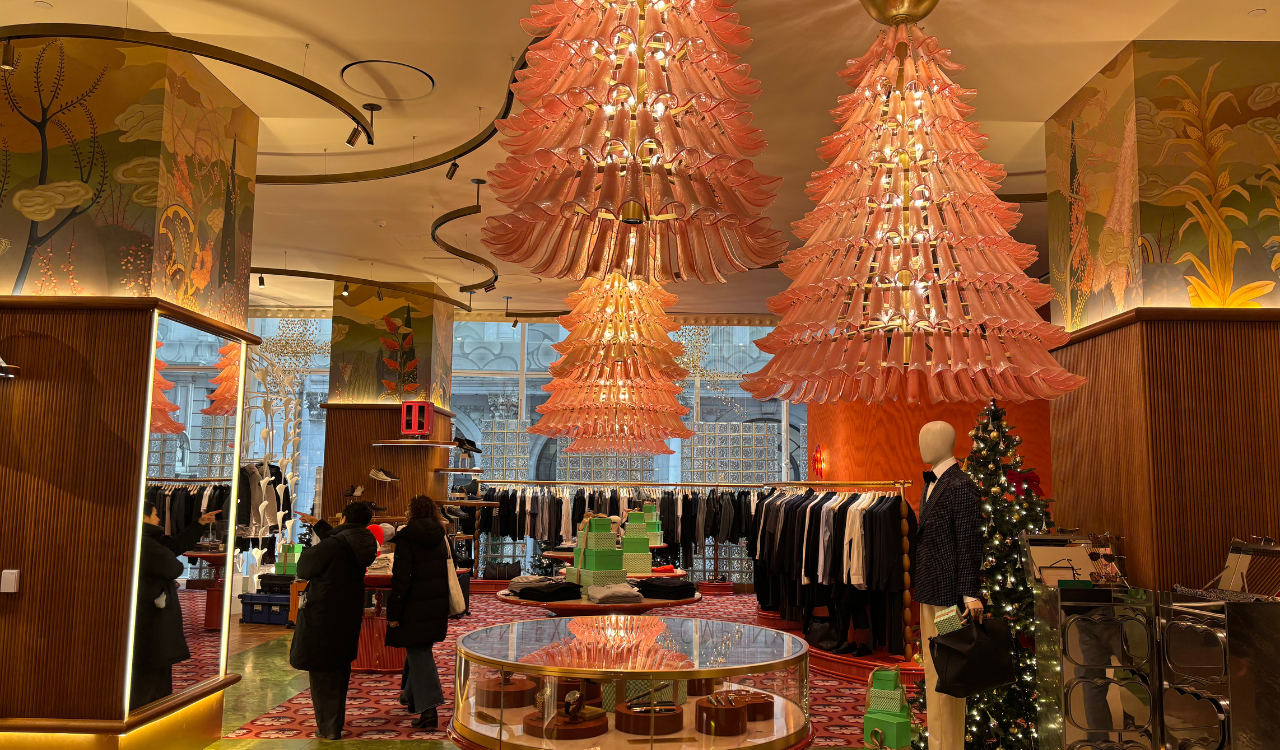
And how are next gens responding to all of this? Are they really as miserable as everybody and all the media reports? Jasmine Glasheen explained, “Well, are we talking about miserable or overstimulated? Because I think those are two different things. Young consumers (78 percent of them) are telling retailers that they’re overstimulated by the in-store experience. Because of that, retailers should be creating low-stimuli, more tranquil lighting environments, like Walmart is doing between 8:00 to 10:00 AM. But instead, we’re seeing Urban Outfitters rolling out brighter, more aggressive physical store spaces.”
Surprise, Surprise
When asked what the most surprising thing was that they observed this year, Lempert said, “I think it’s probably the reaction to the GLP-1 drugs. Just take a look at how quickly companies like Nestle and Conagra have rolled out GLP-1 food products. Circana just released a survey that said that by 2030, 35 percent of all food and beverages will be consumed by users of GLP-1. We also saw Kroger come out with their line of high-protein foods that are designed for GLP-1 users. It’ll be interesting to see now that the Wegovy pill form is approved and more people go for the pill than the injectables, how that’s going to change the food and beverage industry.” Shoulberg added, “The biggest surprise to me was that the economy is still chugging along as strong as it is. I would have thought that the consumer would be shutting down with higher and higher prices. I really thought this Christmas we’d see a lot fewer goods out there. And it didn’t happen. Stores were promoting like crazy. And Americans are still shopping until they drop.”
Glasheen was surprised by how American Eagle and Gap are visibly fighting for consumers within the retail industry by battling with cultural memes. Cohen said, “What surprises me is how much of a struggle the luxury sector has been in all year long. You would think that with the extraordinarily exuberant stock market, that sector would be able to shrug off the kind of price increases that they’re slamming consumers with because of tariffs. But then, of course, there’s the move down market that actually is not a surprise because it occurred in 2008 and to some extent in 2020. Business at Walmart is booming, and business at TJX, Ross, and Burlington stores are all doing great. And I don’t know if it’s a surprise or not, but the degree to which consumers are embracing buy now, pay later, which is just another form of subprime lending is disconcerting.”
Advice to CEOs
We asked the experts what they would do right now if they were retail CEOs. Lempert responded, “Well, number one, it’s to know your shopper and their needs, because I think that’s the problem that so many retailers have. They really don’t understand their shopper. Number two is to get into your stores. You know, I can’t tell you the number of grocery executives that I talk to haven’t been in one of their stores for a while. They don’t walk the stores and talk to people. Look at Danny and Colleen Wegman, who are really working the stores; if they see a piece of paper on the ground, they stoop down and pick it up. They’re the retailers who really, really get it. And then the third, related to next gens being overstimulated, I would kill retail media networks. I think that whether it’s the overstimulation or the greed to get more money from the brands, you walk into some of these supermarkets and they’ve got 50 to 100 screens assaulting you.”
Cohen asserts, “Well, there are two issues. One, if you’re a private company and another if you’re public. The biggest challenge is protecting the viability of your enterprise financially. You have to plan, like it or not, if you’re the CEO of any organization. And you have to be extremely conservative and careful, not knowing what to expect as this craziness spills over into next year. And in planning for next year, I would say you have to conserve your investment and inventory. You have to protect your associates to the degree that you hold onto your best people. You have to be very, very careful that your financial geniuses don’t cut selling, maintenance and operational issues that customers come into contact with. You have to assume that business is going to be very tough. So, get yourself into the bunker, get your people ready for disruption, and stay very close to them.”
Glasheen advocates for next gens and says as CEO, she’d be protecting associates. “Organized retail crime is on the rise. And the violence of retail crimes is also on the rise. So, I would understand that the in-store associates are really who dictate the experience that consumers are having with a brand. I’d focus on recruiting, retaining, and creating a decent working environment for those associates, because that’s how you stay accountable to your stakeholders.” The consensus was that at the end of the day, you can’t expect sales associates to be your loss prevention team. It’s not fair. It’s not effective. And it’s completely unreliable and unreasonable.
Shoulberg speaks about the supply chain that experienced a year of relentless whiplash. The long-heralded “move out of China” proved illusory. “As a CEO, I’d try to diversify where I’m getting product from. The stampede out of China has been remarkable. But the irony is that a lot of suppliers have moved to Vietnam or other places. So, anybody who’s thinking that this is some saving grace is just not realistic. Likewise, anybody who thinks that production is coming back to the U.S. is just being foolish. There are lots of examples of people that are trying this that are failing. And I’ll give you a great example; All-Clad frying pans and cookware are great products made in Pittsburgh. They should be flying, but they can’t find enough workers because nobody wants to work in a factory. I’ve talked to a lot of companies that are that are going slowly and are not quite turning their operations upside down until they get a better read on what’s actually happening. Ironically, a lot of the companies who were trying to move their production out of China are staying in China because China is not so bad compared to Switzerland, let’s say.”
And what’s the one key question a retail CEO should be asking him or herself right now to lead their brand to prosperity? Shoulberg advocates that retailers be more precise about what their stores are and represent, “I think so many companies just don’t have a description of what their store should be. They’re all over the place.” Lempert would ask, “How do I navigate and protect my organization between today and January 20th, 2028?” Glasheen says, “What’s my core customer’s ideal shopping experience?
A Cultural Reset
The numbers have come out that the top 10 percent of American households are responsible for 50 percent of all spending. And then it drills down to one percent of our households that are responsible for 33 percent of spending. There’s clearly an economic inequity going on in terms of the American consumer. What’s happening with this economic asymmetry in terms of how it’s impacting retail? Shoulberg weighs in, “It’s been building, and you look at the disparity between CEO salaries and basic employee salaries, you know, they’re up by a factor of 100 in the last two decades. My math’s not quite right, but it’s close. I think the loss of the middle class of America is one of the greatest tragedies that we’re seeing in our country right now.” Cohen adds, “Well, the asymmetry is not new, but it is explosive in its ultimate effect on our lives and if you look toward the future. About 70 percent of Americans live paycheck to paycheck, even people with high incomes. At the end of the day, where does this take us? We have become increasingly a society of haves, a few haves, and a whole lot of have-nots. And that’s why there is this discernible migration down market into the Walmarts, Dollar Stores, and off-pricers.” Lempert adds, “Dollar Stores are doing really well. And we’ve seen private label really capture more than ever before. And it’s not just about price; these retailers have upped the game from a quality standpoint. Then on the other end you’ve got the retailers like Erewhon, who are just killing it with their $22 smoothies. And now we’re starting to see other retailers like Whole Foods with their daily small shop format; operationally, they don’t have to have as many employees, they don’t have to have as much rent or costs; smaller stores are efficiently run.”
Return on Experience
Return on experience is a metric that stands adjacent to ROI. As a former retail CEO, Cohen is pragmatic and practical: “Well, how about clean, neat, and friendly stores? You don’t necessarily need the theatrics. You don’t necessarily need the techno presentation by way of screens, sights and sounds. I mean, those are gravy if you can align them with your customer base. But neat, clean, and friendly stores that are safe, fully stocked, and priced correctly. And if you can do that, every time they visit, you’ve got them. If you disappoint them, they won’t come back, because they don’t have to come back.”
Glasheen echoed with practical advice. “I think retailers need to ask themselves if they want to be held accountable to their stakeholders or their solution providers. Because the solution providers are the ones telling retailers to invest more and more in tech without actually looking at the level of debt that the human brain can take in before it starts to feel scandalized and alienated from that retailer brand. So, when actually looking at the customer journey, how much data are you feeding them? Is that obscuring their path to purchase? Are they leaving your checkout because of pop-ups that you think are going to get them to buy more?” And Lempert adds, “And I think what retail really needs to do to grow and survive is produce a great experience for people. Number one, know your shopper and create that experience for them, because not every shopper wants the same experience. Let’s put our heart back into retail.”
A Look Ahead
When predicting what’s to come for 2026, Shoulberg says, “I think the word of the year will be bifurcation. And we’ve all said that the bill for tariffs is going to come due sometime. It has to. So, at the risk of being crass, I think it’s all about to hit the fan in the first or second quarter for the retail business.” Lempert adds, “The price of food is still going to go up. And part of it is tariffs, but the bigger picture is really climate change and the environment. We can’t grow our food the way we used to, so we’re going to need some heavy investments for more vertical and indoor farming. Until we can get climate change controlled, our food prices are going to continue throughout our lifetime.”
Glasheen observes that “Retailers can’t compete based on price alone anymore, because too much is uncertain. So that’s why we’re seeing retailers like Shein, Mango, and H&M doing lifestyle. And I think that that’s as much about branding that resonates with the customer base, as it is about the merchandise. I think marketing is going to continue to be more subversive. We’re going to see more creep out in goth type of tropes because it’s getting harder to capture consumer attention and harder to show consumers that you’re on their side. And we’ll see more low-sensory environments in-person and online catalog experiences where customers can shop and feel good and calm again. Making retail calm again would be my resounding statement.”
Cohen takes a skeptical view of a bleaker future. “I hate to be the Grinch, but I think in Q3 we will be in a full boat recession. And as we move into the election midterms in Q4, we’re into wholesale chaos, maybe the likes of which we haven’t seen in the United States since the late 70s, when there were all sorts of civic breakdowns, looting, people burning parts of the city. I mean, we’re going to be looking at a very, very challenging time, which will coincide with a reckoning that America is going to have to face. There’s no resurgence of manufacturing. We’re looking at a terrible, deep mess that is not going to be easy to reconcile, predict, or foretell. And of course, retailers are on the front line of any and all of this kind of behavior.”
Getting It Right
Not everything is gloom and doom. Our panelists identified the retailers that get it and are doing it right as role models for others in the industry. For Lempert, “Whole Foods. In the past two years, the whole image of Whole Paycheck has changed. Whole Foods has come up with new formats, lower prices, and new private labels. And number two is Aldi.” Glasheen says, “I was really impressed by how Gap responded to the situation created by American Eagle with their Kat’s Eye campaign and also denied awareness of the cultural moment in so doing. So, I’m going to go with Gap for this one.” Shoulberg declares, “I’m calling Walmart the retailer of the year, just in terms of all the right things that they’ve done. And what a remarkable transformation they have accomplished this year. And I give an honorable mention to Dick’s.” Cohen completed the list with Costco, Dick’s, Walmart, and Apple. In that order.
Key Takeaways
You may not be able to anticipate the next round of regulations, tariffs and changes, but you can be prepared. Uncertainty drives resilience in how you respond to conditions you cannot control. Pragmatism is an essential tool to manage in a disruptive marketplace and pays off better than clinging strictly to a codified strategic plan. Placing your customers above all operational and leadership agendas is an essential strategy. Protecting and developing your employees strengthens the infrastructure and foundation of your enterprise. And having a North Star for yourself and your organization ensures principled decision-making and building a business with purpose. To thrive in an ongoing uncertain marketplace with uncertain customers, you need to matter.