

While President Donald Trump continues to flip-flop on tariffs, the message coming out of this year’s MAPIC event in Cannes on the French Riviera was clear: Asian brands aren’t waiting around. They’re heading West, and they’re planning to scale up fast.
Westward Ho
The standout theme from MAPIC 2025—Europe’s biggest retail real estate event—was the surge of Chinese and Asian brands setting their sights on the U.S. and Europe, with aggressive expansion plans and a long-term outlook. “When it comes to the U.S., Chinese brands are in this for the long haul. They’re not chasing short-term profits. These companies are showing real confidence, creativity, and design strength,” said Sam Foyle, London-based Co-Head of Global Retail at broker Savills. As a result, he added that most Asian retailers appear to view tariffs as a temporary setback rather than as a deal-breaker.
Should U.S. and European retailers welcome the influx of Asian retail brands, or fear them? And the answer is: When it comes to expansion Chinese brands are in this for the long haul. They’re not chasing short-term profits. These companies are showing real confidence and most Asian retailers view tariffs as a temporary setback rather than as a deal-breaker.
Breakneck Expansion
Things are moving fast. As recently reported by The Robin Report, Chinese online giant JD.com is set to reshape the consumer electronics retail sector in Europe after it launched a takeover offer for Ceconomy, the parent company of German retail giants MediaMarkt and Saturn. The deal is valued at about $2.5 billion and is expected to be complete in the first half of 2026. Out of the gate, this positions JD to challenge Amazon’s dominance in Europe’s consumer electronics market.
But much of the activity is coming from brands with extraordinary aspirations. One of the fastest-growing is Miniso, a Guangzhou-based lifestyle retailer that’s been on a rapid global expansion streak. Founded in 2013, Miniso now operates around 8,000 stores across 111 markets, debuted in the U.S. in 2017 and has nearly 500 stores in Europe. Many American readers might first have taken note when it opened a flagship Times Square store in New York.
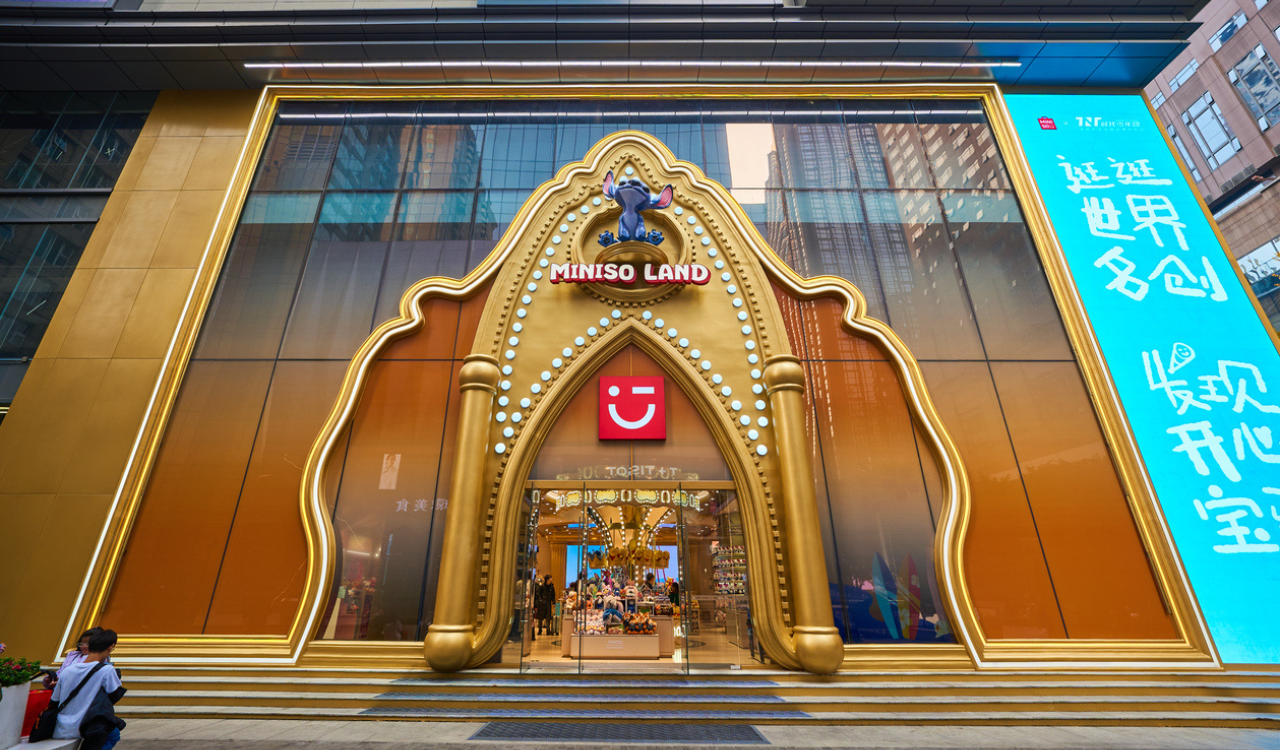
After breakneck expansion, Miniso has turned its attention to large-format superstores in high-traffic areas, leveraging partnerships with well-known IP brands like Marvel, Disney, and Barbie. After testing its Miniso Land concept in Shanghai, the company launched its first Miniso Land stores outside China in Madrid, Spain and Bangkok, Thailand and most recently at the West Edmonton Mall in Canada.
“The Miniso Land format averages about 10,000 square feet, much larger than our standard 3,000 square foot stores,” said Vincent Huang, Miniso Group Vice President and General Manager of Overseas Business. “They’re designed for experience, fun, and engagement, especially for younger shoppers.” According to Huang, one Miniso Land store in China has generated roughly $14 million in sales within its first nine months. While the company expects to slow its overall store openings slightly after years of rapid expansion, it plans to continue rolling out large flagship stores across major U.S. and European cities, focused far more on experience and engagement.
“While our store expansion pace may slow a little after some incredible years growing the brand around the world, we want to open more of these large stores where we can really showcase our IP collaborations and also our own IP,” he added. “I think that if you bring together products that really resonate with shoppers and then you are able to sell them at a great price, then you have a fantastic proposition,” he stressed.
Malaysia Joins the Road West
Another relative unknown in the West is Malaysia’s home improvement chain Mr. DIY, which continues to grow at an astonishing pace. Since launching in 2005, the chain has opened more than 5,200 outlets across 14 markets, including 1,000 new stores last year and another 1,200 expected by the end of 2025. The retailer is currently focused on expanding across Europe, including Spain, Poland, Turkey, and soon Romania, the Czech Republic, Hungary and perhaps Greece. “Germany and neighboring markets are a key focus for us as we maintain our current growth momentum,” said Mr. DIY Chief Operating Officer Leo Gann.
Children’s apparel brand Balabala, part of China’s Semir Group, has also been pushing international growth and debuted in California in November. With over 4,500 stores in mainland China and Hong Kong and 100-plus overseas, the company has opened its first U.S. store at the Stoneridge Shopping Center in Pleasanton, CA and its debut European stores will open in Italy in 2026, with three sites identified.
Nicole Zhou, Senior Director of Semir & Balabala’s International Division, said that as the global fashion market faces new challenges, brands are increasingly being driven to look beyond traditional boundaries to find growth opportunities. “Over the next year, we’ll strengthen our Asian presence and expand into markets where we don’t yet have a physical footprint,” Zhou said. “The Middle East remains a strategic focus; our store count there is expected to double within the next 12 months. We’ve finalized a development deal in Italy and are preparing for broader European entry.” Zhou added that North America is currently in a “test phase,” both online and offline, as the company studies consumer behavior to shape its future expansion plans.
China’s Answer to Urban Revivo?
Urban Revivo, often compared with Spain’s fashion powerhouse Zara, is also making waves. Founded in 2006, the fashion chain has been expanding into major capital cities, opening flagship stores in New York, London, and other fashion-forward markets to raise global visibility. “Tariffs have minimal impact on consumer retail,” said Urban Revivo CEO Leo Li. “Still, we’re optimizing our cost structure and sourcing strategy to offset any potential increases.”
Meanwhile, tech and electronics powerhouse Xiaomi, best known for cell phones, is setting its sights on opening about 10,000 new Mi Home stores globally within five years and has recently entered the electric vehicle space. “We’re building on our brand recognition and moving quickly to open EV showrooms and stores across Europe and the U.S.,” said Eva Niu, Xiaomi’s Head of Retail for Western Europe.
The Shein Paradox
The influx of Chinese retailers and Asian products has not gone without controversy, and a lot of that has swarmed around the November opening of super-cheap fashion retailer Shein within the BHV Marais department store in central Paris.
The run-up to Shein’s debut ignited a political, cultural and industrial backlash in France that has touched on questions of national identity, ethical consumption and the future direction of French fashion. Yet despite the furor, the store attracted “more than 50,000 visitors” in its opening days, according to Frédéric Merlin, the unapologetic President of Société des Grands Magasins (SGM), which owns BHV. He reported an average basket of over $52 for customers and said that “nearly 15 percent of them went on to shop in other departments” of the department store.
Yet in the wake, Galeries Lafayette pulled its name from four more department stores licensed to SGM that were also set to introduce Shein shop-in-shops. As a result, those plans were cancelled, while a string of brands including A.P.C., Agnès b, Aime Cosmetics, Figaret Paris, Le Slip Français, Maison Lejaby, Maison Serge Lesage and Odaje pulled out of the Paris BHV Marais store.
France’s parliament is also debating a proposed €2 ($2.15) levy on low-cost fashion imports, which could take effect in 2026 and would precede a similar European Union-wide tax that is not expected to be in place before 2028. The French initiative, intended as a stopgap ahead of the economic bloc’s delayed plans, would mark one of the first national attempts to rein in the surge of ultra-cheap apparel and merchandise flooding European markets from Asia.
Lawmakers are also considering introducing an additional environmental charge of up to $5.40 per parcel, which could rise to $10.80 by 2030, reflecting growing political pressure to address the environmental and social costs of fast fashion.
Industry bodies such as EuroCommerce have also called on the E.U. to rally the European nations around a more rigorous implementation of current rules and regulations over product compliance, claiming that many products targeting the continent do not meet European standards.
Gen Z Key to the China Syndrome
What is unquestionable is the deep ambition of Asian retailers to create a significant physical footprint in the U.S. and Europe, bolstered by their breakneck expansion rates to date, proving that they can do it just because they’ve done it.
Will Gen Z’s insatiable desire for cheap chic flag? That’s the hardest question to answer; a conscientious consumer generation that continues to be sidetracked by rock bottom prices, this conflicted demographic could be the key to whether the west can be won by Asia.