

This is a true story. I am a veteran of the dysfunctional retail beauty training business. It’s not technically a scandal, but it’s a signal. This report isn’t just a complaint (well, sort of). I’m pulling back the curtain in an honest attempt to level up the profession and ensure that, ultimately customers walk away without any regrets. That starts with well-trained graduates who have experience in real-life situations, taught by working professionals who share their knowledge.
What’s a subtle reason retailers face so many returns? And the answer is: dysfunctional educational and trade school training.
A Cautionary Tale
I earned my beauty license after decades of working in natural hair. After nine grueling months of what felt like an endless pregnancy and then transitioning into the retail space, I found a disturbing disconnect between the classroom and performance on a retail sales floor. This is an industry-wide problem. If you ask any local retail manager, they’ll probably tell you they’re retraining new hires from scratch while eating the costs of avoidable returns. And that’s if the retailer still has a training program, which is another story, but at the root of the customer/sales associate disconnect. Bottom line: We should be concerned about how our sales associates and beauticians are being trained.
As a customer, walk into almost any beauty retailer, be it salon or anywhere else, and odds are you’ll leave with the wrong foundation shade, hair services that disappoint, and a skincare routine that misses the mark for your actual skin issue. As much as retail would like to make this a people problem, there’s no denying it’s very much an infrastructure problem. In short, the way we train beauty talent doesn’t match the way beauty is being sold or how consumers want to purchase it.
On the Big Stage
In the U.S. alone, the hair salon industry generates an estimated $60 billion in annual revenue. And a big chunk of this revenue engine is decided by the customer in front of the checkout counter. And that’s before you even get into what clients spend online maintaining results at home.
On the product side, the global professional hair-care channel is projected to be around $23.5 billion in 2025 worldwide. This includes products being moved through professional recommendations. The most notable powerhouses with the biggest portfolios are the ones that shape the industry because they’re the ones funding training and securing prime product placements on shelves. We’re talking L’Oréal, Paul Mitchell, Estée Lauder Companies (Aveda), and the likes.
Meanwhile, shiny new players like Olaplex and amika have entered this newer era where shoppers expect more than “this smells good and feels nice.” Olaplex set a standard by making haircare feel almost clinical with their exclusive product mechanisms and haircare routines. amika brought a whimsical spin on haircare but didn’t compromise on quality and community building. But all that momentum still collapses if associates can’t translate products into the right recommendation for a real face, scalp, or hair texture.
Retailers Feel the Pinch
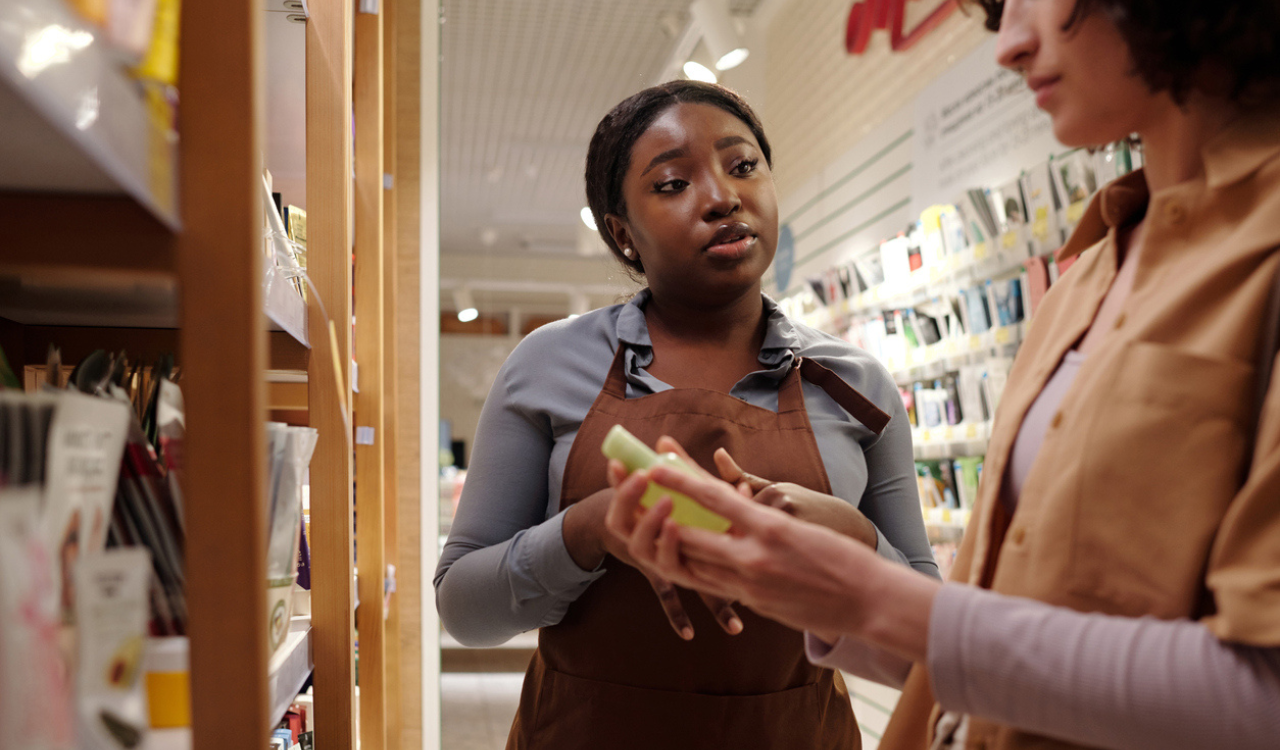
Achieving desired personal beauty is, by definition, intimate. Retailers like Sephora or even the brands in most department stores lack a private space for personal consultation. These services are performed on the floor amidst the distractions of store traffic and demanding shoppers. Consumers already have high expectations when it comes to complexion accuracy and routine curation, and it’s so sad that too many customers are still walking out of the store with products that don’t align with their wants or needs.
Then, you have hybrid model retailers who promote the “store plus salon model” where there’s a solid educational backbone. But that doesn’t solve the problem of new beauty pros who hit the floor lacking in brand fluency. For example, in professional retail stores, associates at CosmoProf and Sally’s are often undertrained on the science of beauty—what works for which texture, tone, or regimen. To be blunt, what retailers fail to realize is that the counter is only as good as the training behind it.
Training Camps
Education has mostly moved online and on demand to teach standardized hair and beauty theory. Retailers and brand houses are also building supportive educational infrastructure internally. In a recent SEC filing, Ulta cited an education program that serves nearly 7,500 salon professionals, while Coty built an internal “Coty Campus” to upskill 11,000 employees. These initiatives are admirable. But where things fall short is the lack of post-secondary ongoing coursework that includes curriculum on retail sales or even how to work with the products that are in big box beauty retailers. In the beauty business, lifelong learning and frequent product updates are table stakes.
Excellent training isn’t cheap. Compared to a typical four-year college education ($100,000-$264,000), or two-year technical training ($10,000 -$30,000), trade school training is affordable. According to legacy beauty educator Milady, a typical U.S. cosmetology program runs around $16,000, including tuition, kit, and licensing.
Cosmetology programs are often underfunded, so when budgets are stretched, schools ration products and students are rationed on practice. In the long run, retailers are hurt because students show up to the workforce unprepared to properly service customers who eventually return products. As a reminder, processing a return can cost up to 59 percent of an item’s original price, which is a constant headache for retailers across the board.
The government is getting involved. The Gainful Employment rule directly ties federal aid to employment outcomes. Starting in 2026, students who enroll in an academic program that leaves them as graduates with debt they can’t afford will have to sign a disclosure notice. This new federal rule aims to provide families with more information about the costs and risks associated with programs. This means that educational programs that chronically deliver high debt and low earnings risk losing eligibility. Whether you love the policy or hate it, it’s forcing schools, brands, and retailers alike to tighten their investment alignment between training and real job results.
The Irrelevant Classroom
In beauty school, you get required reading, tests, and hands-on practice. That’s it! I never met brand reps from big beauty brands or learned about the products sold in stores. I had to research product information and experiment on my own, which was costly. My experience was not unique. The lack of real-life case studies, use cases, and professional experts as visiting teachers is a common practice.
Originally, I planned to use my license to offer more services at my salon, but then I pivoted to test my skills by working at a salon in a major beauty retailer. Here’s what I noticed, and these lessons can be generalized to other training education/programs, which should give any retail leader pause.
- Board prep is more important than job readiness. Most programs teach licensure requirements, which emphasize safety, sanitation, and basic technique. Even during the middle of my studies, I was forced to sign a paper that stripped me of a cosmetology diploma (never mind the money I paid for core curriculum courses) and replaced it with a “certificate for licensure.” Aside from the switch-pitch credentials, the training was out of touch with the real world. What is not taught are on-site skills. Employees need to be speedy, adept at good consultations, and have retail smarts. New grads often struggle with building routines, picking the right product for the customer, or finishing a service on time. This leads to longer appointments, fewer product sales, and inconsistent services in the retail environment.
- Too many gaps in product fluency. I was never taught about specific product lines in school. Our inventory was random, nonexistent, or watered down. Can you imagine bleaching someone’s hair and realizing you have no toners? Learning how products work together was not in the curriculum. As a result, on the retail floor, graduates don’t know how to deal with different textures, finishes, or shade systems. It’s hard to be loyal to brands or make good recommendations without prior experience with said brands. Retailers feel the impact of this immediately. Workers who don’t look at beauty as an ecosystem and don’t suggest related products for upsells, result in customers returning purchases due to dissatisfaction.
- Tight budgets limit hands-on practice. In my case, paying $800 for a toolkit of shears, a razor, rollers, perm rods, a blow dryer, a flat iron, and three mannequin heads for one year was crazy. I also ran out of materials halfway through the course and had to buy more. There was a lack of real-life professionals who could demonstrate faster styling techniques and makeup shade matching. Training for completing a sales routine was missing, which is so integral for being an asset to a retailer.
- Drastically underdeveloped soft skills. Soft skills aren’t part of a state board exam. Inclusive consultations? Expectation setting? Service recovery? Empathy? These skills are treated as optional, but when you break into retail, they are most certainly non-negotiable. These skills are at the heart of building trust with customers; they reduce buyer’s remorse and protect store margins.
What’s the Fix?
For starters, any school curriculum has to be closely aligned with real retail tasks. Brand-backed product modules and tracking practice hours tied to actual product assortments should be requisite. Assessing soft skills alongside technical ones is critical.
Programs that teach the consult, the match, and the close while measuring accuracy and speed will produce graduates who are truly ready for the sales floor. Retail needs graduates who can perform on day one. Until training mirrors the realities of the sales floor, there’s a serious disconnect.
My solution is to make school look like the retail floor, then measure outcomes the same way retailers do.
- Tie curriculum directly to product use. If you want confident recommendations, train on the actual product assortments graduates will use in stores. Plug brand academies and retailer modules into required coursework (complexion mapping, curl systems, scalp health) and verify competency with short assessments.
- Build “workforce labs” that connect the classroom to the counter. Co-create cohort rotations with nearby schools inside select stores where students can complete live consults, timed services, and real shade-matching under staff supervision. This could serve as a candidate qualifying tool by tying hiring to lab performance versus only conducting interviews.
- Lower the cost of practice. It would certainly help to underwrite student kits with tiered brand sponsorships and retailer grants. To track progress, require utilization reporting so the products and tools turn into practice hours.
Postscript
I came to school with 20-plus years in natural haircare. I expected to add precision cutting, color theory, and a retail-ready consult. Instead, I was immersed in a system designed to pass a test. This isn’t an indictment against instructors; it’s about aligning programs that mirror real life.
I think the beauty industry sees education as charity, not a way to help retail success. When new beauty pros know products and are confident in consults, sales go up, and returns go down. We have the technology, the programs, and the pressure from government regulations. So, what’s the issue? If schools, stores, and services align, retailers will see profits rise.