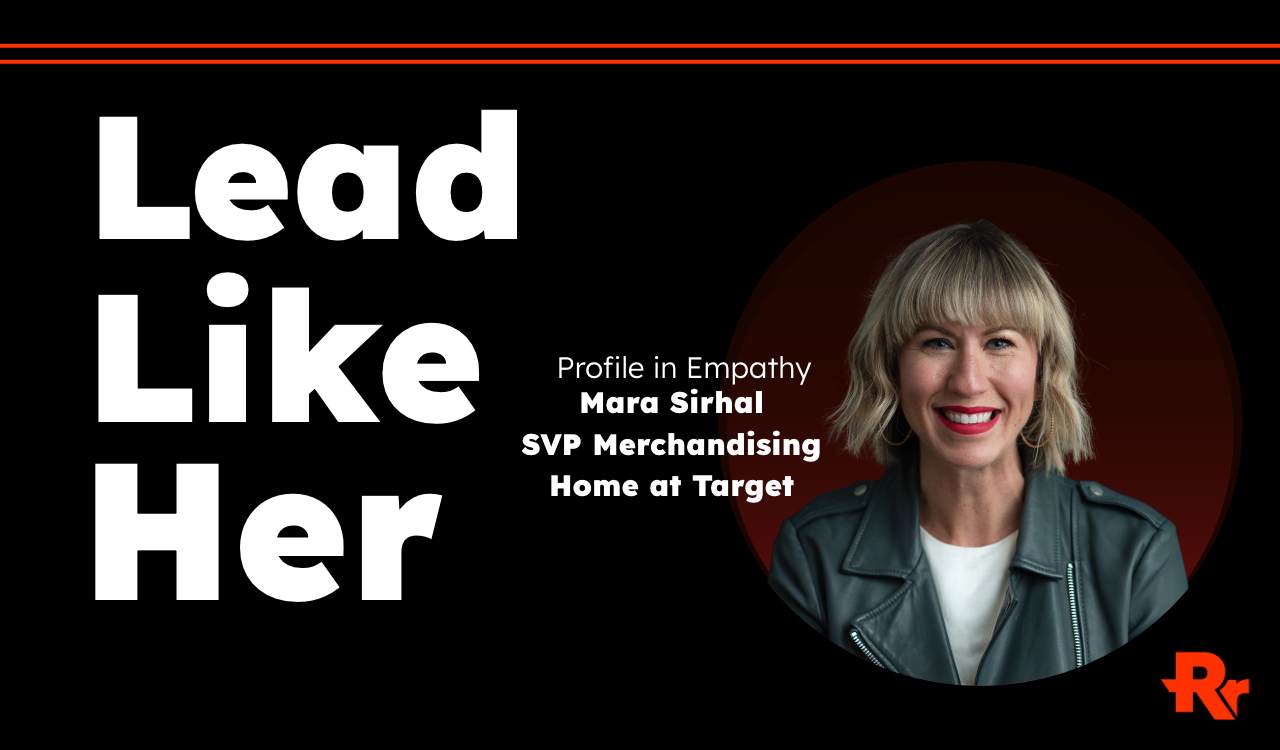


Retail is at a hinge point. Mara Sirhal is SVP Merchandising Home at Target and candidly describes the retail business as tough; consumer count is declining, leadership teams often aren’t aligned, and friction points develop complicating a very volatile industry. She adds the industry is heavily impacted by macroeconomic factors. So, how does a leader manage these conditions? “If you spend a lot of energy wallowing in what might feel like a difficult or miserable situation, and you’re not focusing on what is within your control and what you can learn from it, then it’s all for naught,” she says. The skills leaders need are “resiliency, stamina, discerning right from wrong, and being able to understand how you hold your values in place during a tough situation.” She describes powerful leaders as individuals who, when their integrity is tested, stand firm. Watch and learn how Mara has perfected the skills of self-reflection and awareness as a North Star to lead teams to success.
Special Guests
Mara Sirhal, SVP Merchandising Home at Target
Transcript
Haley Boehning (00:05)
Hello and welcome to Lead Like Her. I’m Hailey Boehning, and today my guest is Mara Sirhal. She’s Senior Vice President of Merchandising for Home at Target. Mara has spent over two decades reshaping merchandising strategies for some of retail’s most iconic giants: Macy’s, QVC, Home Shopping Network, Bed Bath and Beyond, Saks Fifth Avenue. All of that before joining Target in late 2025.
Mara talks about thinking of career development as a lattice rather than a ladder, and why cultivating relationships built on trust is one of the most important parts of that lattice. She talks about being bold and taking risks and what it’s necessary to find that boldness in yourself. And she emphasizes the importance of self-reflection and self-awareness to those three steps of leading self, leading others, and leading change. So please join me.
in welcoming Mara to lead like her.
Haley Boehning (01:03)
Mara, thank you so much for joining us for Lead Like Her Today.
Mara Sirhal (01:07)
Yeah, thank you so much for having me, Haaly. I really appreciate it. I’m excited to chat today.
Haley Boehning (01:12)
Great. Well, you you’ve had such a remarkable career in retail and have been at some of the most kind of iconic names in in retail and in housewares and homewares. but I wonder if I could ask you to go back in the way, way back machine to when
Mara Sirhal (01:28)
Yeah.
Haley Boehning (01:28)
you decided that you wanted to focus on retail in college. A lot of people don’t have an insight that early. Can you tell us what it was about retail that that attracted you?
Mara Sirhal (01:39)
Yeah, well, if I’m being really honest, it actually was born out of just, you know, first and foremost, like a love of fashion and, you know, dreaming about that as a preteen and a teen and really wanting to engage in fashion as a career. And so
How it actually started was I had really pursued you know, attending a university that had a fashion design program because the, you know, vision was that I would be the next Donna Karen, you know, as a fashion designer. but you know, this starts sort of a theme, I think, of my career, which is sort of humility and like, you know, self-awareness. But I it turns out I have zero artistic talent.
So fashion design was not going to be the path. And so thankfully I had ended up at Syracuse University, which does have a wonderful fashion design program, but they also have a very developed retail management program. And so I just kind of pivoted from fashion design. I I I called, you know, called the ball pretty early. Like this is not for me. I’m definitely not finding my groove. and was fortunate to kind of just move over to retail and then, you know, really
loved it really ever since then and obviously, you know, younger working in stores and being directly with the customer, to obviously then pursuing, you know, the career track. So it was a good, you know, happy accident, but I I hope, born out of good self awareness and what am I good at versus you know, what am I not and making that pivot early on. So
Haley Boehning (03:17)
Yeah,
it’s fun to just meeting with students here in New York. It’s really fun to hear their early pivots. Sometimes just a couple of months
Mara Sirhal (03:24)
Yeah.
Haley Boehning (03:25)
into their into their into their studies of retail, like, ooh, what I thought I wanted to do is not what I’m going to end up doing. so tell
Mara Sirhal (03:32)
What?
Haley Boehning (03:33)
us what what was your first job in retail and how did you get it?
Mara Sirhal (03:37)
Yeah. So my first first job was actually working at a boutique near a summer cottage that my family had and I was fifteen. So at that time you had to be sixteen to work, but the boutique let me, you know, come in and they had all the brands that I loved and I unpacked clothes and seamed them and all of that. and I loved it. And then I parlayed that into a job in college with actually Ralph Lauren with the polo store in Chicago.
And so worked their summers and holidays and and all of that. And so, you know, the luxury retail, you know, end of things. and then, you know, first job out of college, I was fortunate to be recruited, you know, on campus at Syracuse and so found myself joining the executive development program at Macy’s. So and particularly at the time, it was called Federated Merchandising Group because it was back
before Macy’s kind of rebranded to Macy’s Inc., but I was on the product development side, so joining that executive trading program. So knew that, you know, had that job kind of early on, you know, my senior year and then matriculated into that job, you know, just post graduation. So kind of right from, you know, college into the real world. So
Haley Boehning (04:58)
Real world, but what an amazing experience. For for those of our listeners who don’t know what an executive training program might be, can you can you talk about what it what it was and and what you learned from that experience?
Mara Sirhal (05:11)
Yeah, I mean first and foremost, and it was an amazing opportunity to start my career with a cohort of peers. And so the executive training program at Macy’s was again a a cross section of peers from all different, you know, universities and and places and spaces. and we all started at the same time on the same day and it was a ten week kind of training, you know, course, if you will, that
matriculated us into the company, into the business, learning the fundamentals of the jobs we would go on to have from that training program. And so it was like, I would say 10 to 12 weeks of just a lot of classroom time, some on the job, but essentially with that cohort and kind of moving through that together. So a really unique way to build, you know, friendship, bond, and teamwork really early on and having that support system of others going through at the same time. So
also obviously afforded a great opportunity to just learn the business in sort of a broad sense before starting out. and having, you know, just the time, I think, to really learn and understand how it operated. And so that is again I a mechanism of which Macy’s brought many folks in over the years. and I think a great foundation for so many of us that went through it.
Haley Boehning (06:37)
Great. Tell me a little bit more about what that broad exposure to all the different parts of the business gave you as a as a young person kind of coming up in retail.
Mara Sirhal (06:50)
Yeah, I think
First, it just opened the aperture to like what is retail. I mean, you know, I certainly studied aspects of it, you know, toward my degree in college, but it’s the reality of being there and hearing from all of these different colleagues internally on what was their role and how did that fit into the broader picture. So being able to do that in a pretty methodical, you know, step-by-step way to kind of fit the pieces together. I think two, it also obviously afforded the opportunity of well
What was most interesting, you know, to me and what where would I fit into the company based on all of the different factions that kinda came together to
create at that time because this training program was specific to sourcing and product development, but what would I really, you benefit from and enjoy based on sort of what I had learned. So it was just a good baseline. But I would say there’s nothing like just being in the job, operating in the job, and learning the aspects of it that, you know, I loved and then others that helped me reflect in terms of what where I maybe wanted to dig in further or explore a different avenue, you know, kind of post that.
Haley Boehning (08:01)
Good.
Let’s maybe talk about that a little bit. So those those early days as a as an emerging leader at Macy’s, as you’re exploring the different avenues that are open to you, who were some of those early mentors and and how did they how did they impact you?
Mara Sirhal (08:18)
Yeah, so a couple you know, interestingly my first experience, I was a product assistant, so moving in on the sourcing side of the business, I had a a really tough first boss
And I think from a maturity standpoint, she really made a big impact on me because she was holding me to a standard that I needed to kind of elevate to at the time. You know, I think you’re you’re still growing up, you’re still, you know, quite young. You’re out on your own for the first time. and I think there was a lot of, you know, grappling with just insecurity and confidence, like probably most people do, you know, when they’re learning something new.
and so she was pretty hard on me and she got me really on my toes. but it really soaked kind of that I would say like competitive ambitious energy that I think always been there for me. and it was a real motivation to want to perform, want to maybe prove her wrong. Like I this is something I can be really good at, you know. And so
That first boss, the fact that she was hard on me, the fact that she was kind of calling me on the carpet on some things that I probably needed to hear at the time, was of course I didn’t love it then, but I can really appreciate it now. and then secondly, I had a really amazing HR mentor, which you don’t always hear that, but I had somebody that was really invested in me, was always having me think about
the long game in terms of who I wanted to be and where I wanted to go. And that person became such a touchstone in different decisions that I made in terms of roles I moved into. And so I started out in product development and sourcing and I did that for about six years. But I always had this hunger to be a merchant, right? To be a buyer, to really move into that side of retail.
and this individual really pushed me to think about what it would take to do that. And at the time it was a completely, you know, different skill set and one that I didn’t have. And so, you know, that person really said, I think you’re gonna need to take technically a step down, you know, or a lower level position to learn buying. But when else are you gonna do that? Like now is the time, right? And so about six years in I moved from sourcing to buying and I was
again performing really well on the sourcing side. I think it was a director level at that point. And I needed to go and be an associate buyer and really learn that, you know, craft and that skill. and that person really pushed me to do that, to be bold in making sort of a decision that was gonna serve the long term. But in the short term felt really tough to make. You know, you’re on this trajectory and you wanna keep going, but yet you have dreams over here that you wanna see through and sort of what what’s required.
to really get ahead, you know, long term is often a sacrifice in the short term. So
Haley Boehning (11:22)
Yeah.
Mara Sirhal (11:23)
that person really helped me see that too.
Haley Boehning (11:26)
Was there something about the way they delivered that information to you, or the way you received it, that you now kind of in hindsight that you you now apply to your own work as a mentor and a coach and a leader?
Mara Sirhal (11:41)
Absolutely. So I think first and foremost it’s having an ambition that’s beyond of course just the next step, right? It’s like what is that ultimate goal, you know, that you have for your career based on what you know now? I mean, that can change and evolve, but it’s always having sort of something over here that’s likely ten years down the road ish, right? And having sort of that big dream. and then making decisions based on
To get there, what is going to be the best formative experiences to make you the most well rounded from both the hard skill side but also from the leadership development taking on different challenges. and so kind of based on that I’ve always coached about thinking, you know, of one’s career as a lattice versus a ladder, right? And so
Many a many, many times throughout my career I’ve taken what would be considered kind of a lateral move or maybe even a step down that I just described. to get a new experience, to add something to you know, my experience, you know, story that was going to help develop me further. example of that was going over to Macy’s dot com in two thousand nine. It was growing
incredibly rapidly, but it was not a time that merchants were approaching sort of an from an omni lens. and I took a s kind of a side step to take that job. but what that ended up doing is actually helping me develop as one of the first omni channel merchants at Macy’s because
Haley Boehning (13:22)
Mm.
Mara Sirhal (13:23)
I’d done both and and when all things came together at the end of the day and we ended up really looking at merchandising as you know a holistic function to serve all channels.
It uniquely positioned me, you know, to move quick to move quickly, to move up to provide, you know, a level of leadership that was unique. And so I think the lattice approach, the long game approach, I always coach it’s not about the next job. It’s are you taking the next job? Because it’s in service to the one you want ten years from now. and sometimes that is
a no to because your company will come and ask you to take X, Y, and Z job. It’s really up to you to think about whether it actually does fit as a really important piece, you know, and stepping stone to what you want ultimately. because only you know what is going to be best for you and those goals. and so i it’s scary, but it’s requiring a lot of like confidence and conviction in that. because
Sometimes we want other people to make the decision for us, but it’s really important
Haley Boehning (14:32)
Yeah.
Mara Sirhal (14:32)
to like take that pause and say, does it actually give me X, Y, and Z? and so I think that that’s always been, you know, a real kind of front and forward for me is thinking about the lattice, thinking about the longing, thinking about an amalgam of things together over time versus, you know, so singularly needing to move up, up, up. So yeah.
Haley Boehning (14:56)
That’s interesting. I love
the, I love that analogy of the lattice. That’s that’s easy for for my brain to grasp onto that it’s not always one direction up, but you might be going
Mara Sirhal (15:03)
Yeah. Nope.
Haley Boehning (15:05)
over or sideways. There are big risks that you took, each of those moments. How do you how did you coach yourself in those moments of opportunity that doesn’t look like opportunity?
Mara Sirhal (15:19)
Yeah. Well, I would say first and foremost is just, you know, having a lot of humility to say, I actually am scared to make this decision and I don’t know if it’s what’s best for me, right? But I know I need to consider it. And so just even acknowledging that I think is a great first step. I think two is having a trusted network that isn’t going to just tell you what you want to hear.
And oftentimes I think people want to jump into these like I need a mentor and I need to, you know, and and typically those relationships are just developed over time and kind of naturally and it’s usually because you’re making an a concerted effort to invest time to outreach to an indiv you know a person that you’ve admired or you know, asking them to weigh in on something, asking someone for their point of view. But it is just that, it’s a point of view, right? And it’s a data point like to bring into ultimately.
making you know the decision for yourself and owning it. but I think acknowledging and being vulnerable, which is I think another real key cer certainly is for me and my leadership style to success, but being vulnerable and naming it, you know, two is really knowing the who you can go to to really unpack it. And three is ultimately taking a lot of that feedback.
And kind of putting it into the context of this long game kind of approach that I discussed, which is based on all of that, does that help you clarify whether or not this move and or role project, fill in the blank, is right for you?
And sometimes it might not be, but ultimately what you get out of that and and how you galvanize against some of those like missteps, if you will, is really not a misstep because it’s ultimately, you know, an important moment of like both maturity and inflection in your own career to use for future too. So I don’t think anything’s wasted, but yeah.
Haley Boehning (17:25)
Yeah, that’s true. The old the old saying
that we either we either succeed or we learn. So I wonder, I guess you think about
Mara Sirhal (17:29)
Yeah, exactly.
Haley Boehning (17:32)
those early days at Macy’s your and in your earlier in your career, was there a misstep that taught you something that that has carried you through to to where you are now?
Mara Sirhal (17:47)
Yeah. That is a really great question. I would say that
don’t really see any of like the job decisions and the roles that I took as missteps. But one thing I think that took I took a lot of mind share and energy in my early years that if I were to go back, I wish I could have just shaken myself and said, don’t spend so much energy ruminating all the time is worrying so much about what others thought of me. And some of that I think is maturity. I mean it’s just
where we’re at, mean I spend so much less time now on that, you know, but I’m twenty five or so years into my career, so there’s you know, there’s a natural progression of it. But I was so hyper worried about it. and typically when I was going in front of a group of people and I was always kind of comfortable public speaking, comfortable doing but I I was still not myself and kind of rigid and I need to sort of
really kind of be this, you know, s particular, you know, robotic delivery of like this perfect strategy and all the stuff versus actually adding some of the personality of who I was like into whatever I was trying to communicate. So I think
Haley Boehning (19:09)
How do w when did that when
did you unlock the ability to do that? Like
Mara Sirhal (19:13)
Yeah, I mean I think honestly I’m not care I could p pinpoint to one particular time, but I think it was over time starting to get gain more and more self awareness about what it was that motivated me. So be and then being able to advocate for that, right? So I you know, I need a really good balance of like positive reinforcement, you know, and recognition with constructive feedback and and all of the opportunity, you know,
opportunities that I may have to improve, which I’m also very embracing of, but I have to have a good balance of it. and so I think becoming and just learning myself professionally more, being able to advocate for what those needs are, that’s half the battle. You know, if you understand a little bit about how you operate, what motivates you, what scares you, what creates, you know, potential a backslide of of confidence.
then you’re able to articulate and you know advocate with both your supervisor and or other peers across, like, and just then kind of like lean into the vulnerability of like, hey, these are some of the things I need. and seek it out. You know, nobody’s a mind reader. So I think taking it to that point is probably what helped me like over time develop that. And then I think the like
Course, I care what people think. I want people to see me as someone of high integrity and that you know as a great leader and all those things. I certainly care about that. But I don’t spend a lot of time on superficial opinions, meaning I’m not sitting there worried about what someone that I met like two hours ago thinks about me. and I think a lot of that is just battle-tested, like going through, you know, lots of challenges over the years, opportunities to say, hey, like
This is not what good life looks like. So sometimes it’s looking at leaders that don’t work for you, that don’t embody what motivates you to help clarify, like on the other side, you know, kind of who you wanna be. So
Haley Boehning (21:21)
Yeah, clarifying the positive of who you want to become by looking at the shadow in
Mara Sirhal (21:27)
Mm-hmm.
Haley Boehning (21:27)
others’ leadership.
You just walked us through some wonderful prescriptions for how to lead self through these these moments of change and transition.
I wonder if you can talk to us about your first few experiences leading people and what that change was like for you, going from leading yourself as an individual to to leading a team.
Mara Sirhal (21:51)
Yeah. So I think probably I’d start with, you know, again, it goes back to self-awareness. Like who are you? What motivates you? How do you, you know, where do you gain your energy, you know, kind of in your life, whether it be work life or personal life. and as I would a self prescribed like hyper extrovert, I get all my energy from other people and I actually don’t like to spend time alone. So
When leading a team, I think for me to be really authentic is like investing time, you know, with those individuals. And so doing that early on, finding opportunities to go visit stores, to go to dinner, whatever it is, or you know, whatever the team members I was working with were open to doing, because not everybody’s a hyper extrovert either, is I think where I gain both energy but also building a trust.
And like I think people talk about that often. It’s like you’ve got to build trust first, right? But how do you do that? And everybody’s gonna take a somewhat different potentially or you know, personalized approach to it, but ultimately I think a non-negotiable is like to build trust you have to show genuine interests in the other person also, like what makes them tick, what excites them, how do you shine your light on that individual, giving them credit, recognition, all of those things.
So I think just by being aware of what at least it initially before I really learned a lot of the mechanics of leadership in terms of that is being self-reflective, like that’s sort of the the age old like treat others how you want to be treated yourself. when you’re a real new leader, like starting there versus a place of I am, you know, the boss and this is what I say. but I think the gaining of
that collective perspective by talking things out and again spending time considering others’ points of view was real formative for me. and then again just the energy and excitement and joy, quite frankly, of like seeing, you know, my team succeed, you know, that’s just
Haley Boehning (24:02)
Yeah.
Mara Sirhal (24:03)
perfect it is I would say I’ve I’ve you know, led larger
Haley Boehning (24:08)
Yeah. And how does that that leadership style of yours, how have you scaled that? You know, as your teams have gotten larger and larger,
Mara Sirhal (24:17)
Mm.
Haley Boehning (24:17)
how do you maintain that that high touch that gives you energy, that allows you
Mara Sirhal (24:21)
Yeah.
Haley Boehning (24:22)
to shine light on them and while looking at teams that are larger and larger and and potentially more, I
Mara Sirhal (24:27)
Yeah.
Haley Boehning (24:28)
imagine, geographically dispersed?
Mara Sirhal (24:30)
Yeah, no, it’s a great question. I think the first thing I think is just being authentically myself. And again, I feel like the word authentic is used a lot, so I’m kind of gagging to myself that I’m using it also. But I think just it’s in the little moments because yeah, do I need to have a really engaging and energetic all team meeting that is hundreds of people where we’re talking about what we’re gonna do and we’re recognizing people on a big stage.
Absolutely. Like those moments are important for sort of total team togetherness. But I find that again, investing time where and when I can and making that a priority, whether it’s traveling with a team to, you know, a supplier in California and spending two days with them and getting to engage, you know, maybe potentially down to associate and assistant levels by doing that. it’s really in the little moments. It’s like
See someone in the hallway, hey, you know, Sally, you know, what did you do this weekend? And I was so excited about X, Y, and Z and your business. So it’s the little moments that I think show up that way in terms of building trust. Like, okay, she can talk the talk on the big stage, but is she actually walking the walk in the day-to-day? And I think that’s just treating, you know, all of our team members as
they’re an equal player in in you know on the team and have a big stake in our business and you know creating as much I think like like safety and and you know comfort that I can in any given situation, whether it’s, you know, some sort of meeting that we’re attending together or again these smaller moments that I mentioned.
Haley Boehning (26:17)
Yeah.
Mara Sirhal (26:18)
you know and and ensuring that those are happening. But I think
it it gets harder and harder, but I think the key is really the time investment. You know, where am I going with these teams? When am I traveling? What meetings am I engaging with, you know, on a regular basis? Being very present in those meetings, showing interest and you know, engagement, Inquisitiveness.
Haley Boehning (26:41)
Yes.
Mara Sirhal (26:43)
in terms of what they’re doing. So it’s an amalgam of all of it, but I think the little moments and finding
time to invest there is what’s probably most important to actually deliver on what I’m sure many of us want, which is an authentic approach to our relationship across the team.
Haley Boehning (27:00)
Great. So and that’s great advice for those of our listeners that that are new to leadership and are and are leading teams of people, especially now so geographically diverse or dispersed rather. I wonder, you know, what is your advice for women in retail starting out on how they can help build trust and build those relationships with with the women or men that are in the business that they look up to as their their leadership icons.
Mara Sirhal (27:31)
Yeah, I mean I think first and foremost, I mean, I speak for myself, but I just I want people to be themselves. Like, yes, I might be the pyramid leader of a big business and all of those things, but
If someone’s just approaching, you know, myself with humility, hey, like we worked on this project, here’s our point of view, here’s what we feel really passionately about. we’d really like you to weigh in on X, Y, and Z, right? I think coming in with the authority and the confidence and the subject matter is is critical. And oftentimes I feel like teams are
kind of putting on a whole presentation just to convince you of a decision that they want to make versus we’re making this decision because of these reasons and here’s where we could really value and use you and your, you know, thought leadership in terms of other places we’re stuck or we really do want you to be invested and and on board with us here. I’m really always looking for that like point of view and opinion to come out.
and so I would just say there’s always a way to deliver that with a good balance of again humility and openness to feedback too, because you may do that and the leader’s like, Nope, totally wrong track, like we gotta pivot and do this. And so it may, you know, I I can’t we gotta be honest, like it’s sometimes when that happens it’s kind of like, got punched, like that stinks, you know, but
I think it’s what you do the next day. Like how do you reboot? What do you, you know, think about in that moment. But I think being really bold, balanced with that humility and approach, is what a lot of leaders like myself are looking for. We we need folks that, you know, are experts in what they do, that have that point of view and are going to lead with that boldness, versus sort of asking permission, I guess, you know. I
Haley Boehning (29:29)
Yeah.
Mara Sirhal (29:31)
think that’s
I’m and I have to remind myself of of that as well, you know, I
Haley Boehning (29:35)
Mm.
Mara Sirhal (29:35)
still do. So
Haley Boehning (29:38)
I
wonder if you can talk about the connection between boldness or having the courage to be bold and those moments of doubt. you you’ve moved from some you know traditional specialty retailing or department store retailing into QVC and the home shopping network. I I imagine that was a moment of, gosh, do I know what I’m doing? I wonder
Mara Sirhal (30:04)
Yeah.
Haley Boehning (30:04)
if you could talk about that a little bit.
Mara Sirhal (30:06)
Yeah, well I think you cannot underscore the importance of learning from the experts. And so any situation, you know, like that, where you’re going in and you’re not the expert, you don’t know the business, but you’re being called on to sort of bring a leadership perspective and drive change, you have to balance the what you do know how to do, likely in this case, right? Like the soft skill management. How are you building, you know, trusts? Who is, you know, who are detractors?
Potentially on the team. How are you identifying who are the detractors, the fence sitters, and sort of the promoters assessing a lot of that? Because you know how to do that, likely, depending on what level you’re leading, right? And so you can kind of separate, like, I know I know how to do this, like the people part of it, but the business part I think is where it’s almost harder because you have to
know what questions to ask to get the best sort of input from those most tenured, you know, you know, experts in the business because you you definitely will not have the answer. but it’s the quality of question and where you decide to really spend your energy continuing to dig.
And I would tell you like in retail, it should pretty much always come back to the customer, guests, consumer, whatever you call it, right? here at Target we call them the our guests, but it should always come back there. and so I can answer that question like in retail. It’s like what data can you mine about who you serve? That should be a pretty easy plug and play. It’s just then once you get that, asking the questions to the experts that are already there.
and likely, hopefully, you’ve identified of the experts that are there, who’s sort of the fence sitter, who’s the detractor, who’s the promoter, who’s open to change, who’s open to sharing. because you’ve got to lean on the right people. But there it’s usually through like good quality question, a lot of brainstorm and discussion from that, that then the strategy and the focus on like what is going to turn the business or improve the business is likely like
an output of a team effort versus obviously you as the single individual. But you won’t
Haley Boehning (32:27)
Yeah, but
Mara Sirhal (32:27)
get there unless, right, you’re leading through that level of inquisitiveness, getting back to the guest, like focusing on all of those things.
Haley Boehning (32:35)
Yeah, it’s interesting. The way I hear you talk about it, it’s almost as if the the guest or the customer is the key that kind of unlocks the the conversation that needs to happen from taking us from we have answers or someone here has to have the answer and we have to pitch our answer to
Mara Sirhal (32:53)
No.
Haley Boehning (32:54)
a more of a two-way dialogue. It’s like that if if you’re feeling I I I almost feel like you’re saying if you’re feeling nervous in that situation where you have to move from answers to questions.
Your your handicap is the is the customer. Like your crutch is the customer. Go back to the customer.
Mara Sirhal (33:09)
Yeah. At the end of the day,
if we don’t know anything about the business or very little, it’s like what is the customer telling us? How are they engaged with what we’re doing today? Where are they not engaged? Where are we losing? Market share, competitive edge, what have you, based on how we measure those things. Those are pretty unilateral in any sort of consumer and or retail business. So I think
And it should be the center, you know, of what we do at all times. So I think defaulting to that as the starting point of seeking to understand, you know, and the questions that are gonna need to be asked, is like I think a foolproof way without feeling overwhelmed on I must be the expert and all things. Because there’s no way that you can, you know, but I think it’s how you leverage the experts with that point of view of the the customer, the guests front forward. That can I think accelerate.
Haley Boehning (34:02)
Makes it not
about you, it’s about the customer.
Mara Sirhal (34:05)
Yeah,
exactly. Often
Haley Boehning (34:07)
Mm-hmm.
Mara Sirhal (34:08)
it’s easy to forget it, but it’s who they we serve, so we have to. Yeah.
Haley Boehning (34:11)
Yeah, yeah, absolutely.
what’s something in your career that you maybe believed to be true when you started out that you had to unlearn?
Mara Sirhal (34:28)
I would say definitely that I need and it kinda goes back to what we just talked about, I would say that I always need to be the expert and have the answer. Because I think when especially when you’re starting out, you know, the first ten years you’re sort of learning, right? You’re like gaining experience and reps and all the things that you need to do to really build
expertise, you know, in a given field. And so it’s sort of what’s required of you to sort of execute against like pretty tangible black and white tasks that need to be done. It evolves so much, right, as you move into leadership roles and as you have, you know, broader and broader purview over different business, you know, unit opportunities. So I think it’s being able to
leverage back to kind of humility. being able to leverage that humility kind of as an always on, like what do I not know? who do I trust to ask those questions? what questions should I ask if I’m unsure about something? but I think it’s the pivot from sort of execution to like really the the the strategic forward thinking, you know, more long term focus.
And it’s usually I think a lot of leaders struggle when they can’t pivot to how do I lead the collective? What are the questions I need to a to ask versus having all the answers. And one thing I’ve been working on a lot is like how do I really transition from as a leader from being like the protector to the guide. I mean I lead
Haley Boehning (36:17)
Hmm. Mm.
Mara Sirhal (36:19)
degree high level leaders now and I’m I mean, I shouldn’t have all the answers for them because
they’re gonna know better than I will in a lot of cases in terms of decisions they need to make. But I think the the guide mentality of are are you asking the right questions? Are you allowing the time sometimes that’s needed? sometimes it’s like just patience. Like you’ve just sit on something for a month. I d you know, whatever it is. so I think to me that journey can sometimes be hard and like an always on reminder where it’s like ultimately
don’t have to be the expert, there’s no way you can, especially as you move into larger scope roles. And so the humility that comes along with like being able to ask the tough questions I think is a real key pivot.
Haley Boehning (37:15)
And
you’ve over 25 years you’ve seen a lot of change in the industry.
Mara Sirhal (37:20)
Yeah.
Haley Boehning (37:20)
perhaps an understatement in this in these last 25 years. what is it that you see in the industry that that you think still needs to change? What’s what’s holding us back that we need to address?
Mara Sirhal (37:36)
I think we have an opportunity as an industry to leverage technology so much more deeply in sort of the craft of retail, you know, and and merchandising, which is sort of the center of it, right? but I think we are still kind of held to this, we’ve got to do everything in in this long
Form process that really in a lot of categories, it’s it’s at least eight months plus from like conception of a product to you know delivering it to the sales floor. And so how are we leveraging technology to shorten that while actually using it to fortify what we know about our customer base and trusting it more from that standpoint? And I think a lot of that goes back to ultimately retail is.
Is a big business that’s very reliant on systems and connected systems at that. And they get, you know, out of date so quickly. And so I think we use that as a crutch. It’s like, we’re just dealing with bad systems. and that might be the case, but I think the agility we need in technology to like move faster is one that I think pretty unilaterally, I mean, now having been at several retailers where it’s like,
All the same issue. Like we’re outdated technology, we’re not real time learning from the customer like what they want and why they want it to then apply it to, you know, future state. And think that’s why fast fashion had such a ramp when it did, because it was like this insatiable, we must have these trends and they’re on this you know, they’re on the selling floor. And I think the fast fashion model like has certainly been very successful in Europe and and Asian markets.
and so I’m sure there are aspects of technology that are helping power that we’re not doing here in the US, but I think it’s just being more open and embracing of it to be able to move quicker. We’re still like too long to market on a lot of stuff.
Haley Boehning (39:45)
I wonder, you know, as you look at your career and you look at the women that are coming up behind you, we know that there’s this dramatic gap between the number of women that are working in the retail industry.
and the number of women that are at the C-suite, that are in the C-suite and leading. What are the things that you see that that you think we need to address openly to change that, to close that gap?
Mara Sirhal (40:12)
Yeah.
Yeah. Well, I think it first starts with the board, right? Because ultimately, you know, a govern a a board, whether it be a private or a public company, is responsible for CEO succession. And so I do really think it starts there because I don’t I I very much do not think we have enough diversity on boards.
to allow for the right balance of voices, you know, in the room in terms of how we’re building against succession plans. so I do really see a lot of responsibility on how board candidacy is evolving. the diversity both of experience, so folks serving on boards, for end as well, you know,
from a demographic standpoint, both gender, you know, and race, I think it’s really critical to like helping that evolve. because
Again, that body you know, that body of individuals is collectively responsible for the the CEOP. So I do think it has to kinda start with the ward. but then two, I think it’s really like for me, it’s looking like a lot of these companies, it’s like, okay, what is the majority of their consumer base made up of, right? And many retailer you know, many retailers and and brands in general it is females and so
then, you know, are we crafting multiple succession plans that include more than just one female in terms of even internally, how we’re building, you know, glide path to CEO because I think you can always bring someone in from the outside, but at that level it’s just and I’m living it today, like we have just an amazing opportunity to work, you know, with a CEO that’s been here. And it’s there’s a huge benefit to that. So that is within our power to do that.
and so I think the really overtness of really mirroring a lot of who’s serving at the senior level, to make sure it’s reflective of the the consumer base too, I think is is critical. and then I think it is ultimately you know, embracing differences that, you know, a female leader may bring.
Haley Boehning (42:38)
Mm.
Mara Sirhal (42:38)
and I think usually that is
tie it a little bit more overtly to you know I don’t want to say humility, because that there’s certainly many men that I work with that, you know, have a real humble servant, you know, leadership style as well. But maybe the word is more comfortable being vulnerable, comfortable, you know, really emotionally connecting with the organization in
Haley Boehning (43:06)
Yes.
Mara Sirhal (43:07)
a way that it may be different, you know, than
of how how it’s been perceived in the past. So I think there’s many ways that we can do a better job, but ultimately, I mean we have to plan for it. So it’s like if we want more women at the CEO role, in particular, I think C suite is a little bit further along. but
Haley Boehning (43:26)
Yeah, it’s
Mara Sirhal (43:28)
it would like we have to actually plan for that. and
Haley Boehning (43:31)
Yeah.
Mara Sirhal (43:32)
I think that’s dual fold like between the board and you know then internal you
Haley Boehning (43:34)
Send those pilots to
Mara Sirhal (43:38)
session plan and develop talent development measures. So
Yeah. Well, I think we we started to touch on it in terms of, you know, where missteps were and I kind of went toward, you know, making sure you’re not spending a ton of time wallowing in self-doubt. It’s natural it’s gonna happen, but finding those places that you can gain confidence and energy, you know, and what are those. But I would also say there are going to be really tough
situations that you’ll manage through. I mean, I’ve definitely had a few over my last few roles actually, where there’s just a lot in conflict, right? Like the business is tough, the get the, you know, consumer count is declining. There’s a leadership team that doesn’t seem aligned, right? Like all of the, you know, friction points that can happen in a in what is a very volatile, you know, industry, retail.
And heavily impacted by macroeconomic, you know, factors. I think it’s if you spend a lot of energy you know, wallowing in what might feel like, you know, a difficult or miserable situation, and you’re and you’re not focusing on like what is within my control and what can I learn from it, then it’s kind of for naught, right? And so I think thinking about
you know, not just missteps, but what are actually like those really tough experiences, scenarios where are you putting yourself in, you know, a position that it’s not a guaranteed win. but if you’re looking at it really specifically in terms of what will I gain from it as a leader, particularly around, you know, areas like resiliency and
you know, and just stamina and being able to discern right from wrong, being able to understand how you hold your values in place during a tough situation, how your integrity could be tested and how you stand firm. So they’re not pleasant when you’re, you know, in it, but you will find yourself in it at some point. And I think if you can when you can, ’cause that could be like a daily thing.
But when you can kinda come up and out and say, like, what can I take from this? I think it it’s it brings a lot of clarity in terms of what it’s gonna bring long term. and I think some of that I wish I had been more like aware of going through some of those, you know, tougher experiences I’ve had. versus just waiting. Like so.
Haley Boehning (46:25)
Yeah. In hind in hindsight, i Yeah, honestly. Yeah, as I
as I listen to you talk about your career, it certainly in hindsight, it feels like you have developed a habit of self reflection, and and thinking about your thinking and thinking about how you have been and how you are as a leader. Is that is that a is that a practice you’ve developed over time?
Mara Sirhal (46:50)
It is, yeah. And I I mean again, I think it’s it’s I wish I could say it was so overt that I was doing that. I think it’s just kinda goes back to like keeping humility at the core of, you know, how you operate on a day to day basis, like ultimately high accountability, you know, sometimes really hard and hurts, but usually is super, you know,
successful in the end ’cause I think people really recognize like the the consistency and repetition that I talked a lot about in terms of always operating that way. And so yeah, I mean I I I am really self reflective. I think particularly, you know, I had this sort of long tenure at Macy’s and then a couple of like shorter tenure experiences all in a row. And so I’ve also kind of had this
just situation, situational opportunity to sort of reflect, say, what did it all mean? I went from like a company
Haley Boehning (47:51)
Yeah.
Mara Sirhal (47:52)
person to having all these experiences. and so I I mean that’s not a loss on me too. I sort of was forced to have that in a way just because of how, you know, the trajectory happened. But I think coming back to like the humility, what can I learn from it? Maybe what could I have done differently taking responsibility for like our part, you know, in in in our own experience.
Is really critical.
Haley Boehning (48:16)
so each each of our interviews, we like to ask three questions. so our first question is, is there a a book or a podcast or something that you’ve consumed recently that’s really been inspiring to you?
Mara Sirhal (48:34)
You know, was funny because I I was reflecting on this and I think I mentioned to you when we started I’ve been so busy because I’ve had kind of this big career change and life transition, moving my family. And so and I’m sort of a I’ve always been motivated like by others. So I’ve mentioned a lot about I get all my energy from that. So I honestly would say and I mean this truly, like I’ve actually not read like a
you know, inspirational book recently or anything. But I think really learning and listening to like the stories of a lot of my team members has been really inspiring to me and and really seeing, you know, what, you know, the last couple of years, like what that’s felt like for them and and how and what they’re motivated and inspired to go forward with. Like I’ve gotten so much more out of that just because I’ve been in this like transition of being at a new company.
So I might answer it that way. It’s not a book or a podcast, but more like because I’ve invested all this time in in building new relationships because I have to. I’m here at a new company. that’s been really inspiring to me and and has given me like a lot of I think confidence in terms of well what’s the possible is. So
Haley Boehning (49:51)
Wow, that’s good. I almost see two potential exercises that people could do. One is pretend you’re new. Like, you know, pretend you’re new. Who would you want to beat with? Who would
Mara Sirhal (49:59)
Yeah, yeah. Yeah.
Haley Boehning (50:02)
you have coffee with? What questions would you ask them?
Mara Sirhal (50:05)
Yeah.
Haley Boehning (50:06)
and then I think back to your your the way you described the Macy’s program that you were so lucky and fortunate to fall into that doesn’t really exist anymore. And and how
Mara Sirhal (50:16)
Yeah.
Haley Boehning (50:16)
could someone just starting out put together their own little program?
And say, you know,
Mara Sirhal (50:20)
Yeah.
Haley Boehning (50:21)
what what are the other parts of the business I should know more about and how do I go about doing it? So interesting. so second question for rapid fire, which I just took us off on a tangent. second rapid fire question is is there a woman leading in retail right now that you particularly admire that you’re learning a lot from? And you don’t have to know them personally, it might be someone you admire from afar.
Mara Sirhal (50:43)
Yeah. Well, interestingly I was
like really admirer of hers and then have had the opportunity to kind of work with her and and with her team over the last year. But I would say Fran Horowitz at Abercobi. So first of all I love that Fran is a merchant. I think we need more merchants and CEO roles because it’s retail and it’s what we do. So it’s been really cool to see the transformation that’s she’s led and then the consistent results that have come from that. And it is
Multi-brand, you know, retail group, and so
Haley Boehning (51:21)
Yeah.
Mara Sirhal (51:21)
the distinction of each brand and the role it plays has been really clear to me as a consumer and sort
Haley Boehning (51:24)
C R C it’s not it’s not right.
Mara Sirhal (51:27)
of a an admirer outside looking in. and then I’ve had the pleasure of of interacting with her and her team. We recently did a
partnership with them as a home space here at Target and so gotten to meet her a few times and the way she reads and empowers her team is inspiring and really exudes that humility and that
Haley Boehning (51:51)
Mm.
Mara Sirhal (51:51)
ability that I that I s I I so strive to to bring as well every day. So yeah, so it’s been kind of a cool full circle ’cause I was an admirer and now I’ve had the opportunity to you know, work with her a little bit. So
Haley Boehning (52:05)
That’s great. Well you’re you’re the second person I’ve interviewed in seven days who’s talked about Fran. So we definitely need to get
Mara Sirhal (52:10)
Okay.
Haley Boehning (52:11)
her on lead like her. So I’ll let her know and we’ll we’ll reach out and see what questions you’d want us to ask her when we do interview.
So a final question for our rapid fire is what is a song that you put on when you need to hype yourself up?
Mara Sirhal (52:28)
I I cannot name just one but my favorite band of all time, Led Zeppelin. So usually it’s some sort of Led Zeppelin anthem, you know? I usually just have the Led Zeppelin Essentials playlist going, something like that. So that would be it. Big heavy drums and guitar, so
Haley Boehning (52:41)
Perfect. Great. Excellent. Well,
we will pull the playlist and we’ll we’ll pick one to represent you in the lead like her Spotify playlist that we’ll be sharing with folks soon. So this is great. This has
Mara Sirhal (52:55)
Love it. Yes. I love it.
Haley Boehning (52:57)
been just so delightful. It’s been so great to get to know you and hear about your experiences.
Mara Sirhal (53:02)
So much.
Haley Boehning (53:03)
I know our audience will really enjoy hearing about you and we’ll look forward to talking to you in a year or two and seeing how.
Mara Sirhal (53:14)
Thank you so much, Haley. A big thanks to you and and lead like her for having me. And it’s always humbling and you know kinda cool when you’re like, okay, yeah, I can actually say all this stuff out loud and reflect. So it was a treat for me and I really appreciate you guys thinking of me. And I will come back anytime. So thank you so much. All
Haley Boehning (53:32)
Thank you.