
With offices on four continents, more than 500 employees toiling in 119 countries, and a client roster that includes Marriott and Westin hotels, Heathrow and Tampa International airports and an eclectic mix of retailers (Kookaï, Altar’d State, Plato’s Closet and Play It Again Sports)—not to mention a bustling DTC business in home diffusers—ScentAir likes to describe itself as “the global leader in scent marketing.”
Of course, it’s the client ScentAir won’t confirm, Disney Resorts, that probably contributes a mega chunk to the 32-year-old, Charlotte, North Carolina-based enterprise’s bottom line. “As a privately held company, we respect the privacy and preferences of all our clients and do not disclose client-specific information without their express permission,” says Evin Ellis, ScentAir’s Director of Global Marketing & E-Commerce. “Many of our clients consider their scent programs to be an integral part of their brand experience and differentiation and therefore choose to keep these details confidential.”
But here’s what Ellis is more than happy to share: the positively rosy current state of the ambient scent market. “We estimate the total addressable market (TAM) for scent marketing at around $3 billion globally,” he says. That’s a lot of piped-in perfume.
Does scent marketing work? And the answer is: Just ask Baccarat, Altr’d States, The Northface, and Disney.
Translating a Retailer’s Core Values Into a Signature Scent
Though she isn’t as willing to hazard a guess at the scope of the ambient market as Ellis, Scent Marketing, Inc. CEO Caroline Fabrigas is equally bullish on the category’s prospects. Serving clients that span boutique and mega-chain hotels (Arlo,1 Hotels, Hyatt Place, Baccarat, Auberge Resorts), retail (The Northface, Converse, Wayfair, Aeropostale), wellness (Physique 57, The Well) and commercial real estate developers (Fisher Brothers, SL Green, Naftali Group), when she says the scent marketing business is booming, it’s an understatement.
“For a smaller company, we have some great clients,” says Fabrigas, who has a core team of seven working from the company’s Scarsdale, New York, headquarters and an equivalently sized crew to whom she outsources projects. She mentions Coach as a new retail win, and recent experiential ventures like scenting Fifth Avenue during the holidays. When we spoke, she was just about to head to Boston to discuss partnering with the MTA.
But how, exactly, does Fabrigas and her team translate a hotel, retail store, workout studio or multi-unit Miami condo into a scent? There are multiple ways; the most elaborate and costly is custom development. For Kindling, the signature scent for 1 Hotels, Scent Marketing took the key stakeholders through a four-step process that includes: Discovering the brand’s core values and unique connection with nature; defining the initial prototype via an exclusive olfactory ingredient palette; designing and developing a prototype scent; and delivering and diffusing the finished product throughout the brand’s properties.
“We call it a journey,” Fabrigas says of the custom process. “It takes about 10 to 12 weeks and starts with an intake session and analyzing the brand.” After Scent Marketing has landed on an initial prototype, the ideal next step is an in-person “sniffing session” that may yield a request for a tweak or two. “But that’s rare,” says Fabrigas, “because of all the pre-work we’re doing.”
If a brand doesn’t have the budget, time or desire to express itself by building a signature fragrance from scratch, other options for landing on a scent for a public space include “Guided Scent Curation.” In this case, Fabrigas and team visit the untapped archives of some of the world’s major oil houses. The third, least costly, process is for a brand to buy directly from the company’s in-house scent library.
With a quick look at the scent library section of the Scent Marketing website, retailers can pick from ready-made fragrances. The names of the scents evoke their emotional and psychological effects: Full of Energy, Teak & Herbs, Walk in the Woods, Fresh Tea, Exaltation, Pink Grapefruit and Mint Focus.
Evoke a Beloved Vacation Scent at Home
While it doesn’t have direct ties to hospitality or real estate, Tocca has long had a stellar candle and reed diffuser business. An offshoot of the boho-chic namesake fashion brand, which launched in 1994, Tocca’s home products followed beauty, which made its debut in 1997. According to COO Joyce Barnes, Tocca added home in 1999, kicking off with its still-popular “blue box” classic candle collection. “We were a fashion brand at the time and had started to dip our toes into beauty with three products: a solid perfume, a dry body oil and a laundry delicate,” Barnes recalls. “We saw home as a logical next step in our beauty division. And to be frank, our candles were popular straight out of the gate.”
Named for posh vacation destinations—think Chamonix, Amalfi, Montauk and St. Tropez—the candles and diffusers have been a solid boost to Tocca’s balance sheet. “We are first and foremost a fine fragrance house, so our eau de parfums continue to be the majority of our business,” says Barnes. “But we’ve been pleased with how home fragrance gives us the opportunity to expand into other channels.”
And for now, at least, the home scent sector is looking bright. “People are investing in their homes, and fragrance is a beautiful way to really personalize their environment,” says Barnes. “We also continue to see customers’ interest in exploring different ways to layer fragrance in their lives. They don’t just want to wear their favorite scents; they want to live among their favorite scents, too.”
From Commercial Lobbies to Living Rooms: The Rise of D2C
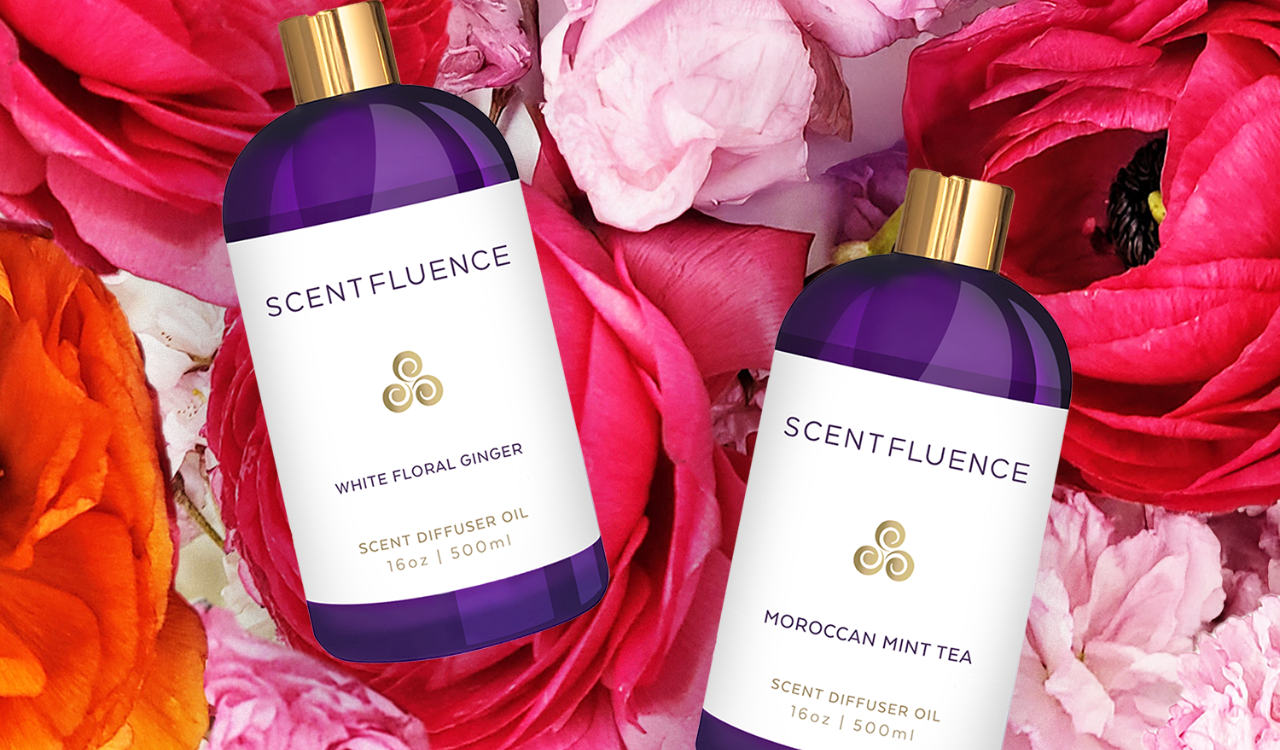
Even more extensively than ScentAir, Scent Marketing is making sure consumers have multiple ways to nab the fragrances they become addicted to when staying at chic hotels and shopping at their favorite stores. On scentfluence.com, its D2C site, a full range of property-affiliated candles and room sprays is on offer—everything from Fireside for Baccarat and Deep Blue Med Spa Collection to Fisher Bros @Ease. The company’s physical store, Scentfluence Aroma Design Studio, is based in Scarsdale. Scentfluence is about to make its debut on Amazon in addition to the debut of “The Perfect Weekend” candles currently landing at Wayfair stores across the country.
None of the category’s success is a surprise to Dr. Liz Lehman, licensed physician and CEO of Alluminate Life, an international wellness brand crafted to enhance mind-body health. “Any public gathering place that is designed to evoke a mood, feeling, or brand identity benefits from an ambient fragrance,” she says.
And while public scenting is on the uptick, it certainly isn’t new. “I remember Disney World smelling like sunshine and laughter as a child,” Lehman recalls. “Hospitality groups have used scenting for years.” Today, the phenomenon is on a distinct upward trajectory. “As research studies continue to publish the psychological link between scent, behavior and mood, and consumers desire a more enhanced experiential environment,” says Lehman, “I have no doubt that scent in public spaces will be as important as furnishings and lighting.”
Fabrigas couldn’t agree more. “I think of scent as being ‘a logo in the air,’ another way to communicate your brand message,” she says. “It’s really powerful and actually more memorable than something you can see.”