


The department store retail sector has been in a death spiral since the turn of the century, now plunging from $232.5 billion in 2020 to $39.6 billion in 2024. Macy’s, the dominant player in the space, has been caught in that vortex. Since peaking at $27 billion and 850 stores after acquiring the May Company portfolio of stores in 2006, Macy’s immediately started a downward slide. A brief reprieve from 2012 to 2014 lifted net sales to $28 billion, then it resumed its downward course.
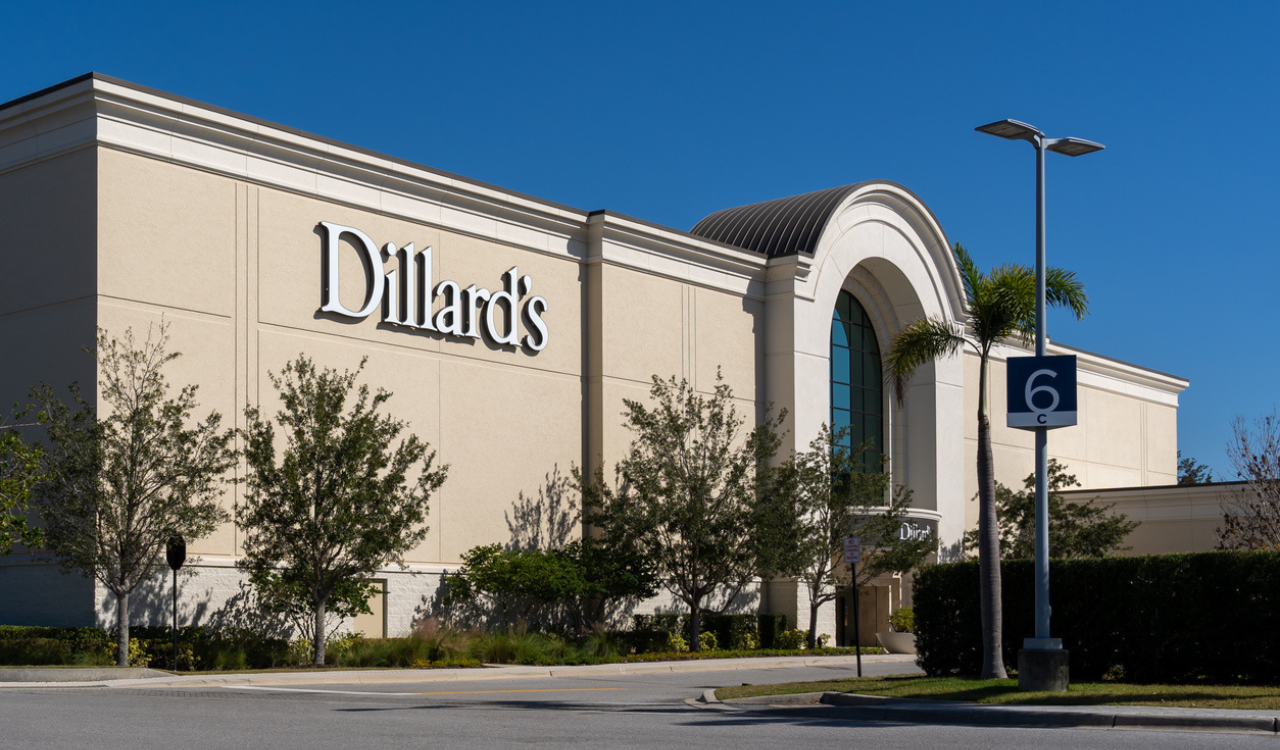
Dillard’s, by contrast, has held on tight. Its revenues have hovered between $6 billion and $7 billion since 2000, and it’s been remarkably profitable all the while. In fact, in fiscal 2024, with revenues of $6.6 billion, Dillard’s net income of $594 million was a shade higher than Macy’s at $582 million.
Dillard’s family control, financial discipline, a focus on local customers and a refusal to chase scale for its own sake has helped it weather the storm that has sunk so many other department store rivals. Dillard’s understands the business it’s in, whereas others have lost the playbook and lost their way.
Dillard’s isn’t flashy—in certain circles, it’s been called “Dullard’s.” Yet it has remained a safe harbor in an increasingly turbulent retail market that has battered its department store rivals.
Macy’s Misadventures
Back in the day, when the company formerly known as Federated Department Store acquired May Company’s collection of regional department stores and began rebranding them to Macy’s, the move had disaster written all over it.
Marshall Field’s was a veritable institution in Chicago, as was Wanamaker’s in Philadelphia and Hecht’s in Washington, DC. These stores, along with others in the May portfolio, had a loyal and faithful following in their local markets. May operated them as separate divisions and retained their brand names, some going back over a hundred years— Marshall Field’s was founded in 1852, Wanamaker’s in 1861, and Hecht’s in 1857.
Yet, in the name of corporate efficiency, Macy’s thought it knew better. It rebranded the department stores that were deeply embedded in their local communities, to Macy’s, severing local ties—both with customers and employees— and ultimately delivering a death blow to many of those stores.
In 2006, when the Macy’s rebrand was complete, the department store sector brought in $213.2 billion. Last year, the sector shrank to less than $40 billion—a mere shadow of its former self. Macy’s has continued this fall, as well. Through the third quarter, Macy’s department store net sales were off 2.8 percent, largely attributed to store closings. Currently, Macy’s operates about 450 stores, and more closures are planned for 2026. The point is that a business can’t shrink its way to growth. Despite an inkling of good news in the third quarter—comp sales were up 2 percent—Macy’s Inc. is guiding on year-end total revenues between $21.48 billion and $21.63 billion. That is against the $23 billion generated in 2024.
Dillard’s on a Different Track
By contrast, Dillard’s has been effectively and profitably rolling along. Though the company has been publicly traded since 1969, the Dillard family owns the largest share of Class B stock, giving them a dominant voting block and effectively keeping control of the company.
Dillard’s faces the same challenges as Macy’s in the department store sector, but on a smaller scale. With 272 stores, including 28 clearance centers, its revenues in 2024 were $6.6 billion. Dillard’s also owns a construction business, called CDI, which generated $264 million, or 4 percent of corporate net sales, in 2024.
“Disruption in our industry and evolving consumer behaviors were continuing themes in 2024,” chairman of the board and son of the company’s founder, William Dillard II, wrote in the annual report. “Retailers reported mass store closures, bankruptcies and realignments, making it difficult to believe in the future of our sector at all. But Dillard’s is different.”
That is an understatement.
Family Connections
There’s no question that Macy’s Inc. CEO Tony Spring is a skilled and talented executive with deep ties to the company, having come up through the ranks at Bloomingdale’s. He is also a breath of fresh air compared to previous leadership. GlobalData’s Neil Saunders said that before Spring’s arrival, “Macy’s seemed to be a business that was content to sit back and accept its fate as a fading icon of retail.”
But Spring has a sprawling empire to run, including 680 store locations and 95,000 employees, across three distinct segments—general merchandise at Macy’s, luxury in Bloomingdale’s and beauty in Bluemercury.
Alternatively, Dillard’s leadership can focus on one retail operation, which is primarily centered on fashion and beauty; less than five percent of Dillard’s revenues are in home/furniture compared to 15 percent for Macy’s. It can also attend to a narrower band of customers located in the South and Midwest regions of the country. Plus, its senior executives have Dillard in their blood. President Alex Dillard and executive vice president Mike Dillard are the sons of the founder, and executive vice president Drue Dillard Matheny is his daughter. Mike oversees operations, and Drue heads up merchandising and product selection.
The word used most often to describe the Dillard family is “conservative,” both in politics and the business realm. Dillard’s isn’t a first mover, and it doesn’t take big swings. Instead, it has built a reputation as a steady performer, studying the field and learning from others’ mistakes. Staying the course and sticking to its knitting has proven a winning long-term strategy, even as the department store sector has imploded. Customers, in turn, reward Dillard’s for its reliable consistency.
Community Centricity
Since its founding in 1938, Dillard’s has maintained its steadfast commitment to the customers in their communities, something that Macy’s forfeited when it rebranded its stores. Another department store that has followed a similar community-centric path is Boscov’s, founded in 1914 in Reading, PA and now with 51 stores under the leadership of CEO Jim Boscov, nephew of founder Albert Boscov.
Dillard’s commitment to community retail is reflected in the results of the MIT Sloan Management Review’s Culture 500 survey among corporate employees. The most positive value stated by Dillard’s employees is the “customer,” and their core cultural value is “respect.” Those are the ideal values for any retailer, since retail is first and foremost a people business rather than a product business. That contrasts sharply with the corporate-speak, transactional words from Macy’s employees: “Execution” and “collaboration” are their chief talking points. Primarily focused on serving its local customers’ fashion needs and thinking more like a specialty retailer than a general merchandise department store, Dillard’s keeps close tabs on customers’ preferences, tastes and sizes to tailor assortments specific to each market. And its well-developed private-label program, which provides greater design and pricing control, enables Dillard’s to curate local store selections even more.
“Dillard’s has relatively strong levels of loyalty,” said GlobalData’s Saunders. “It manages to drive good rates of repeat visits. A lot of this comes down to good buying, constant range refreshes, an authoritative offer and pleasant store environments. Taken together, good execution on these things makes Dillard’s a destination worth visiting. And that, in this more constrained environment, makes all the difference.”
Financial Discipline
Dillard’s excels in the retail basics, and most basic of all, is its financial discipline. No matter which way the economic winds blow, it just keeps delivering results. Dillard’s stock has risen 66 percent over the past year and has been on a steady upward trajectory since early April, when it traded just under $300 per share. Currently, it’s nearing $700 per share.
While the family attends to business, making regular visits to the stores, long-time financial heavyweights watch over the money. Principal financial officer Chris Johnson has been with the company for nearly 20 years, and principal accounting officer Phillip Watts is virtually a Dillard’s lifer. Dillard’s results in the third quarter ending November show how they’ve all been minding the store. Total retail sales were up 3 percent to $1.3 billion and comparable sales increased by the same percentage.
Most remarkably, Dillard’s delivered net income of $130 million in the third quarter, compared with Macy’s Inc., which squeaked out net income of only $11 million on revenues of $4.9 billion during the same 13-week time period. And Dillard’s is sitting on a $1.2 billion war chest of cash and equivalents that gives it control of its destiny.
That capital enabled Dillard’s to make an unexpected but shrewd move in August. It bought the 646,000-square-foot Longview Mall with property developer Trademark Property Co for an undisclosed sum from Washington Prime Group. Dillard’s has long been an anchor tenant in the mall located outside Longview, TX, east of Dallas and about 60 miles from Shreveport, LA. Trademark will manage operations and leasing in the mall. Dillard’s owns over 90 percent of its 46.3 million-square-foot footprint.
Sticking to the Fundamentals
In a retail world where rivals chase the latest trends and frequently flounder, Dillard’s has thrived by sticking to the basics. Family control, customer-focused merchandising, disciplined in-store execution and tight financial controls are its superpowers.
“Dillard’s has a good grip on operations and is very well managed,” Saunders remarked, as he stressed that Dillard’s has mastered the ability to get shoppers to buy across multiple departments to enlarge its share of the customers’ wallet. “In theory, this is something all department stores should be doing—but too many still fall short.”
Dillard’s isn’t flashy—in certain circles, it’s been called “Dullard’s.” Yet it has remained a safe harbor in an increasingly turbulent retail market that has battered its department store rivals. Dillard’s reliability and unwavering commitment to serving its customers are what they value and keep them coming back for more.
“While it is true that Dillard’s isn’t the most ambitious of retailers and would rarely be in the vanguard for initiatives such as agentic commerce, it more than makes up for this by a strict adherence to the basics of retail. These things show through in everything from merchandising to customer service, and they make a genuine difference. This focus will continue to serve Dillard’s well in a choppy consumer economy,” Saunders concluded.