
Anyone who followed the historic 2026 midterm elections may have noticed another less consequential but revealing shift in the political conversation. Alongside the familiar procession of polls, pundits and projections, a new set of numbers entered the national vocabulary: the odds on Kalshi, Polymarket, PredictIt and a proliferating universe of prediction markets. As Reuters reported, wagering on political outcomes has become a booming business. But politics is only the beginning.
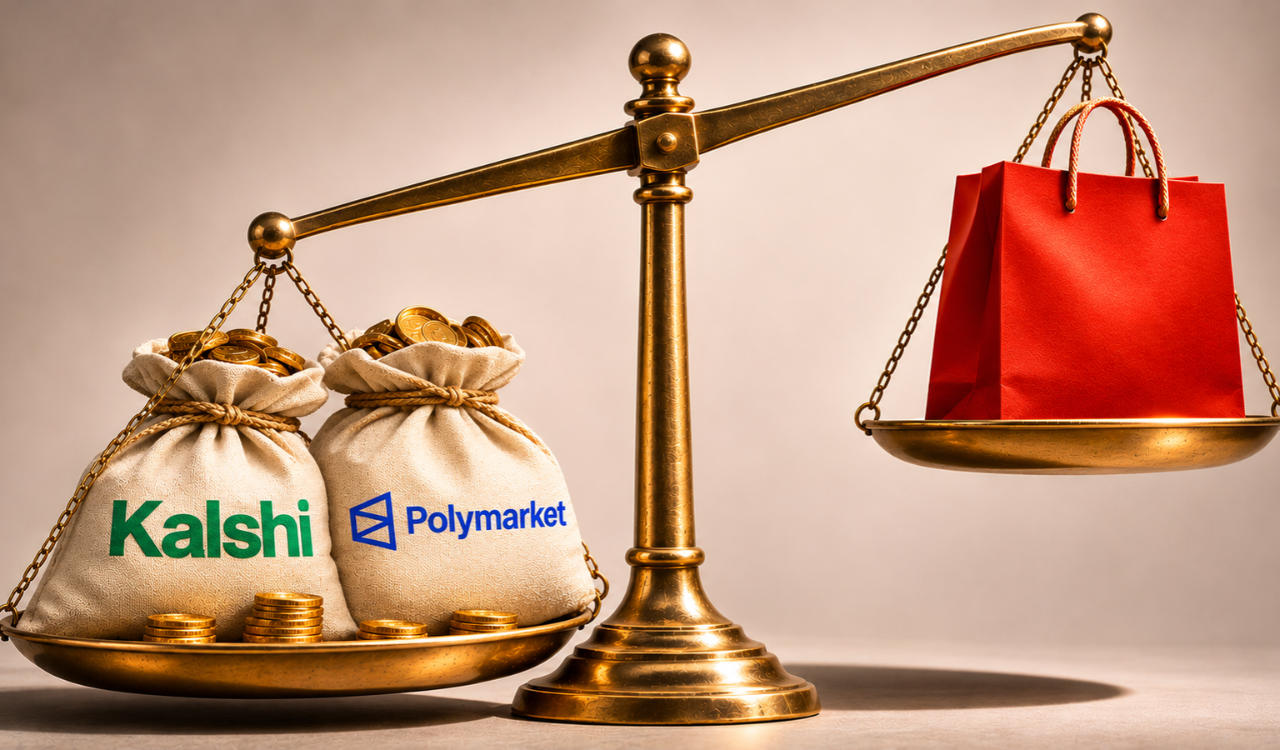
Why is the predictions market a threat to retail? And the answer is: The thrill of buying something is competing with the thrill of potentially winning something.
Better’s Call
Today’s prediction markets invite participants to speculate on everything from who will play the next James Bond (Emily Blunt, anyone?) to how many times Elon Musk will post on X, and even whether the United States government will officially confirm the existence of extraterrestrial life. Almost any uncertainty, however consequential or absurd, can acquire a price. There is nothing especially novel about gambling on sports or speculating about elections. What is new is the ease with which such speculation has insinuated itself into ordinary life.
The smartphone has accomplished what generations of bookmakers could scarcely have imagined: It transformed wagering from an occasional diversion into an activity available virtually anywhere, at any hour, on almost anything. One can now place a wager from bed, on a treadmill, or even hiking in the Badlands. Where doomscrolling once offered an endless succession of small jolts of novelty, prediction markets now offer something infinitely more intoxicating: the possibility of making money while doing essentially nothing. It invites the user to take a financial position.
The Bet Replaces the Treasure Hunt
For the retail industry, which has spent more than a century refining the art of stimulating desire, this development raises an uncomfortable question: What happens when the thrill of buying something begins to compete with the thrill of potentially winning something?
Retail has always traded, at least partly, on aspiration. The Oscars red carpet, the latest on the Paris or Milan runways, the much-hyped sneaker release—all rely on the proposition that wanting something can be nearly as pleasurable as possessing it. Consider a consumer’s choices with $1,000 in discretionary spending. That money might buy a new handbag, a gaming console, or a memorable dinner for four. Alternatively, it could finance a wager on the outcome of a sporting event, an election, or a reality-television competition, with the possibility of multiplying the original stake—or losing it entirely. One transaction promises possession. The other offers possibility, and possibility has become an extraordinarily marketable commodity.
The Gamification of Everything
The numbers suggest that something significant is underway. According to a September 2026 analysis by Pew Research Center, combined monthly global trading volume on Kalshi and Polymarket reached approximately $53 billion in July, compared with roughly $2 billion a year earlier; the velocity of the expansion is difficult to ignore. For Jackie Swanson, managing partner at Gartner Consulting and a retail and consumer-products strategist, the phenomenon raises questions that extend well beyond the gambling industry. “The phone has effectively placed a casino, shopping mall, and stock ticker in the same pocket, all competing for the next tap.”
That observation gets to the heart of a problem retailers may be underestimating. Their competitive universe has traditionally been defined by merchandise: Nike competes with Adidas, Macy’s with other department stores, Sephora with Ulta. But the competition for discretionary spending is no longer neatly confined to businesses selling physical goods. Increasingly, retailers must contend with an expanding marketplace of digital experiences promising excitement, immediacy, and the possibility of financial reward.
The modern boom traces one of its origins to the Supreme Court’s 2018 decision allowing states to authorize sports betting. Companies such as FanDuel and DraftKings subsequently made wagering nearly frictionless, transforming the sportsbook into another icon on the smartphone screen. Prediction markets extended the logic further, turning political outcomes, economic indicators and cultural events into opportunities for financial speculation.
Perhaps the clearest indication that the worlds of retail and speculation are beginning to converge comes from Fanatics, the sports-merchandise empire that built its business selling jerseys, caps and other wearable expressions of fan loyalty. Having expanded into sports betting and casino gaming, the company launched Fanatics Markets in December 2025, bringing the machinery of financial speculation into a business once devoted principally to helping fans wear their allegiances. By September 2026, Fanatics had consolidated its sportsbook, casino, and prediction-market offerings into a single app. What began as a company selling the trappings of fandom was now offering customers the opportunity to wager on the very events and personalities that made those products desirable in the first place.
More intriguing still is FanCash, the company’s loyalty currency, which customers can earn through qualifying wagers and prediction-market trades, even unsuccessful ones, and redeem for merchandise, collectibles, and other offerings across the Fanatics ecosystem. The arrangement turns an old retail proposition on its head. Traditionally, a purchase might earn a customer a reward; at Fanatics, the act of speculation itself can generate purchasing power. Even a losing bet can become a steppingstone toward the next jersey. Whether this represents the future of retail or simply an ingenious extension of the gambling economy remains to be seen. But the larger implication is difficult to miss: The boundary between spending money for pleasure and risking it for the possibility of reward is becoming increasingly porous.
For retailers, the implications are potentially enormous. The gamification of money is no longer simply changing how consumers speculate; it may be changing how they seek excitement, allocate discretionary income, and experience gratification—three impulses upon which the retail industry has built much of its success. And all of this should sound familiar to retailers. The technological infrastructure that made one-click commerce possible—digital payments, personalized notifications, instantaneous transactions, and live commerce—has also made speculative entertainment ubiquitous. There is, however, a crucial distinction. A retailer must generally persuade someone to want a product. A prediction market can monetize the consumer’s interest in an event that is going to happen anyway.
The Neuroscience of Wanting
The relationship between commerce and the brain’s reward systems is hardly speculative. In a landmark 2007 study published in Neuron, Stanford neuroscientist Brian Knutson and his colleagues used functional magnetic resonance imaging to observe consumers contemplating purchases. They found that activity in regions associated with anticipated reward, valuation, and aversion helped predict whether participants would ultimately buy particular products.
A subsequent 2021 study published in Scientific Reports suggested that even the means of payment matters. Purchasing with a credit card, rather than cash, was associated with heightened activity in reward-related neural circuitry (Come on Delta SkyMiles!). The researchers proposed that familiar credit-card cues may actively stimulate spending motivation, rather than merely dulling the discomfort of parting with money.
Jamey Maniscalco, a PhD neuroscientist and founder of Manifest Wellness Consulting, cautions against reducing this complicated process to the popular shorthand of a dopamine rush. “Our brain’s reward systems aren’t simply activated when we receive something pleasurable. They’re fundamentally involved in anticipation, learning, and predicting future rewards,” he explains to TRR. “Dopamine plays a particularly important role in this process, helping the brain learn from differences between expected and actual outcomes.”
The distinction becomes even more interesting when uncertainty enters the equation. A shopper contemplating a jacket knows, more or less, what awaits her at the end of the transaction. The bettor knows only that the outcome remains unresolved. Every change in the odds offers another reason to remain engaged. “Shopping and gambling engage overlapping reward circuitry, but they create very different experiences,” Maniscalco adds. Could repeated exposure to uncertain financial rewards eventually alter what consumers find exciting? Maniscalco considers the question worth investigating, while cautioning that such research has not established that betting makes shopping less satisfying.
Admittedly, we are still in the early stages of this mass-market experiment—there is no convincing evidence (yet) that prediction markets are rewiring consumers to find ordinary purchases less pleasurable. What neuroscience does establish is that anticipation, uncertainty, and reward prediction play important roles in human motivation. Retailers have understood elements of this intuitively for generations. The betting industry has found another way to commercialize them.
Retail’s New Competition
The implications for retail become clearer when one considers how narrowly the industry defines its competition. Fashion brands watch rival labels, and beauty companies track competing cosmetics lines. Yet consumers with limited discretionary income are choosing not simply between products, but between different sources of gratification. A $150 impulse purchase now competes with the possibility of turning that same money into $500 through a wager. For retailers, particularly those courting younger consumers, the emerging threat is not merely the diversion of spending, but competition for the anticipation and excitement that have long helped drive shopping.
There are early indications that this competition is beginning to attract Wall Street’s attention. Speaking at a retail-industry conference in March 2026, Nik Modi, managing director at RBC Capital Markets, warned that online sports betting was beginning to influence discretionary spending, potentially creating headwinds for categories traditionally sold through convenience stores. Modi cited figures suggesting that consumers in states permitting online sports betting were spending an additional $1,100 on wagering, alongside a 14 percent decline in household spending. The underlying methodology was not disclosed in the published account, making the precise relationship difficult to establish. Nevertheless, the warning is significant: A major consumer-sector analyst is already treating betting as a potential competitor for retail dollars.
Academic research provides additional grounds for concern. A 2026 National Bureau of Economic Research study found that legal sports betting was associated with reduced food sufficiency among economically vulnerable households. Meanwhile, research from the Federal Reserve Bank of New York documented increased consumer credit delinquencies following the introduction of mobile wagering.
The emerging lesson for retailers is not that prediction markets will necessarily cannibalize retail sales. It is that an entirely different industry is competing for the financial and psychological resources that make discretionary shopping collateral damage; the first signs of strain may appear in household finances long before they become visible in store traffic or quarterly earnings.
The New Economics of Anticipation
There is an important difference between competing for a customer’s money and competing for the customer’s desire. Retailers are extraordinarily sophisticated at analyzing transactions. They can measure conversion rates, average basket sizes, repeat purchases, customer acquisition costs, and loyalty-program participation with remarkable precision. But what happens before the transaction—or instead of it—can be much harder to quantify. Gartner’s Swanson is careful not to overstate the evidence. “Betting platforms and retailers clearly compete for discretionary money, attention, and the impulse to act now. Evidence that betting is broadly replacing shopping remains limited,” she says. “At this stage, it is a serious hypothesis worth testing rather than an established change in consumer spending.”
That caution should not be confused with indifference. Retailers have spent years adapting to competition from streaming platforms, social media, video games, and other businesses whose products bear little resemblance to merchandise on a store shelf. Prediction markets may represent the latest extension of that increasingly crowded attention economy—distinguished by the added attraction of potential financial gain.
The extraordinary rise of Kalshi, Polymarket, and their competitors may ultimately reveal something larger about the character of modern consumption. In an economy increasingly organized around immediacy, uncertainty itself has become a marketable experience. The prospect of a reward, rather than the reward alone, is something consumers are willing to pay for.
None of this means Americans are about to abandon the pleasures of acquiring things. Shopping satisfies needs that speculation cannot, and the evidence of direct substitution remains limited. But the commercial success of prediction markets suggests that retailers may be confronting an unfamiliar rival for the psychological territory they have spent generations learning to cultivate.