
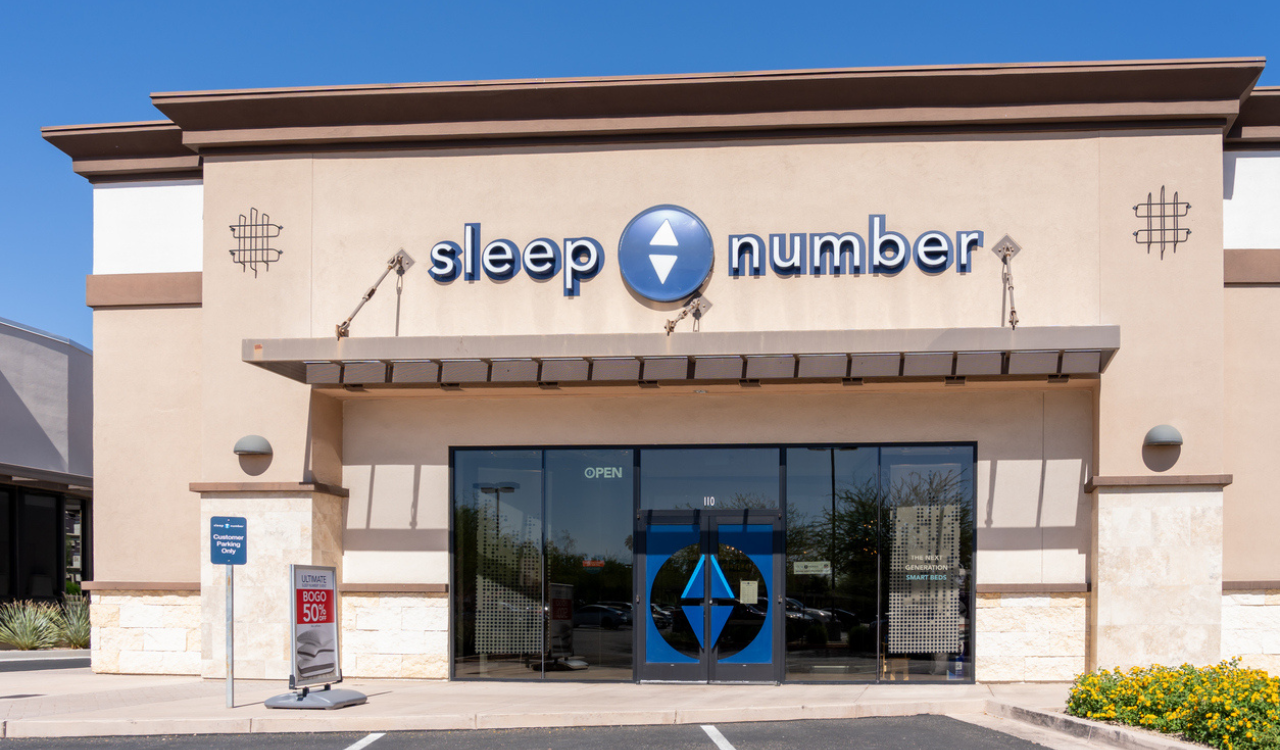

Retailing has always been a fragile beast, with few brands that endure and become future-proofed. Ironically, early success can often lead to a failure to innovate and complacency. That was not Sleep Number’s problem; in fact, it may have been the opposite. It evolved from a sub‑$1M startup to a $1.8B smart‑bed leader, then entered a steep decline after 2021, culminating in heavy losses and a near‑zero market cap.
How did such a revolutionary brand go from a $3.5 billion valuation in April 2021 to a pennies-on-the-dollar “fire sale” in five short years? The Minnesota-based Sleep Number Corporation received a bankruptcy court’s approval to sell its assets to retailer Sleep Country of Canada for $701 million in total valuation. Since its 1987 launch as Select Comfort, it became known as an industry disruptor, selling individually adjustable air mattresses via mail order (at the time), making big headlines in what had previously been a sleepy legacy industry dominated by the 3-S’s: Sealy, Simmons, and Serta.
This is a case study of mismanagement and misplaced dreams, and a cautionary tale for other brands that begin as a brilliant idea and then spiral out of control.
How did Sleep Number self-destruct? And the answer is: It went from a $1.8 billion innovative sleep disruptor to bankruptcy in five years because of mismanagement and hubris.
Evolution to Devolution
Co-founder Robert “Bob” Walker left Comfortaire, an early inventor of adjustable air‑supported beds, and along with his wife JoAnn, saw the potential to introduce adjustable “individual firmness” to a mattress. Select Comfort became a unique differentiator in the crowded marketplace of traditional mattress engineering. The idea was brilliant, but they lacked both the financial and marketing wherewithal to scale it into an industry leader.
In 1992, Select Comfort had nominal sales through direct marketing and almost no brand recognition. They opened stores but were in dire need of a complete brand makeover to build the business. The Walkers were smart enough to manage a private investor acquisition, and the tides dramatically changed. What followed was the musical equivalent of a crescendo and decrescendo, marked by peak revenue and strong profitability (2020–2021) and a post‑peak decline accompanied by margin compression leading to severe financial deterioration (2022–2026).
The Other Walker
As good fortune and serendipity would have it, I had a ringside seat for the 1992 to 1999 growth spurt. In 1987, I was introduced to Kenneth Walker (no relation to the founding Walkers), whose firm, New York City-based Walker Group, became one of the country’s preeminent and largest retail design firms. Ken also became one of my most valued mentors and collaborators.
In 1994, Ken was tapped by the Select Comfort investor group to guide the company’s rebranding. After an unexpected call from Ken, our small Twin Cities retail design firm was “drafted” to lead the entire rebranding effort, including developing a new prototype store design along with a national rollout of new Select Comfort stores; a career-changing project for sure! In a matter of moments, I was instructed to prepare for a meeting at Select Comfort’s headquarters in one of the Twin Cities’ suburbs. Days later, Ken briefed me on our assignment while en route to Select Comfort’s offices. He would assume the position of project director, assisted by Select’s President of Retail, Brent Hutton. But clearly, we were going to be doing the heavy lifting.
Disrupting an Industry
At this point, no mattress brand had standalone mall stores, let alone large-scale leasing agreements devoted exclusively to mattresses in A-class malls. But the team believed that the product’s unique adjustability, along with their lofty 70 percent sales margins, could disrupt a very sleepy industry.
Our job was to create a design hook that would drive customers into the store and “lie down” for a brilliantly conceived demonstration—even if it was the last thing they were thinking when they entered the mall. Fast forward, the retail design concept and flagship stores proved to be a hit. And in just two and a half years, my firm oversaw the planning, approvals, and build-out of 145 Select Comfort stores across the country. From the time of our introduction to the brand in 1994, the company’s valuation grew from $20 million to $200 million by 1997.
Pedal to the Metal
The need to continue to fund Select’s hyper-growth led to an IPO in late 1999. Then through the 2000s, Select Comfort continued to grow with hundreds of new stores. It changed its focus from mere adjustability to calibrating the customer’s unique “sleep number.” By 2001, a marketing push for the “Sleep Number” bed led to new branding: “Sleep Number by Select Comfort.”
Around this time, a new technological focus was taking shape, marking the shift from mattress retailer to sleep‑data company. It also signaled the onset of extremely expensive R&D, which further differentiated the brand but also set the stage for its undoing. In 2010, they debuted the Dual Temp feature for hot or cold sleepers, followed by the digital integration of embedded sensors and cloud connectivity in 2012. Then in 2014, SleepIQ, a sensor‑based sleep‑tracking platform, was unveiled at CES, which led to the launch of the 360® Smart Bed, which automatically adjusts firmness throughout the night.
The Sky-High Costs of Brand Differentiation
Companies that believe too much in their own brand’s durability and past success often succumb to excess. In 2012, their large-scale R&D expenditure began with the purchase of an 18 percent stake in the biometric sensor company BAM labs, the brains behind Sleep Number’s SleepIQ sleep-tracking technology and 360 Smart Bed line. In 2015, they acquired the remaining interest in the company for $58 million, bringing the total tab to $70 million.
Feeling confident and optimistic, Select Comfort became Sleep Number Corporation in 2017, and moved its corporate headquarters from suburban Minneapolis to downtown. They went all-in, taking on a 15-year lease for a 250,000-square-foot space, along with naming rights to the building. The space housed 900 employees, and was remodeled with a tech bar, cafeteria, coffee bar, research & development, and collaborative, “reconfigurable” work areas.
In 2018, Sleep Number began a multi‑year partnership with the NFL, positioning Sleep Number as the league’s official sleep and wellness partner. And in 2019, they signed a spokesperson deal with Travis Kelce for an undisclosed amount. In 2020, they signed a $10 million research collaboration with Mayo Clinic focused on cardiovascular sleep science, followed by a long‑term partnership with the American Cancer Society to study sleep’s role in cancer prevention and recovery. It all sounded like a smart, relevant marketing strategy.
Boom and Bust
The hubris of brand invincibility, however, has a price tag. With such big-ticket expenditures, Sleep Number was challenged by the limits of price elasticity to pay the tab. What started as Select Comfort’s 1990s “good–better–best” lineup, which sold for between $400–$1,000 (an already staggering number), shot sky high to $5,000+, with premium builds exceeding $10,000.
By 2020, Sleep Number offered roughly 10 to 12 distinct bed models across its 360® Smart Bed portfolio — and this does not account for multiple bed size variations within each bed type. Sleep Number reached peak profitability and $1.8 billion in revenue in 2021, driven in part by the pandemic. But things began to soften, faced by supply‑chain costs, lower demand, and higher promotional intensity.
Their once-strong cash position evaporated. Shrinking revenue, negative earnings, and a weakening balance sheet raised red flags. In 52 weeks, between 2025 and 2026, they watched their stock price drop from just under $14.00 per share to $0.43, resulting in a market cap of $9.8 million and penny-stock status.
Rear View Mirror
Brent Hutton, Select Comfort’s President of Retail from 1992-1999, has many opinions on Sleep Number’s financial undoing. He was dumbfounded that the vertically integrated direct-to-consumer industry disruptor, generating 70 percent margins on a brilliantly conceived offering, ended up selling for pennies on the dollar. He said, “The simplicity of the elegant good-better-best offering led to an overly complex and outrageously priced portfolio. But the price alone was only the tip of the iceberg. Both the sell-side and the buy-side were impacted.” Hutton emphasized that sales training and the customer decision-making process became infinitely more challenging, coupled with the costs of manufacturing and inventory management. He also criticized the decision to add a line of sheets and pillowcases, when most customers could shop for broader offerings, at lower prices elsewhere. Summing it up, he said, “How many folks want to buy a $15,000 bed?”
Sleep No More
Several other external factors contributed to the Sleep Number’s challenges along the way. Nearly two decades after Select Comfort’s launch, the first commercial bed-in-a-box was sold in 2006 by BedInABox. Tuft & Needle was the first ecommerce DTC entry, and between 2014 and 2016, Casper, Purple, Saatva, Helix, and Avocado launched. That entire DTC sector is estimated to represent between 20-25 percent of the market; a significant piece of the pie.
Sleep Number filed for bankruptcy in June; now its new owner, Sleep Country, must figure out what to do with 570 U.S. stores and 300 other Canadian stores under seven different banners. The logical solution? A combination of massive store closures and deep discounts. So, it’s night, night to an innovative disruptor that got out ahead of its skis and self-destructed in five years.