
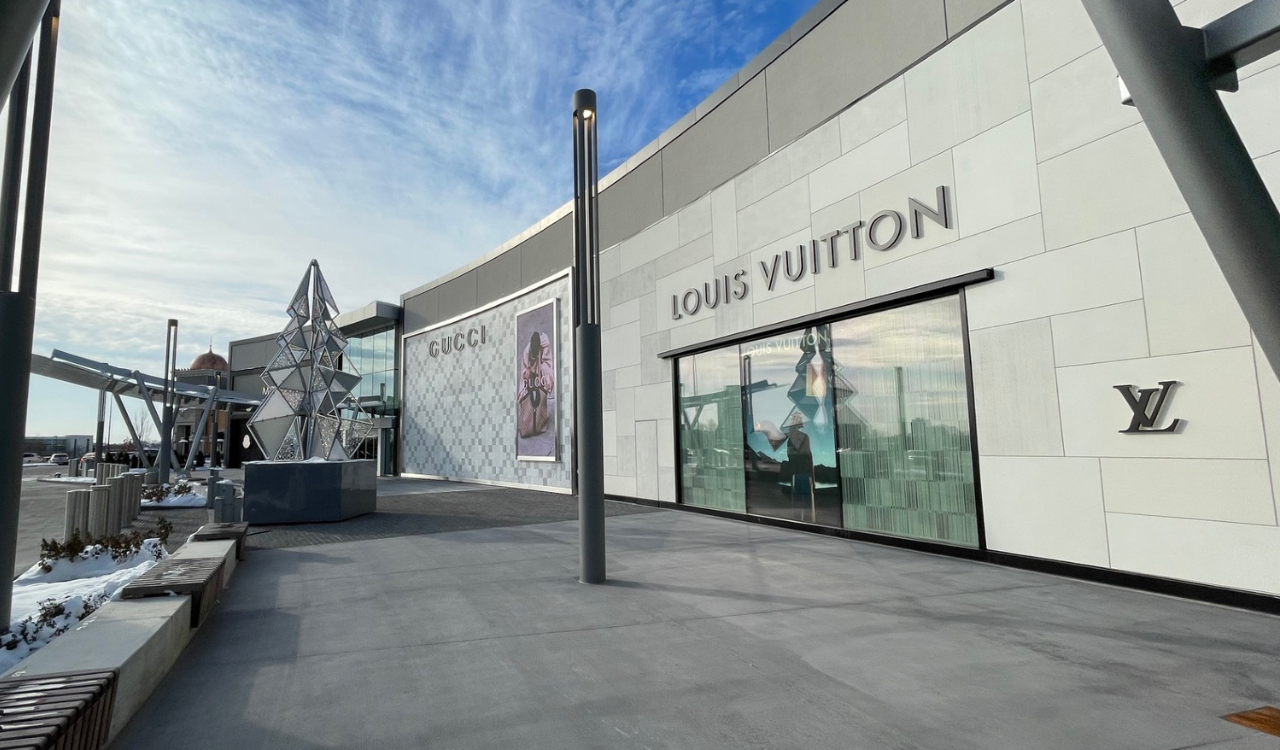

America’s first indoor mall, Southdale Center in Edina, Minnesota, is celebrating its 70th anniversary this year. This birthday could be a litmus test of the viability of the traditional shopping mall. To ensure its relevance, owner Simon Properties just completed a $400 million renovation and new luxury wing, bringing together Gucci, Louis Vuitton, Moncler, Watches of Switzerland/Rolex, MaxMara, and David Yurman. Southdale now has the highest concentration of luxury retail in the upper Midwest and elevates the “luxe listings” above its mega-competitor Mall of America, just a few miles away. But the question remains: Will this capital infusion guarantee Southdale’s future as a 20th-century architectural aberration in a digital/agentic age? And will chasing the top 10 percent of spenders buy Southdale and Simon time? It is by no means a guarantee of its longevity.
Can the 70-year-old Southdale Center live up to consumers’ expectations? And the answer is: Adding a new luxury wing is not a panacea for cultural relevance; today’s malls need to deliver experience and brands that are meaningful to consumers.
In the Beginning
Southdale’s origin story is a retail case study. Funded by the Dayton Development Company, it’s widely considered to be the nation’s first fully enclosed, climate-controlled shopping mall. Austrian-born architect Victor Gruen had a different vision from Dayton’s. Gruen planned for the center to be surrounded by housing, apartment buildings, schools, and medical facilities, as well as natural amenities including a lake and a park, modeled after the commerce centers of many European cities. In 1956, he was ahead of his time; the mall became…a mall.
Gruen’s original vision, now known as mixed-use development, has become the formula for the reinvention and salvation of malls like Southdale. Repositioning malls from single-purpose points of transaction into dynamic community forums promoting human interaction is the sustainable reinvention of irrelevant malls. But, given the ginormous price tag involved, there are only a finite number of malls destined for such rejuvenation. The vast majority will perish.
Class Distinctions
Between 1970 and 2002, over 800 shopping malls were built in America. Money was cheap, second-string suburbs were flourishing, and young consumers—baby boomers—were entering their prime earning years. By the mid-1990s, mall numbers peaked at over 1,500 enclosed malls. Then the tide changed. Today, approximately 700 fully enclosed malls still exist, and projections suggest that another 25 percent of these remaining centers will shutter within the next five years. Analysts predict as few as 200 survivors by the mid-2030’s.
What’s the formula for mall survival? Malls are bluntly, real estate assets. And for real estate, the age-old adage “location, location, location” is the playbook. In terms of sustainability, a mall’s age, tenant mix, occupancy rates, and institutional ownership play decisive roles in defining the ABCs of property class ranking.
- The highest performing A-class malls boast premium tenants, affluent customers, and high occupancy rates (mid-high 90 percent range). Their tenants are made up of stable, national luxury and premium brands. These properties are newer or heavily renovated, located in affluent markets, typically home to Apple stores, and many are mixed-use village spaces like The Grove.
- B-class malls are moderate performers, plagued by failing mid-market specialty chains. With occupancy rates of 80-90 percent, they are often found in secondary suburbs and cater to value-oriented families. They are generally older centers devoid of improvements, and many are still anchored by JCPenney.
- C-class malls are the most endangered species, with 500-600 already shuttered since the mid-1990s. Occupancies are often at or below 70 percent and are considered distressed properties. They cater to highly price-sensitive shoppers with local retailers, discounters, and non-retail services.
Gruen’s Gospel
I believe the Gruen gospel of “placemaking” will ultimately determine the fate of Southdale and the rest of the remaining A-class malls. Their ownership is concentrated among a small number of deep-pocketed development and management companies, including Simon Property Group, Brookfield Properties, Macerich, (and to a lesser extent) SITE Centers, Taubman, and Unibail-Rodamco-Westfield.
It’s Simon Property Group and Brookfield Properties, who together own and control nearly half of A-class malls in the U.S. and they must concentrate on bringing their aging mall properties into the 21st century through additions, renovations, and tenant upgrades.
Southdale was completed in 1956, and the mall was just over 800,000 square feet. Today it is 60 percent larger at 1.3 million square feet. The mall’s haphazard expansion in 1963 and 1971, along with multiple renovations through the 2000s and 2010s, has resulted in a rather schizophrenic visitor experience. The current luxury wing is at odds with the rest of the mall. While the new single-level wing is upscale and polished, it feels like an island (or peninsula) unto itself. Visitors arriving through any of the mall’s other primary entrances will, no doubt, be wowed by the newly renovated center court. However, finding the new luxury wing presents a quandary, accessible exclusively via a second-level corridor.
Futureproofing an Aging Mall
All the money in the world can’t save an irrelevant mall. Some centers are destined to fail in the brutal survival of the fittest. There are core fundamentals that are prerequisites in the reimagining and futureproofing of aging malls. Will Southdale measure up?
- Anchor Replacement: A mall’s once dominant department stores literally served as anchors and traffic generators, as well as magnets to attract desirable specialty stores. With their departure, similarly compelling anchor-like players must fill that role. A plethora of unlikely candidates are filling the bill today. They include high-end grocery stores, fitness and co-working centers, hotels, medical centers, “high experience” retailers, and even private clubs. Dick’s House of Sport, which has effectively replaced former Sears stores in several top-tier malls is an excellent example.
To Southdale’s credit, it has flexed its “anchor’s away” muscle. In 2019, on the site of a JCPenney store, a massive $43 million, 204,000-square-foot Life Time Fitness flagship dropped anchor. Billed as a three-story athletic resort, it included a rooftop beach club, pool, and even pickleball courts. Immediately adjacent is a 75,000 square foot Life Time luxury coworking development and indoor soccer field. Both are knockout examples of anchor replacement.
In 2024, on the site of a former Herberger’s department store, Southdale introduced a 25,000 square foot, two-level Puttshack, that bills itself as an “upscale, tech-infused” mini-golf experience. Immediately adjacent is Kowalski’s Market, a premier specialty grocer which should also generate repeat traffic. Southdale’s score: 9 out of 10.
- Retail Theater and Experience Engines: The success of the reimagined mall becomes a shared proposition between landlord and tenants. In the face of unified commerce, the continued growth of online retail, augmented reality, and generative AI, brands are being forced to up their game to get folks off the couch. Becoming fully immersed in a brand’s storytelling has become the new norm. Brands like Lego, Crayola, Build-A-Bear, and Camp have become the new “play stations,” undergoing constant reinvention aimed at lengthening the customer’s visit and creating memorable moments.
With the massive popularity of the collectables market that grew by 32 percent in 2025, select specialty retailers are cashing in. Among them, CardVault, Pokémon Center, Kura Sushi gashapon, and Pop Mart. They sit at the intersection of collecting, surprise, and social sharing. They are selling sets, series, rarities, even blind boxes that foster “the chase.”
And beyond the store purchase, often viral “unboxing” follows, driving social media sharing. These brands, and others like, them populate the halls of the Mall of America, while Southdale hasn’t hopped on that brand wagon yet. Southdale’s score: 2 out of 10.
- Social Interaction and Brand Activation: More than ever, brands depend on popular performers and sports figures to co-promote product drops. To that end, top malls have beefed-up marketing and event teams to facilitate high-energy, revolving events to drive traffic. Southdale currently has a considerable amount of underutilized space which could be captured for such events that bring “like-minded” groups together around a shared passion. Southdale’s score: 5 out of 10.
- Food-Forward Destinations: National restaurant chains like Applebee’s will no longer cut it with new generations, proud of their food-fixated tastes. The winning ticket includes chef-driven restaurants, multicultural food halls, and experiential dining. Chef-staged, fixed-price dinners are selling out months in advance. Even ghost kitchens are being created to facilitate the preparation of Michelin Chef-quality meals for takeout or near-instant delivery to area foodies.
Southdale’s Dining Pavilion is the ghost of its former massive food court; there are plenty of tables and chairs, but light on eats. Southdale is lacking in the fine dining experience that will lure in customers. Southdale’s score: 7 out of 10.
- Social Infrastructure and Walkability: Too many major malls resemble fortresses, surrounded by seas of asphalt, as vehicular access and parking overrode pedestrian friendliness during the planning process. The new mall’s viability focuses on socialization, visit duration, relaxation, and immersion. Reimagined, multi-use developments are selling off excess parking to accommodate multi-family housing. Other pedestrian-centric amenities include green spaces, walking paths, water features, community gardens, and well-equipped play areas, for folks to gather, linger, meet, and work. Southdale hasn’t begun turning parking lots into parks. With an influx of multi-family residential properties and luxury services, “greening” initiatives are a must. Southdale’s score: 5 out of 10.
Prescription
While Southdale doesn’t publish its annual visits, The Minneapolis/St. Paul Business Journal reported an 11 percent increase in foot traffic following the opening of the new luxury wing, which isn’t too surprising. Applying my “mall-metamorphosis metrics,” Southdale is an overachiever with its recent retail and lifestyle additions; however, it is clearly an underachiever in the rest of the crucial placemaking attributes. New retail is moving much faster than center owners, including Southdale, can anticipate and act on. Its relevance will depend on staying ahead of what customers want, not catching up to them.