



According to Brick Meets Click’s Grocery Shopper Survey which it conducts in partnership with Mercatus, “Monthly U.S. online grocery sales experienced a dramatic acceleration in November, with total sales surging 29 percent year-over-year (YOY) to finish the month at $12.3 billion.” Wait, what? During a period of tight budgets and inflation? How can that be true? Ah, but it is.
“Online share of weekly grocery spending in November 2025 ended the month at 17.1 percent, climbing 340 bps versus November 2024,” the survey reported. Moreover, all three fulfillment options that the survey tracks –delivery orders (aka orders from third-party services like Instacart), pickup orders, and ship-to-home orders (aka direct orders from Walmart and Amazon) – increased across the board. Ship-to-home sales increased 12 percent over the prior year, pickup gained 11 percent, and delivery brought up the rear at a still remarkable 8 percent increase year-over-year.
But again, how can this be? How can a consumer that is reportedly so budget-constrained be purchasing his or her groceries in a relatively more expensive way across the board? Albeit pickup doesn’t cost more, ship-to-home and delivery certainly do, especially when one factors in shipping and membership fees.
How is the K-shaped income disparity feeding the grocery business? And the answer is: Customers who are more open to agentic AI commerce, pragmatic shopping, time as currency, and values-based consumption.
The Haves, the Have-Nots, the Have Everythings
So, what on earth could be driving it? Well, the answer comes down to two words: rich people. A Brick Meets Click press release stated that “The (online) share expansion was fueled largely by higher spending rates in large metro markets, by the 30-44 age group, and by households earning $100K or more annually,” a fact later confirmed to me by Brick Meets Click Partner David Bishop. And that data point adds all the context one needs to understand the full impact of what this report could mean, both now but also in the future. Or, said another way, seismic change is coming to the grocery industry, and these latest survey results likely are just the beginning.
Now, before anyone gets their pitchforks out, let me clarify something. When I say, “rich people,” I’m not talking about yacht owners and trust fund babies. I’m talking about households earning $100,000 or more annually (i.e., households that earn more than 60 percent of the U.S. population). In many large metro markets, that’s a dual-income household with kids, a mortgage, and maybe enough left over for a Costco membership and a family vacation once a year.
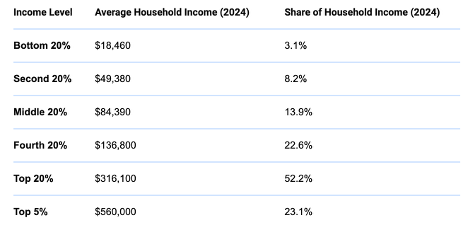
These aren’t the 1 percenters. These are the people who need convenience but still care deeply about value. And that’s what makes this data so fascinating. Because here’s what’s really happening: The 30- to 44-year-old group, aka the core users, posted the strongest increase in order frequency, surging over 20 percent compared to last year. They’re placing an average of 3.1 orders per month. That’s a record high. These aren’t people experimenting with e-grocery. These are people who have fundamentally changed how they buy groceries.
The Value Equation That Makes e-Grocery Work (For Some People)
So why are higher-income households driving this surge? Four principal reasons could explain the increase.
- The time-value equation.When you’re a dual-income household in the 30-44 age range, you’ve likely got kids, careers that demand constant attention, and maybe aging parents. The hour you can save by ordering groceries online isn’t just leisure time. It’s the hour you need to make dinner, help with homework, or actually see your family. For these households, paying $10-15 extra per week to reclaim that time is a value-laden trade-off.
- The price transparency and loyalty program effect. When you’re reordering the same items week after week from a place you trust, like Walmart or your local grocer, you develop loyalty. Platforms like Walmart+ with their cash-back incentives make that relationship even stickier.
- What’s actually happening in stores right now. The in-store grocery experience has degraded significantly. Staffing shortages. Out-of-stocks. The general chaos of trying to navigate a crowded store with kids in tow as you try and elbow your way around an Instacart driver. When you order online, you know immediately what’s available and what’s not. No wild goose chases down the aisles. No asking three different employees where something is. For busy professionals, that certainty alone has to be worth something.
- Younger high-income households are simply acclimated to buying everything online.For these consumers, ordering groceries from an app is as natural as ordering an Uber. There’s no psychological barrier to overcome. And they have relatively more disposable income to make the behavior stick.
But What About Everyone Else?
If higher-income households in large metro markets are driving the e-grocery surge, what happens with everyone else? What happens to the budget-constrained families in smaller markets who can’t justify the premium? What happens to the traditional grocers who built their entire business model around serving those customers?
Here is where the story gets really interesting … and also complicated. The data suggests that we’re witnessing the beginning of a bifurcation in the grocery market. You’ve got one segment, affluent, tech-savvy, time-starved, rapidly moving online. And you’ve got another segment that’s still shopping primarily in-store, either by choice or by economic necessity. This is another K-shaped economic ecosystem.
And the uncomfortable truth is that the segment going online is the one with the most purchasing power and the highest lifetime value. They’re the customers every grocer wants to retain. But they’re also the customers who are learning to shop in ways that fundamentally challenge traditional grocery economics.
Take a box of Kraft macaroni and cheese. There’s no difference between buying it at Store A versus Store B, all things being equal, particularly when the price is the same. The product is identical. So, what happens when we layer agentic AI on top of this existing behavioral shift? That is the question the industry needs to be asking itself.
The AI Acceleration That’s Coming (Whether You’re Ready or Not)
If we’re already seeing this kind of explosive growth in e-grocery with today’s technology, just imagine what happens when agentic AI enters the picture. We’re now talking about far more than incremental improvements. We’ve got consumers who are already comfortable ordering groceries online. We’ve got loyalty programs that understand their purchase patterns. There’s greater price transparency online. There’s the time savings. Now add an AI agent into the mix that can scan every retailer’s prices in real-time, then apply a consumer’s preferences, factor in dietary restrictions, optimize for a budget, and automatically reorder staples at the best possible price across multiple retailers. All of a sudden, every income demographic is jumping into e-grocery. That’s not science fiction, either. That’s all coming in the short-term, like in the next one to three years. Open the pod bay doors, HAL.
The Ultimate Irony: Grocery Pioneers Agentic Commerce
David Dorf, Head of Retail Industry Solutions at AWS, recently mentioned that UBS is predicting grocery will be the first industry hit by agentic commerce. Grocery, the category that was supposed to be the last frontier for ecommerce, the holdout, the one format that would always need physical stores because people wanted to see and touch their avocados, is now predicted to be the first industry disrupted by AI agents.
It’s the complete flip side of how ecommerce developed. Back in the 1990s and 2000s, we sold books, electronics, and clothing online while everyone said grocery would never work. The margins were too thin. The logistics were too complex. Customers would never trust someone else to pick their bananas.
But now? Now Dorf believes (and I agree) that the infrastructure to support e-groceries is different, and, most importantly, we are also dealing with new customer behaviors and desires. In other words, grocery shopping brings with it the perfect conditions for agentic AI to amplify what’s already working, with a little more budget and time savings sprinkled in for good measure.
David Bishop from Brick Meets Click put it well: “The online grocery customer pool continues to expand, order frequency has steadily grown for over a year, and spending remains resilient, which shows that e-grocery is evolving from just a convenient option to the preferred way to get groceries for many.”
Not just convenient. Preferred. Right now, it’s predominantly high-income households in large metro markets driving this behavior. But behavioral patterns established by early adopters don’t stay confined to early adopters. They diffuse. They spread. They become the new normal. The question isn’t whether e-grocery will expand beyond high-income households. It will. The real question is what happens when it does, and whether traditional grocers will still be around to compete when that day comes.
The Seismic Shift Hidden in Plain Sight
In my now almost 30 years of retail experience (yes, I am getting old), I have learned that you can take one simple idea to the bank – by the time a behavioral shift becomes obvious to everyone, it’s too late to catch up. The infrastructure investments, the technology platforms, the loyalty programs, and the customer data, all take years to build. You can’t flip a switch and suddenly compete with Walmart’s fulfillment network or Amazon’s delivery infrastructure.
So, yes, relatively more well-off people are driving e-grocery growth right now. But they’re not the endgame. They’re the early warning signal. They’re showing us where the entire retail market is heading. Moreover, if Dorf and UBS are right about grocery being first in line for the agentic commerce revolution, then that future is coming faster than most people realize. Seismic change isn’t just coming. It’s already here. 2025 November’s numbers may just be the tremor or foreshock before the earthquake, revealing an ignored fault line.
Editor’s note: This is a modified reprint from Omni Talk.